-
-
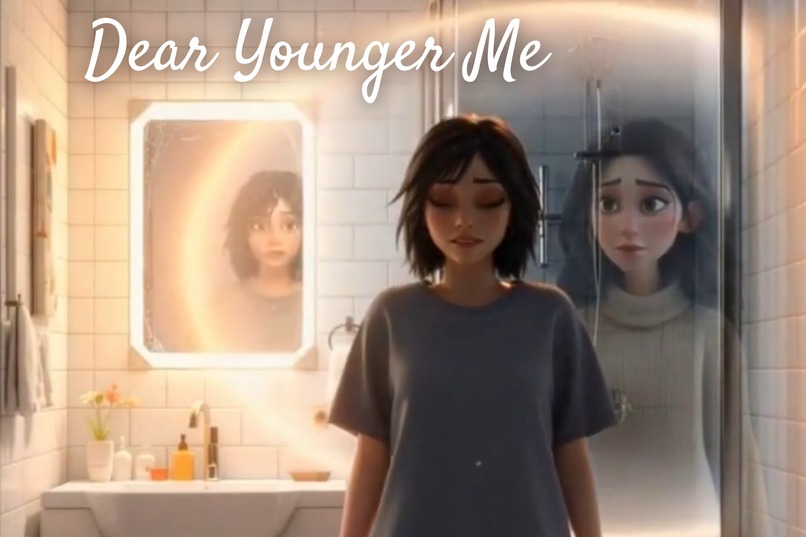
Dear Younger Me -- You'll be glad you stayed. I promise. From Your Future Self.
Inspiration
Years ago, I lost a close friend to suicide. That loss changed the trajectory of my life—it's part of what led me from physics to clinical psychology. As a therapist, I've spent years sitting with people in their darkest moments, and I kept searching for new ways to reach people who are struggling.
One of the most powerful therapeutic interventions I've encountered is temporal self-compassion—the practice of imagining your future self reaching back through time to comfort your present suffering. It's a way of borrowing hope from a version of you that hasn't arrived yet but will. When I had the opportunity to create an AI music video, I saw a chance to visualize something I've only been able to describe in words: the feeling of being held across time by your own future compassion.
What it does
"Dear Younger Me" is a three-minute music video that serves as a visual letter from your future self to your younger, struggling self. It's designed to reach someone in crisis—at 3 AM when they can't sleep, when the pain feels insurmountable, when they need a reminder that their story doesn't end here. The video makes abstract therapeutic concepts visceral: you survive, your future self exists, and that version of you is already reaching back to say "You'll make it through this."
How we built it
I composed the song specifically for people struggling with depression and suicidal ideation, drawing on both my clinical experience and my own history with loss. I used Suno to generate the musical composition, carefully crafting lyrics and melody that would resonate with someone in crisis.
For the visuals, I used Popcorn to create AI-generated imagery that allowed me to render something deeply abstract—temporal compassion, the weight of despair, the gradual emergence of hope. The visuals move from darkness to light, from isolation to connection, mirroring the psychological journey from crisis to survival.
The production process involved carefully calibrating every element to be therapeutically sound while remaining artistically authentic. I wasn't interested in toxic positivity or empty reassurance—I wanted something that acknowledged the reality of pain while offering a genuine lifeline.
Challenges we ran into
The biggest challenge was balancing artistic expression with therapeutic responsibility. How do you create something beautiful about suicide prevention without romanticizing suffering? How do you offer hope without dismissing pain? I had to constantly check myself against my clinical training—would this actually help someone, or would it inadvertently reinforce rumination?
Technically, translating abstract psychological concepts into visual language through AI was an iterative process. The technology had to serve the emotional truth of the experience, not overshadow it.
Accomplishments that we're proud of
"Dear Younger Me" won in the music video category at the Uncanny Valley Film Festival sponsored by Machine Cinema. But more importantly, people have told me it reached them when they needed it most. That's exactly what I hoped for—to touch even one person in their moment of need.
I'm also proud that this project bridges my interdisciplinary background: from my early neural networks research through physics and philosophy to clinical psychology. AI has come full circle in my life—from academic curiosity to a tool for emotional healing.
What we learned
I learned that AI can be a tool for emotional healing when used thoughtfully. The technology allowed me to visualize the ineffable—those moments when we most need to know that our pain isn't permanent, that continuation is possible.
I also learned that my friend's death, as devastating as it was, gave me a mission that spans decades and mediums. Every creative project I make in this space is another attempt to prevent someone else from losing a friend the way I did.
What's next for Dear Younger Me
"Dear Younger Me" is the debut single for a larger mental health music project. I'm developing additional therapeutic songs—"Comma" (about life as a pause, not a period), "Borrowed Light" (about borrowing hope when you can't find your own), and others specifically designed to support people through different aspects of depression and crisis.
This isn't meant to replace therapy or human connection—it's meant to be what I wish existed when I was younger and my friend was struggling. A three-minute reminder that the person you're becoming is already reaching back to tell you: "You'll make it through this. I'm proof."
Built With
- popcorn
- suno


Log in or sign up for Devpost to join the conversation.