Inspiration
I run a small software house in Pakistan. Our hardest problem was never writing code. It was everything around it: finding the next client, writing the proposal, chasing the payment, and then turning a paid deal into a plan that design, engineering, QA and DevOps can act on. Each handoff lived in a different tool, and every one was a place where deals stalled and money went uncollected.
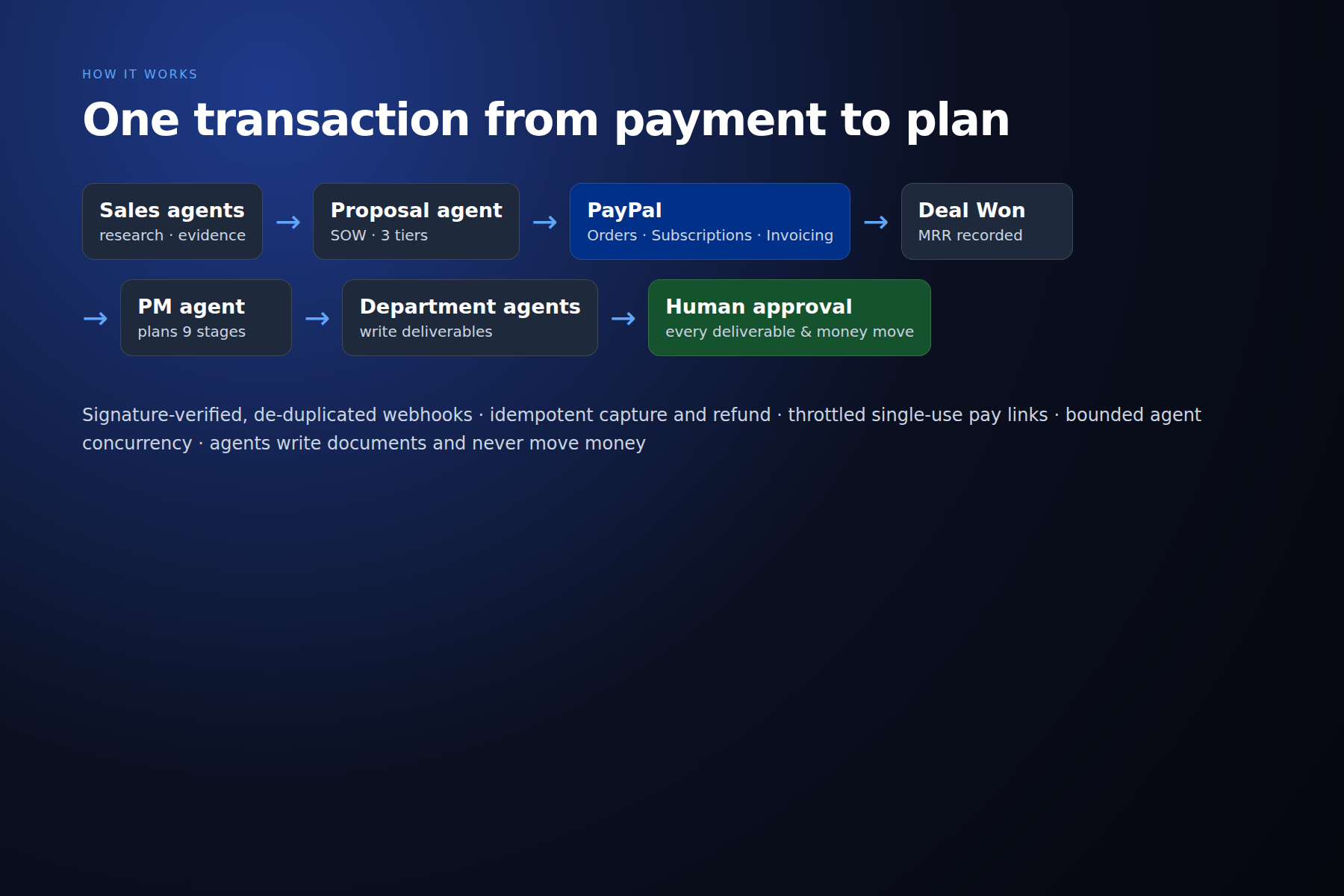
A software company is really a pipeline: lead → proposal → payment → delivery. Payments sit in the middle, so we asked: what if PayPal were the moment that sets the whole company in motion, and AI agents did the busywork on both sides of it, with a person approving everything that matters?
What it does
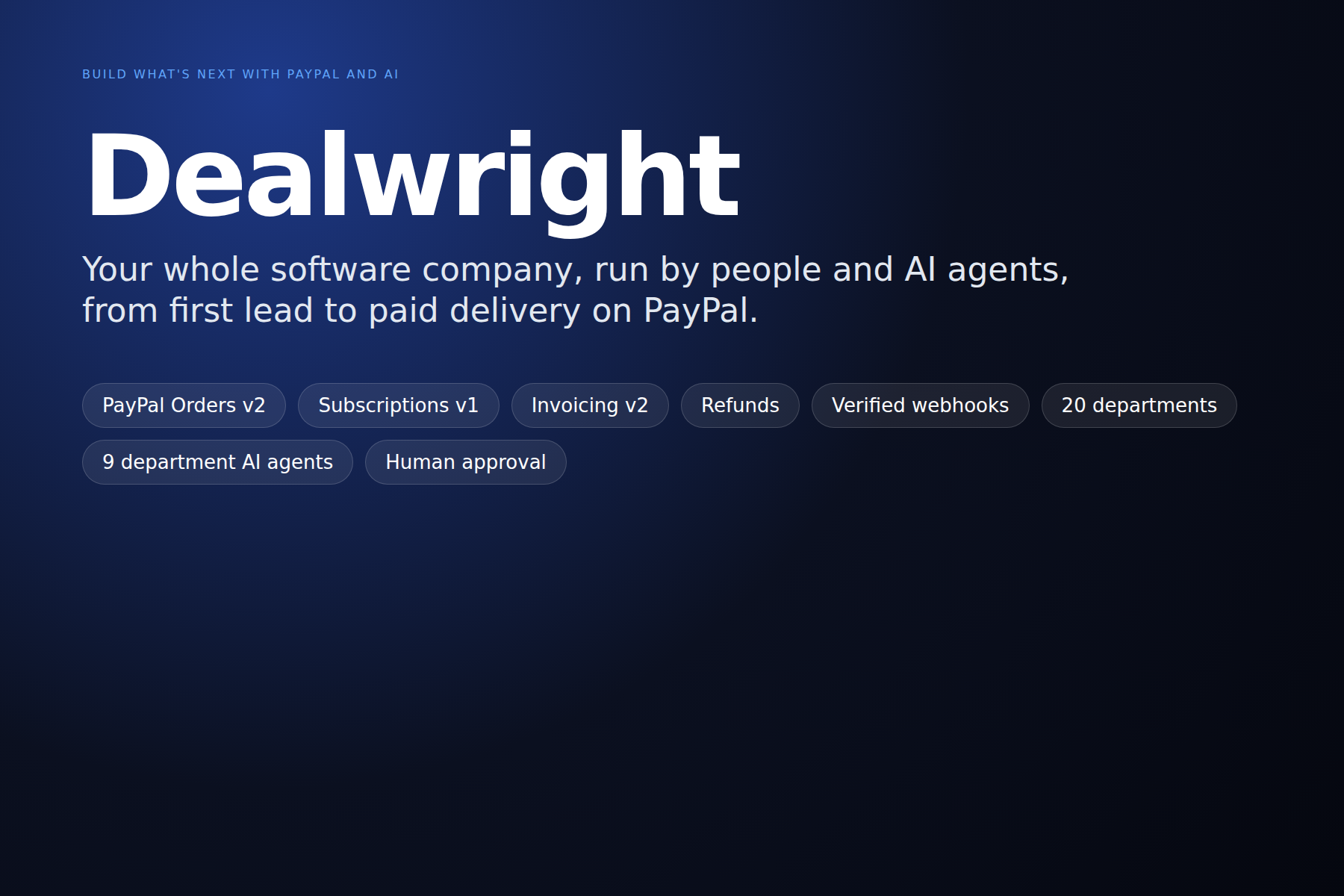
Dealwright runs a software house end to end, with people and AI agents working side by side.
Revenue
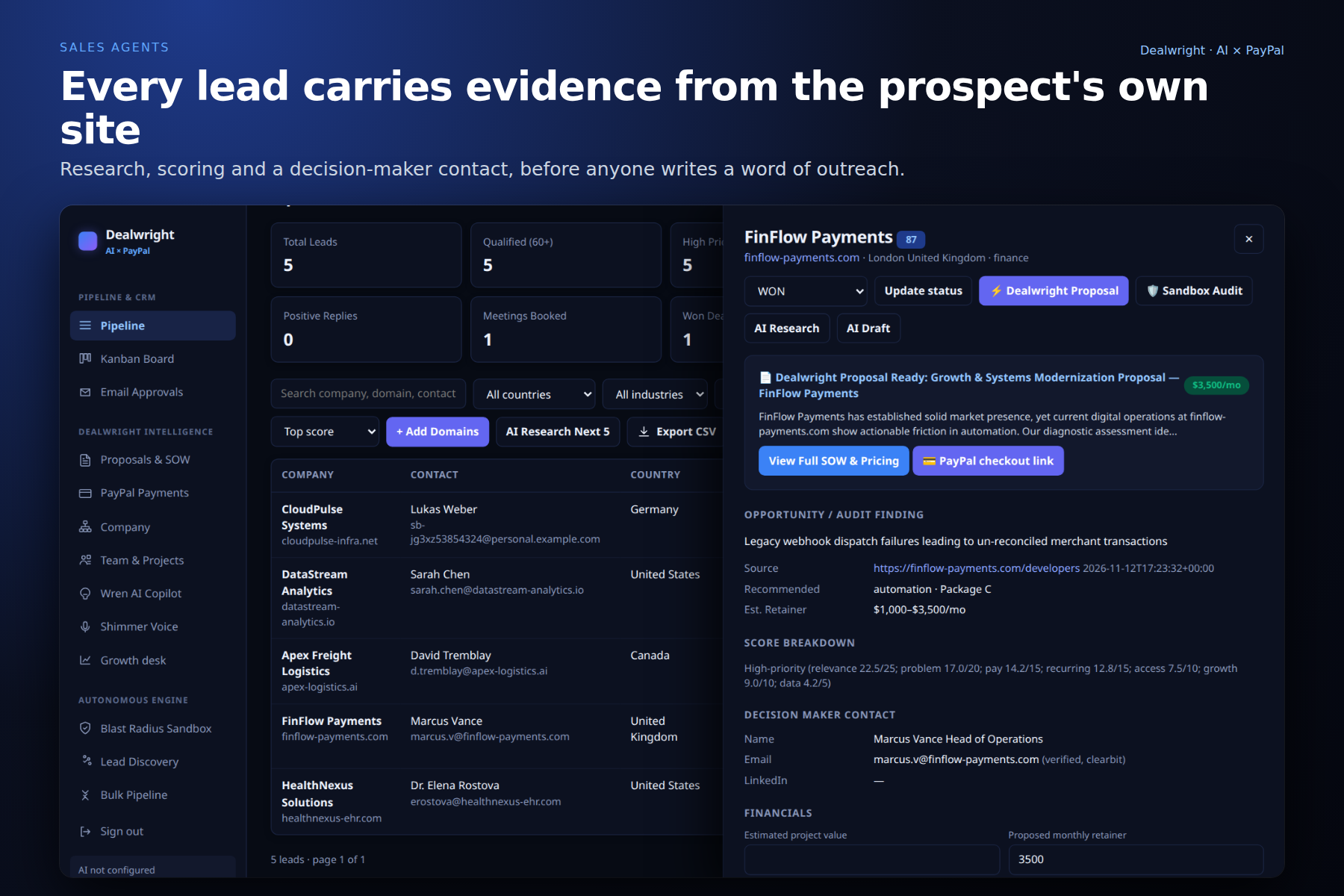
- Sales agents research prospects and quote evidence from the prospect's own website.
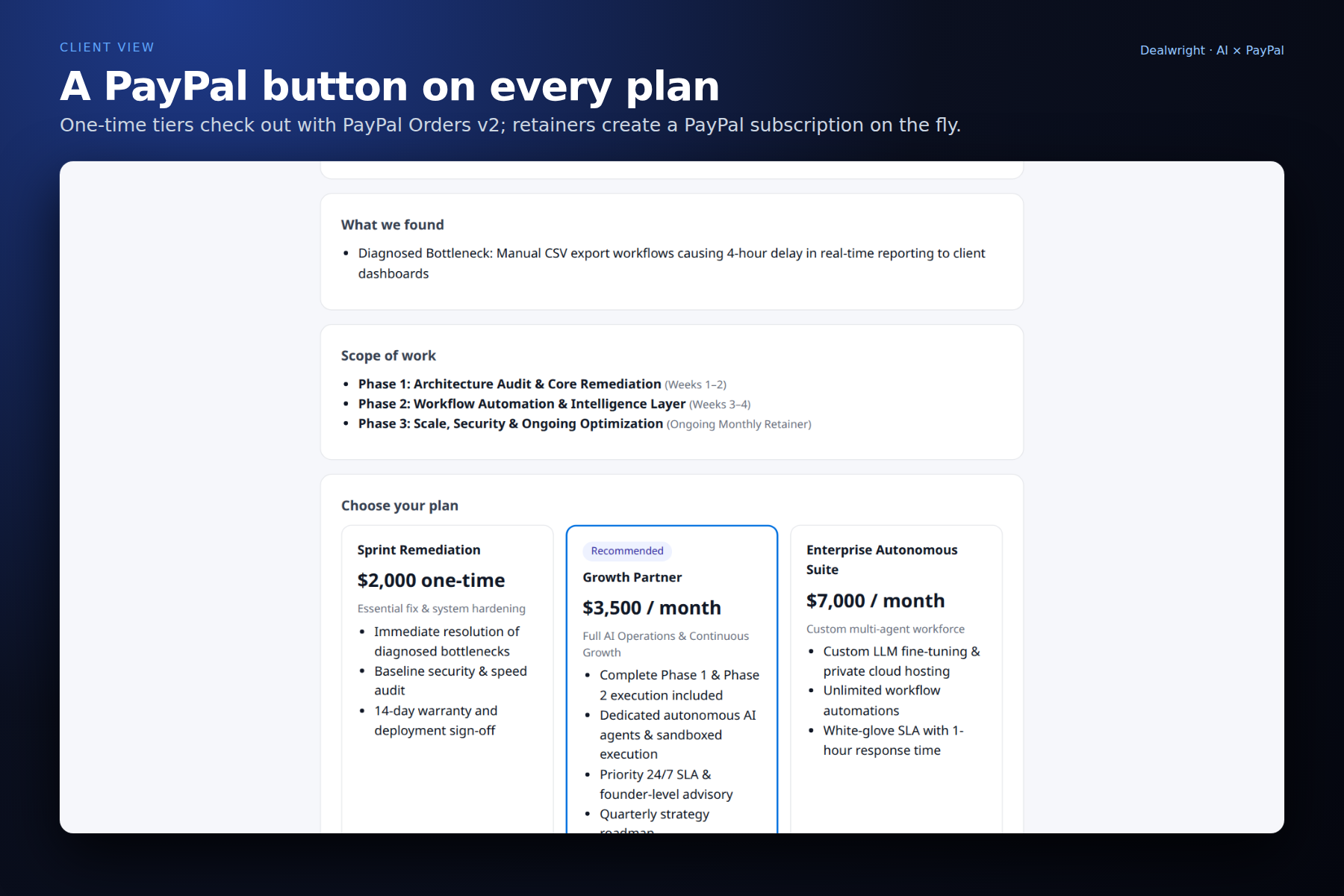
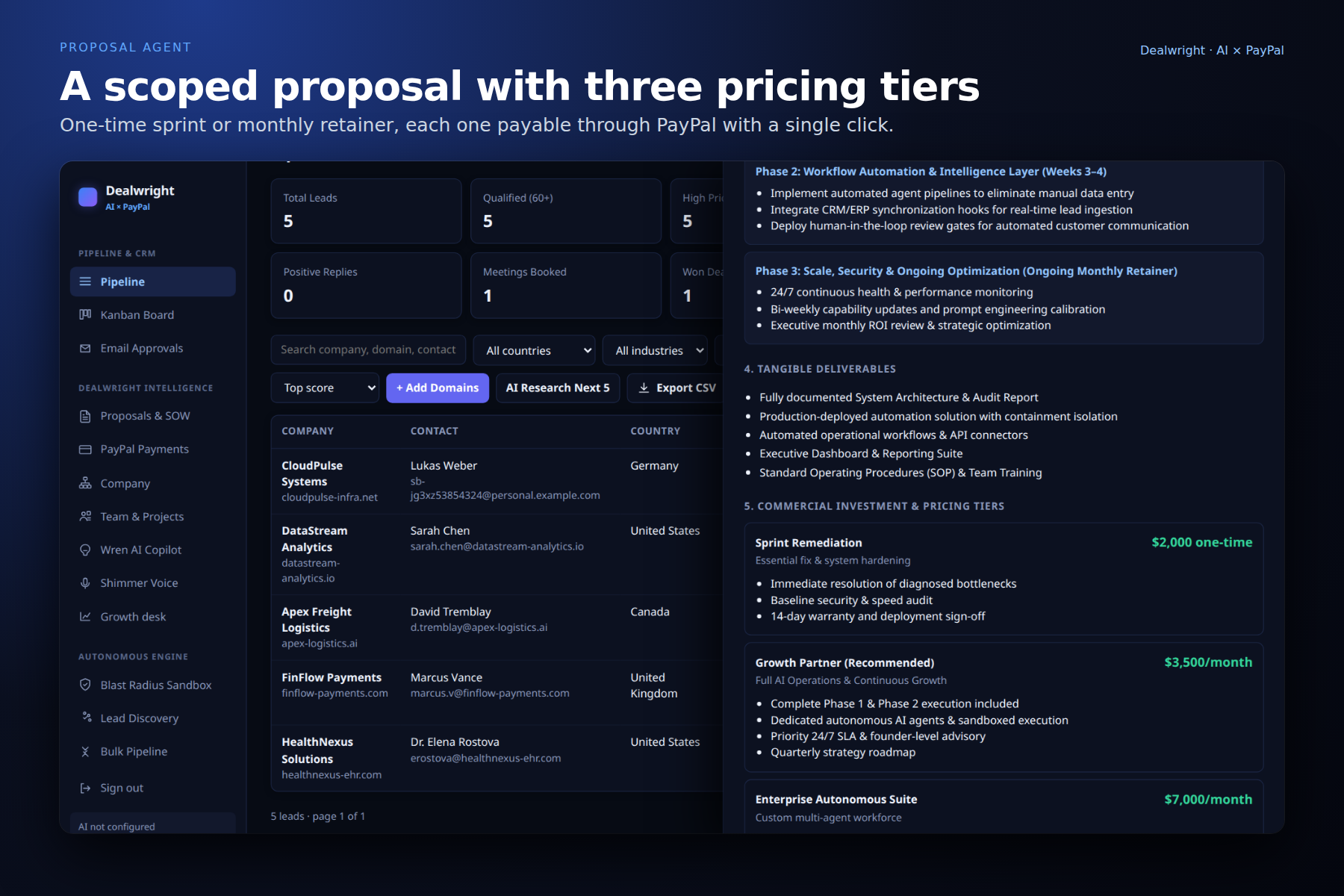
- A proposal agent writes a scoped proposal with three pricing tiers.
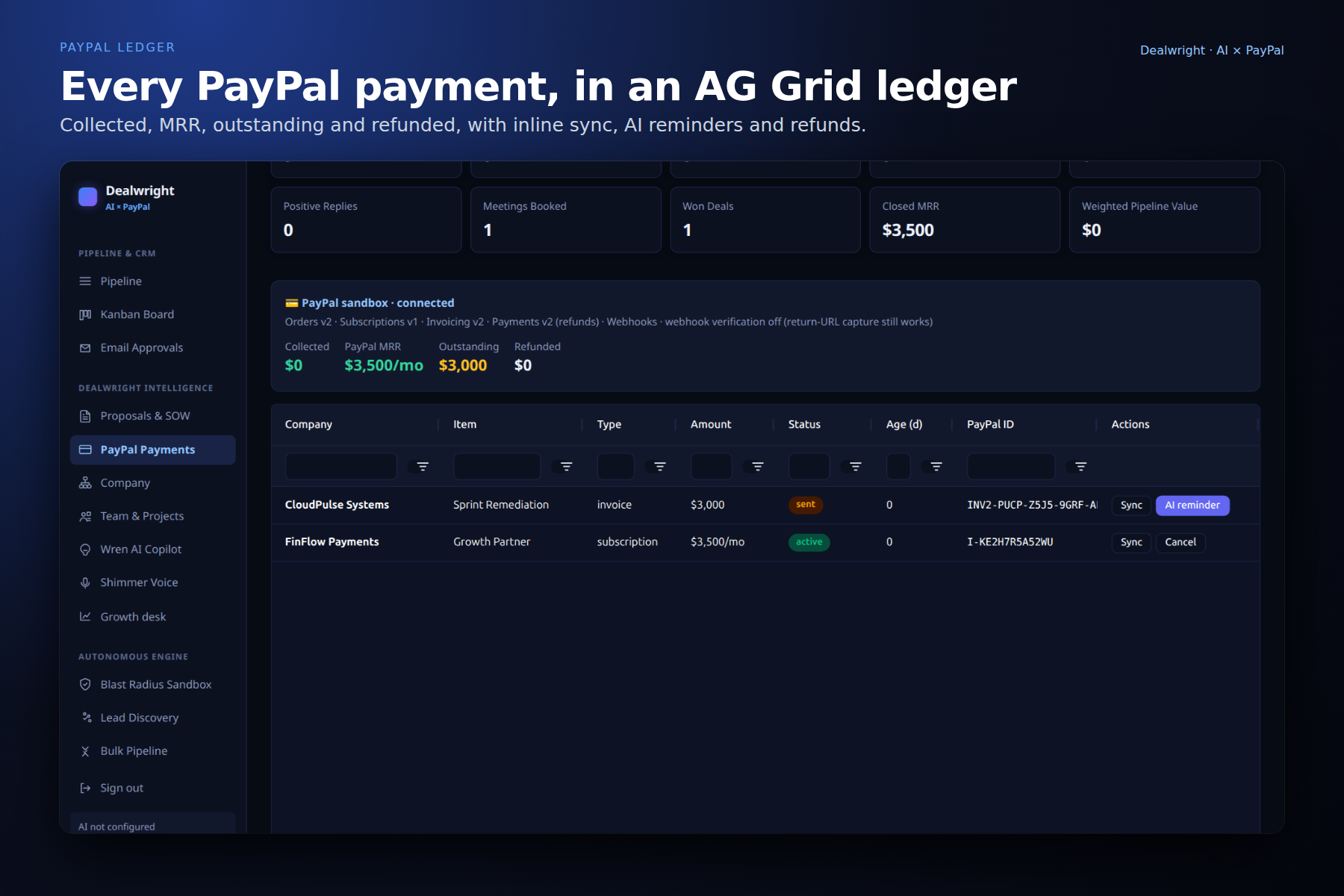
- One click turns the proposal into a client pay page: one-time tiers use PayPal Orders v2, and monthly retainers create a PayPal product, plan and subscription on the fly.
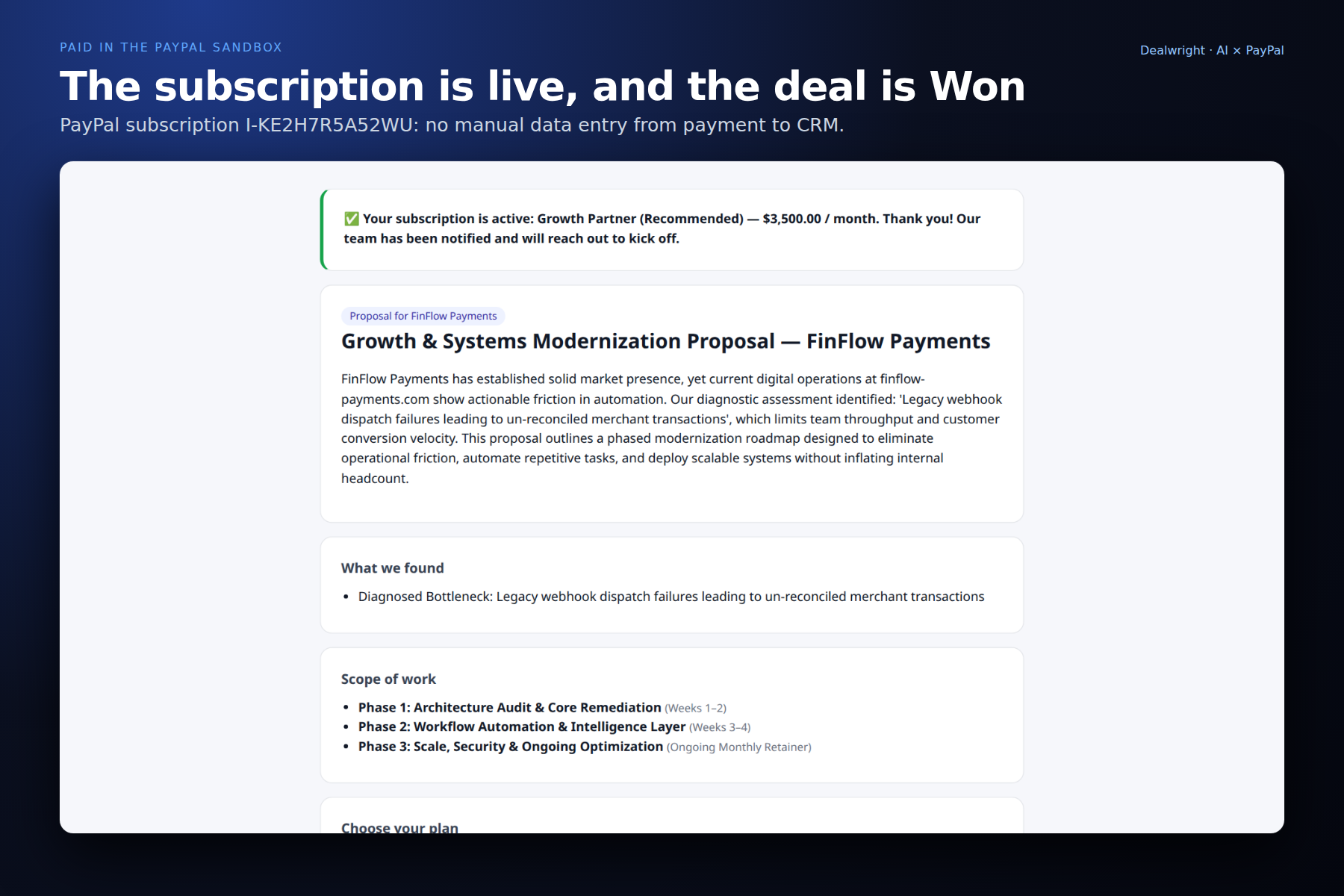
- When PayPal confirms the payment (on the return URL or a signature-verified webhook), the deal moves to Won and revenue is recorded, with no manual data entry.
Delivery
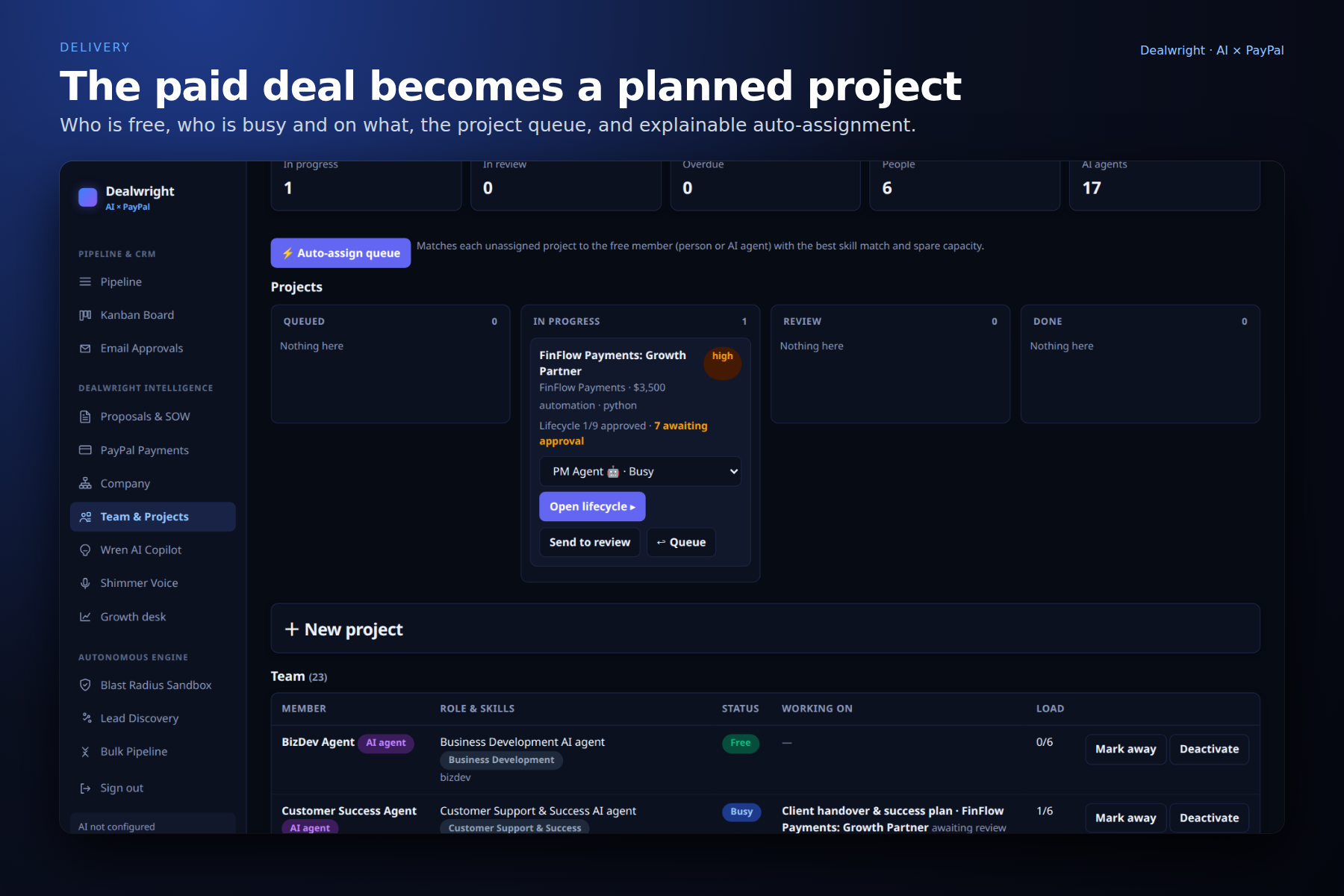
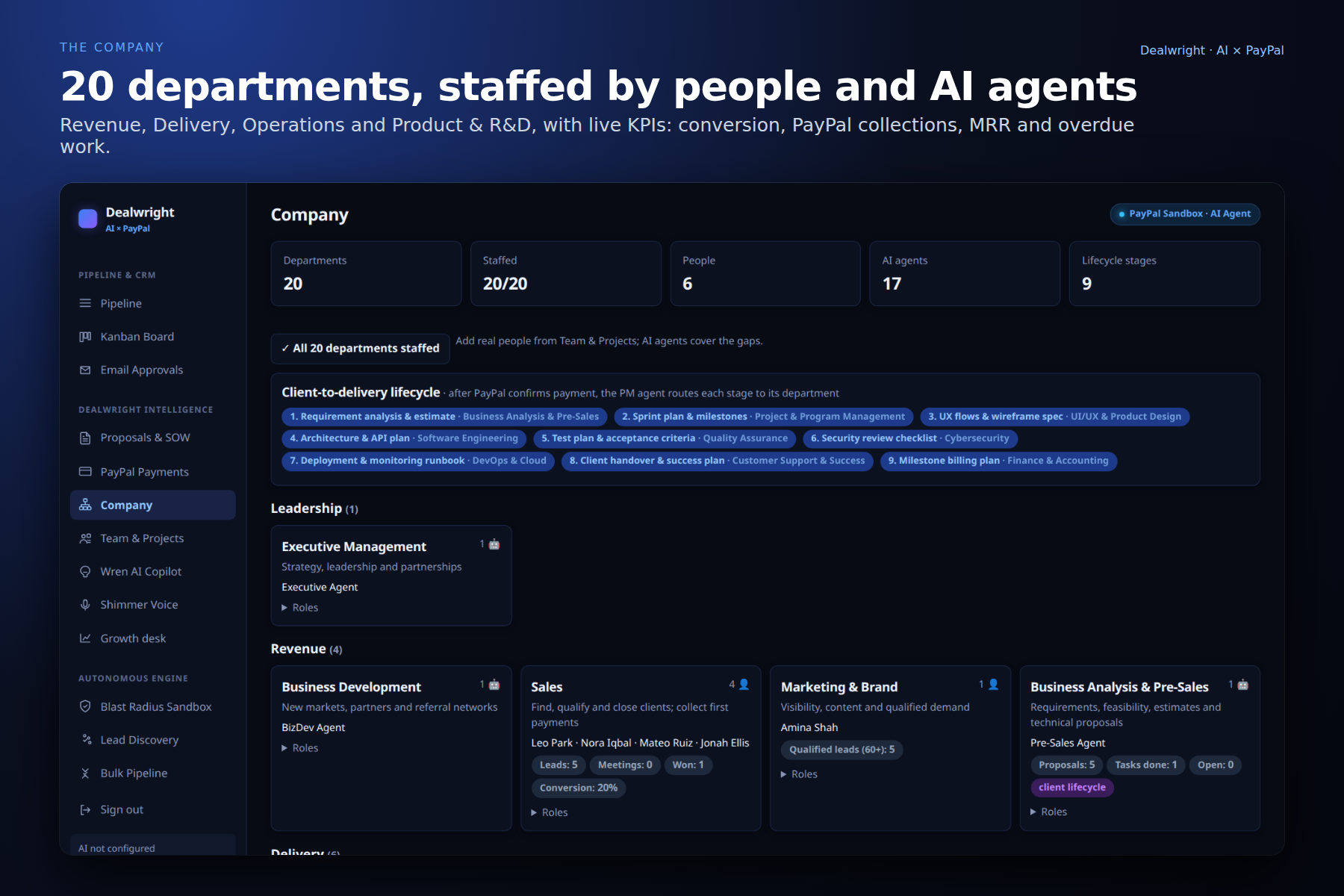
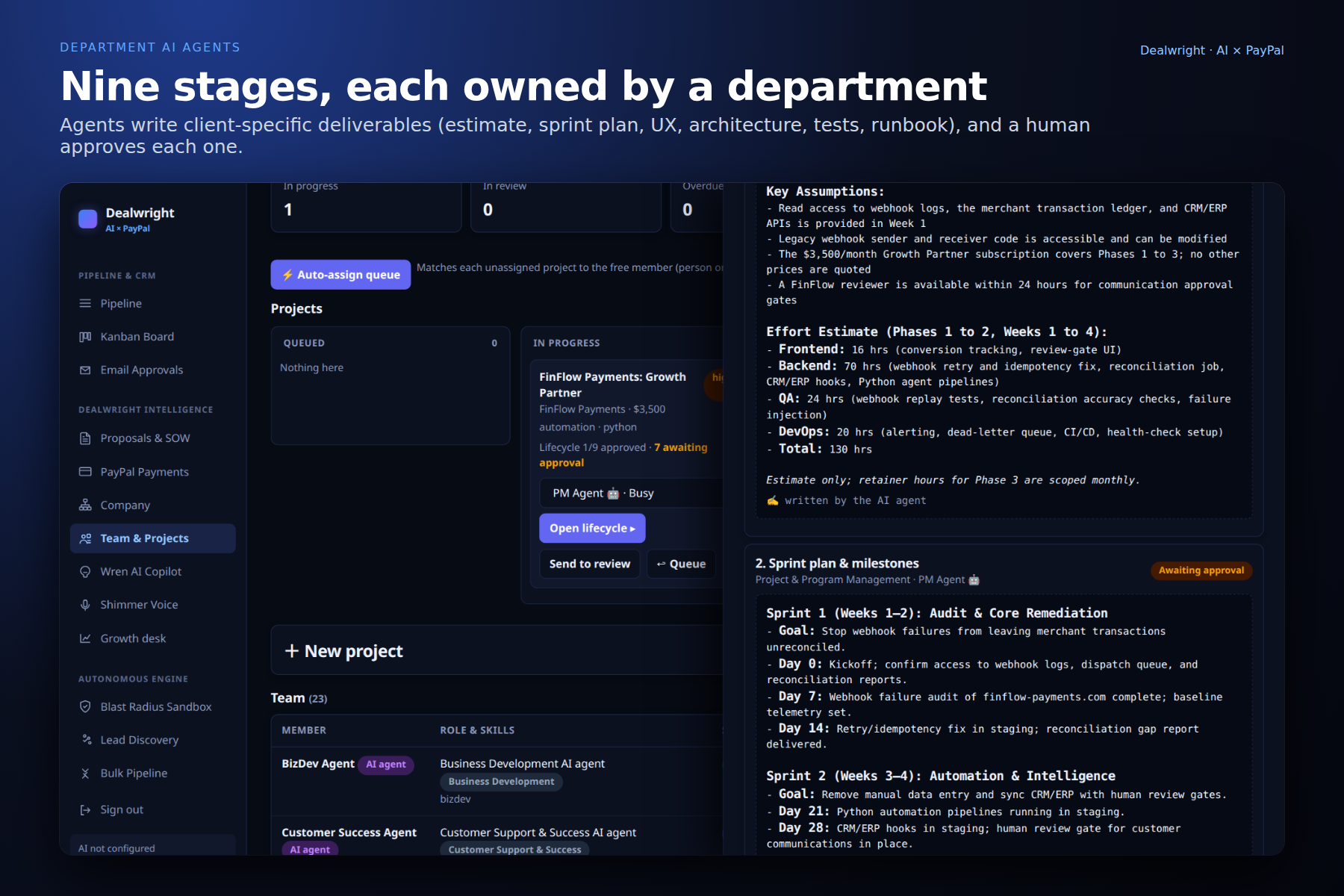
- The paid deal becomes a project, and a Project Manager agent plans a 9-stage lifecycle: requirements and estimate, sprint plan, UX, architecture, test plan, security review, deployment runbook, handover, and milestone billing.
- Each stage goes to the department that owns it. Department AI agents write their deliverable for that specific client, and every deliverable waits for human approval. Tasks owned by people stay with them.
The company
- 20 departments in four pillars (Revenue, Delivery, Operations, Product & R&D), staffed by people, AI agents, or both, with live KPIs.
- Admins add employees and agents, see who is free, busy or at capacity and what they are working on, and auto-assign the project queue.
Finance in plain English
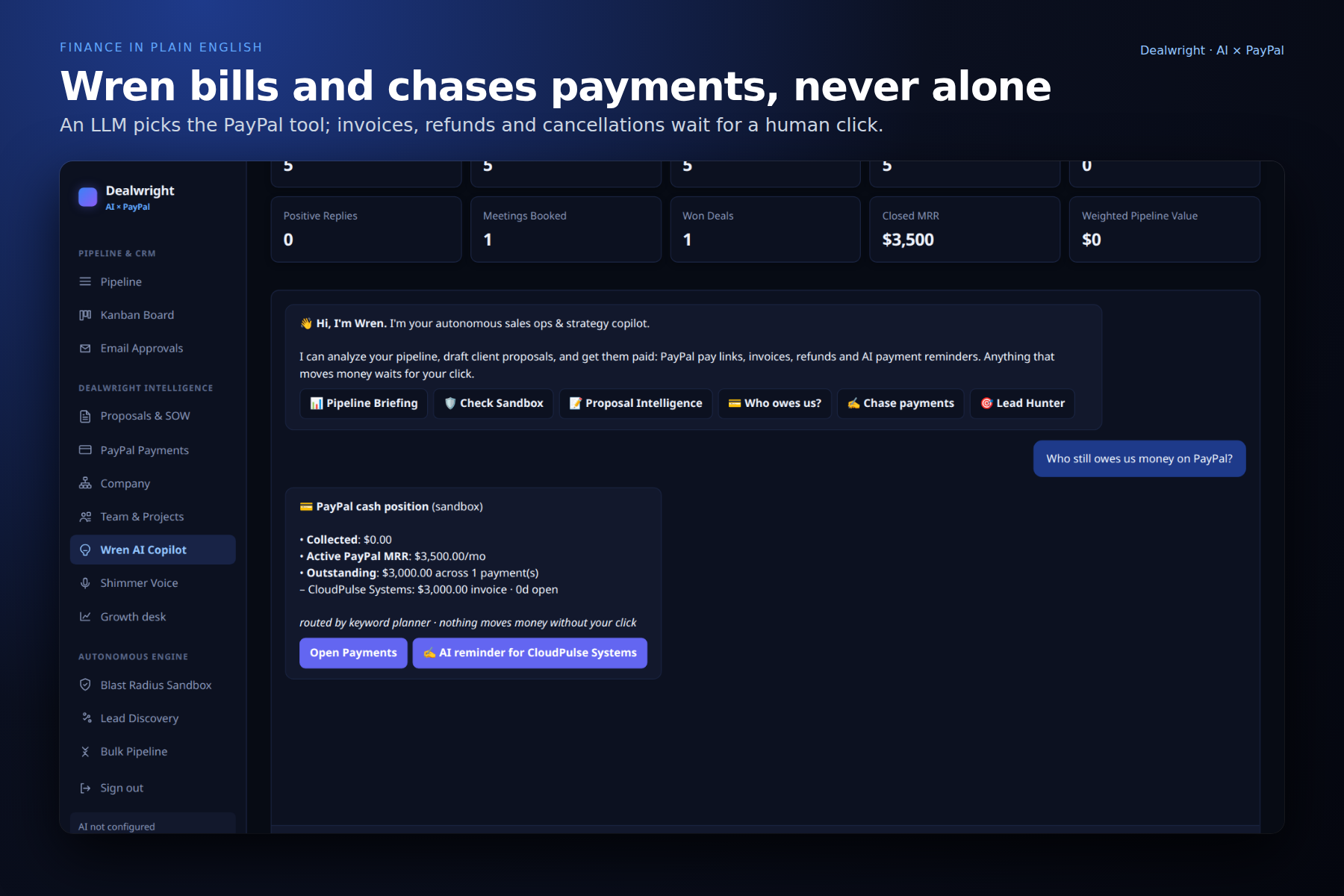
- Wren, the copilot, invoices, refunds and chases payments: "invoice CloudPulse for the one-time sprint".
- An LLM picks the PayPal tool and extracts the client and plan, but nothing that moves money runs without a human click, and the API rejects it without explicit confirmation.
- For unpaid invoices, an AI collections agent drafts a reminder whose tone matches how overdue it is, and queues it for approval.
How we built it
- Backend: Python with no web framework, SQLite, and a small REST API. The PayPal layer (
paypal.py) wraps Orders, Subscriptions, Invoicing, Payments and Webhooks, with OAuth token caching and idempotency keys on create, capture and refund. - Settlement is atomic. One transaction captures the payment, moves the deal to Won, records revenue, queues the delivery project and plans its nine tasks. Webhooks are verified with
verify-webhook-signatureand de-duplicated by event ID. - AI: Claude (
claude-haiku-5.5via OpenRouter) powers the copilot's JSON tool router, proposal summaries, the department deliverables and collections emails. Department agents run in parallel under a semaphore, so we stay inside provider rate limits. - Auto-assignment is deterministic and explainable. For a project needing skills $S_p$, each available member $m$ with skills $S_m$, capacity $c_m$, $a_m$ active and $q_m$ queued items is ranked by
$$\text{rank}(m) = \Big(\,|S_p \cap S_m|,\;\; c_m - a_m - q_m\,\Big)$$
in lexicographic order: most matching skills first, then most headroom. Members with no headroom, or with no matching skills when skills are required, are skipped, and every decision is stored with its reason.
- UI: a single-page app in vanilla JavaScript, with an AG Grid PayPal ledger.
- Tests: 25 end-to-end tests run against a fake PayPal API, including a sweep that runs every agent, plus 25 crawler tests. A sandbox self-check script verifies a real PayPal account in 30 seconds.
- The demo video is code. A storyboard drives a real browser through the live PayPal sandbox, and the narration, captions and speed-ups are rendered automatically, so anyone can reproduce it.
Challenges we ran into
- Atomic money flows. SQLite's
executescript()silently commits the open transaction. One of our hooks ran inside a PayPal settlement and could have committed a payment halfway through. We caught it and now settlement is all-or-nothing. - Agents that are useful and safe. It is tempting to let an agent "just send the invoice." We made money-moving tools return confirmation requests instead. That turned out to make a better product: the agent does the thinking and the person makes the decision.
- Model reality. A free reasoning model spent its whole token budget thinking and returned empty answers, and parallel agents tripped rate limits. We added bounded concurrency, a fallback model chain, and honest labelled templates that record why the LLM was unavailable, so a template is never passed off as AI output.
- PayPal's subscription approval takes several steps (funding source, then consent), and the sandbox is sometimes slow. The demo recorder had to handle both.
- Doing it responsibly. The project started as a lead-generation tool with CAPTCHA solvers and LinkedIn scraping. We removed them: the crawler now identifies itself honestly, rate-limits itself, and skips any site that shows a bot challenge.
Accomplishments that we're proud of
- A real payment in the PayPal sandbox turns into a planned, staffed, documented delivery project, with no manual data entry.
- Nine department agents write client-specific deliverables in seconds, and none of them can ship code or move money on their own.
- It is honest about its limits: agents write plans and documents, and the README says so.
What we learned
- The most valuable place for AI in a services business is the handoffs, not the core craft.
- With agents, "propose, then confirm" beats "act autonomously" for anything involving money or clients.
- PayPal's Orders, Subscriptions and Invoicing APIs cover the whole commercial lifecycle of a service company, and webhooks make them work like an event bus for the business.
What's next for Dealwright
- Milestone invoices sent automatically when lifecycle stages are approved, with PayPal Payouts for contractors.
- An MCP server, so outside agents can request PayPal actions under the same human-approval rules.
- Profitability per project (PayPal revenue against time spent by people and agents), and real code-review and CI agents for the Engineering department.
