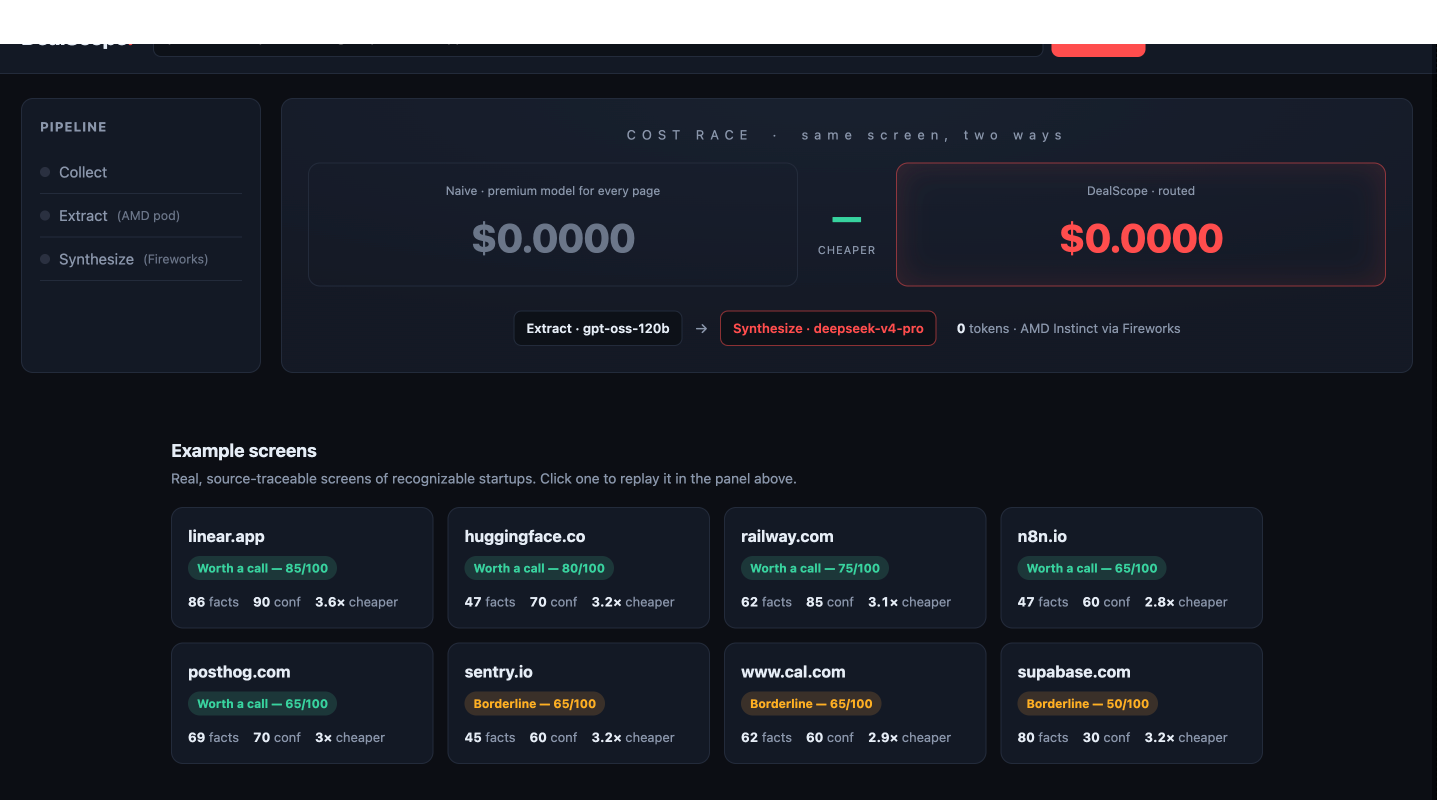
Angel investors, VC scouts, and accelerator reviewers screen dozens of startups a month with nothing but Google and gut instinct. They just need to answer one question fast: is this worth a call?
DealScope answers it. Paste a company's URL and autonomous agents read its public footprint — website, GitHub, hiring boards — and return a structured screen where every claim links to the source it came from, with a confidence score.
The wedge isn't "no input." It's traceability: Perplexity hallucinates and won't show its work; DealScope cites every line and lets you click to verify. The one model-opinion section (market) is labeled as such.
Why it's built on AMD — the cost engine Screening one company means reading 100+ pages — a lot of LLM calls. The trick is not using your most expensive model for the cheap work. DealScope routes across two AMD-hosted models on Fireworks:
Stage Model (on AMD Instinct via Fireworks) Role 1 · Extract gpt-oss-120b — $0.15/$0.60 per 1M tok Bulk page → structured facts (high volume) 2 · Synthesize deepseek-v4-pro — $1.74/$3.48 per 1M tok Verdict, risk matrix, bull/bear (one call) A naive pipeline uses the premium model for everything. DealScope reserves it for the single synthesis call and routes the high-volume extraction to the cheap model:
Naive (premium for every page) ──► $0.0337 DealScope (routed) ──► $0.0095 ◄── 3.6× cheaper on real tokens
The number is honest: computed live from real input/output token counts × published Fireworks rates — reproducible by any judge, no estimation. The more bulk extraction a company needs, the wider the gap. This is the hackathon's token-efficiency thesis shipped as a product.
Built With
- amd
- fastapi
- firework
- python

