-
-
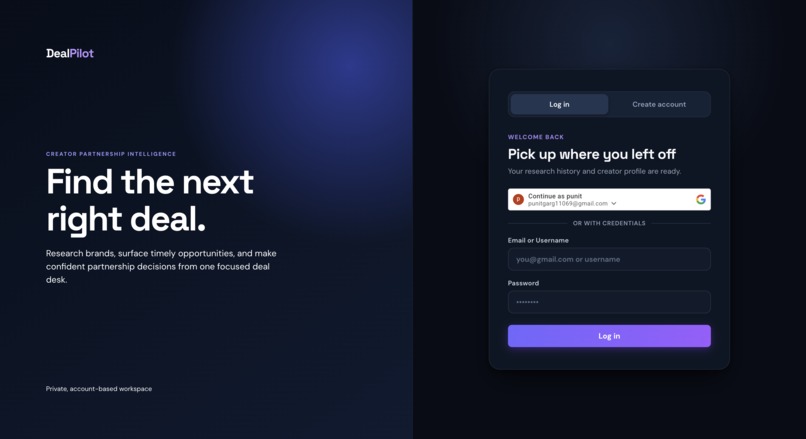
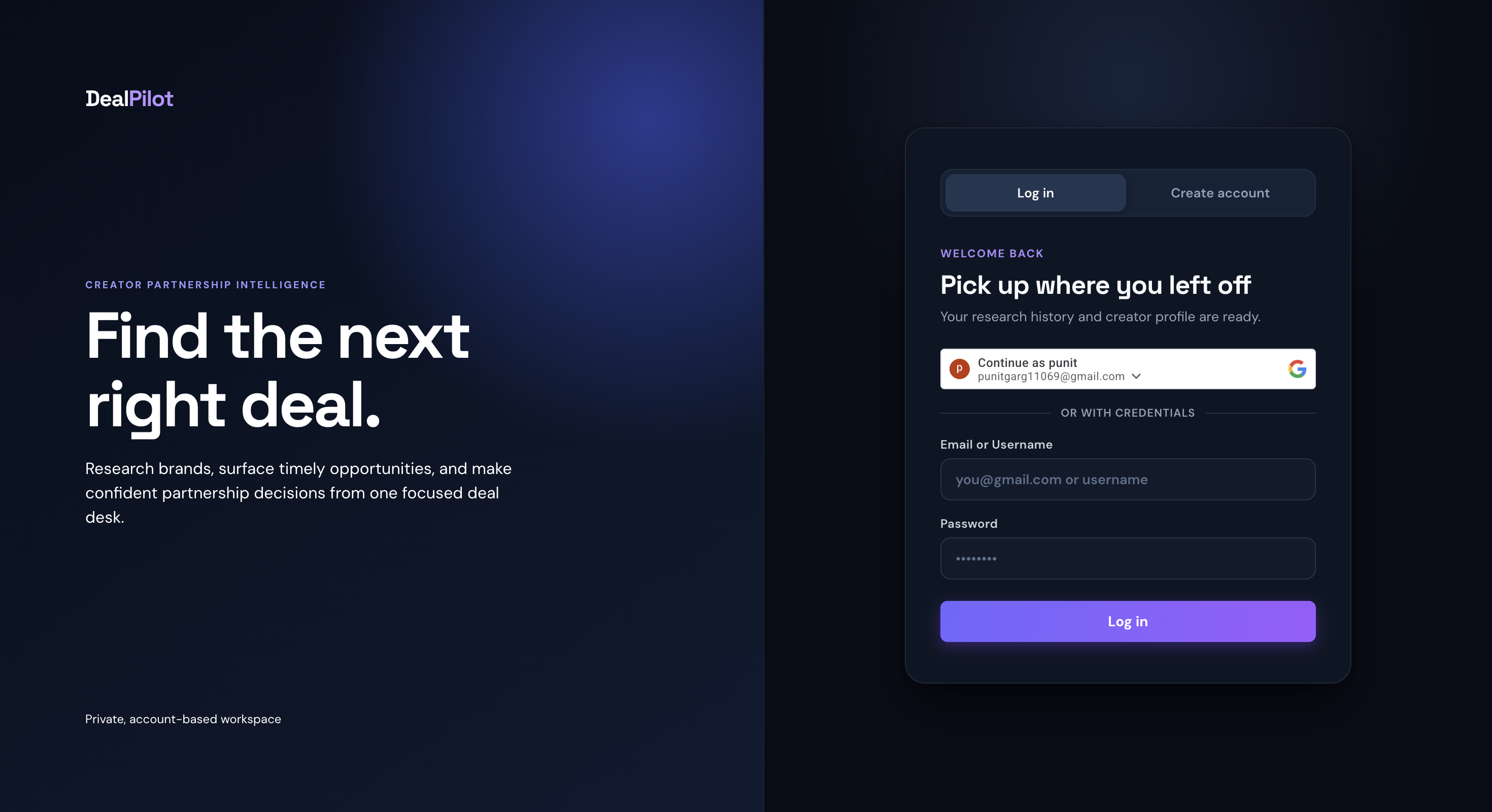
login page
-
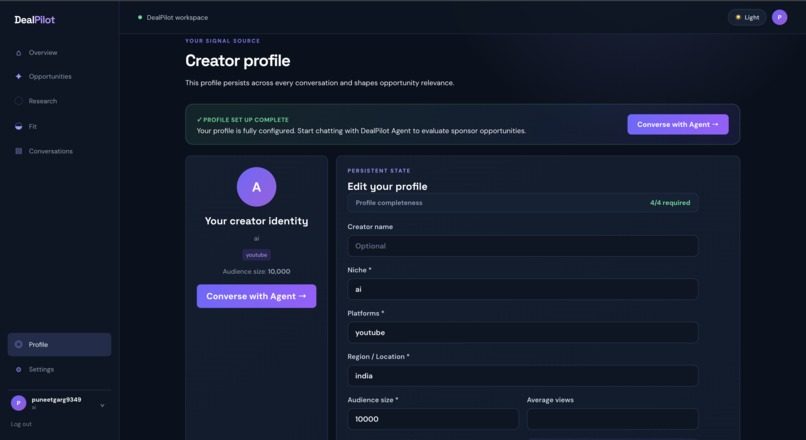
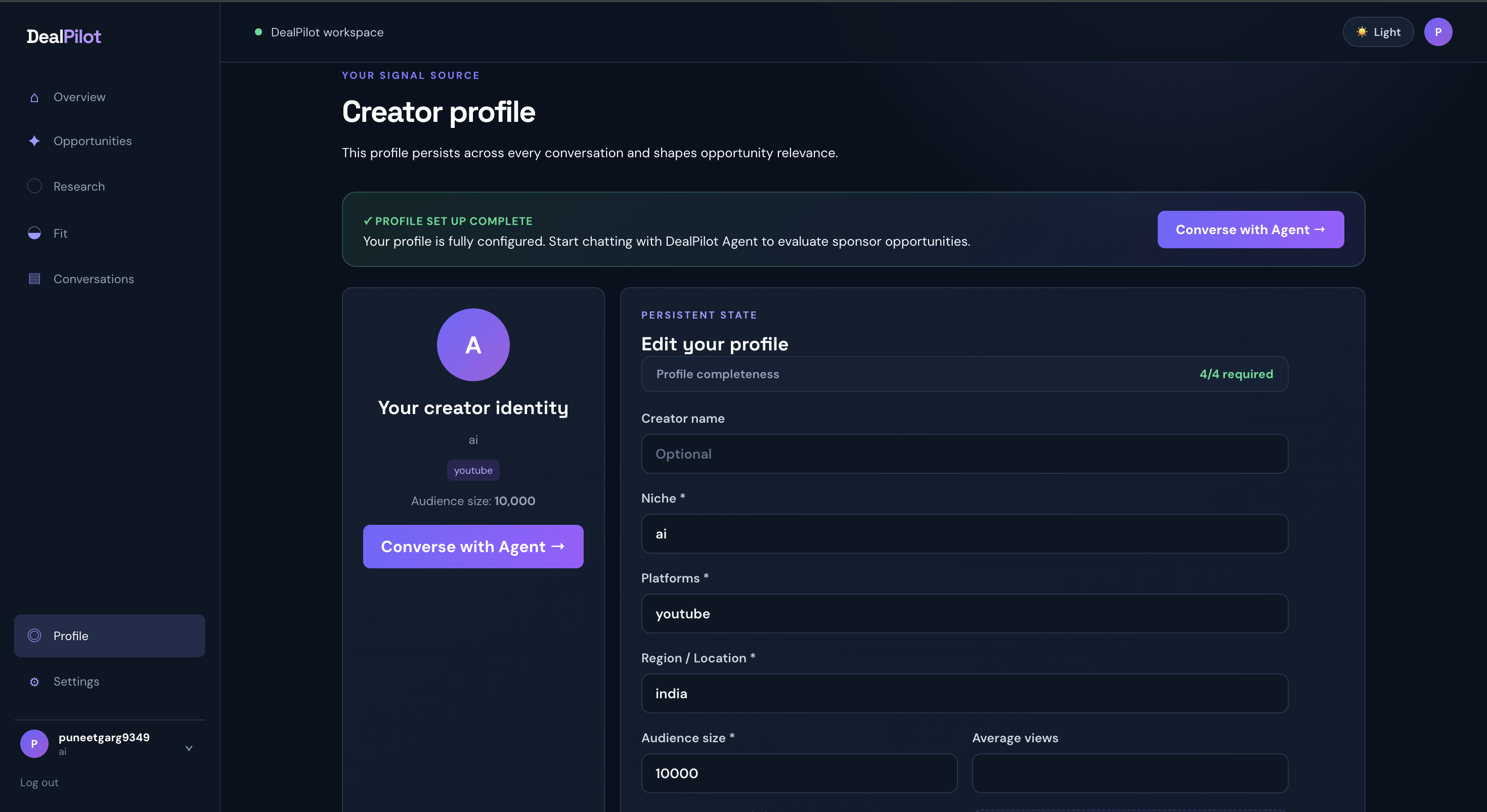
creator profile
-
-
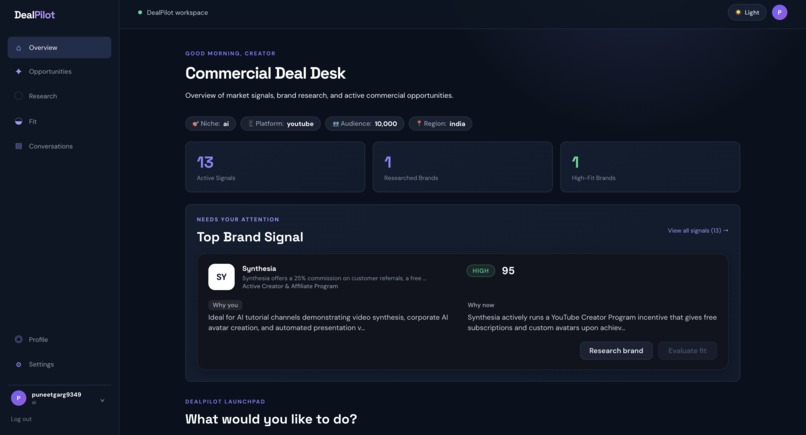
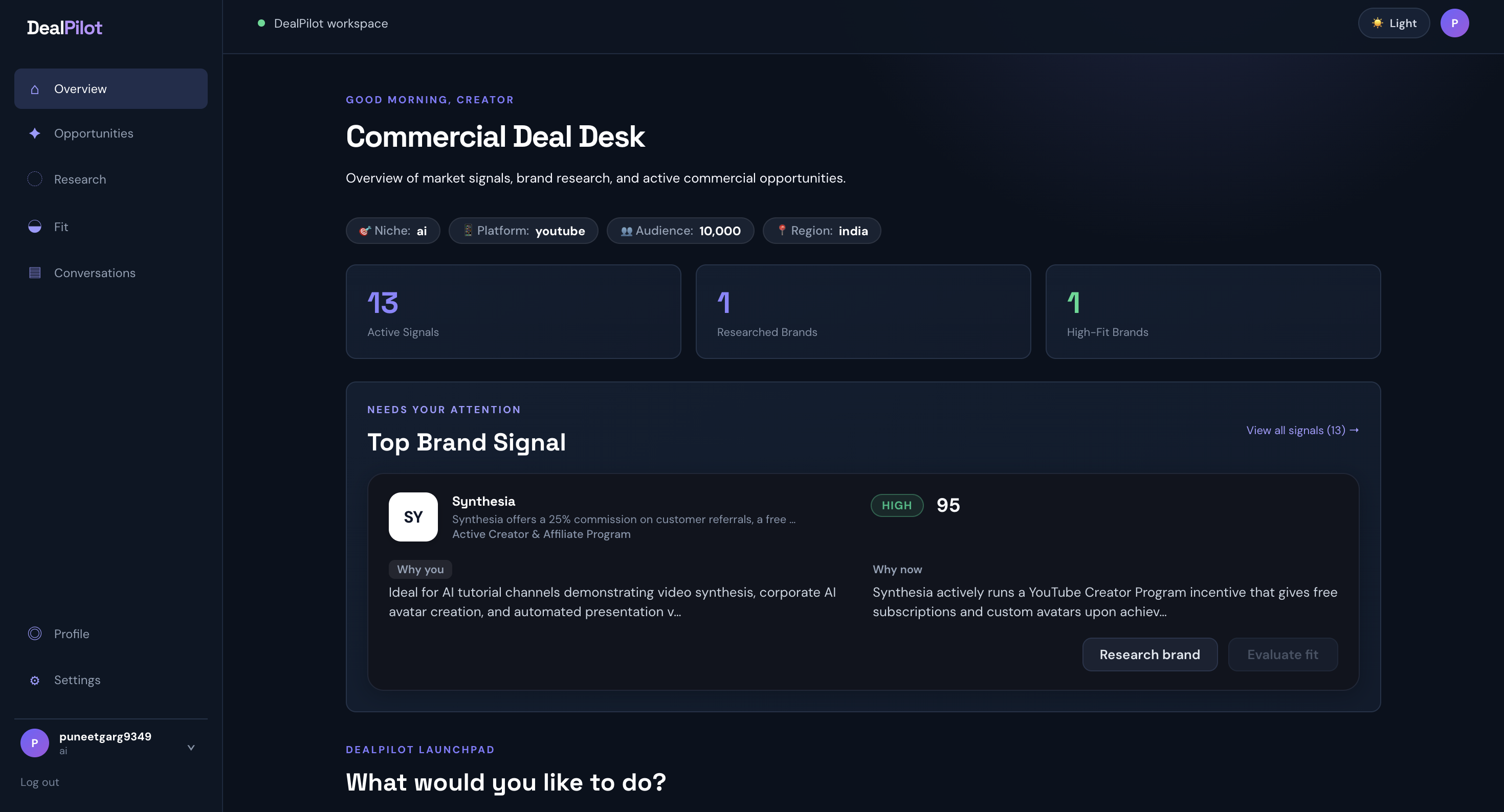
overview
-
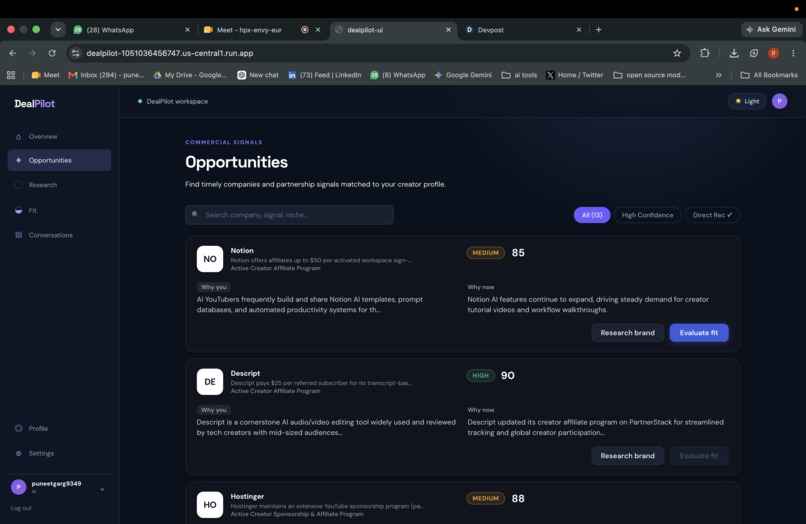
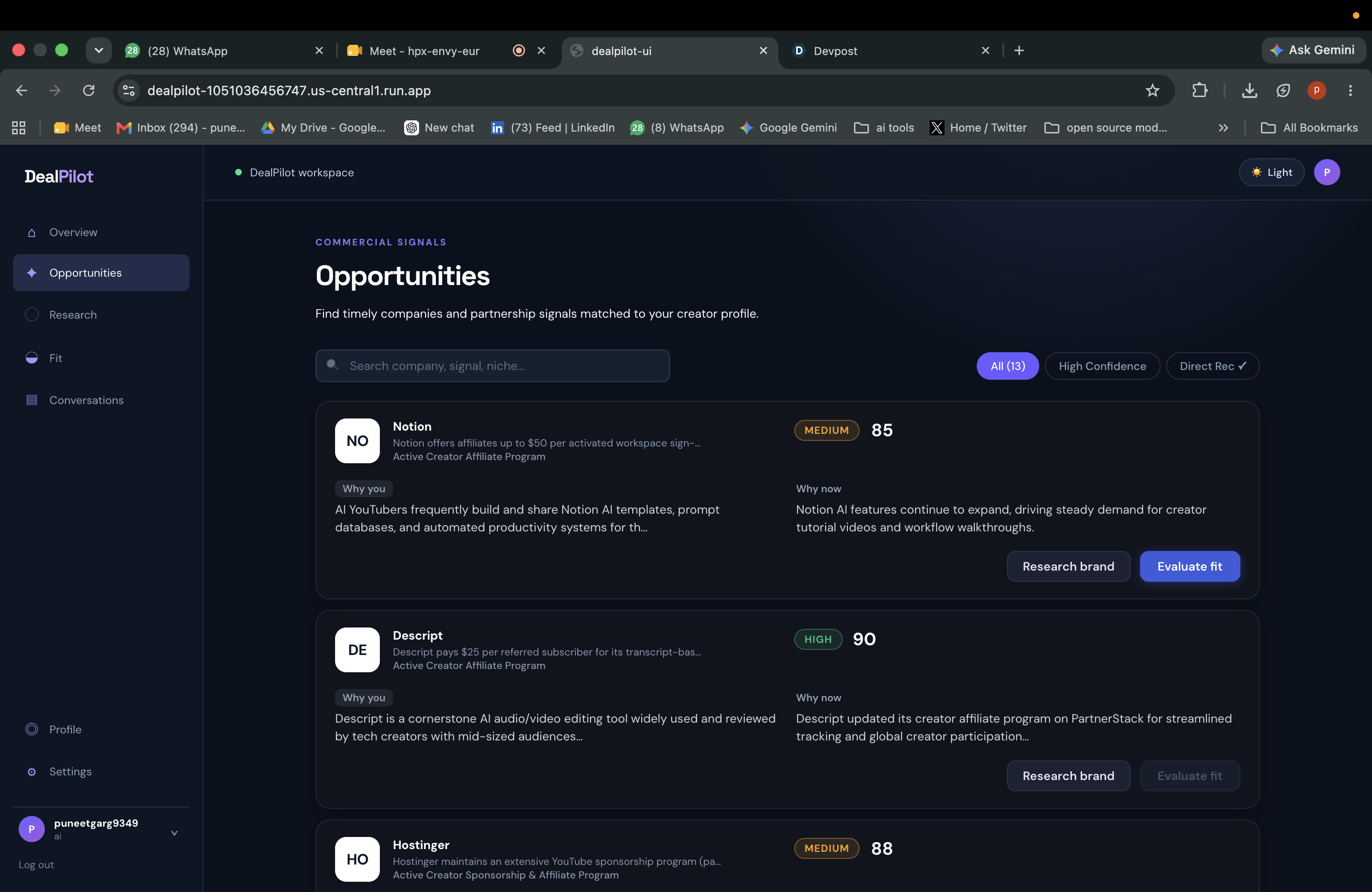
opportunities page
-
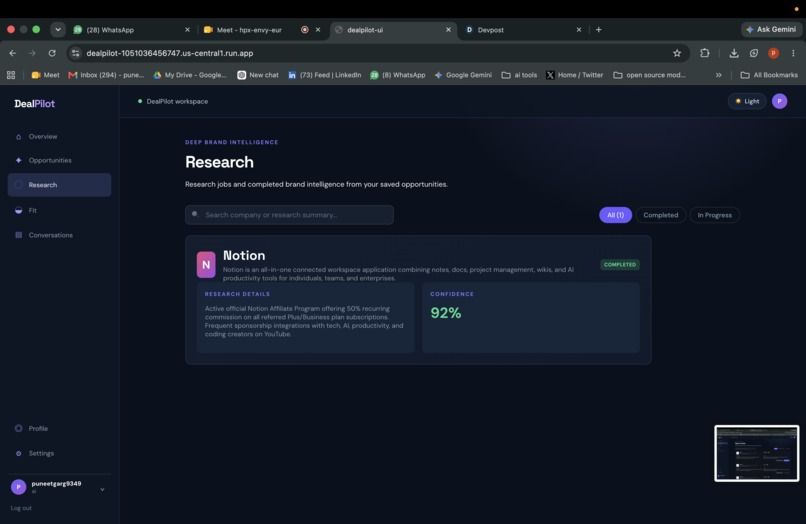
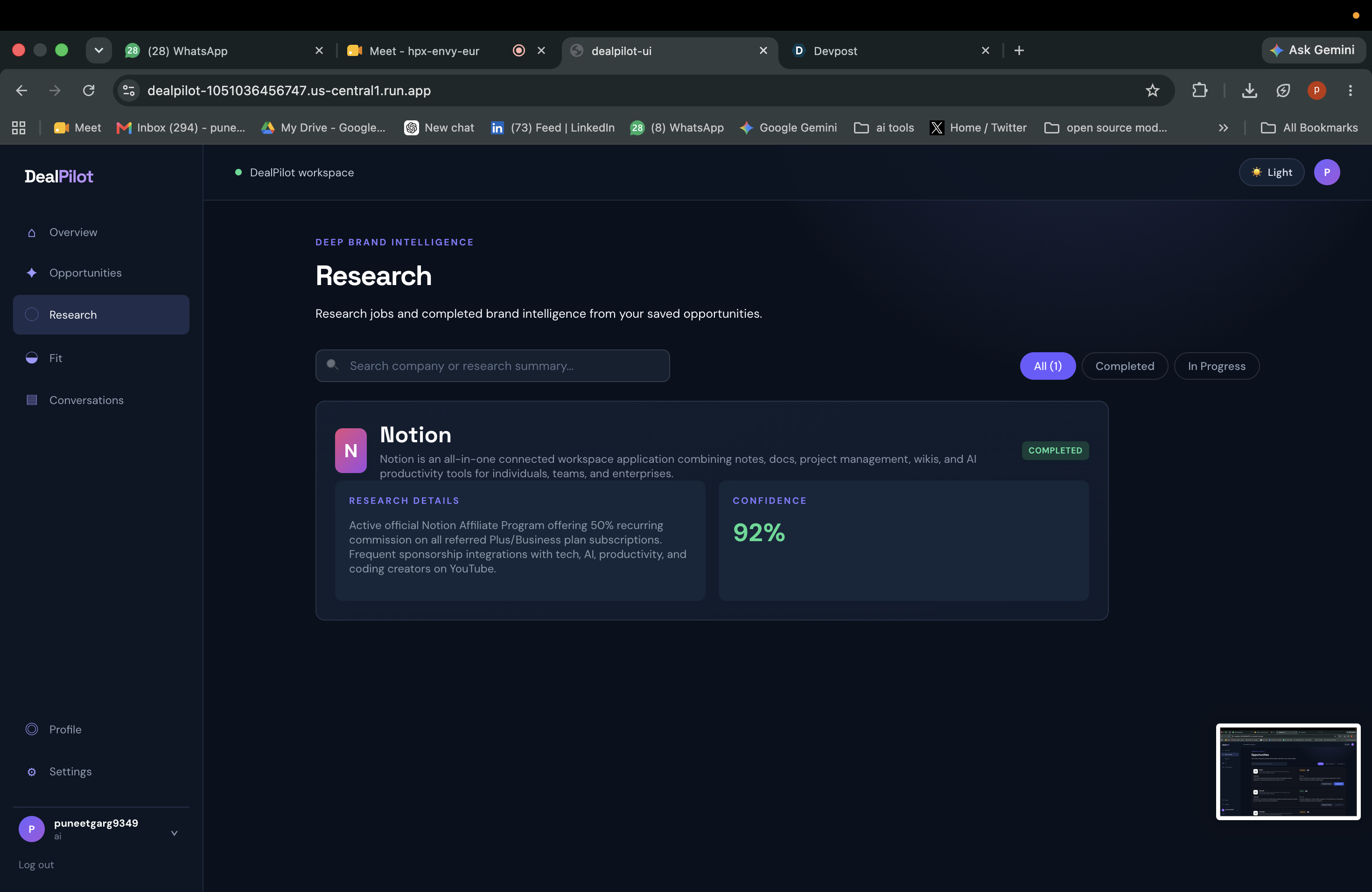
reasearch page
-
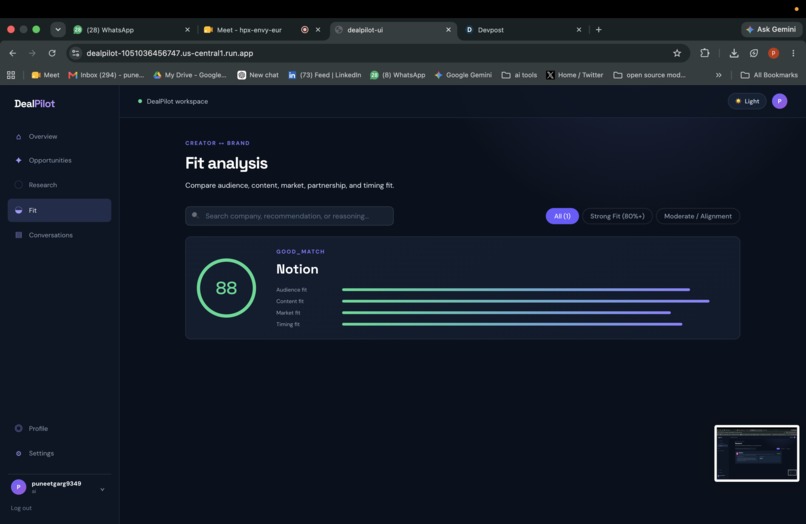
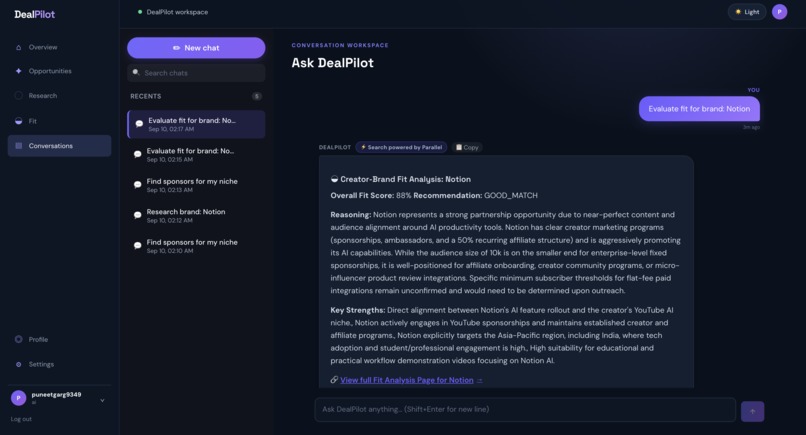
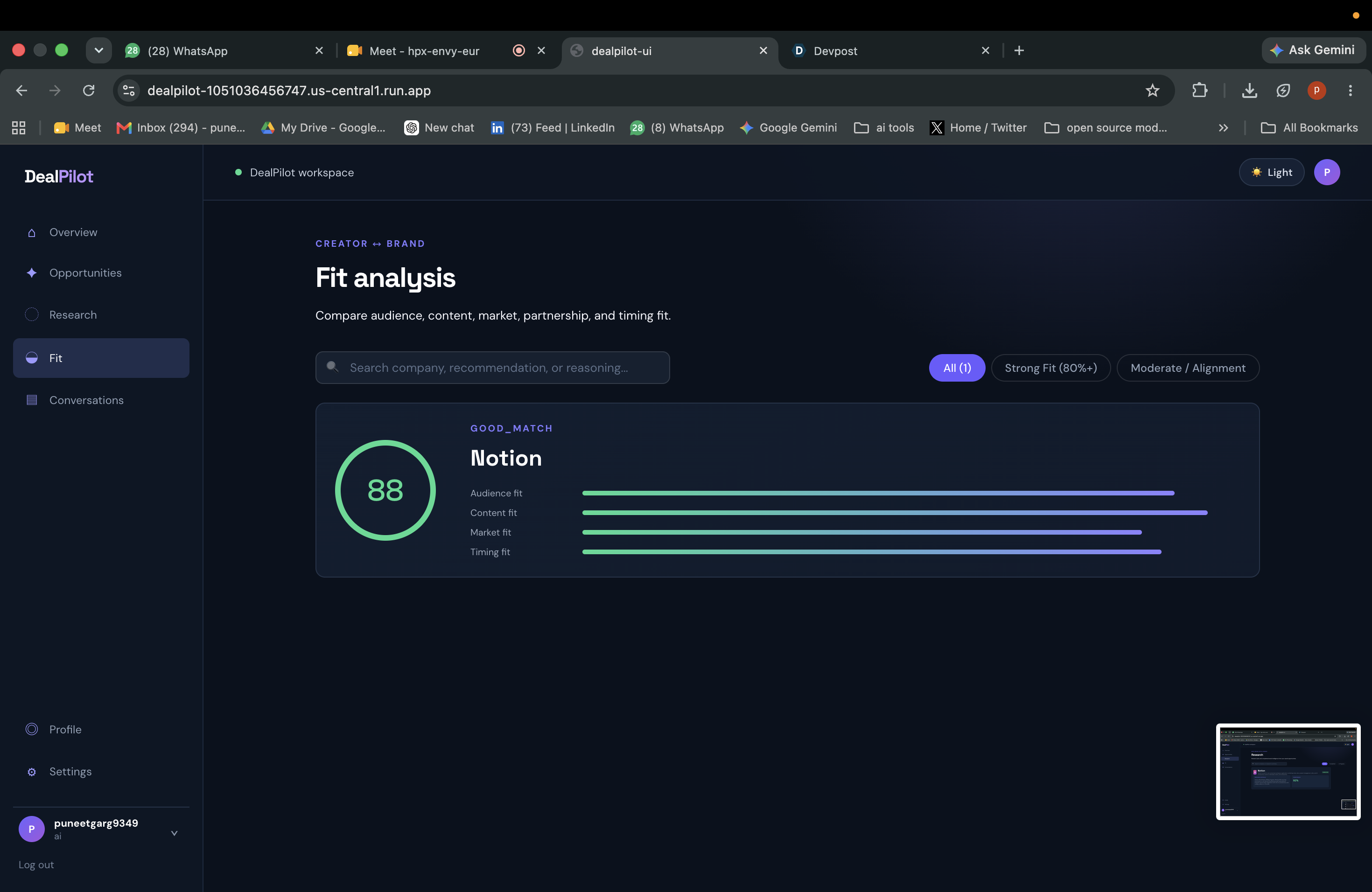
fit analysis page
Inspiration
Independent filmmakers and media creators often have an audience, content, and influence but no dedicated business manager to help turn that attention into revenue. Sponsorship opportunities are rarely presented as simple “brand deals.” They often begin as indirect signals: a company launching a product, expanding into a creator-relevant market, hiring for creator marketing, announcing partnerships, or increasing its presence in a specific audience segment.
We built DealPilot to act like an autonomous business manager for creators. Instead of waiting for creators to search for sponsors manually, it discovers commercial signals, investigates the companies behind them, and evaluates whether an opportunity is actually worth pursuing.
What it does
DealPilot gives creators a conversational command center for discovering and evaluating business opportunities.
A creator maintains a persistent profile containing their niche, platforms, region, audience, average views, engagement, and other business context. From the conversation, the creator can ask DealPilot to find opportunities, research a company, evaluate fit, compare opportunities, or update their profile.
DealPilot works through three specialized stages:
Opportunity Discovery finds relevant commercial signals and potential opportunities using Parallel Search.
Brand Research performs deeper investigation into a selected company using Parallel Task MCP, collecting information such as products, target markets, recent activity, creator partnership signals, requirements, evidence, and risks.
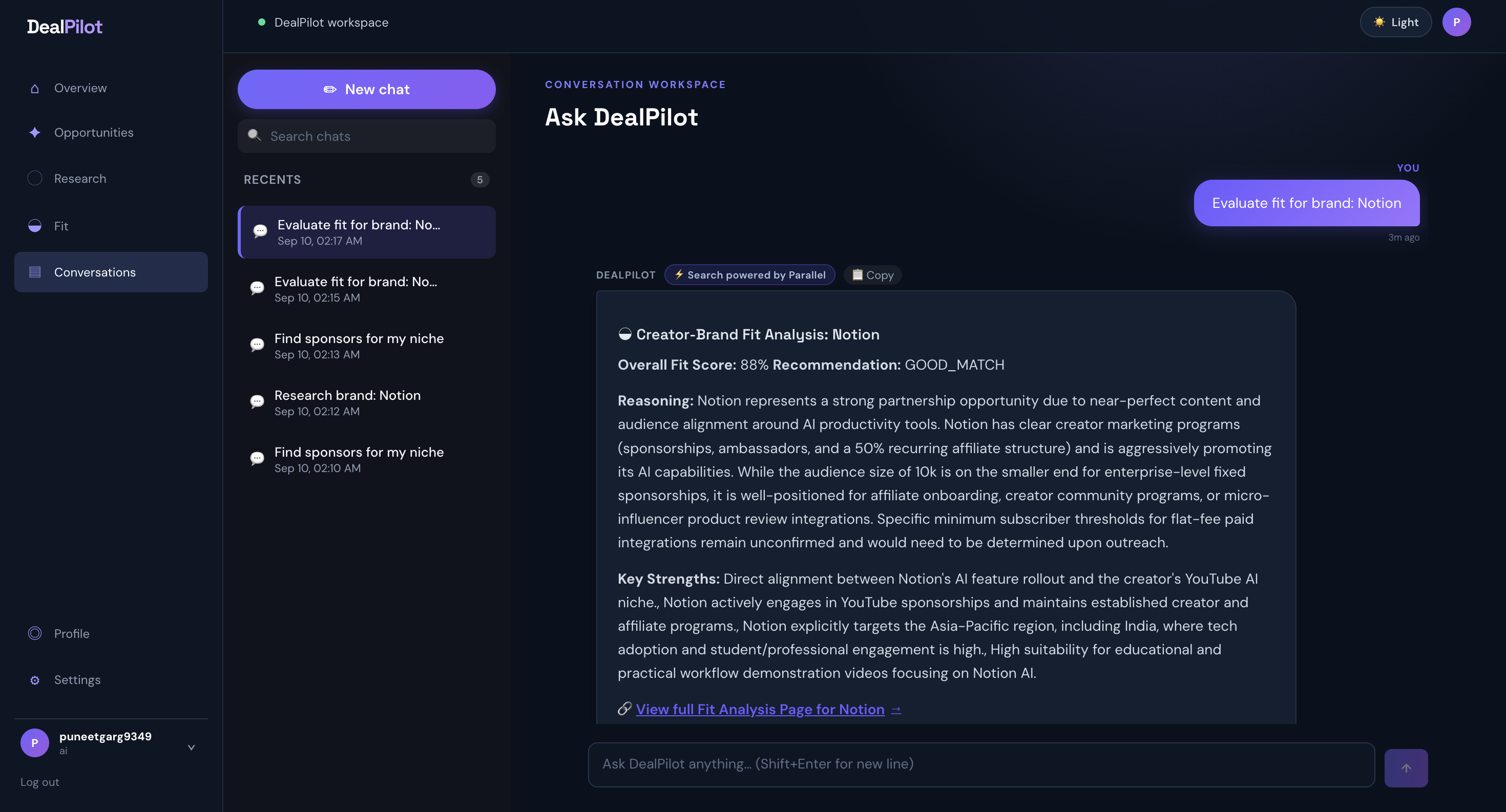
Fit Evaluation combines the creator profile and researched company information to determine audience fit, content fit, market fit, partnership fit, timing, overall score, and recommendation.
The results are persisted into dedicated workspaces so the conversation is not just a chat history. Opportunities, Research, and Fit become reusable business intelligence that the creator can revisit and act on.
How we built it
DealPilot is built with a React frontend and a FastAPI backend, using Google Gemini and Google Cloud Agent Development Kit (ADK) for agent orchestration and Parallel MCP for external intelligence.
The core architecture is:
Director Agent
- Understands the creator's request.
- Uses the persistent creator profile as context.
- Routes work to the appropriate specialist.
- Coordinates workflows such as discover → research → evaluate.
Opportunity Agent
- Uses Parallel Search MCP.
- Searches for differentiated commercial signals and potential opportunities.
- Produces structured opportunity information with source evidence, relevance, timing, and confidence.
Brand Research Agent
- Uses Parallel Task MCP for deep company research.
- Research is initiated and handled as a Task MCP operation.
- We intentionally do not use polling or webhooks for the research flow.
Fit Agent
- Uses Gemini reasoning over the creator profile and brand research.
- Produces structured scoring, strengths, concerns, and a recommendation.
ADK user-scoped state is used for the persistent creator profile, while application-level database records persist conversations, opportunities, research, and fit results. This allows the same business intelligence to power both the conversational experience and the dedicated workspace tabs.
The frontend is designed as a business dashboard rather than a generic chatbot, with persistent areas for Overview, Opportunities, Research, Fit, Conversations, and Profile.
Challenges we ran into
One of the biggest challenges was deciding how an agentic system should behave like a real business manager rather than a chatbot that simply answers questions. We needed conversational flexibility while still producing structured, persistent business outcomes.
Another challenge was separating different kinds of work. Discovery, deep company research, and fit evaluation require different tools and reasoning patterns, so we split them into specialist agents and used a Director Agent for orchestration.
Persistence was another important challenge. A useful business manager cannot lose creator information or previously discovered opportunities between conversations. We therefore separated persistent creator state from session-level working data and persisted the major business outputs.
We also had to design around asynchronous deep research. Instead of repeatedly polling for completion or building a webhook-based pipeline, our research workflow uses Parallel Task MCP directly and treats the research task as the unit of deep investigation.
Accomplishments that we're proud of
We are proud that DealPilot turns an open-ended creator question into an actual business workflow rather than a single AI response.
The strongest part of the system is the signal-to-decision pipeline:
commercial signal → opportunity → deep research → creator-brand fit → recommendation
We are also proud of the separation between conversation and business workspace. A creator can discover something in conversation and later find the same opportunity, research, and fit evaluation in dedicated tabs.
Another major accomplishment is combining Google ADK/Gemini reasoning with Parallel's search and task capabilities in a focused, creator-first use case rather than building a generic research assistant.
What we learned
We learned that useful agentic systems need clear boundaries between discovery, research, reasoning, and persistence. Giving one agent every responsibility makes the workflow harder to control and harder to make reliable.
We also learned that the most valuable commercial opportunities are not always explicit sponsorship listings. Signals surrounding a company's growth, launches, partnerships, creator strategy, and market activity can be equally valuable starting points.
Finally, we learned that persistence changes the product completely. Once creator context and business intelligence survive across conversations, the AI stops feeling like a one-off assistant and starts behaving like an ongoing business manager.
What's next for DealPilot
Our next major feature is a proactive Opportunity Radar, internally called Spies.
A creator will be able to create a personalized Spy that continuously watches for new and meaningful commercial signals relevant to their profile — such as emerging brands, product launches, market expansion, creator programs, partnerships, events, or companies showing strong sponsorship potential.
Powered by Parallel's Monitor API, each Spy will watch its defined area of interest over time rather than requiring the creator to manually search again and again. When a genuinely strong opportunity appears, DealPilot will analyze the signal against the creator's profile and notify them only when the opportunity has a strong potential fit.
This turns DealPilot from a reactive assistant into a proactive one:
Today: “Find me brands I could work with.”
Next: “Keep watching the market for me and tell me when something worth pursuing appears.”
The long-term vision is for DealPilot to become an autonomous revenue operating system for independent creators — continuously discovering opportunities, understanding the businesses behind them, evaluating fit, and bringing the right opportunities to the creator at the right time.


Log in or sign up for Devpost to join the conversation.