Inspiration
Buying or selling a second-hand phone, laptop, or other electronic device should be simple, affordable, and safe. However, a deal that looks genuine can quickly become risky when someone asks for an advance deposit, an OTP, a UPI PIN, or the installation of an unknown application.
People may not recognize these warning signs, especially when they are pressured to act quickly or afraid of losing a good deal.
I wanted to create something more useful than another application that simply labels a message as suspicious. I wanted a tool that explains why a request might be risky and helps people decide what to do next.
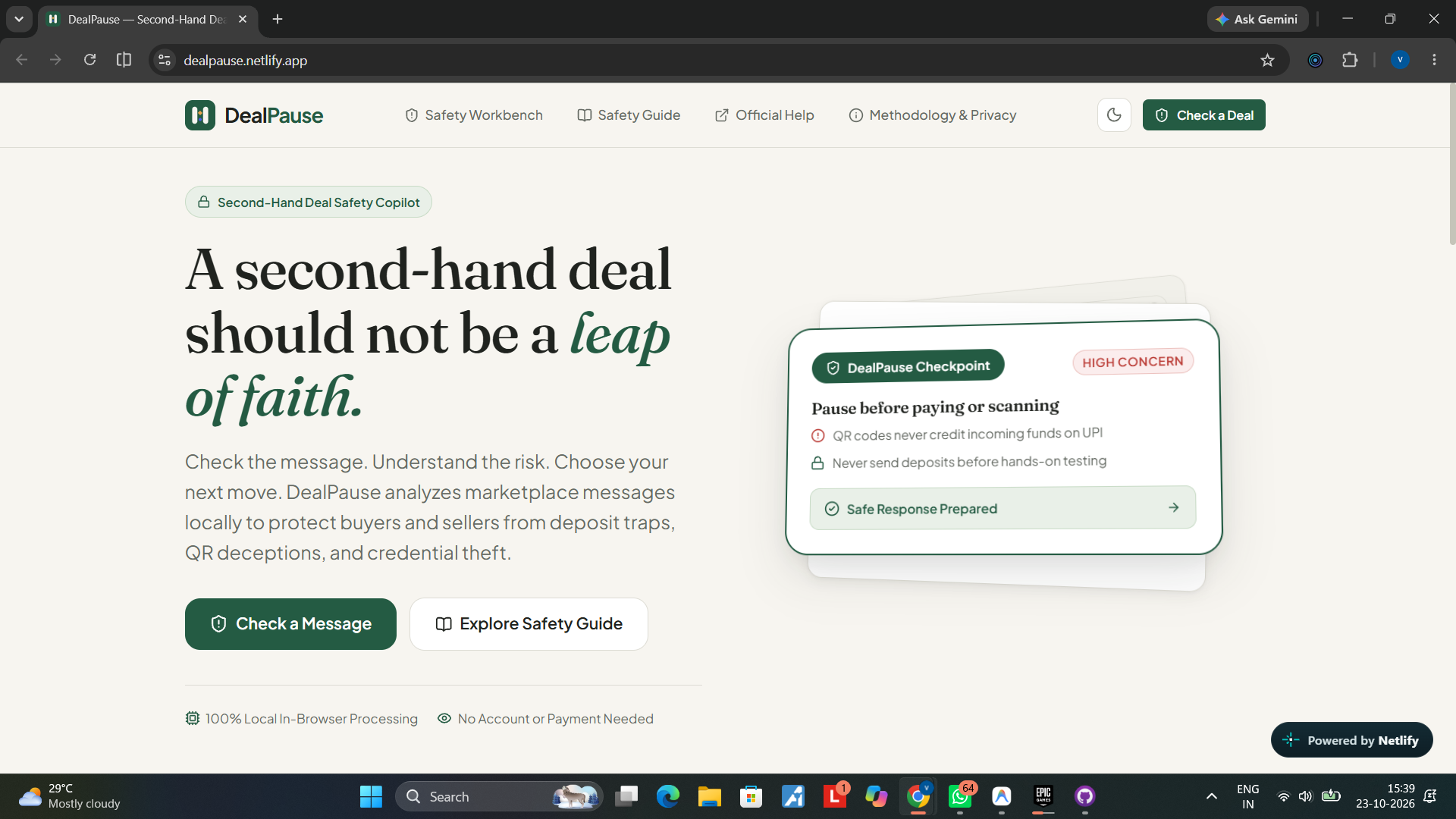
That idea inspired DealPause — Second-Hand Deal Safety Copilot, a privacy-focused web application designed to help people pause, verify, and make more informed decisions before completing a transaction.
What it does
DealPause helps buyers and sellers identify potentially risky requests during second-hand transactions.
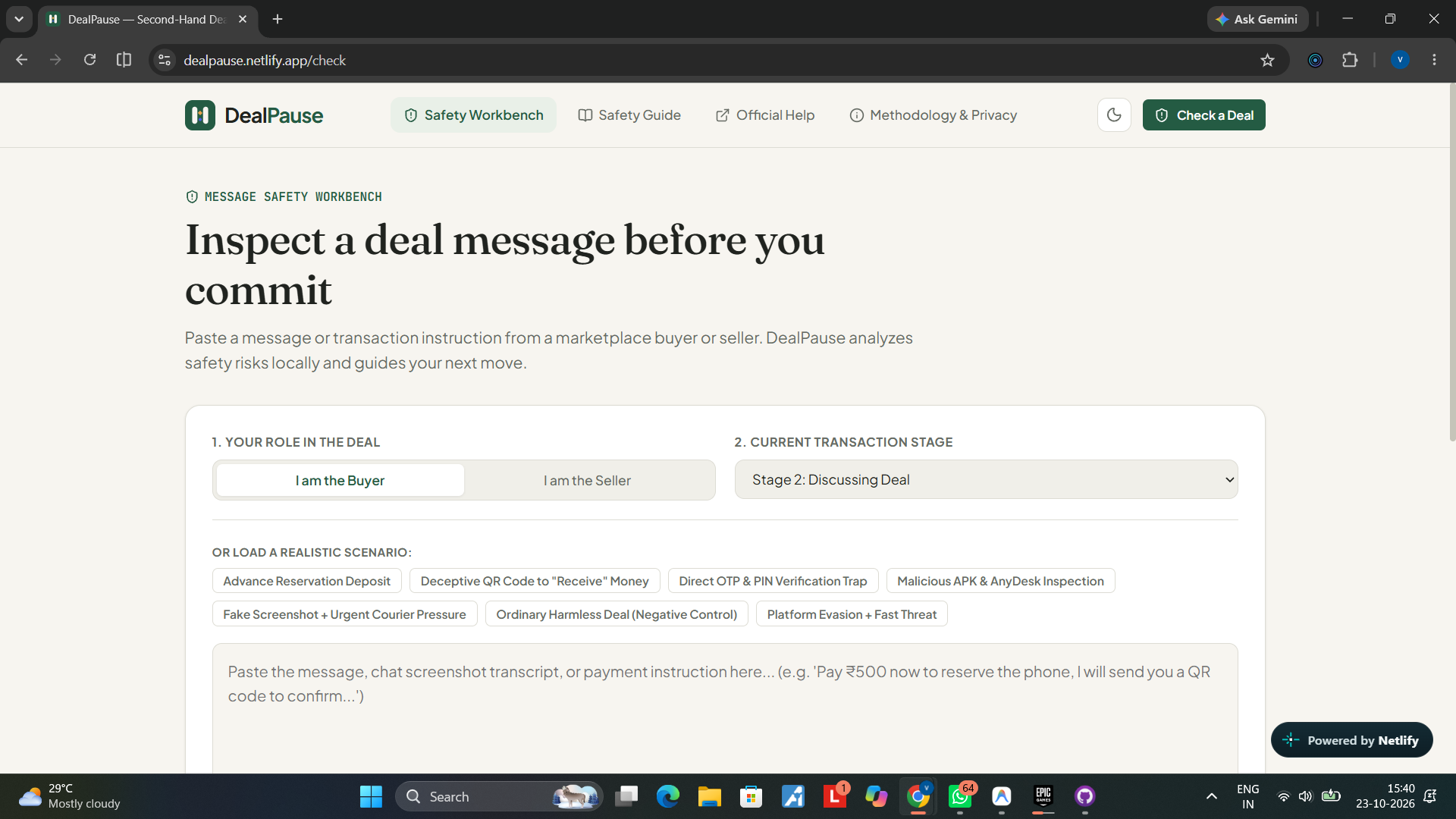
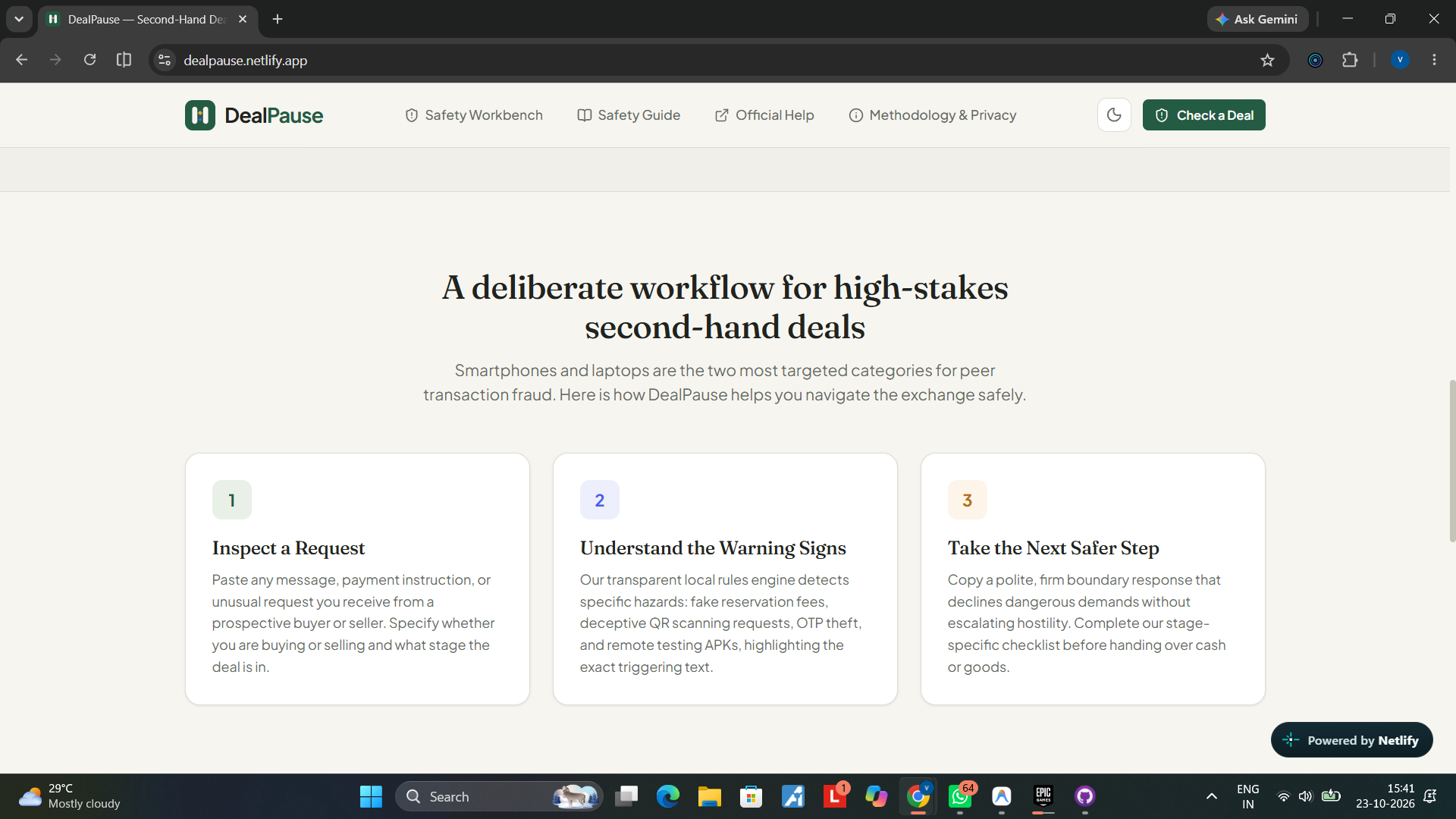
Users can paste a message, select their role as a buyer or seller, choose the current transaction stage, and analyze the message using a transparent, rule-based safety engine.
Key features include:
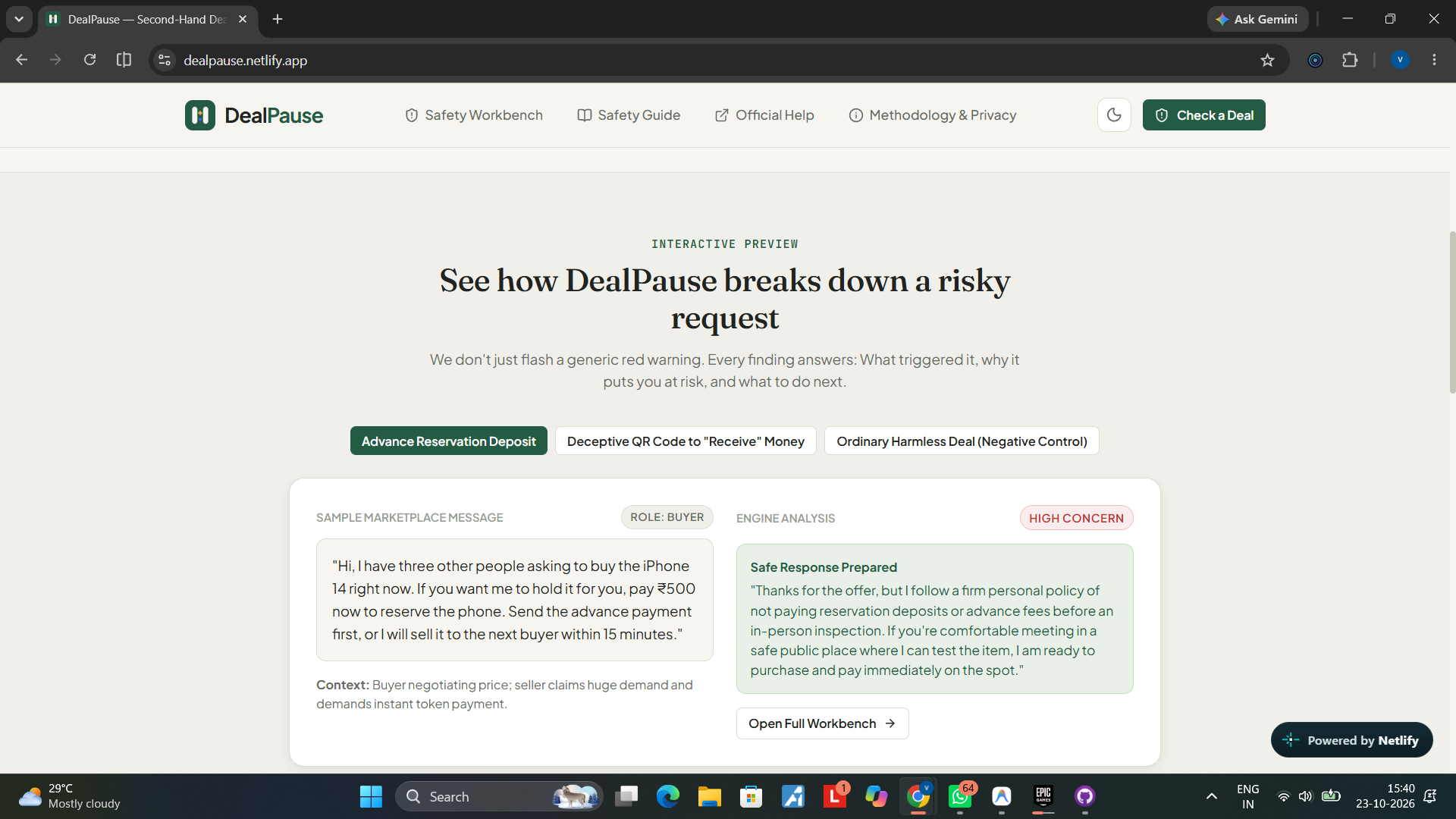
- Explainable safety analysis: Identifies suspicious patterns involving advance-payment requests, OTPs, UPI PINs, deceptive QR-code instructions, unknown APKs, remote-access applications, fake payment screenshots, urgency, and attempts to avoid marketplace protections.
- Evidence highlighting: Highlights the specific phrases that trigger findings and explains why they may indicate risk.
- Context-aware recommendations: Provides practical next steps based on the findings, the user's role, and the transaction stage.
- Safe-reply generator: Creates polite, editable responses that users can copy when they need to set boundaries or refuse an unsafe request.
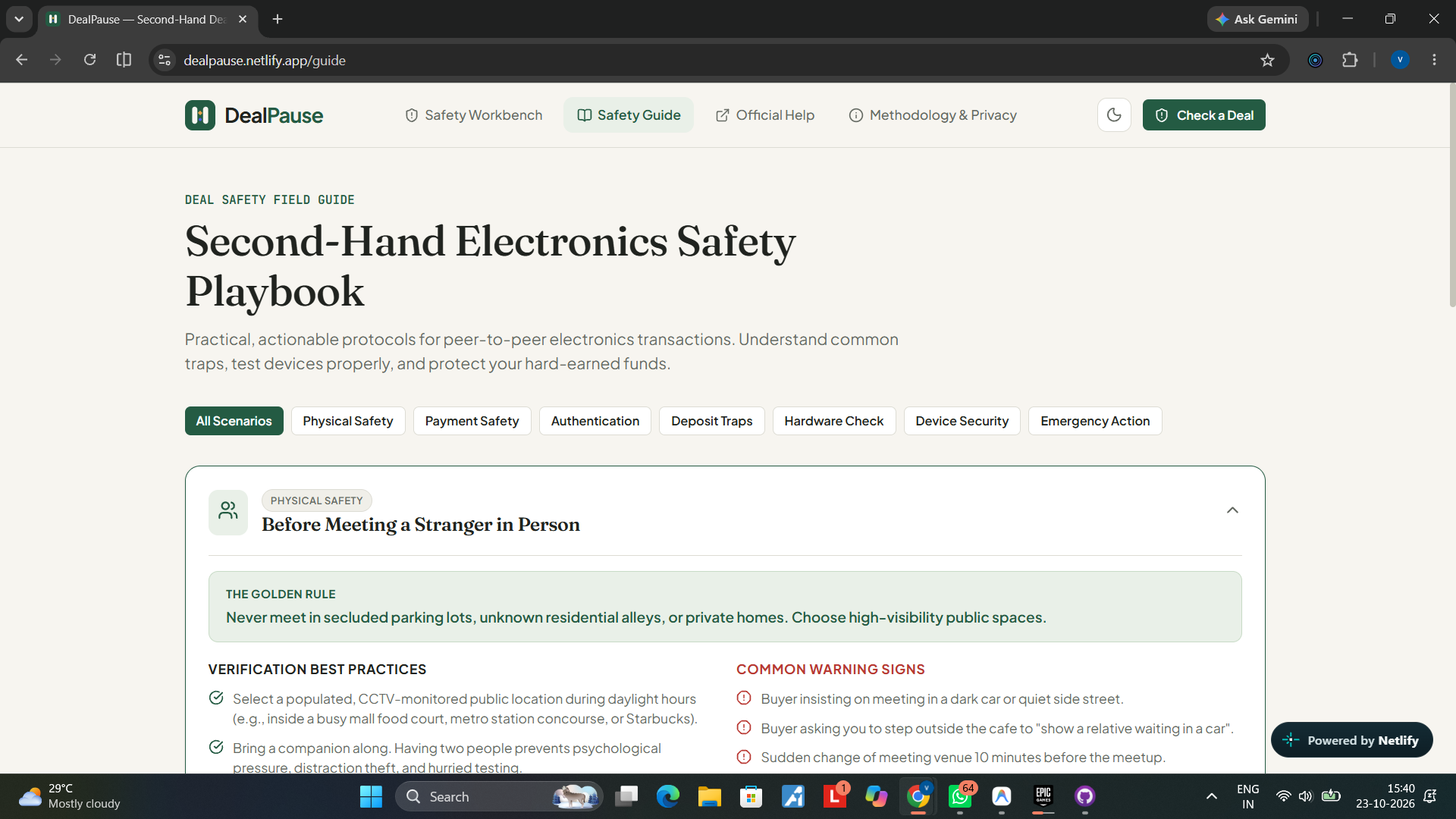
- Transaction safety checklist: Provides interactive guidance for different stages, including arranging a meeting, inspecting an electronic device, confirming payment, and completing an exchange.
- Safety guide and official resources: Offers educational guidance and links to relevant official support resources.
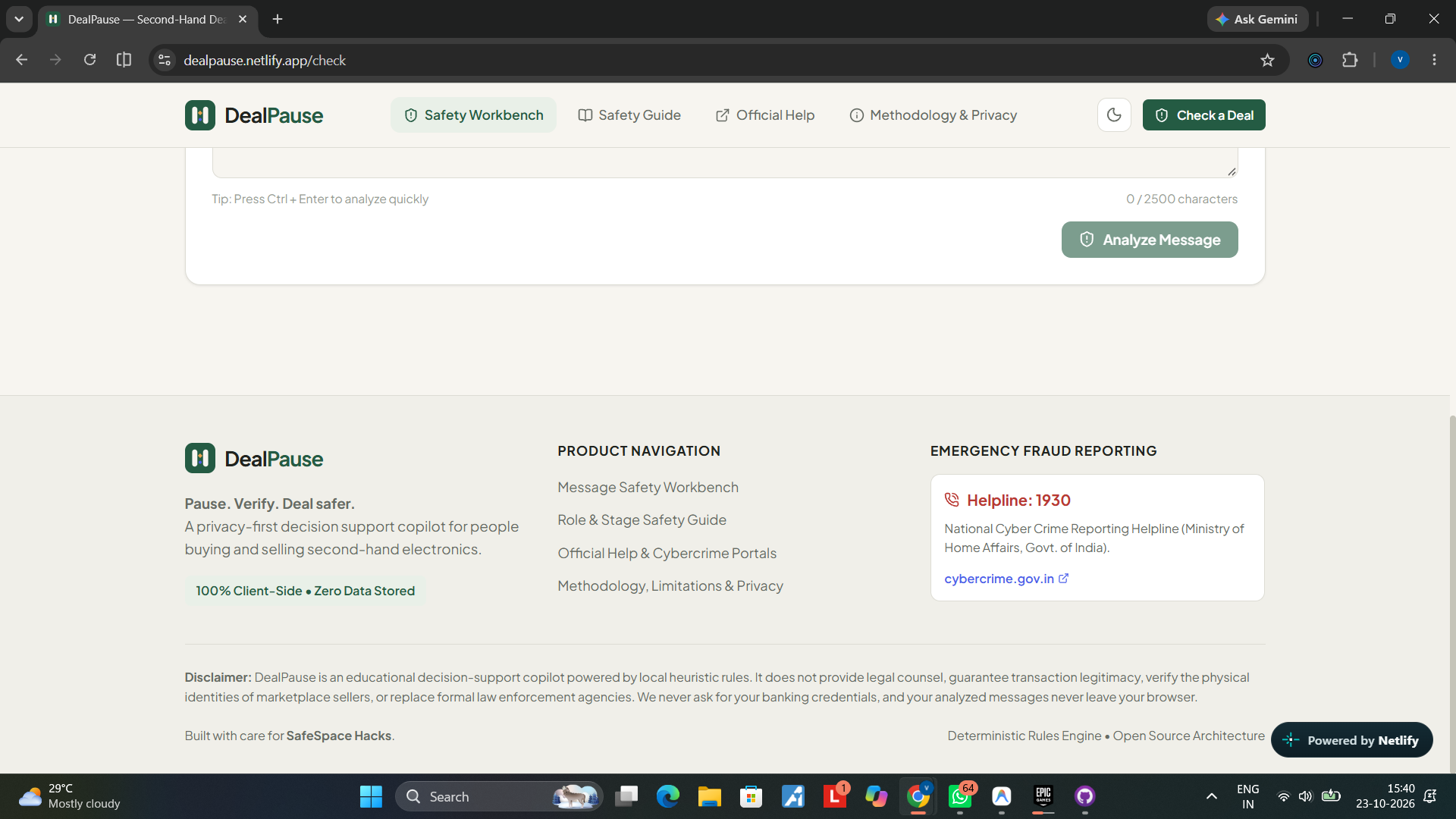
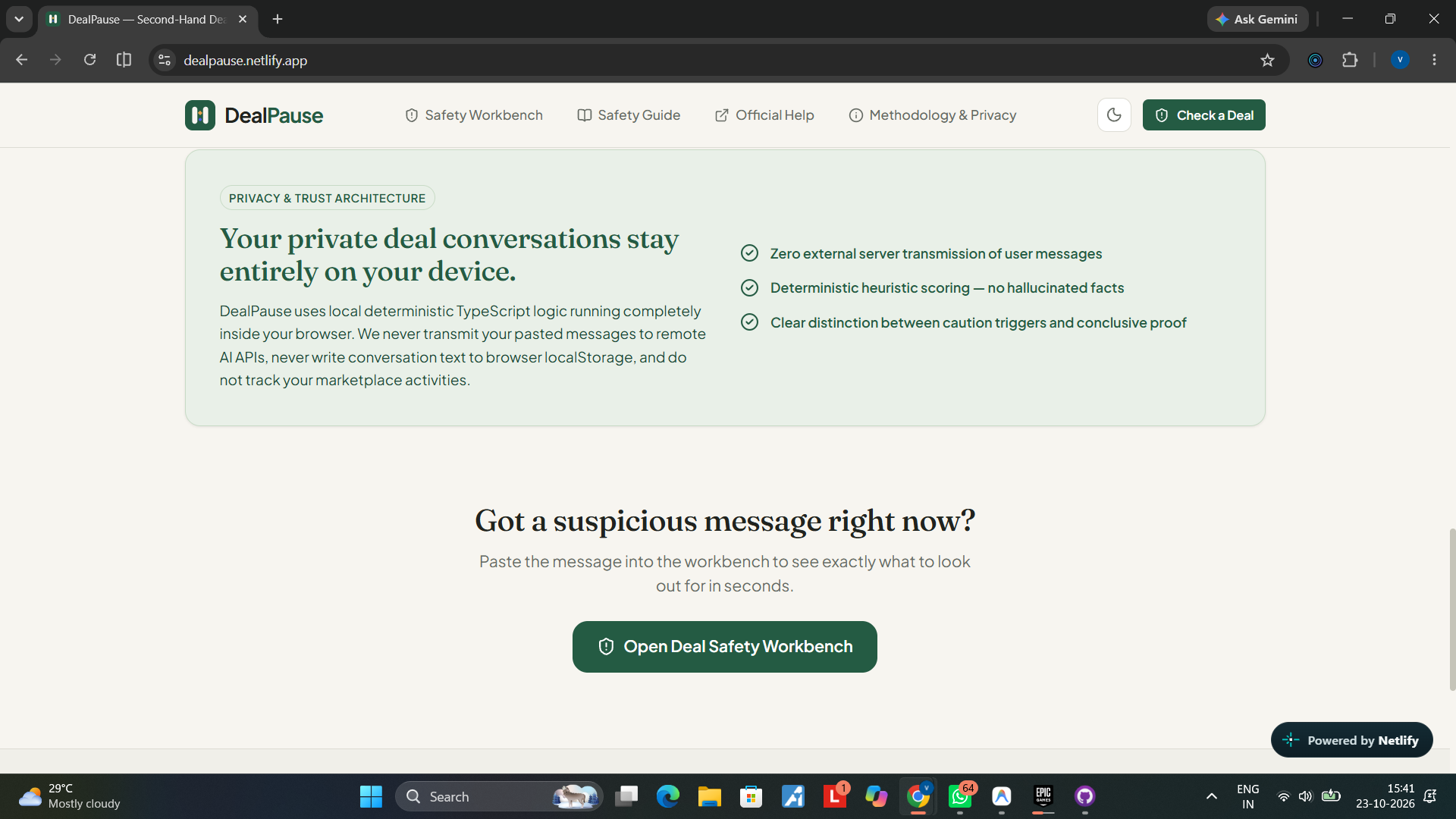
- Privacy-focused analysis: Processes message content locally in the browser without requiring a paid AI API or transmitting messages to an external AI service.
DealPause is designed to explain concerns rather than make unsupported accusations. It does not claim that a person is a scammer or that a transaction is guaranteed to be safe.
How we built it
DealPause was developed as a modern web application using React, TypeScript, and Vite, with a custom responsive interface and a modular architecture.
The core analysis engine uses deterministic rules to identify potentially risky language and combinations of phrases. Each finding connects the detected evidence to an explanation, a concern level, and a recommended action.
The application separates its analysis logic from its user interface to make individual rules easier to test and maintain. Additional modules handle sample scenarios, contextual reply generation, transaction checklists, evidence highlighting, and report export.
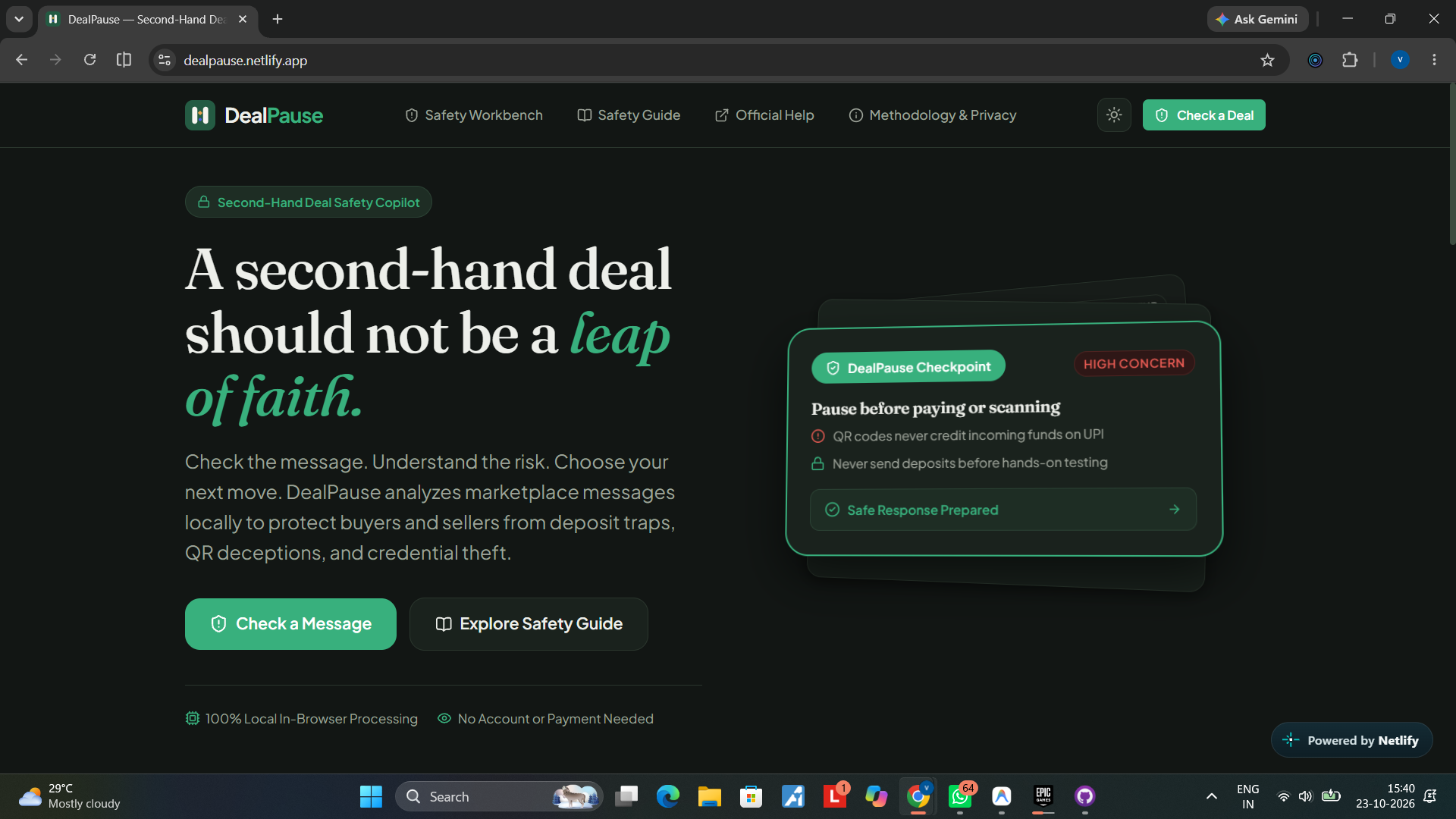
For the visual experience, I created a custom DealPause logo, an editorial-inspired design system, responsive layouts, and a lightweight CSS-based 3D hero animation. The interface was designed to feel like a carefully crafted consumer safety tool rather than a conventional AI dashboard.
AI coding assistance was used during development, alongside the project's implementation and testing workflow. The application was designed to function without paid AI services, mandatory accounts, or required environment secrets.
Challenges we ran into
One of the biggest challenges was distinguishing genuinely concerning requests from ordinary transaction conversations.
For example, mentioning a QR code, payment, or link is not automatically evidence of fraud. A useful safety tool must consider the surrounding wording, identify the particular concern, and avoid generating repetitive or unjustified warnings.
Another challenge was explaining the results clearly. A warning without evidence does not help users make better decisions. DealPause therefore connects its findings to the relevant message text and explains both the potential risk and a sensible next step.
Privacy and responsible communication were also important considerations. The application should not needlessly collect sensitive conversations, claim to verify identities it cannot verify, or present heuristic results as statistically proven fraud probabilities.
Balancing these requirements with a distinctive design, responsive layouts, and reliable interactions shaped many of the implementation decisions.
Accomplishments that we're proud of
We are proud to have developed a working prototype that combines message analysis with practical transaction-safety guidance in one application.
Some of the accomplishments include:
- Building a modular, explainable safety engine without depending on a paid AI API.
- Connecting individual findings to the actual phrases that triggered them.
- Supporting both buyer and seller perspectives across six transaction stages.
- Creating an editable safe-reply generator and interactive checklist.
- Designing an original brand identity and a distinctive animated interface.
- Including fictional scenarios for testing suspicious messages and ordinary, harmless negotiations.
- Preparing the application for production builds and deployment on platforms such as Vercel and Netlify.
- Incorporating privacy, uncertainty, and limitations into the product's design rather than treating them as afterthoughts.
An important design goal was to make the application useful even when it does not detect a warning. A message with no obvious red flags must not be presented as proof that a deal is legitimate.
What we learned
Developing DealPause reinforced that building a useful safety product requires more than implementing detection rules or creating an attractive interface.
We learned the importance of making technical findings understandable, providing actionable recommendations, testing harmless inputs as well as suspicious ones, and designing for uncertainty.
We also gained experience building a modular TypeScript application, integrating interactive React components, handling user input safely, creating responsive layouts, writing automated tests, and preparing a web application for deployment.
Most importantly, we learned that trust comes from being transparent about what a tool can do, what it cannot do, and what the user should independently verify.
What's next for DealPause — Second-Hand Deal Safety Copilot
The next step is to continue evaluating DealPause against a broader collection of realistic synthetic messages, including ambiguous conversations, harmless transactions, spelling variations, and emerging risk patterns.
We plan to improve detection quality, reduce false alarms, expand contextual recommendations, strengthen accessibility, and test the complete experience across mobile devices and desktop browsers.
We also want to improve the safety checklist for different types of second-hand goods and make it easier for users to find appropriate official resources when they encounter suspicious activity.
Our longer-term vision is to make DealPause a practical, privacy-conscious companion that helps people recognize warning signs, ask better questions, and approach online transactions with greater confidence.
DealPause — Pause. Verify. Deal safer.
Built With
- accessibility
- consumer-safety
- css
- cybersecurity
- javascript
- lucide-react
- privacy
- react
- responsive
- rule-based-detection
- scam-awareness
- typescript
- vite
- vitest
- web-development

Log in or sign up for Devpost to join the conversation.