-
-
-
-
-
-
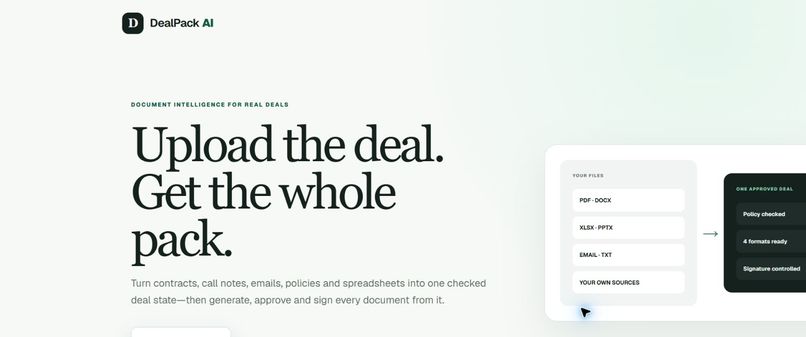
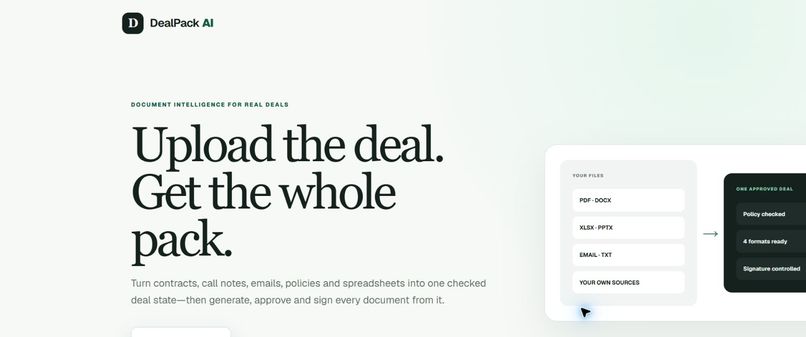
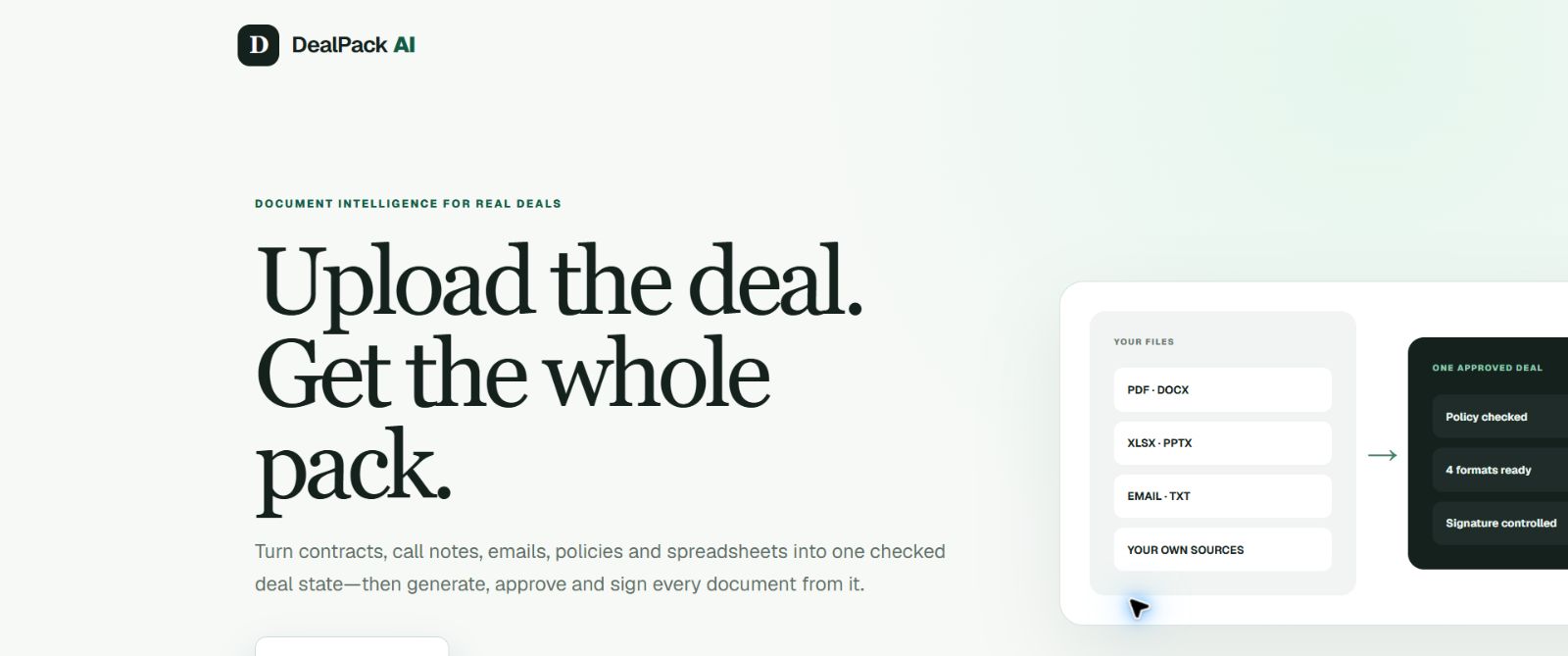
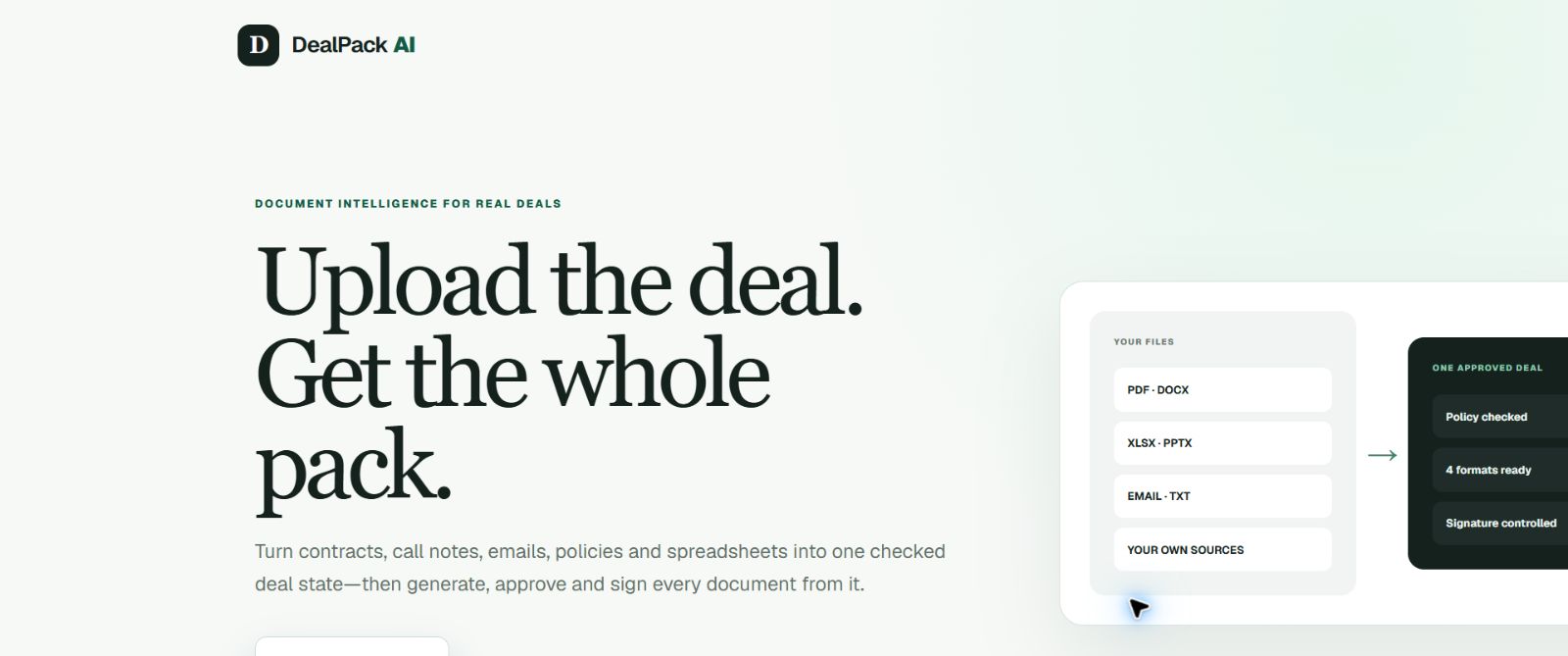
Upload your own deal evidence and compile one controlled deal pack.
-
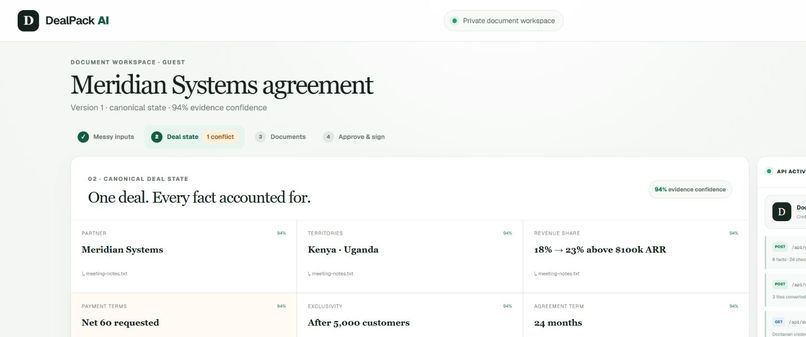
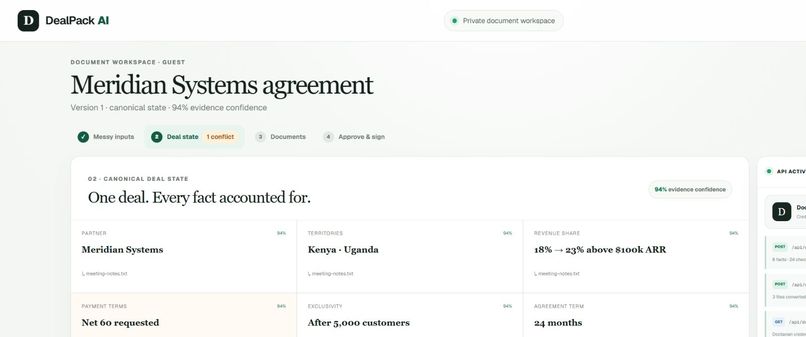
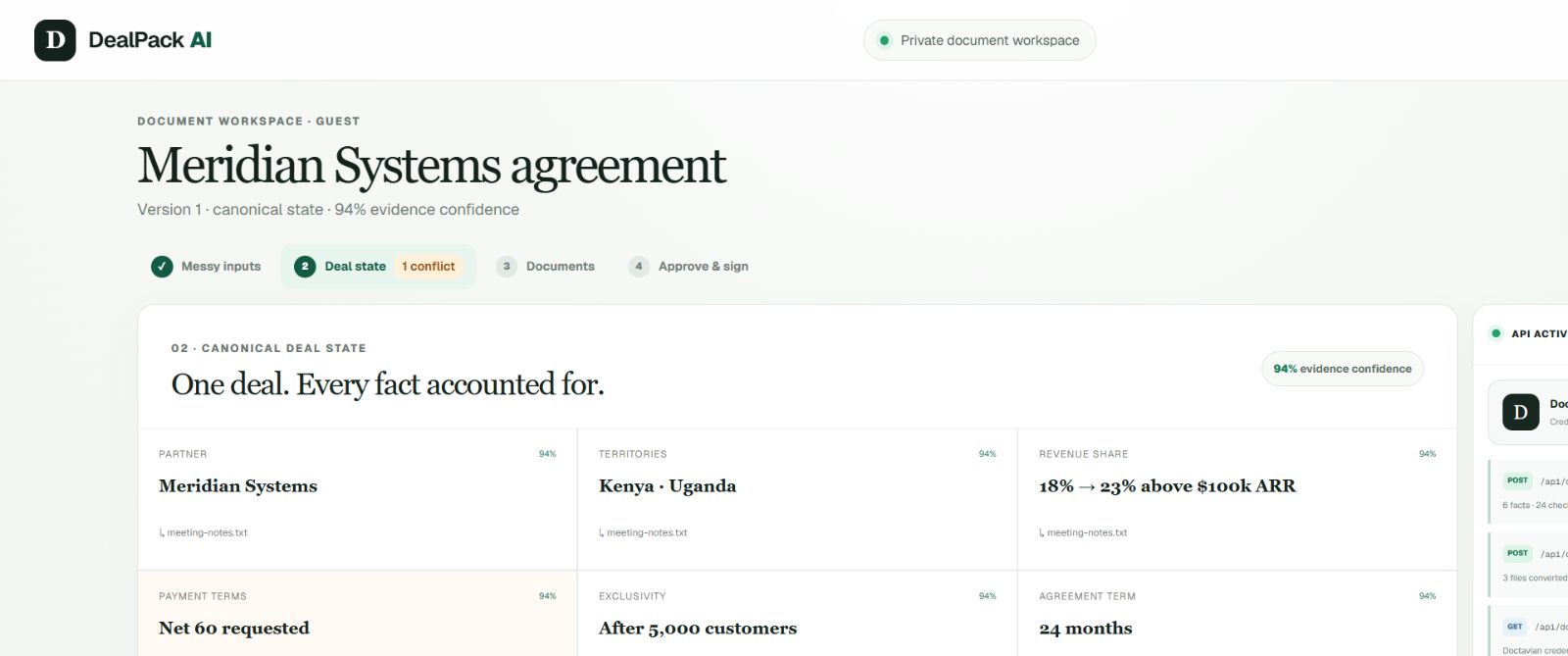
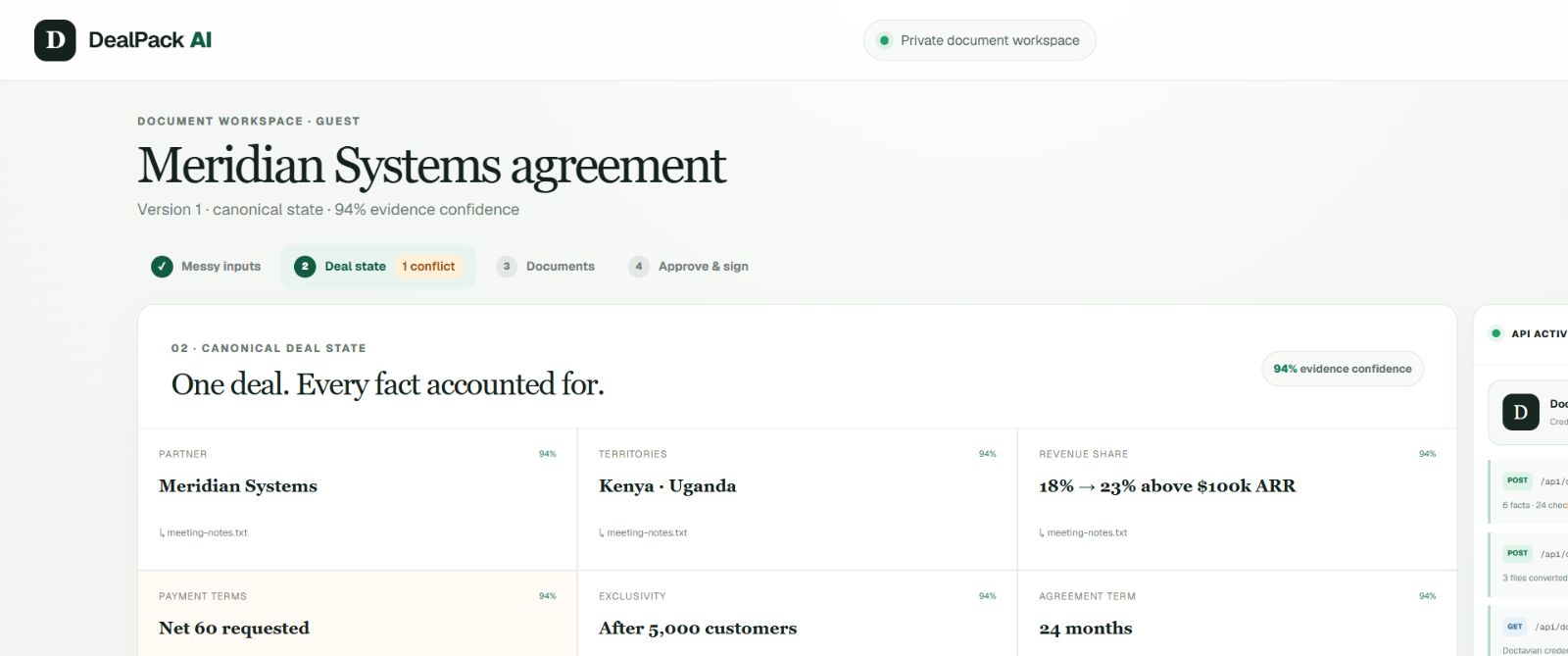
Canonical deal state with evidence confidence, provenance, and policy conflict detection.
-
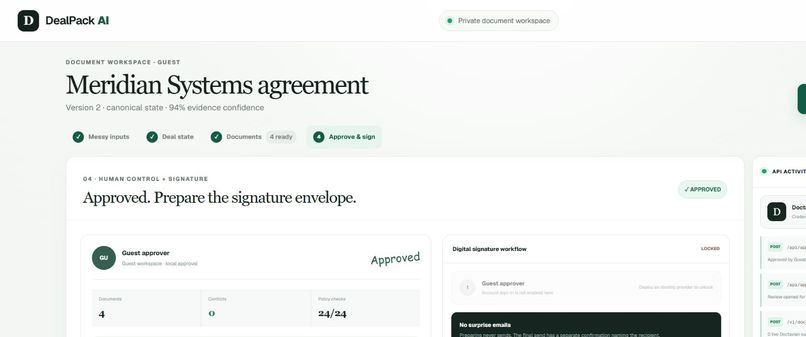
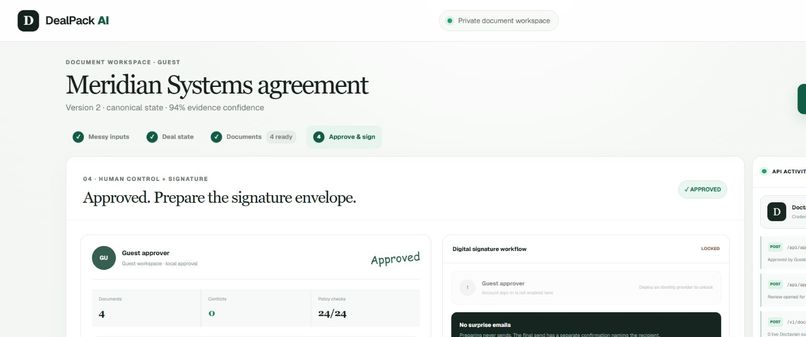
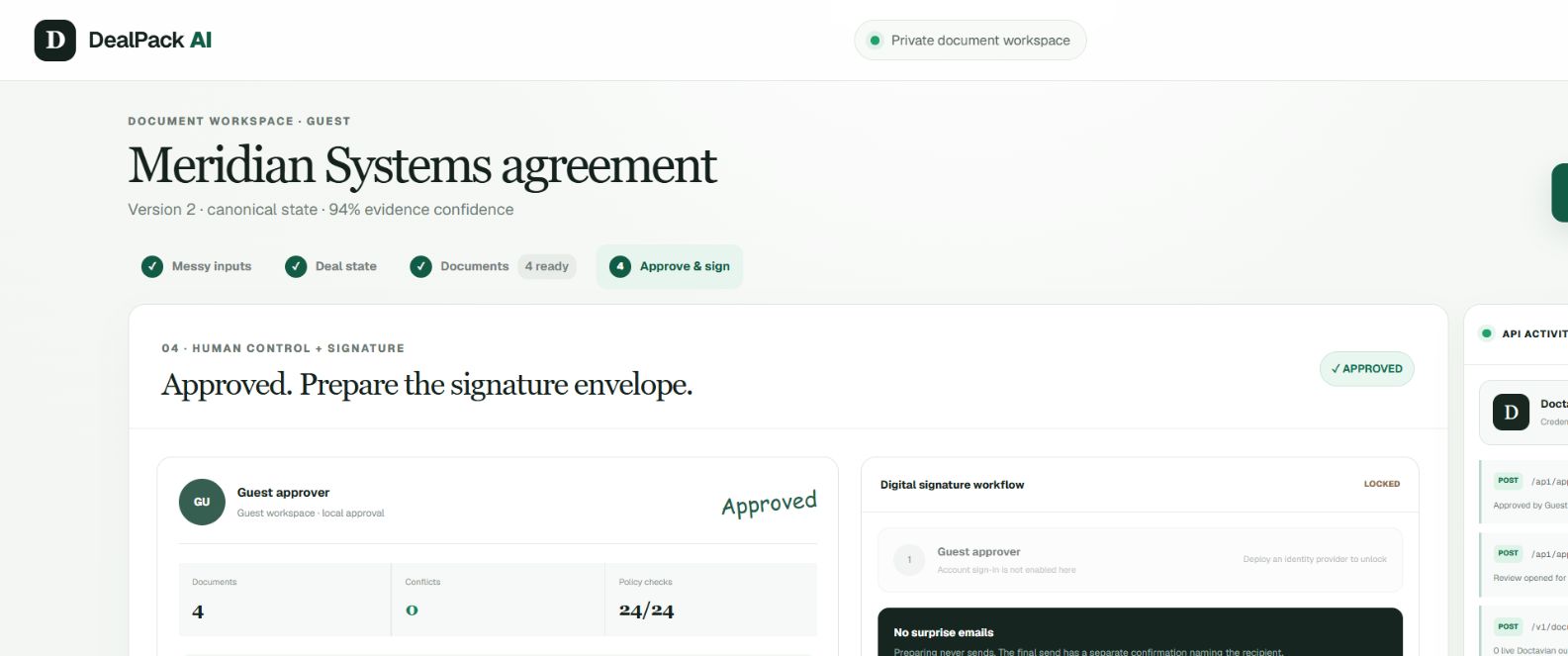
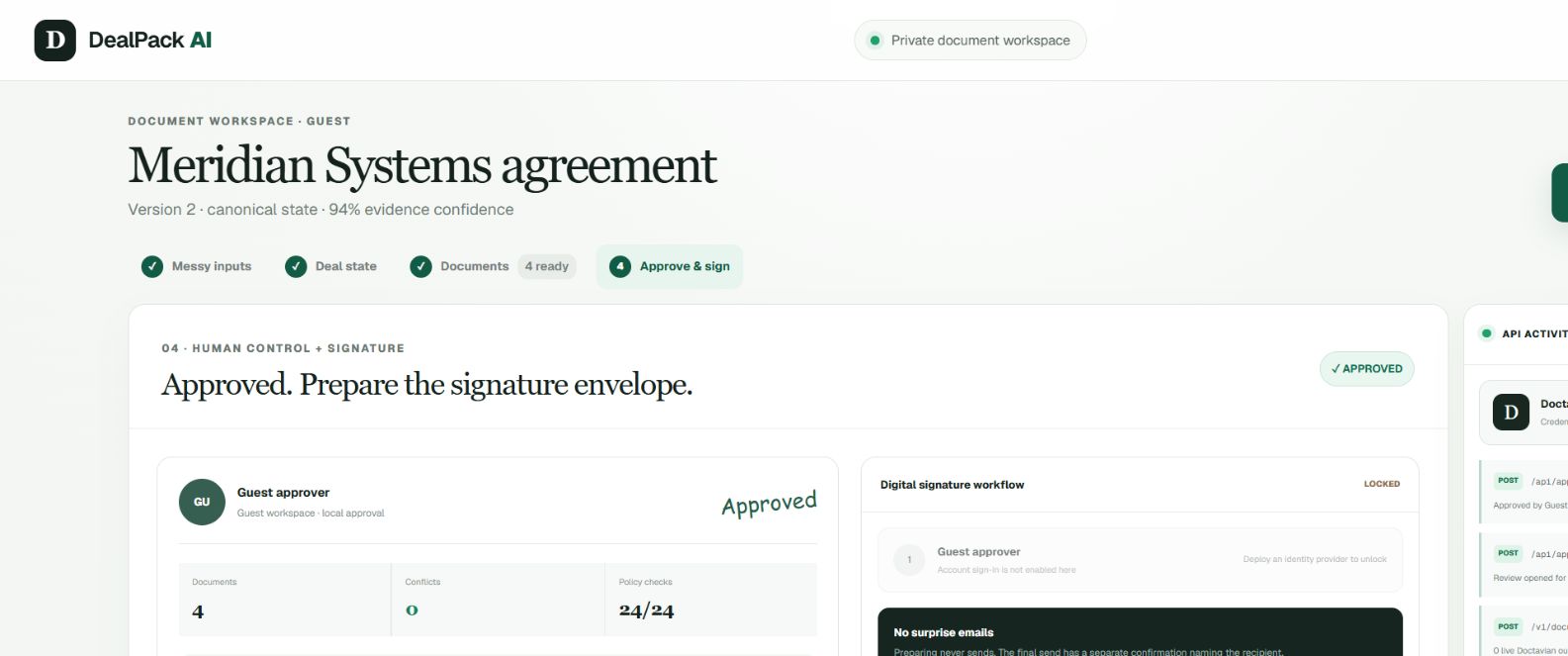
Human approval and a controlled signature workflow with no surprise emails.
-
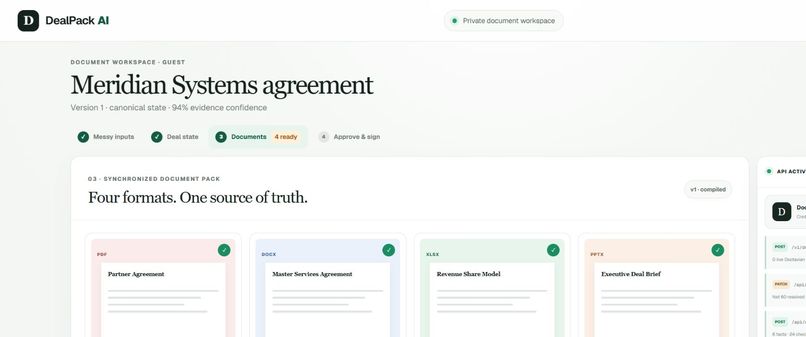
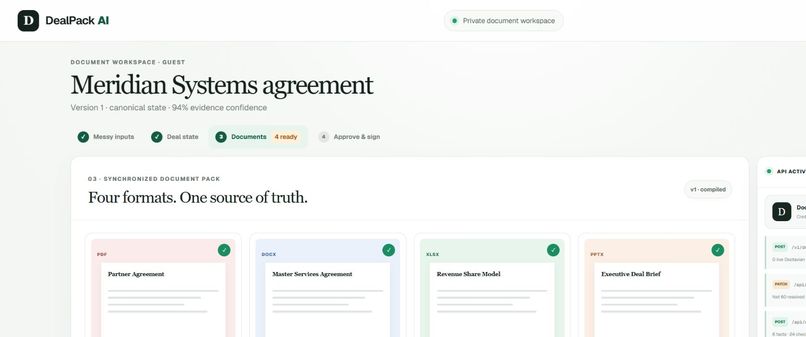
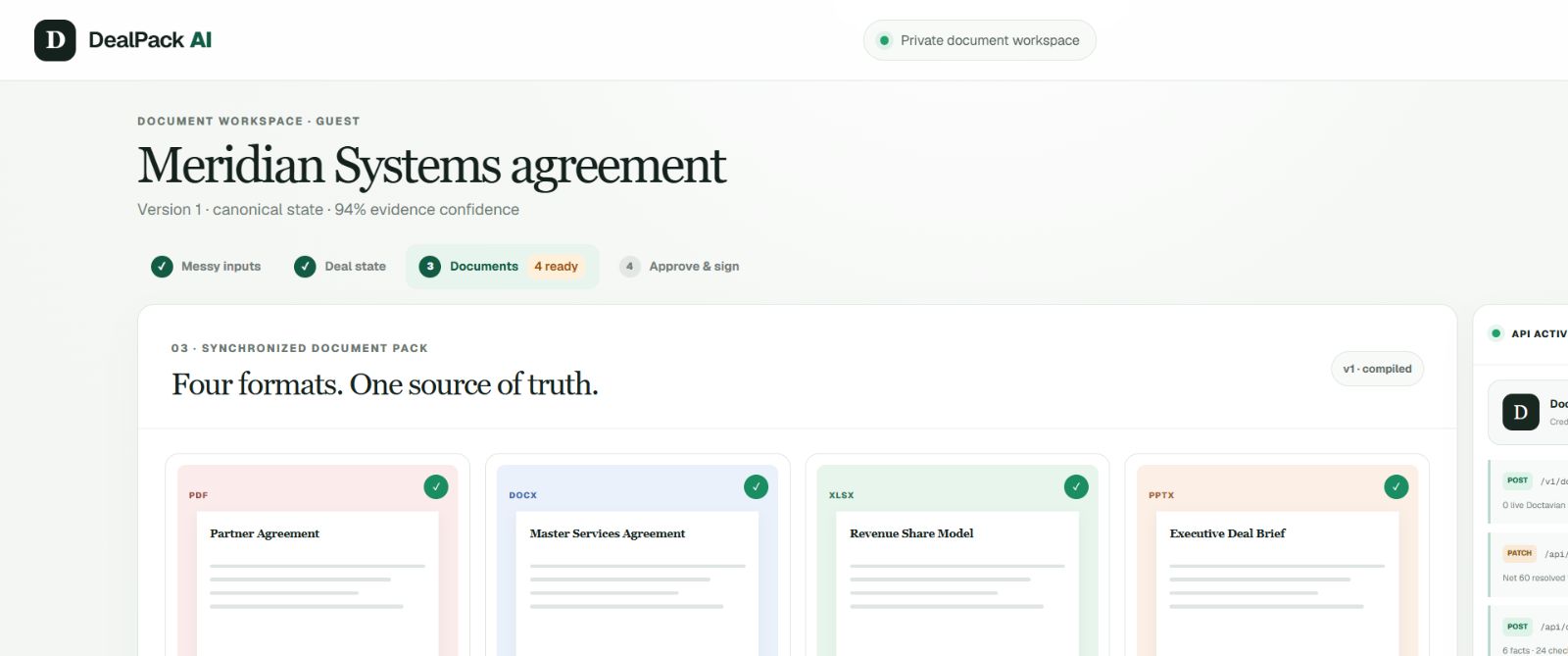
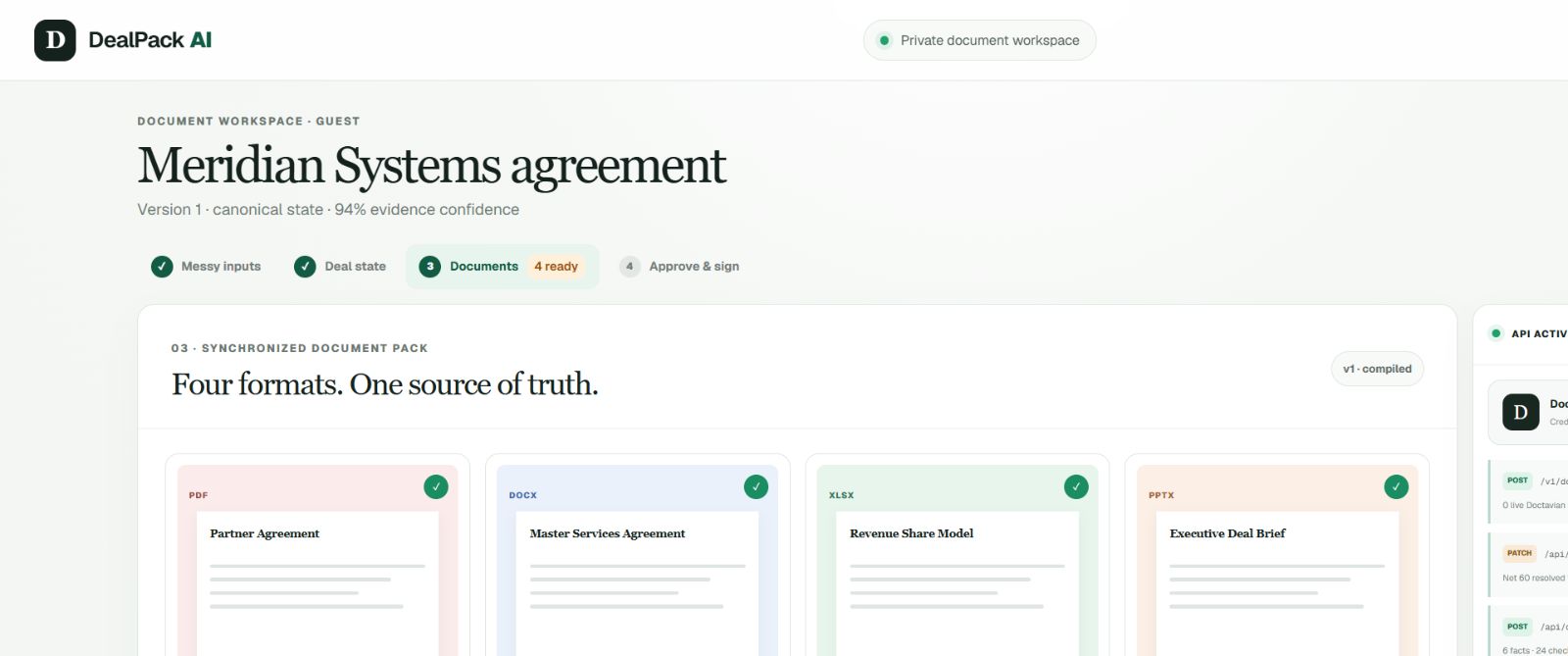
Four synchronized outputs—PDF, DOCX, XLSX, and PPTX—from one source of truth.
Inspiration
What it does
How we built it
Challenges we ran into
Accomplishments that we're proud of
What we learned
What's next for DealPack AI
Inspiration
Business deals rarely arrive as clean forms. The important terms are scattered across contracts, meeting notes, email threads, pricing spreadsheets, internal policies, and slide decks. A document generator can produce polished files, but it cannot guarantee that every output agrees with the evidence or company policy.
That led to DealPack AI: a decision compiler for commercial agreements. It turns messy deal evidence into one canonical, explainable state, checks that state against policy, and compiles a synchronized document pack that people can review, approve, and send for signature.
What it does
A user uploads their own PDF, DOCX, XLSX, PPTX, EML, TXT, CSV, JSON, or Markdown sources. DealPack AI then:
- Extracts and normalizes the content.
- Builds a canonical deal state covering the partner, territories, revenue share, payment terms, exclusivity, term, and approver.
- Attaches source-level provenance, exact supporting quotes, and confidence to every fact.
- Detects blocking policy conflicts before documents can be generated.
- Compiles synchronized PDF, DOCX, XLSX, and PPTX outputs from the same state.
- Shows which artifacts are affected when a fact changes, then recompiles them as a new version.
- Invalidates stale approvals whenever commercial terms change.
- Requires human approval before preparing the signature envelope, and a separate explicit confirmation before any email is sent.
- Exports a versioned audit ZIP containing the evidence, facts, conflicts, approvals, artifacts, and canonical state.
The result is not four independently generated documents. It is one controlled deal represented in four formats.
How we built it
The product is built with React 19, Next.js 16, TypeScript, vinext, Vite, and Cloudflare Workers. Uploaded files are processed in request memory and are not written to repository storage. PDF extraction uses unpdf; Office formats are parsed from their Open XML structures with fflate; text, CSV, JSON, Markdown, and EML use native parsers.
A deterministic deal compiler converts normalized evidence into a provider-independent canonical object. That same object drives policy evaluation, provenance, change-impact analysis, every output generator, approval state, signatures, and the audit bundle. This avoids the consistency problems caused by generating each document independently.
Doctavian integration
DealPack AI targets Doctavian's Generate It Right. Sign It Tight. challenge. The Doctavian adapter is isolated behind production-ready server routes for provider status, generation, authorized downloads, and signatures.
When valid Doctavian OAuth authorization and template URNs are available, eligible PDF, DOCX, and XLSX outputs are generated through Doctavian. The current environment is reported honestly as gateway-ready: the API base URL and key are configured, while missing OAuth/template state triggers format-by-format local fallback. PPTX remains local. Provider failures are never presented as successful sponsor calls.
This architecture keeps the app fully usable during judging while preserving a clean path to live Doctavian generation and signature delivery.
Challenges we ran into
The hardest problem was keeping every artifact synchronized while still allowing human correction. Editing one term must identify every affected clause, calculation, summary, and approval. We solved this by making the canonical deal state the sole compilation input and versioning every change.
Multi-format ingestion was another challenge. Office files, email, spreadsheets, and PDFs expose text differently, so each parser produces the same normalized evidence shape before compilation.
Finally, signature delivery needed strong safety boundaries. Preparing an envelope does not send it; sending requires a second confirmation, a verified identity, a live provider document, and an explicit deployment flag.
Accomplishments that we're proud of
- A real empty-state product where users upload their own documents—no hidden demo dataset.
- Evidence-backed facts with source quotes and confidence.
- Blocking policy checks and explain-why provenance.
- Synchronized PDF, DOCX, XLSX, and PPTX generation.
- Change-impact analysis, recompilation, and approval invalidation.
- Safe Doctavian adapter with truthful provider state and per-format fallback.
- Human approval, controlled signatures, and a downloadable audit bundle.
- Public Cloudflare deployment, public source repository, CI, and a tested 3-minute product demo.
What we learned
Trustworthy document automation depends less on generating prose and more on preserving state, evidence, versioning, and human control. A strong sponsor integration also needs honest capability reporting: users should always know whether an artifact came from Doctavian or the local fallback.
What's next
Next steps include app-owned authentication, shared team workspaces, durable encrypted storage, richer policy authoring, LLM-assisted extraction for broader deal vocabulary, live Doctavian templates and OAuth renewal, and organization-level audit and approval workflows.
Built With
- cloudflare
- doctavian
- github
- javascript
- microsoft
- next.js
- node.js
- react
- typescript
- vite

Log in or sign up for Devpost to join the conversation.