-
-
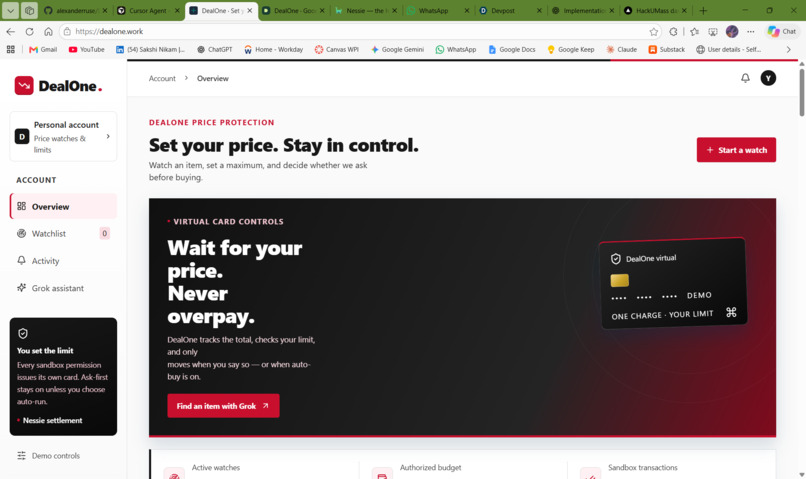
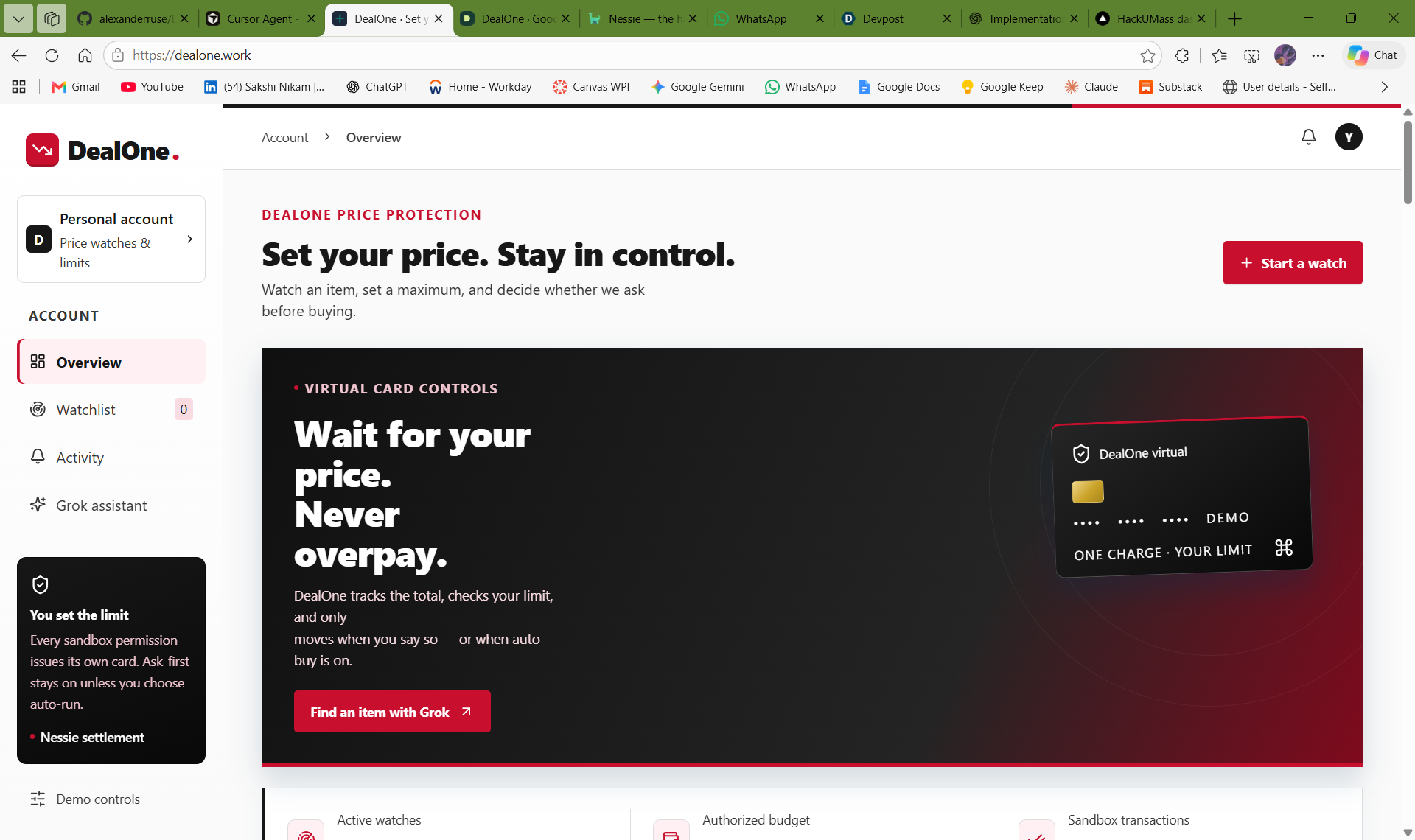
DealOne: Your AI shopping assistant that tracks prices, finds deals, and keeps every purchase within your approved budget.
Inspiration
DealOne was built around a simple idea: finding a great deal shouldn't require giving an AI unlimited permission to spend.
Online shoppers constantly monitor prices, compare product variants, and wait for discounts, often without knowing whether a deal is actually worthwhile. We wanted to automate this repetitive process while keeping important decisions—what to buy, where to buy it, how much to spend, and when permission expires—in the user's hands.
What it does
DealOne is an AI-powered shopping assistant that combines product discovery, automated price monitoring, user-approved spending rules, and sandbox banking.
Users can create specific shopping permissions, such as: "Watch these keycaps for a week with a maximum total of $30." Each permission explicitly defines the product, variant, merchant, quantity, budget, and expiration.
Key features include:
- Automated product price and availability monitoring.
- Smart price watches with user-defined spending limits.
- Gemini-powered shopping assistance through OpenRouter.
- Nessie sandbox banking to demonstrate controlled spending.
- Browser-based checkout preparation and visual evidence capture.
- AI spending controls with a planned shared $10 rolling three-hour limit.
Our goal is to move beyond simply recommending deals and build an assistant that can intelligently act on shopping opportunities while keeping users in control.
How we built it
DealOne uses React, TypeScript, Vite, and Tailwind CSS for its frontend, with Python, FastAPI, and Pydantic powering the backend. SQLAlchemy, Psycopg, Alembic, and Tiger Cloud manage persistent application data and timestamped price observations.
We use Docker, GitHub Actions, and Vultr Kubernetes Engine for deployment, with Traefik and cert-manager providing HTTPS.
Nessie provides sandbox banking integration, allowing us to create dedicated credit accounts for shopping permissions, assign approved limits, record sandbox purchases, and verify available balances.
For the next stage, we're integrating Google's Gemini through OpenRouter (google/gemini-3.5-flash-lite) and using Playwright for adaptable browser automation. Accessibility-tree snapshots, element references, and screenshots help the agent understand different ecommerce layouts and prepare checkout demonstrations.
Challenges we ran into
One of our biggest challenges was building reliable automation without compromising user control.
Merchant throttling required us to coordinate upstream requests through persistent queues. Variant-specific availability taught us that a listed product does not necessarily mean every configuration is available. We also had to handle persistent state, uncertain transaction outcomes, and duplicate sandbox charges.
Browser automation introduces additional complexity, including changing page layouts, embedded payment fields, validation errors, and CAPTCHAs.
We approached these challenges by prioritizing explicit permissions, independent backend validation, and visible failure reporting rather than assuming every automated action succeeds.
Accomplishments that we're proud of
We're proud of building a working foundation that connects real product data, price monitoring, user-defined budgets, and sandbox banking.
In one verified demonstration, a $69.99 Nessie sandbox credit limit supported a $59.99 sandbox charge, leaving $10.00 available. Cancelling the pending transaction restored the original available credit.
We're also proud of our persistent price-history architecture, containerized Kubernetes deployment, and our safety-first direction for browser automation.
Most importantly, we demonstrated how an AI shopping agent can operate within explicit financial boundaries instead of having unrestricted spending authority.
What we learned
We learned that useful autonomy depends on clear boundaries.
Language models can interpret user intent and select tools, but budgets, merchant access, permissions, and transaction rules must be independently enforced by the backend.
We also learned the importance of persistent state, reliable background workers, time-series price history, atomic spending controls, and transparent evidence.
Trust is just as important as intelligence when building autonomous agents.
What's next for DealOne
Our next milestone is validating the Gemini/OpenRouter migration and browser automation workflow end to end.
We're working toward:
- Expanding merchant integrations beyond Keychron to Shopify-powered and independent ecommerce stores.
- Supporting automatic and administrator-triggered checkout demonstrations.
- Capturing visual evidence of checkout preparation through a dedicated
/screenshotsviewer. - Enforcing strict submission prevention through browser-level blockers and network restrictions.
- Implementing atomic AI spending controls across API replicas and background workers.
- Improving deal discovery through historical price trends and smarter recommendations.
Ultimately, we envision DealOne as a personal shopping agent that finds opportunities, monitors prices, and prepares actions—all while keeping spending bounded, transparent, and under human control.
Built With
- ai-agents
- alembic
- browser-automation
- docker
- e-commerce
- fastapi
- github-actions
- google-gemini
- kubernetes
- nessie-api
- openrouter
- playwright
- postgresql
- price-monitoring
- pydantic
- python
- react
- rest-api
- sqlalchemy
- tailwind-css
- tiger-cloud
- typescript
- vite
- vultr
