-
-
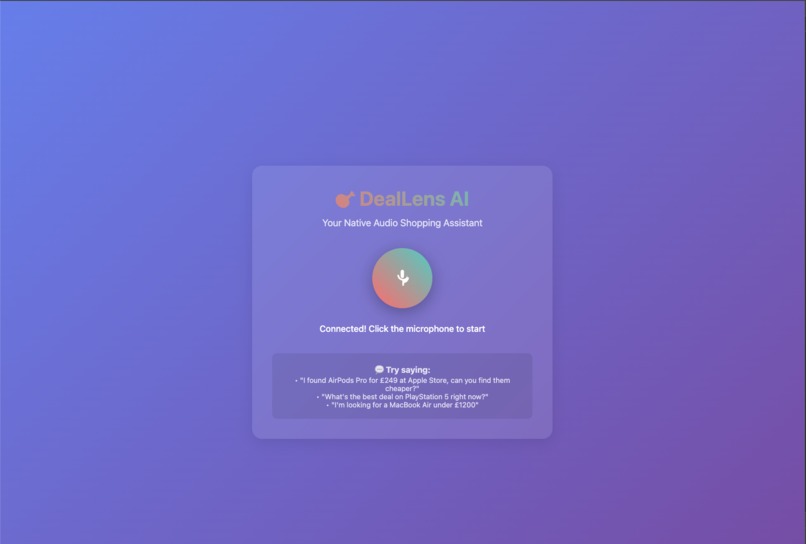
UI
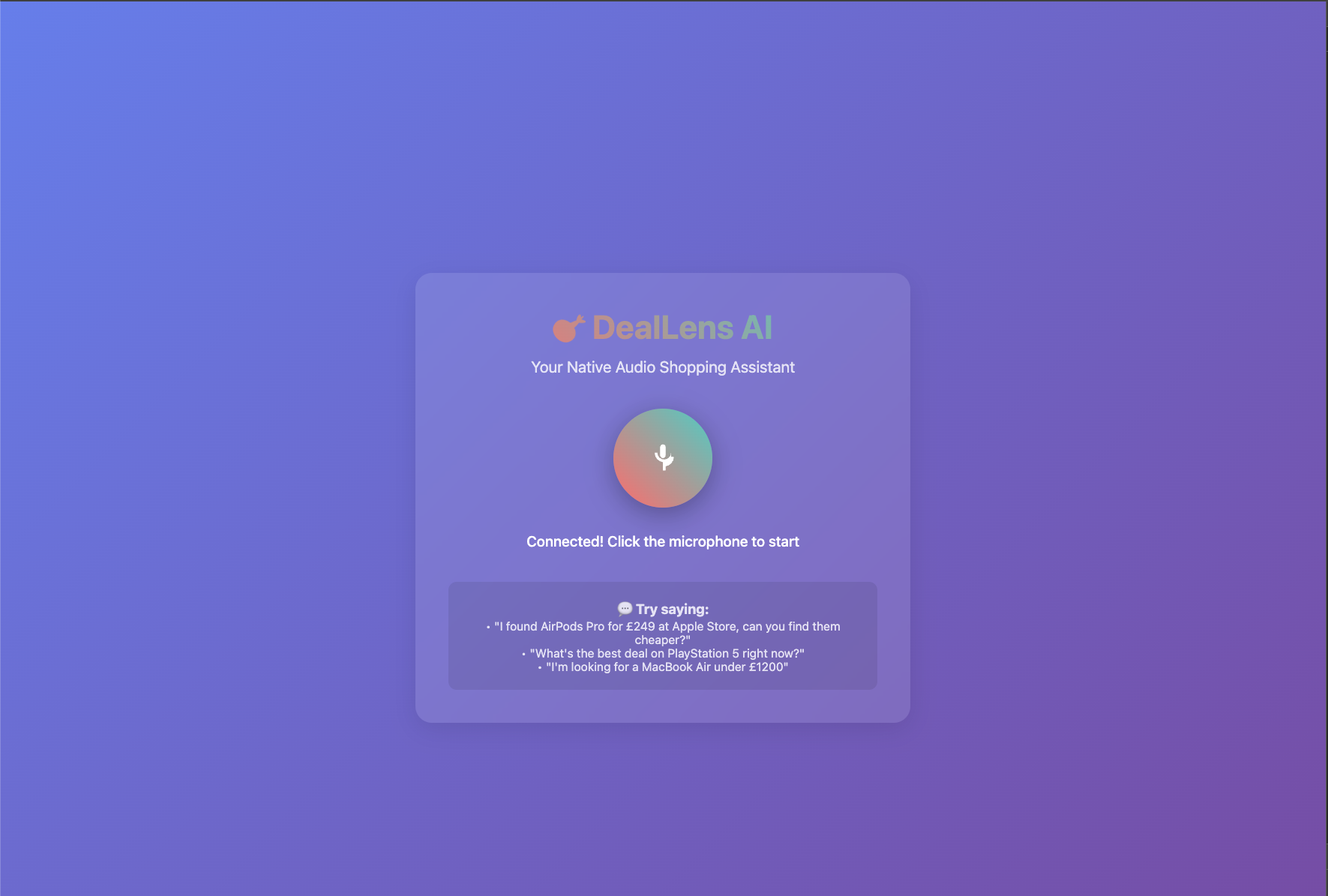
Inspiration
Shopping in physical stores often creates a small but important moment of doubt.
You see a product and wonder: “Is this actually the best price I can get?”
Checking usually means unlocking your phone, opening multiple websites, typing the product name, comparing retailers, and breaking the shopping experience entirely. Most people either buy without confidence or postpone the purchase.
At the same time, conversational AI has become powerful enough to interact with users naturally in real time.
This inspired me to build DealLens AI — a conversational shopping assistant that lets users simply ask a question out loud and instantly discover better deals.
The idea was to combine real-time voice interaction with AI-powered price discovery, turning shopping decisions into a simple conversation.
What it does
DealLens AI is a real-time conversational shopping assistant powered by Gemini 2.0 Flash Live API.
Users can speak naturally to the assistant while shopping and ask questions like:
“I see AirPods for £249 at the Apple Store. Can you check if it's cheaper somewhere else?”
The system:
- Captures the user's voice input in real time
- Uses Gemini Live API to transcribe and understand the request
- Searches for alternative deals using a product price database
- Responds with both voice feedback and visual deal comparison cards
For example, the assistant may respond:
“Amazon has it for £219 and Argos for £229. You could save £30.”
This creates a hands-free, real-time shopping experience where users can instantly verify if they are getting the best deal.
The interface also supports natural interruptions, allowing users to change their request mid-conversation just like they would when talking to a human.
How I built it
DealLens AI is built as a real-time multimodal conversational system.
Frontend
- Vanilla JavaScript
- Web Audio API for microphone input
- Real-time audio streaming to the backend
- UI that displays visual deal comparison cards
Backend
- Python FastAPI
- WebSocket communication for real-time audio streaming
- Integration with Gemini 2.0 Flash Live API
AI Layer
Gemini Live handles:
- Speech-to-text transcription
- Intent understanding
- Conversational response generation
- Tool usage for deal search
Deal Search
A lightweight JSON-based product database was used for rapid prototyping to simulate retailer price comparisons.
Deployment
The backend is deployed on Google Cloud Run, allowing the application to scale and be accessed globally.
Audio Optimization
To ensure a smooth conversational experience, several optimizations were implemented:
- Unified 24kHz audio sampling
- Seamless audio chunk scheduling
- Persistent microphone streams
- Web Audio API compliant buffer sizes
These improvements significantly reduced latency and removed audio playback issues.
Challenges I ran into
Voice breaking during AI responses
When streaming audio responses from the model, there were noticeable gaps between audio chunks that caused the voice to break. I solved this by implementing seamless chunk scheduling in the audio pipeline.
Model responding before the user finished speaking
Early versions of the system responded too quickly, sometimes interrupting the user mid-sentence. To make the interaction feel more natural, I implemented silence detection logic to determine when the user had finished speaking before triggering the AI response.
Cloud deployment permission issues
When deploying the backend to Google Cloud Run, I ran into permission and configuration issues related to service access and API authentication. This required setting up Secret Manager and correct IAM permissions for secure API access.
Accomplishments that I'm proud of
One accomplishment I'm particularly proud of is building a real-world generative AI application that goes beyond simple text chat.
DealLens combines voice interaction, real-time AI processing, and visual output, creating a more natural and practical user experience.
I'm also proud of connecting this technology to a real everyday problem that millions of shoppers experience — the uncertainty of whether they're getting the best price.
Finally, optimizing the audio pipeline to achieve smooth, low-latency voice interactions was a major milestone for the project.
What I learned
This project reinforced how much potential generative AI has beyond traditional chat interfaces.
When combined with the right APIs, real-time data, and thoughtful UX design, AI can become a powerful assistant for everyday decisions.
I also learned how important latency and interaction design are when building voice-first AI systems. Even small delays or interruptions can break the conversational experience.
Working with the Gemini Live API was especially exciting, as it enables truly real-time conversational applications with multimodal capabilities.
What's next for DealLens AI
This hackathon version demonstrates the core concept, but there are several exciting directions for future development.
Vision-enabled product recognition
Allow users to scan a product using their phone camera or barcode so they don't have to say the exact product name.
Real-time pricing integrations
Integrate with retailer APIs to provide live prices, stock availability, and shipping options.
Smarter deal ranking
Use AI to rank deals based on:
- price
- delivery speed
- retailer trust
- return policies
Purchase integrations
Eventually, DealLens could allow users to complete purchases directly through the assistant.
The long-term goal is to evolve DealLens into a full AI retail companion that helps people make smarter purchasing decisions instantly.
Built With
- cloudrun
- flaskapi
- gemini
- html
- javascript
- python
- webaudio

Log in or sign up for Devpost to join the conversation.