-
-
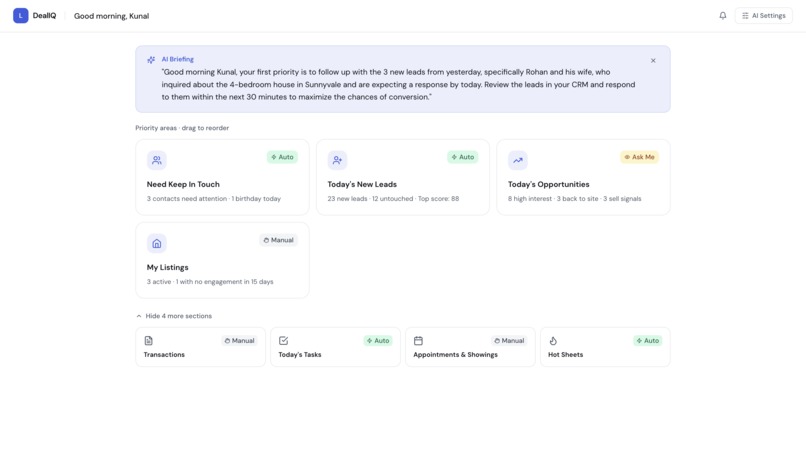
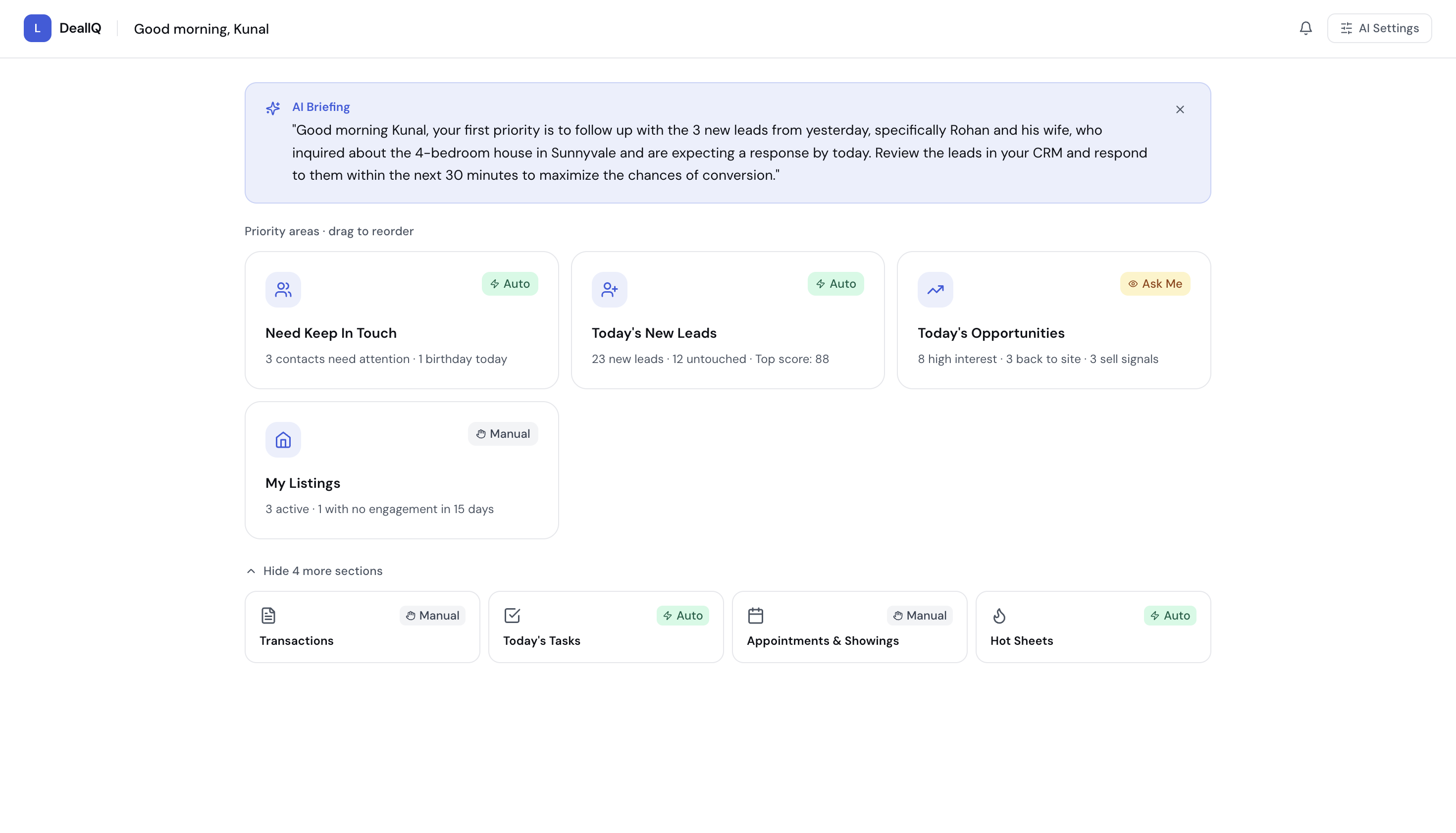
Dashboard and Morning Briefing
-
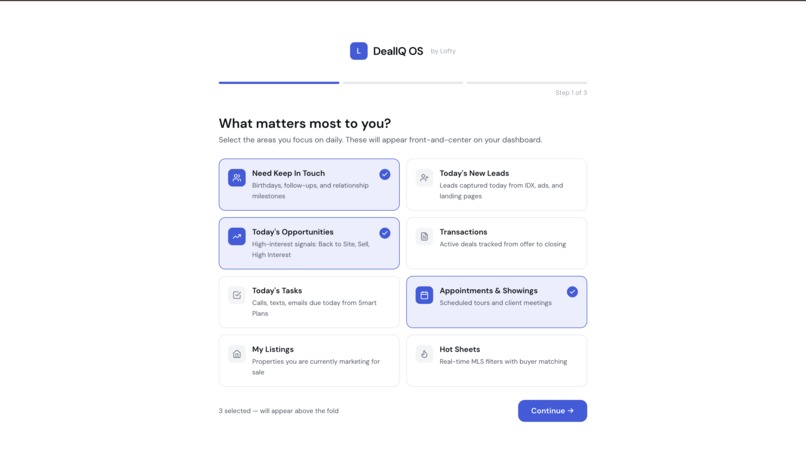
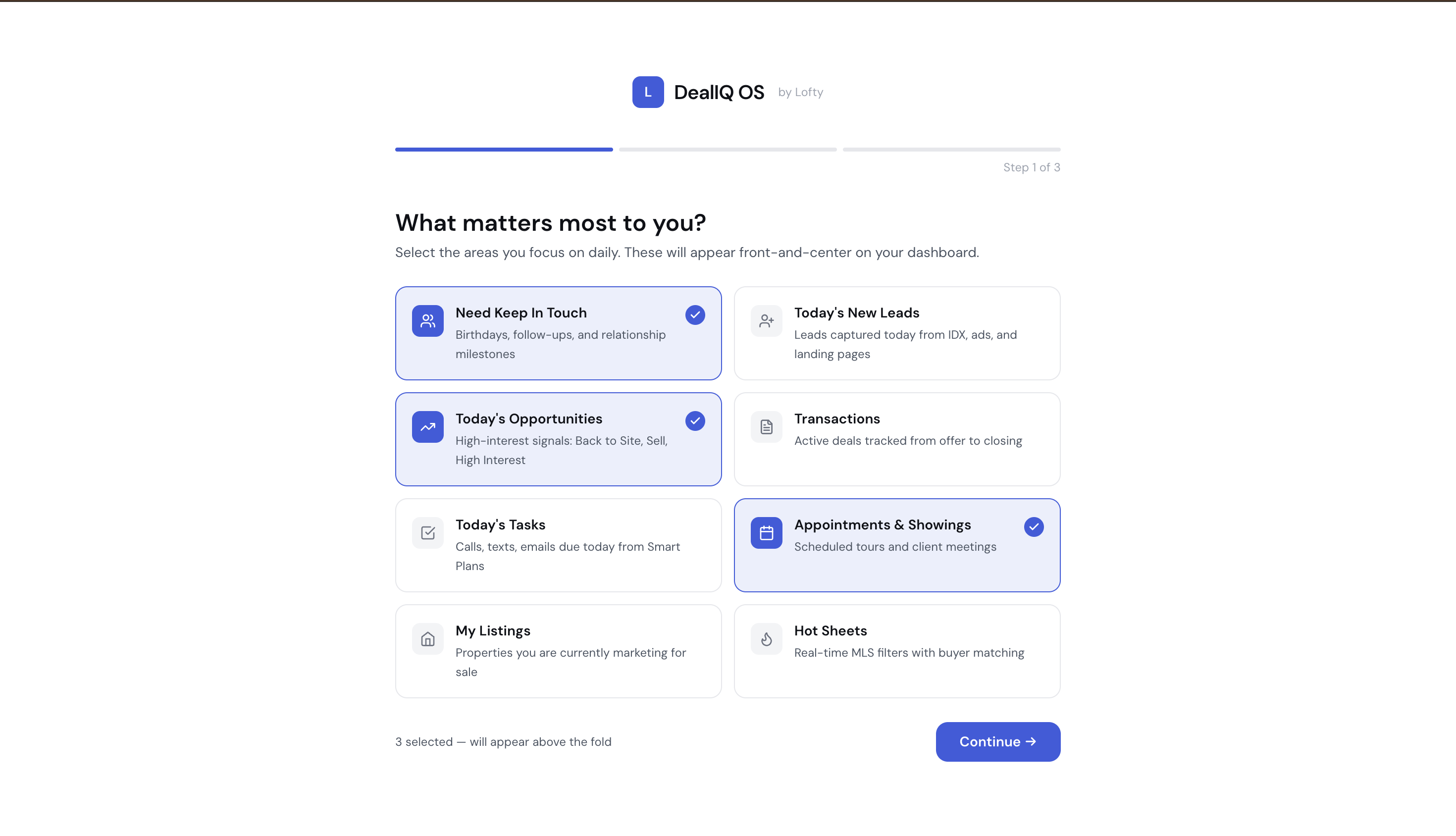
Onboarding
-
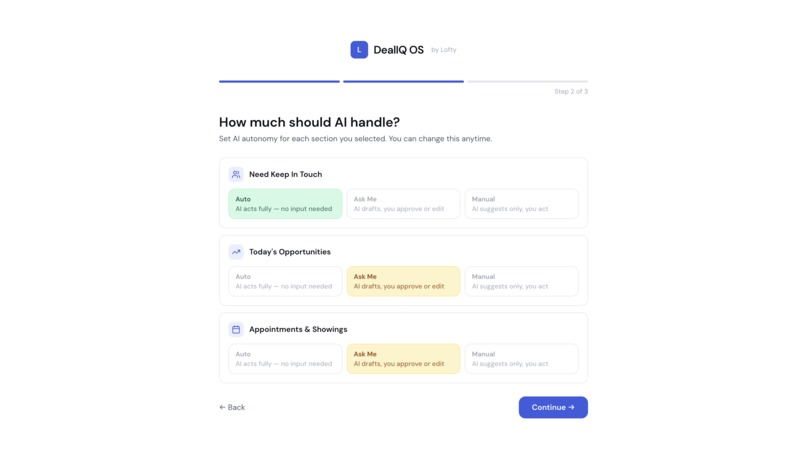
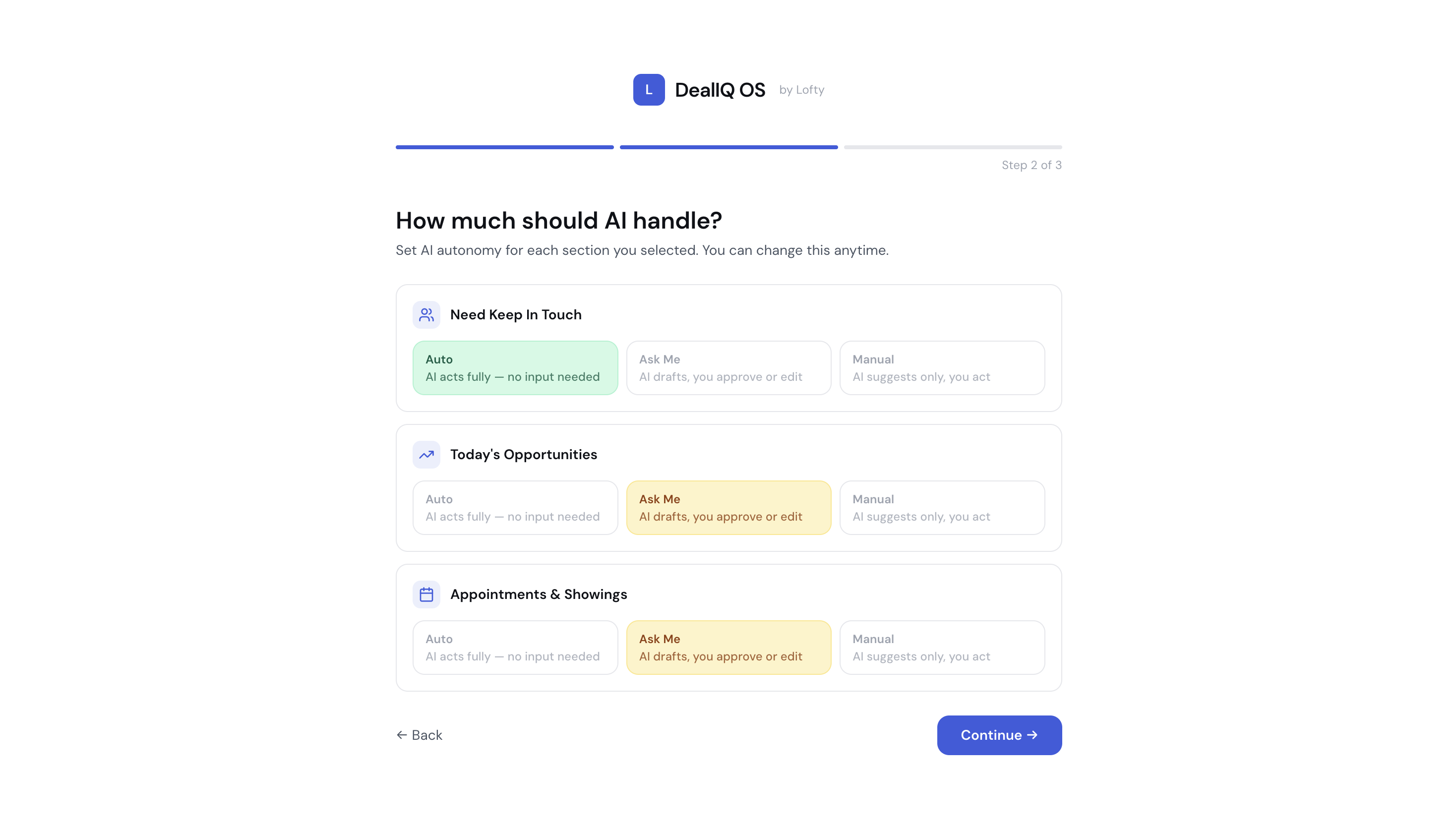
Onboarding
-
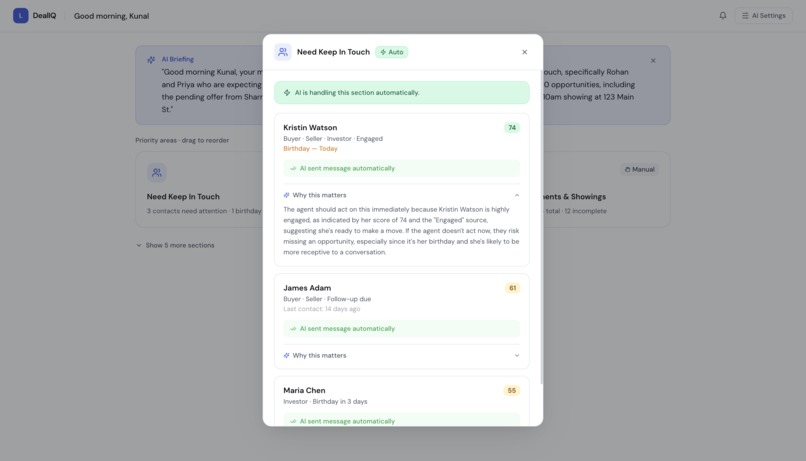
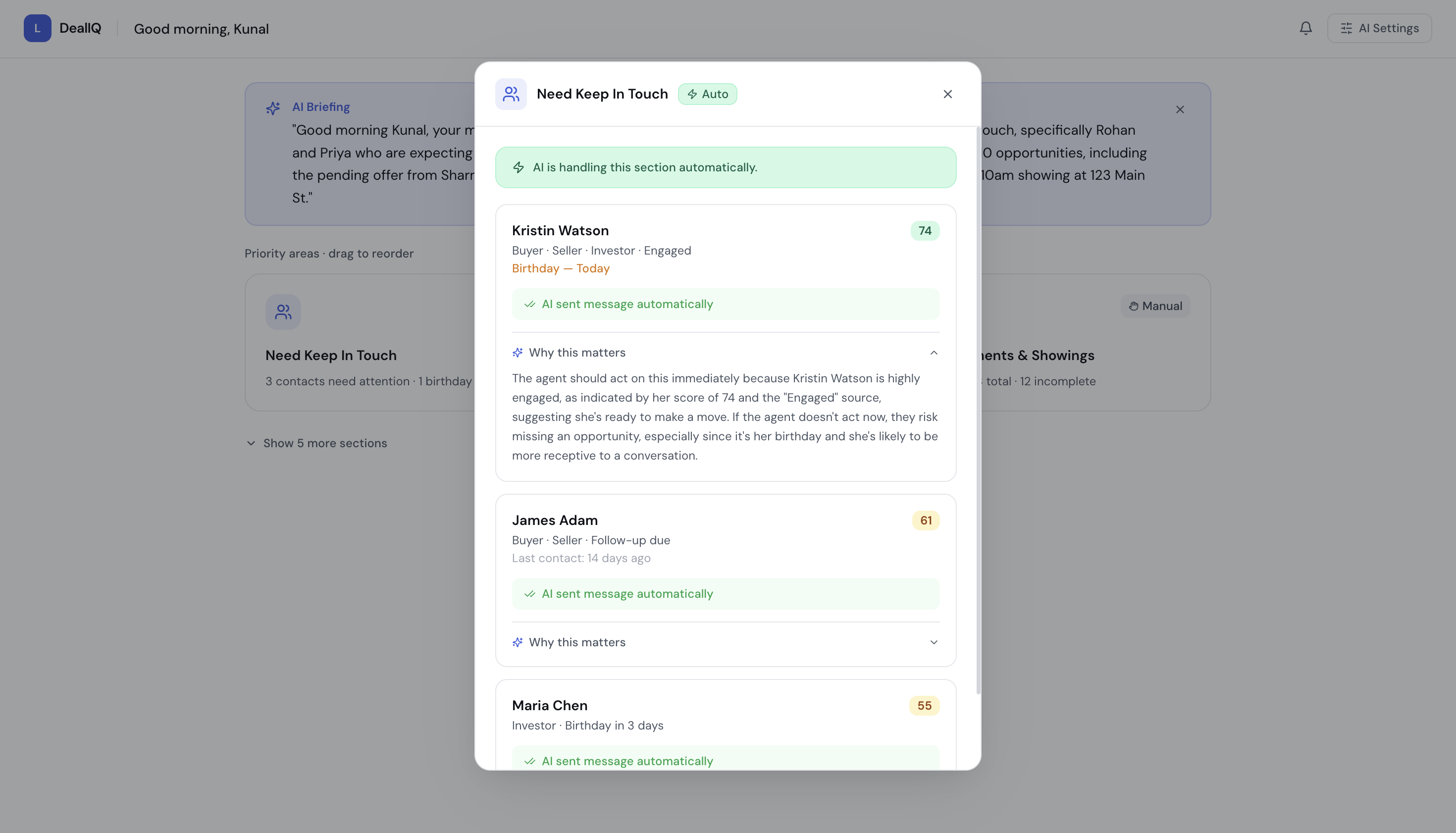
AI Explanation on Automated Tasks
DealIQ — Trust-Calibrated AI for Real Estate Agents
What inspired us
Real estate agents don’t struggle with lack of tools - they struggle with too many tools and no clear direction.
While exploring Lofty’s platform, we noticed something critical:
- It has powerful AI features
- It has rich data across leads, tasks, transactions, listings
- But agents still have to manually figure out what matters most every day
This creates a gap:
AI exists, but it doesn’t lead.
At the same time, we realized something deeper:
The real blocker is not capability — it’s trust.
Agents hesitate to let AI act on their behalf:
- “What if it sends the wrong message?”
- “What if I lose control?”
This is where the idea for DealIQ was born.
What we built
We built DealIQ - a trust-calibrated AI operating system that transforms Lofty from a dashboard into a decision-making and action-taking system.
1. Smart Onboarding (Personalized Workspace)
We start by asking:
“What matters most to you?”
Users select key modules:
- Need Keep In Touch
- Today’s New Leads
- Today’s Opportunities
- Transactions
- Tasks
- Appointments & Showings
- Listings
- Hot Sheets
Only selected modules appear front-and-center Others move to “View More” → reducing clutter and cognitive overload
2. AI Autonomy Layer (Core Innovation)
For each module, users define how much control AI has:
- Auto → AI acts fully (executes tasks, sends messages)
- Ask Me → AI drafts, user approves/edits
- Manual → AI suggests, user acts
This creates a simple but powerful model:
[ AI\ Adoption \propto Trust \times Control ]
Instead of forcing automation, we let users gradually build trust with AI.
3. AI-Powered Workspace
Once onboarding is complete, the workspace becomes fully AI-driven:
Morning Briefing
A personalized summary:
“Kunal, here are your top 3 opportunities today.”
This answers the biggest question:
What should I do right now?
Drag-and-Drop Workflow Customization
In addition to onboarding-based personalization, we introduced a drag-and-drop dashboard experience that allows agents to fully control how their workspace is structured.
What it does
- Users can reorder modules (Leads, Tasks, Opportunities, etc.) directly on the dashboard
- High-priority workflows can be moved to the top for faster access
- Less critical sections can be minimized or pushed lower
Why this matters
While onboarding defines what matters, drag-and-drop enables users to continuously refine how their workflow evolves over time.
This adds a second layer of personalization:
Static personalization → Dynamic control
AI + User Control Together
- AI prioritizes and takes actions
- Users can override layout and workflow visually
This creates a balanced system:
AI drives decisions, but users shape the experience
Impact
- devposReduces friction in daily workflows
- Adapts to changing priorities (e.g., more focus on deals vs leads)
- Reinforces user trust by keeping them in control
Key Insight
“AI should not lock users into a system - it should adapt with them.”
AI Action Engine
Based on autonomy level:
Auto
- AI already sends follow-ups
- Matches buyers to listings
- Schedules tasks
Ask Me
- AI prepares messages → user approves
Manual
- AI suggests next best actions
“Why This Matters” (Trust Builder)
Every AI action includes an explanation:
- Why this lead is important
- Why this message was sent
- How it impacts deal conversion
This turns AI from a black box → into a transparent assistant
4. Clean UX Decisions
- New Updates moved → notification bell (reduces noise)
- Modal-based deep work → no navigation overload
- AI Preferences → easily adjustable anytime
How we built it
We focused on speed + real-world feasibility:
- Frontend: React (component-driven modular UI)
- State Management: Config-driven architecture for dynamic dashboard rendering
AI Integration:
- Prompt-based decision engine
- Action classification (Auto / Ask / Manual)
Design:
- User-first onboarding flow
- Minimal, focused dashboard
We also leveraged AI tools heavily:
- ChatGPT → ideation, UX flows, logic refinement
- Claude → prompt refinement, rapid coding, iteration & reasoning validation
Challenges we faced
1. Balancing automation vs control
Too much AI = loss of trust Too little AI = no value
Solved using per-module autonomy control
2. Avoiding dashboard clutter
Real estate platforms are inherently dense
Solved using:
- Priority-based onboarding
- Dynamic rendering
3. Making AI feel trustworthy
Users don’t trust invisible decisions
Solved using:
- “Ask Me” mode
- “Why This Matters” explanations
4. Building something truly AI-native
We didn’t want to just “add AI”
Instead:
- AI decides priorities
- AI takes actions
- UI adapts based on AI
What we learned
- AI adoption is a product problem, not just a technical problem
- Trust is the biggest bottleneck in automation systems
- The future is not dashboards - it’s decision systems
- Users don’t want more features - they want clarity and outcomes
Impact
DealIQ transforms Lofty into:
A system that doesn’t just show data - but decides, acts, and explains.
What’s next
- Predictive deal scoring
- Voice-based AI assistant
- Fully autonomous transaction workflows
- Team-level AI coordination
Final Thought
“The best AI is not the one that shows you more - it’s the one that helps you do less, and achieve more.”
Built With
- css
- html
- javascript
- openai
- react
- tailwindcss
- typescript

Log in or sign up for Devpost to join the conversation.