Inspiration
I was inspired by the mess of "email tag" that happens during high-stakes legal negotiations. In the syndicated loan market, document versions get lost in endless email threads constantly. I wanted to build something like a Bloomberg Terminal for legal drafting, replacing static Word files with a live environment where everything is transparent.
What it does
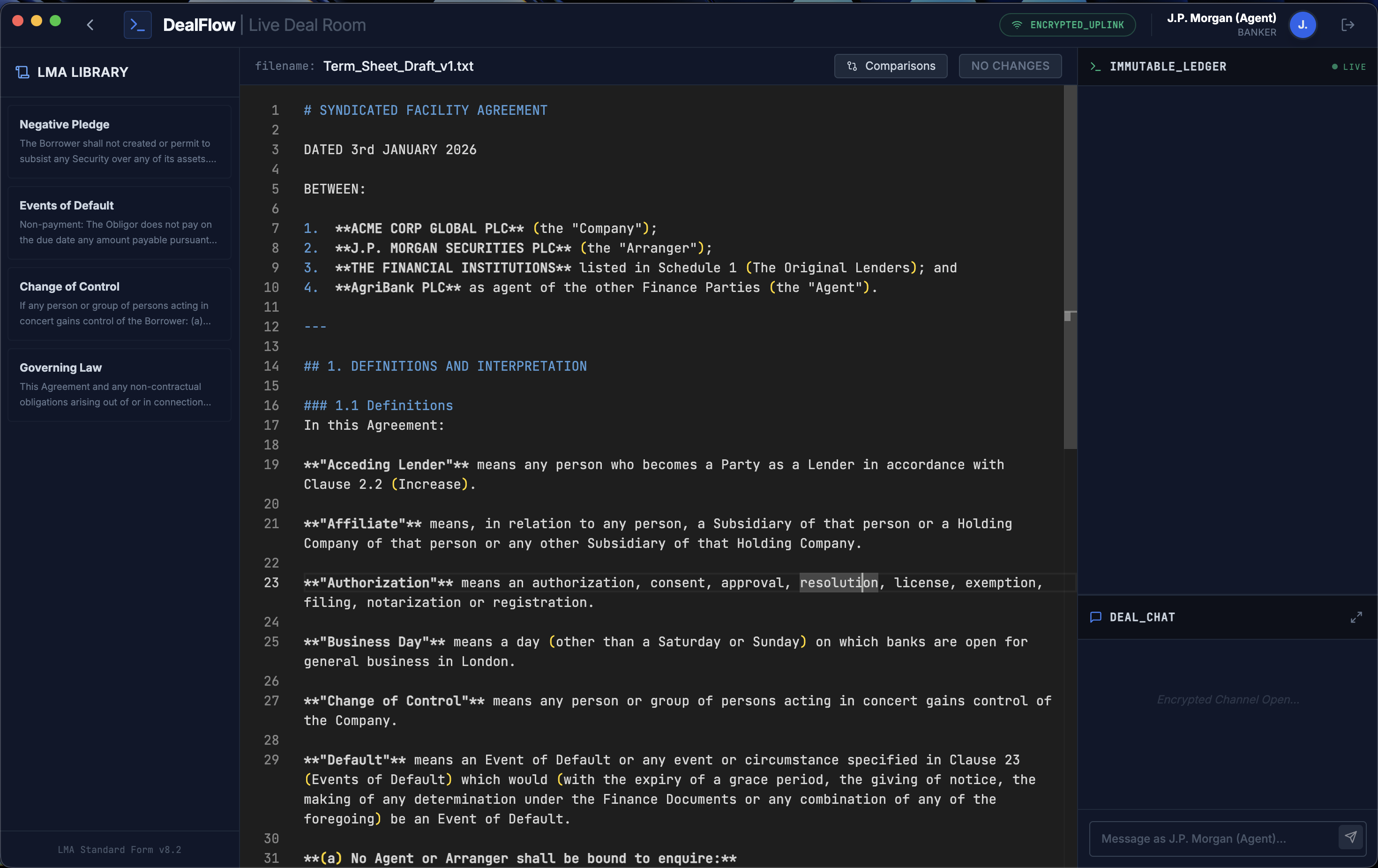
DealFlow turns static contracts into living, real-time documents. It lets Bankers, Lawyers, and Borrowers edit a Term Sheet at the same time in a "Deal Room". The big difference is that it replaces "Track Changes" with a cryptographic Audit Log. Every time someone commits a change, the app hashes the difference and anchors it to a local Ethereum blockchain using Hardhat. This creates a history of the negotiation that nobody can tamper with.
How we built it
I built DealFlow as a desktop app using Electron and React for a fast UI.
Real-Time Sync: I used Socket.io to broadcast keystrokes and cursor movements instantly. Trust Layer: I wrote a Solidity smart contract (DealRegistry.sol) and deployed it to a local Hardhat node. Persistence: I used Prisma ORM with SQLite to save document states and chat history. Editor: I implemented the Monaco Editor so lawyers get a powerful text editing experience they might recognize from VS Code.
Challenges we ran into
Apart from learning about loans and its process in EMEA region which was hard for a challenge during initial days given my technical background and country, the biggest challenge technically was connecting real-time WebSockets with a slow, immutable Blockchain. Blockchains aren't fast, but editing needs to be instant. I fixed this by using an optimistic UI that updates immediately via Sockets, while the app "mines" the audit blocks to the local chain in the background. Learning electron for developing desktop based application was also a challenge but it was quite fun too.
Accomplishments that we're proud of
I'm really proud of the Audit Log system. Watching the app confirm a "Block Mined" notification and knowing a real Ethereum transaction just happened on my local node was a great feeling. It actually simulates how a serious legal ledger would work. Initally this was not part of the project but as I was developing I thought of this as an important piece of whole ledger like thing so I built it on the fly and was quite product of it when it came together with the whole application. Slightly displeased as it is not working as I was planning for the demo but the code is in place for it.
What we learned
Learned a lot about loan process, greener lending ( my initial submission was on this category but due to time constraint changed it ). Apart from this technical knowledge about electron library specially its networking part, using DB for decentralised verification ( similar to web3 ) and a lot about LMA clauses.
What's next for DealFlow
I plan to add AI-Assisted Drafting using fine-tuned LLMs to suggest standard clauses. I also want to move the blockchain part from a local Hardhat node to a private testnet so multiple organizations could actually test it out.
Built With
- electron
- hardhat
- react
- solidity
- sqlite
- tailwind
- websockets

Log in or sign up for Devpost to join the conversation.