Inspiration
Every sales organization has a Deal Desk — the person or team that reviews pricing exceptions, emails managers up the chain, waits for replies, consolidates decisions, and updates the CRM. It is 100% manual, 100% inbox-driven, and almost always slower than the sales team needs. I wanted to find out whether an AI agent could actually do that job — not just summarize a deal, but reason about it, decide who needs to sign off, route the request, and close the loop — with real governance and a real audit trail.
What it does
Deal Desk Agent is an AI Deal Desk analyst that runs end to end on UiPath Automation Cloud.
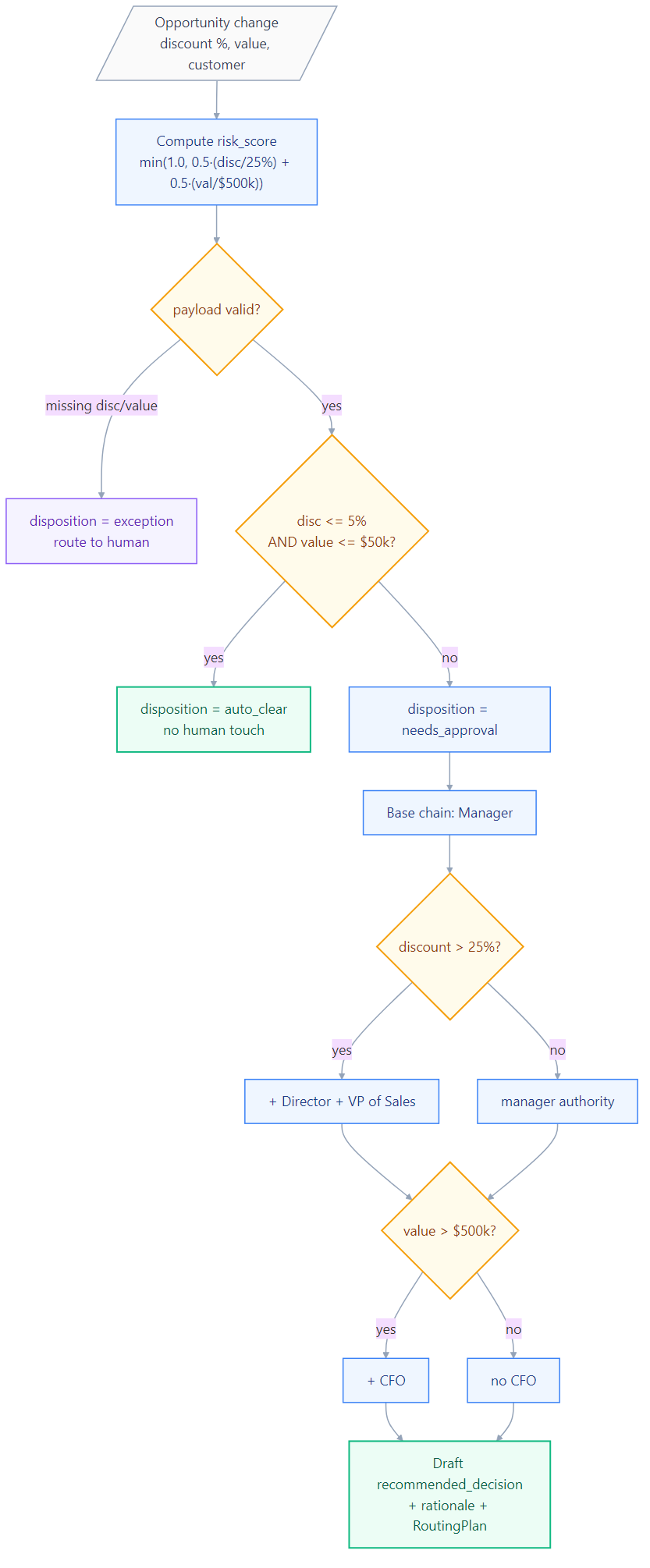
- Collects live Salesforce deal data and resolves the approver org chart (AE → Manager → Director → VP Sales → CFO → CRO) from HiBob.
- Scores risk with deterministic business rules, then uses an LLM to draft a contextual recommendation and rationale — why, not just approve/flag.
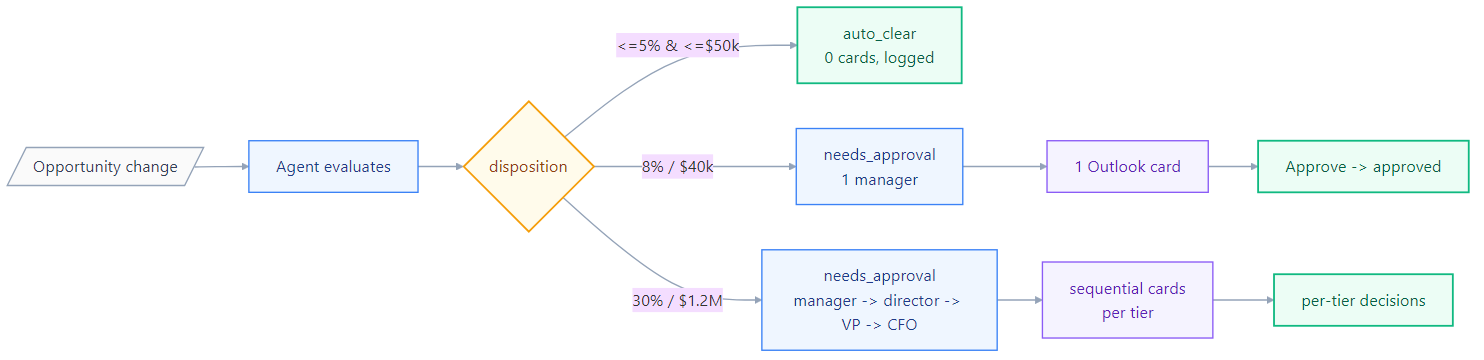
- Auto-approves low-risk deals with zero human touch.
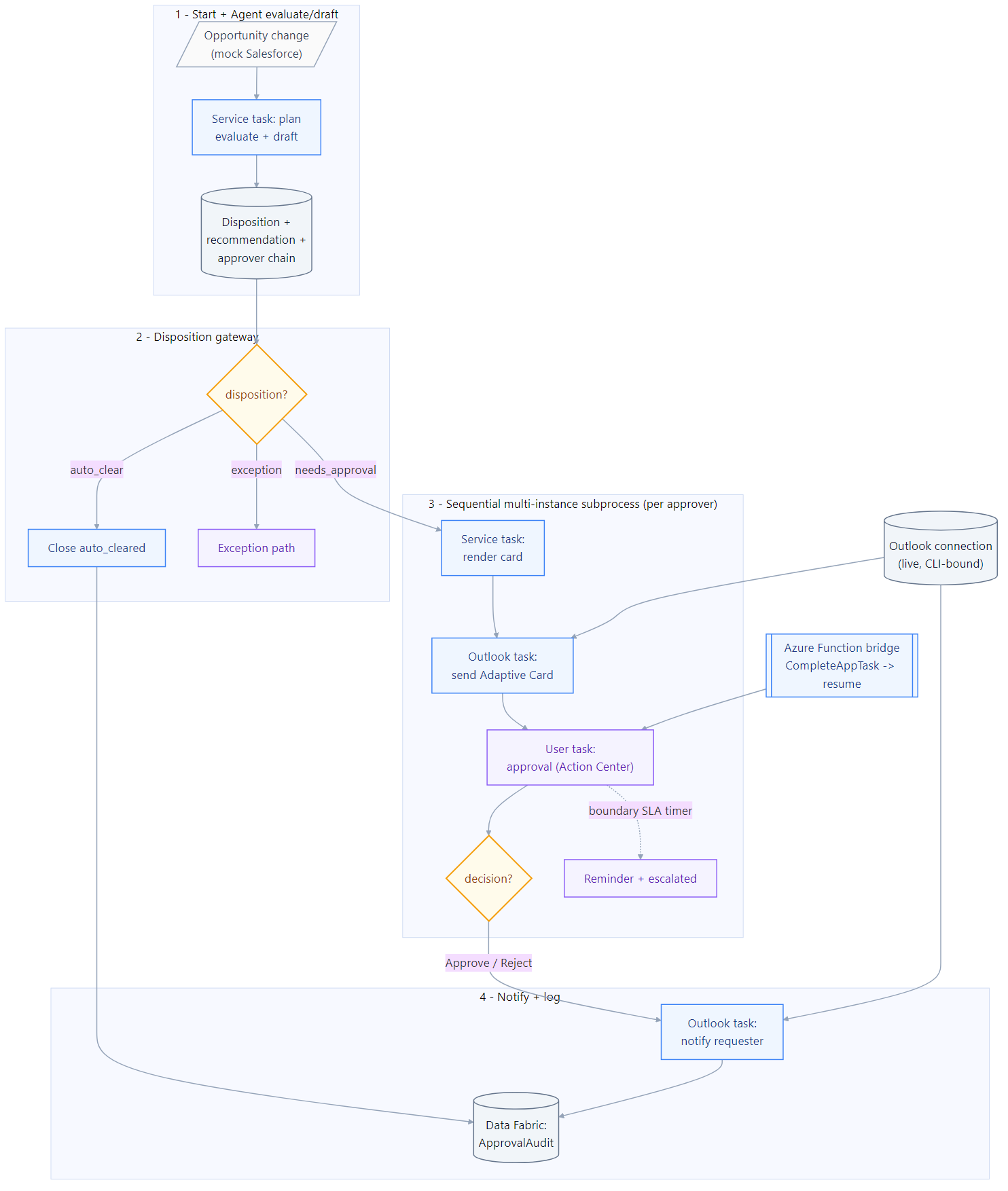
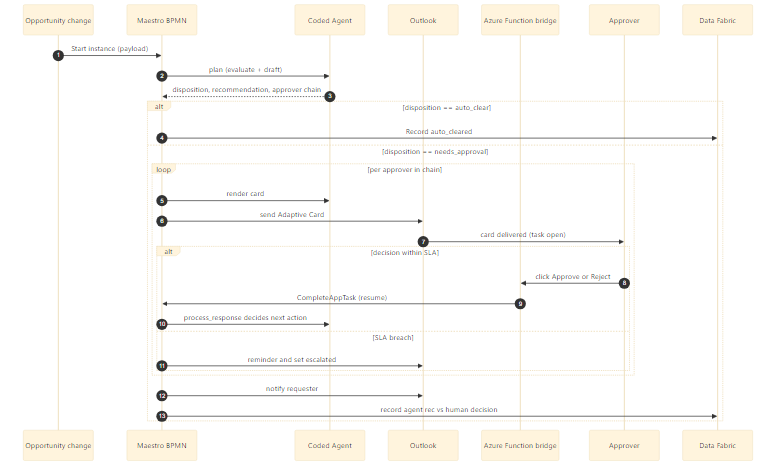
- For everything else, runs a sequential multi-instance approver loop, notifying each approver on three channels at once: an interactive Outlook Adaptive Card, a Slack Block Kit DM, and a native Action Center task. A decision on any channel resolves the step.
- A rejection short-circuits the rest of the chain; the agent interprets the collected decisions to determine the final outcome.
- Writes a full Data Fabric audit record (agent recommendation vs. each human decision, comments, timestamps) and sends the requester a Slack DM + Outlook summary.
How we built it
The brain is three coded agents (Python / LangGraph): plan (data + scoring + rationale), render (approval payload), and process_response (final outcome). Maestro BPMN 2.0 orchestrates everything — a disposition gateway plus the sequential multi-instance approval loop. A UiPath RPA robot (WaitDecision) fans out to all three channels and suspends/resumes via UiPath Persistence, so there is no polling loop in the BPMN. Live data comes through an AgentHub MCP server wrapping a read-only Salesforce Integration Service connection (getSalesforceOpportunity, getSalesforceAccount, searchSalesforceSoql). The whole thing — agents, BPMN, robot, MCP, bindings — was authored with Cursor + Claude via UiPath for Coding Agents and the uip CLI.
Challenges we ran into
- Multi-channel HITL that stays in sync. Getting Outlook Adaptive Card, Slack, and Action Center to represent the same pending decision — and letting any one of them resolve the wait — took careful coordination between the response token, the HITL service, and the robot.
- Suspend/resume instead of polling. Replacing a polling loop with UiPath Persistence so the BPMN truly idles while waiting on a human was a key design shift.
- Real Adaptive Cards in email. Action.Http buttons, originator registration, and a rich HTML fallback for clients that don't render cards.
- Keeping connection IDs and bindings real. Phantom/placeholder IDs broke Studio Web validation; everything had to reference the actual tenant connection IDs across the BPMN, bindings, and debug overwrites.
Accomplishments that we're proud of
- A genuinely agentic flow: the agent reasons, decides autonomously on low-risk deals, sizes the approver chain from live org data, and interprets the human decisions at the end — it stays in the loop throughout.
- Four simultaneous live test runs verified on all three channels (Outlook Adaptive Card, Slack DM, Action Center) on Jun 22, 2026.
- A clean separation of concerns — the right actor for every step: agents reason, the robot communicates, the BPMN governs, Data Fabric remembers.
- The entire solution was built with coding agents on the UiPath platform.
What we learned
- The strongest agent designs combine deterministic rules with LLM reasoning — rules for policy thresholds, the LLM for context and explanation.
- BPMN multi-instance loops are a natural fit for variable-length approval chains produced as data, with no hardcoded branches.
- Meeting approvers where they already are (email, Slack, the UiPath portal) matters more than any single "perfect" UI.
- Coding agents (Cursor + Claude) plus the
uipCLI can take a UiPath solution from idea to a deployed, governed automation surprisingly fast.
What's next for DealDesk Agent
- Deeper CRM write-back so approved terms flow straight back into Salesforce.
- Configurable, tenant-specific policy thresholds and approval matrices without code changes.
- Learning from historical decisions to refine the agent's recommendations over time.
- Analytics on the Data Fabric audit trail (cycle time, override rates, bottleneck approvers) and expansion beyond renewals to new-business pricing exceptions.
Built With
- adaptive-cards
- amazon-web-services
- codedagent
- datafabric
- lambda
- langgraph
- maestro
- outlook
- slack


Log in or sign up for Devpost to join the conversation.