-
-
UI
-
UI
-
UI
-
Realie API
Inspiration
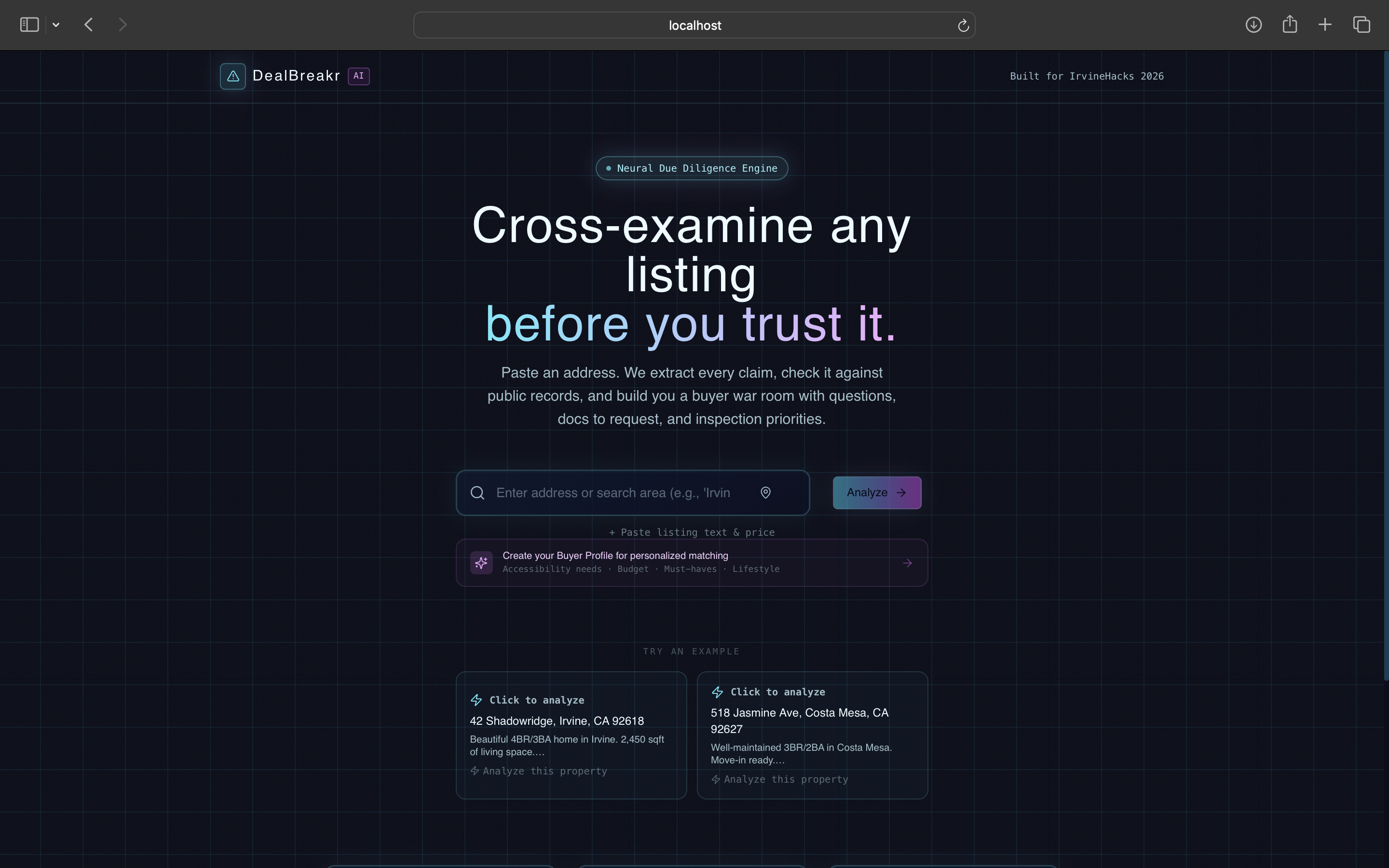
Buyers rely on listing copy and agent descriptions, but have no quick way to see what’s verified versus what’s marketing or missing. We wanted a tool that cross-examines every claim, ties findings to evidence, and gives buyers a clear due diligence checklist instead of guesswork.
What it does
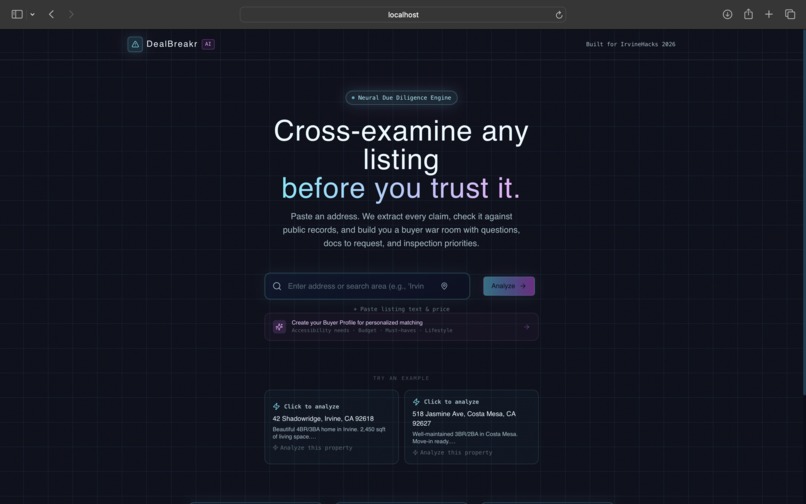
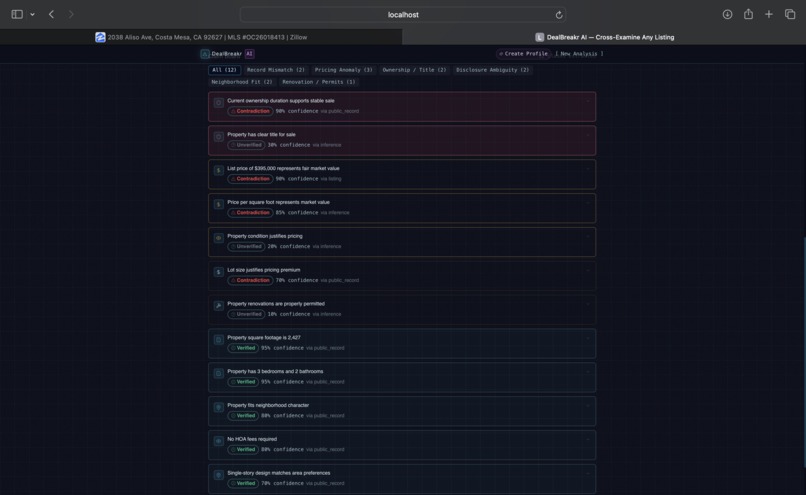
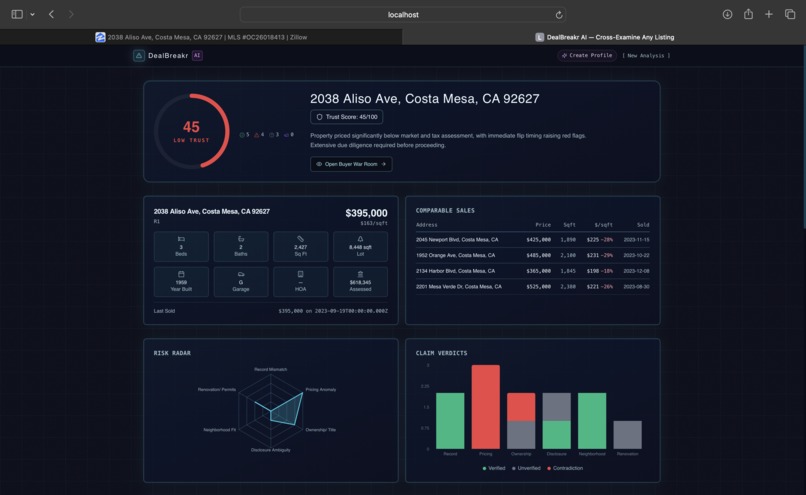
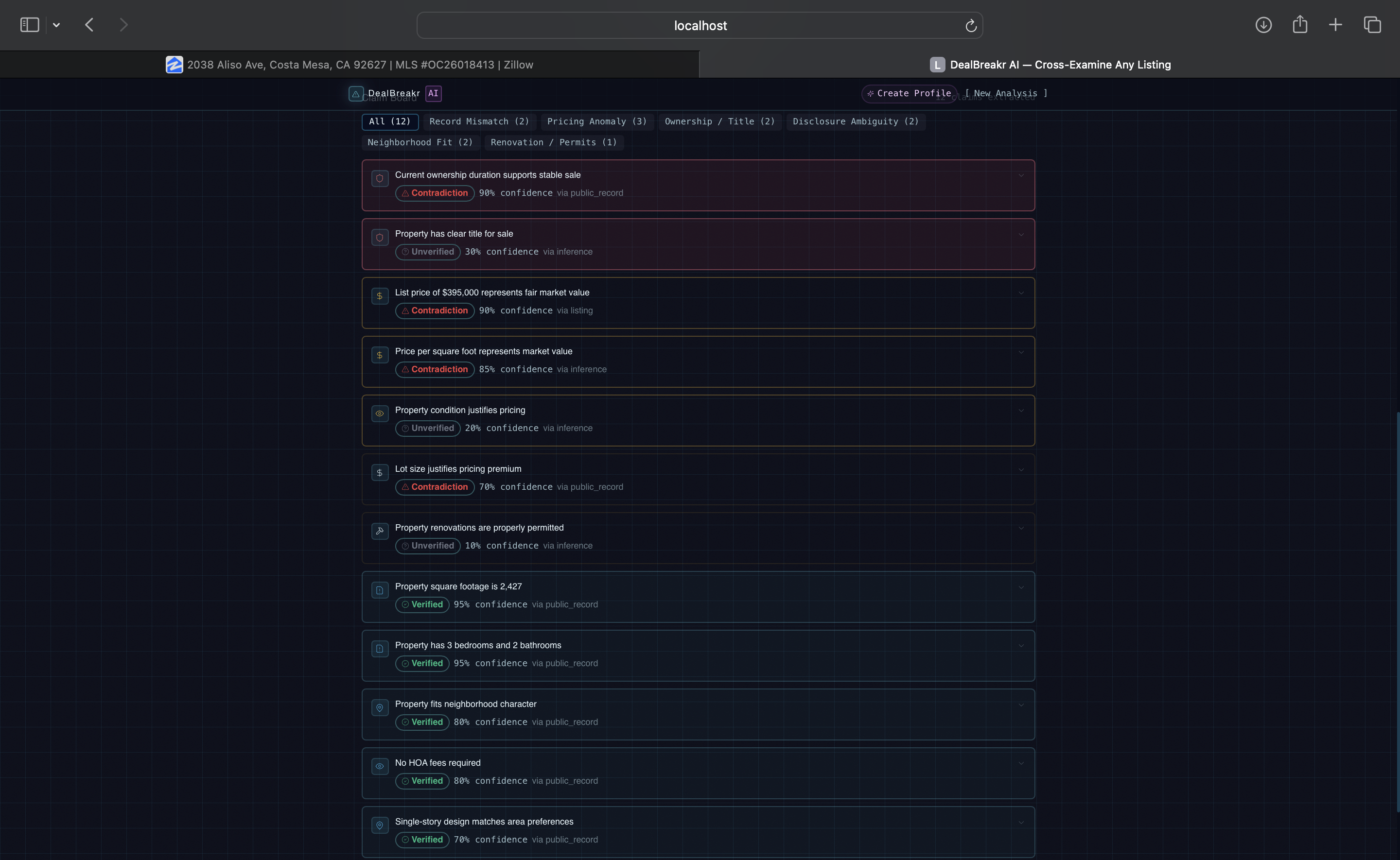
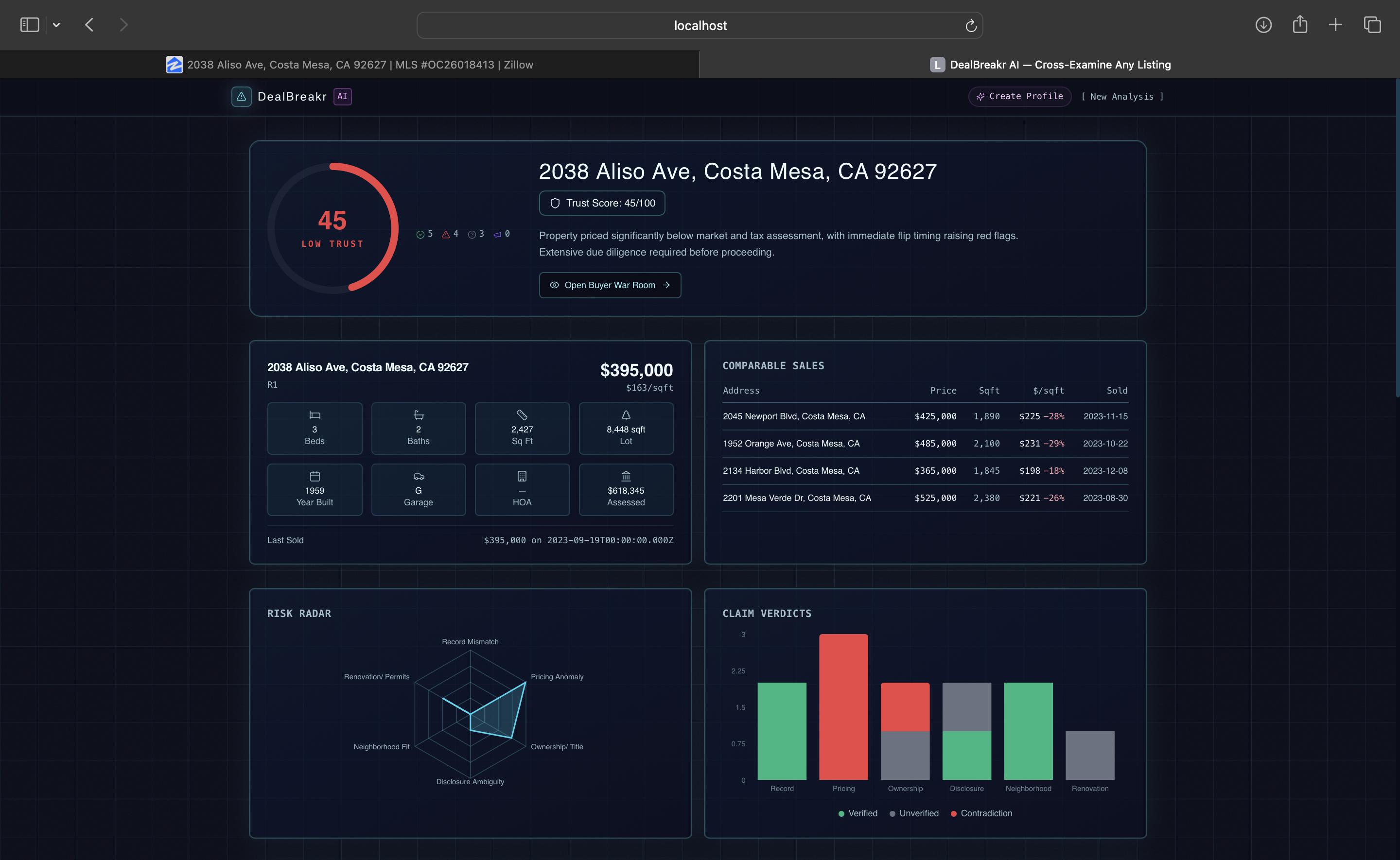
DealBreakr AI takes an address and optional listing text, pulls property facts from external data, and uses AI to extract and classify every claim. It flags contradictions (listing vs. records), unknowns (no evidence), and marketing language. You get a Trust Thermometer, a category breakdown, and a Buyer War Room: questions to ask, documents to request, and inspections to prioritize. Every finding is explainable and linked to sources. We don’t replace agents or inspectors; we make the listing transparent so you can have better conversations and make informed decisions.
How we built it
We built a Next.js 14 (App Router) app in TypeScript with Tailwind and shadcn/ui. Property data comes from the Realie API; we parse full addresses server-side into state and street for their Address Lookup. Analysis runs in a POST API route: we create a pending record in SQLite via Prisma, call the Claude API with strict prompts that demand structured JSON (claims, evidence, action items), then persist the result and serve it to the results and war room pages. Trust is computed from verified, contradictory, and unverified claim counts so the score is interpretable:
[ \text{Trust} \propto \text{verified claims} - \text{contradictions} - \text{unverified gaps} ]
We keep risk scoring transparent: categories, severity, and evidence are all visible. Recharts powers the category breakdown; Zod validates API input and shapes.
Challenges we ran into
Parsing free-form addresses into the format Realie expects (state + street, optional city) was tricky; we added a small US-state parser and clear fallbacks when lookup fails. Keeping Claude’s output strictly JSON and aligned with our schema took prompt iteration and response stripping. Balancing detail (many claims) with token limits meant tuning instructions and example structure. The buyer profile was also crashing on the client side. Every search we made with an active buyer profile had a runtime error. Implementing our ideas was also difficult because there were a lot of unexpected roadblocks, like API usage and our free API's occasionally returning inaccurate data.
Accomplishments that we're proud of
We shipped a full flow: search, analyze, results dashboard, and war room with real property data and explainable AI. Every claim shows verdict, confidence, evidence, and severity. The Buyer War Room turns analysis into concrete next steps. We kept language responsible (no accusations, “unverified” instead of “false”) and made the scoring logic and sources visible.
What we learned
Structured outputs from LLMs need clear schemas, examples in the prompt, and robust parsing. Real-world property APIs often want normalized addresses; a little parsing goes a long way. Explainability and evidence citations made the product more credible and easier to demo.
API
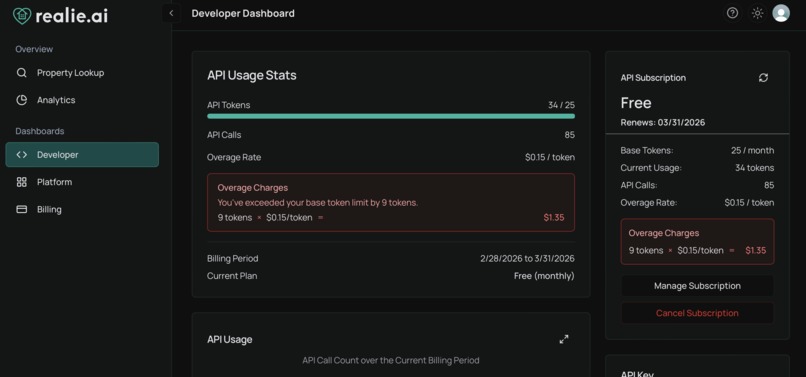
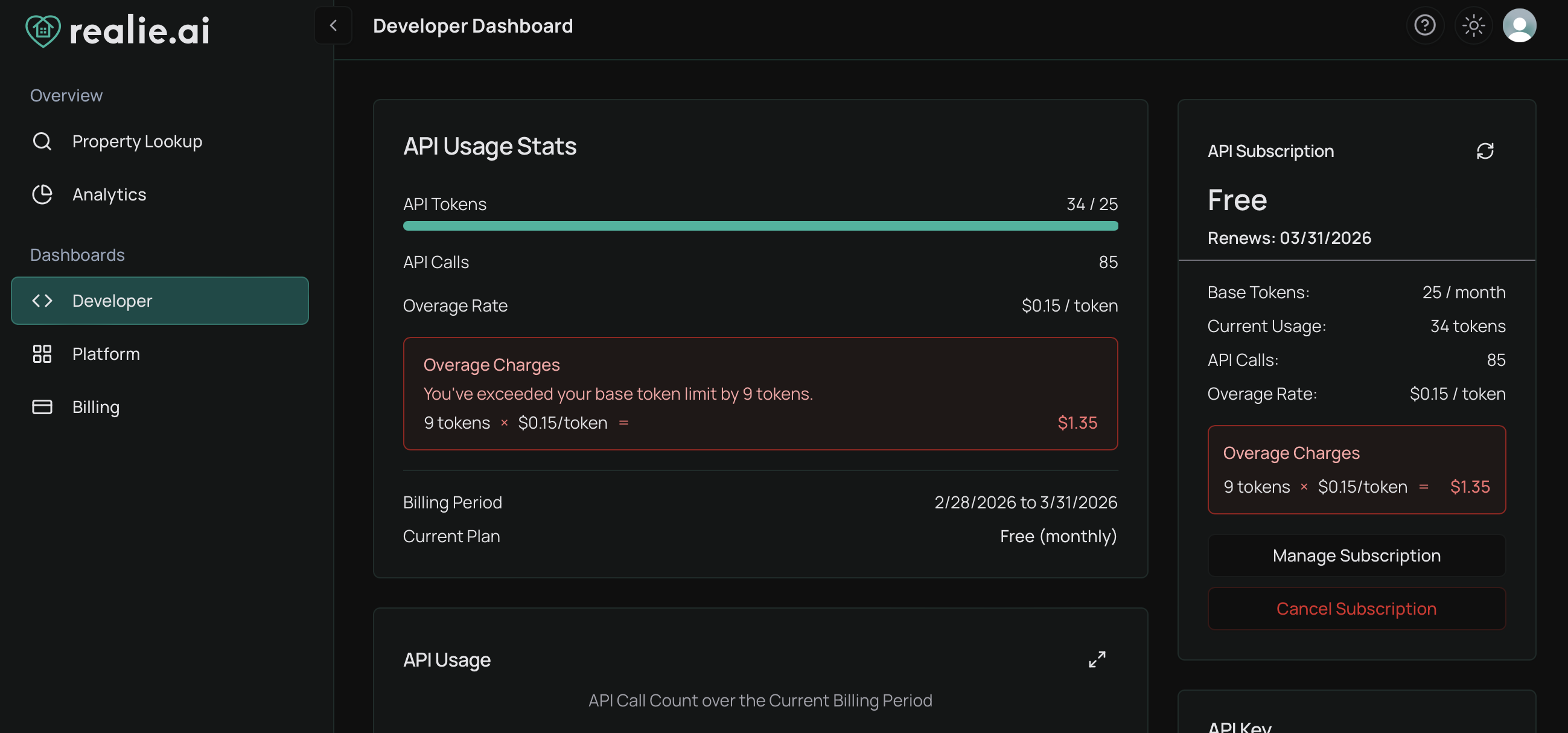
To use this project with your own data, you’ll need to grab your own Realie API key and add it to a local .env file. First, go to Realie’s website and sign up or log in, then create an API key from your account/dashboard (it will look like a long random string). In the root of the project (same folder as package.json), create a file named .env if it doesn’t already exist, and add the following lines: REALIE_API_KEY=your_realie_key_here and REALIE_BASE_URL="https://app.realie.ai/api". Replace your_realie_key_here with the key you got from Realie. Make sure the .env file is not committed to Git (it’s already in .gitignore), then run npm run dev to start the app – it will automatically load your Realie credentials from the .env file, also, don't forget to create a "real" .env file, as in, copy the .env.example provided and rename that same file to .env and you should see a "gear" icon next to it. Do keep in mind you only have a limit of 25 tokens that you could use, so be smart with it! Otherwise, if the limit is exceeded it will charge an additional $0.15 for every search you try and do.
What's next for DealBreakr AI
We’d add Realie’s Premium Comparables so the dashboard and trust score use real comps. Richer prompts could ingest listing PDFs or photos. We’d consider auth and saved analyses, then a production database (e.g. Postgres) and deployment (e.g. Vercel) for real usage in the near future! W'd also think of including a chatbot.
Built With
- anthropic
- next.js
- prisma
- shadcn/ui
- tailwind
- typescript


Log in or sign up for Devpost to join the conversation.