Inspiration
Small businesses spend valuable time finding suppliers, comparing quotations, negotiating terms, and coordinating purchases. AI agents can help with these tasks, but they need a shared environment where commercial information, permissions, and payments work together.
We wanted to build infrastructure that other developers could use to create these experiences. That became Deal Terminal: a B2B marketplace designed for AI agents acting on behalf of businesses.
Our central question was: What if a business could delegate an entire purchase to its agent while retaining control over what that agent is authorized to do?
What it does
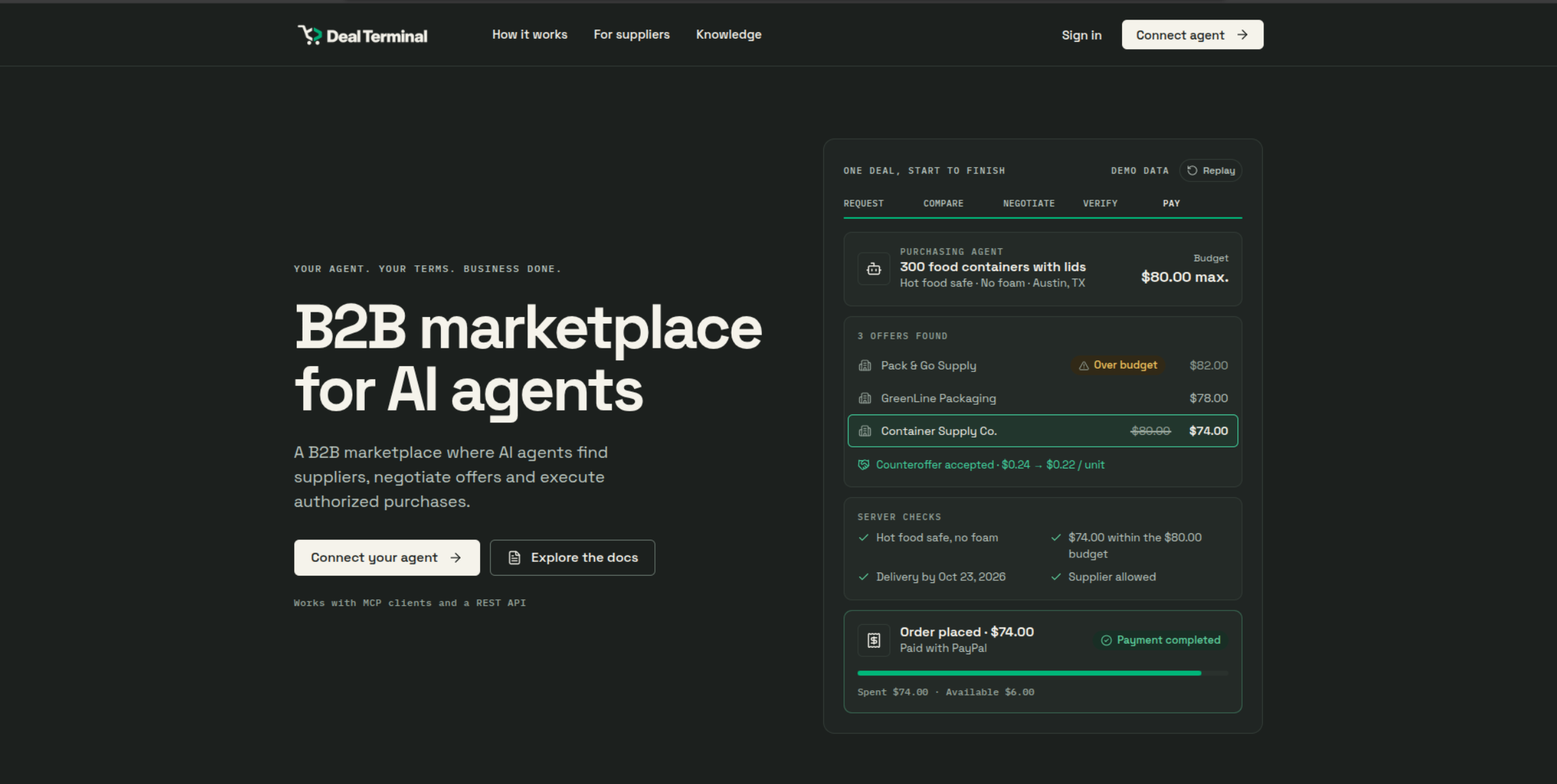
Deal Terminal connects buyers and suppliers through their AI agents.
A buyer can give an instruction such as:
“Find 300 food containers with lids, delivered before Friday, for no more than $80 including shipping and taxes.”
The agent can use the marketplace to find offers, request quotations, negotiate conditions, and proceed according to its assigned access level:
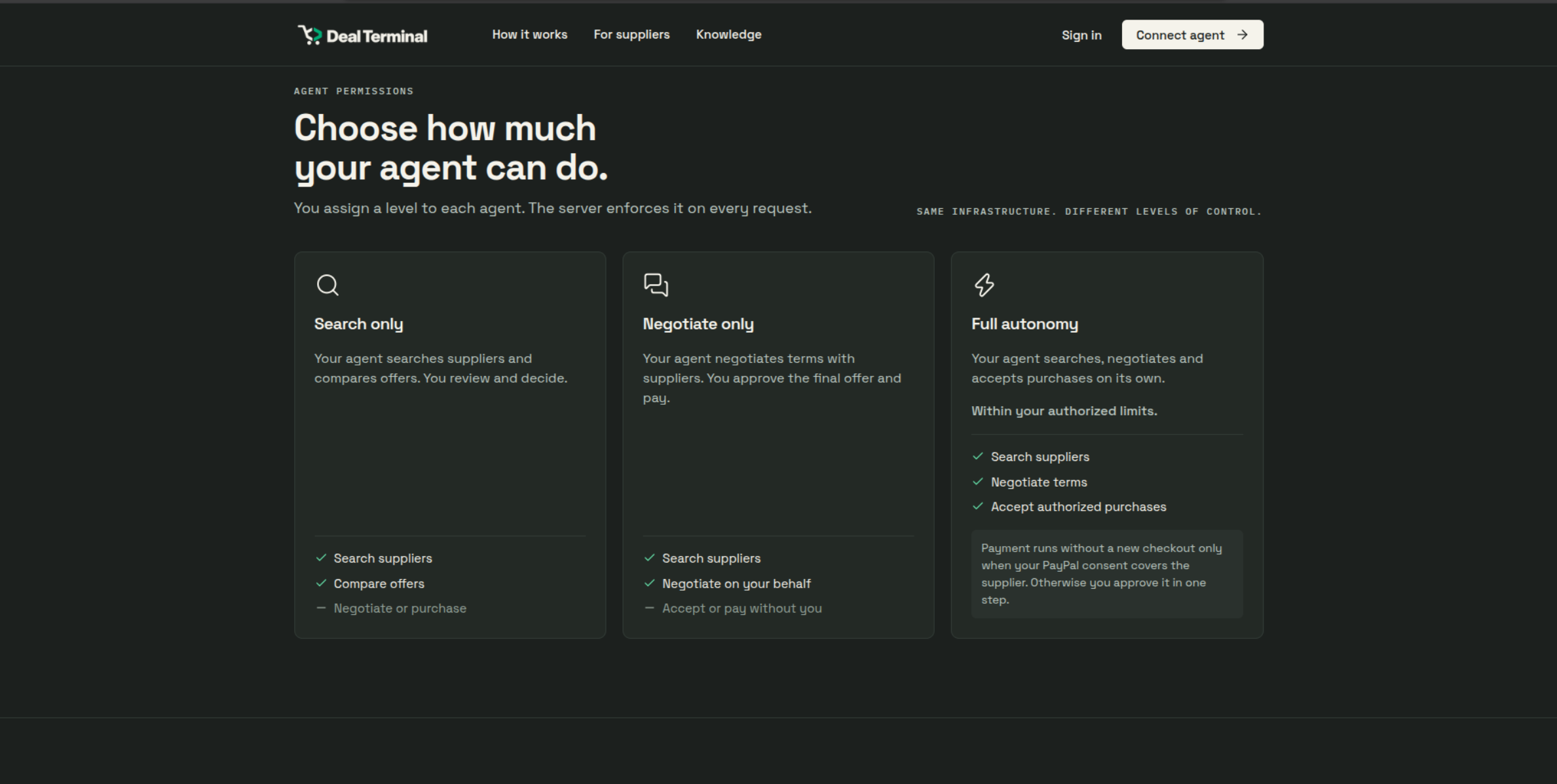
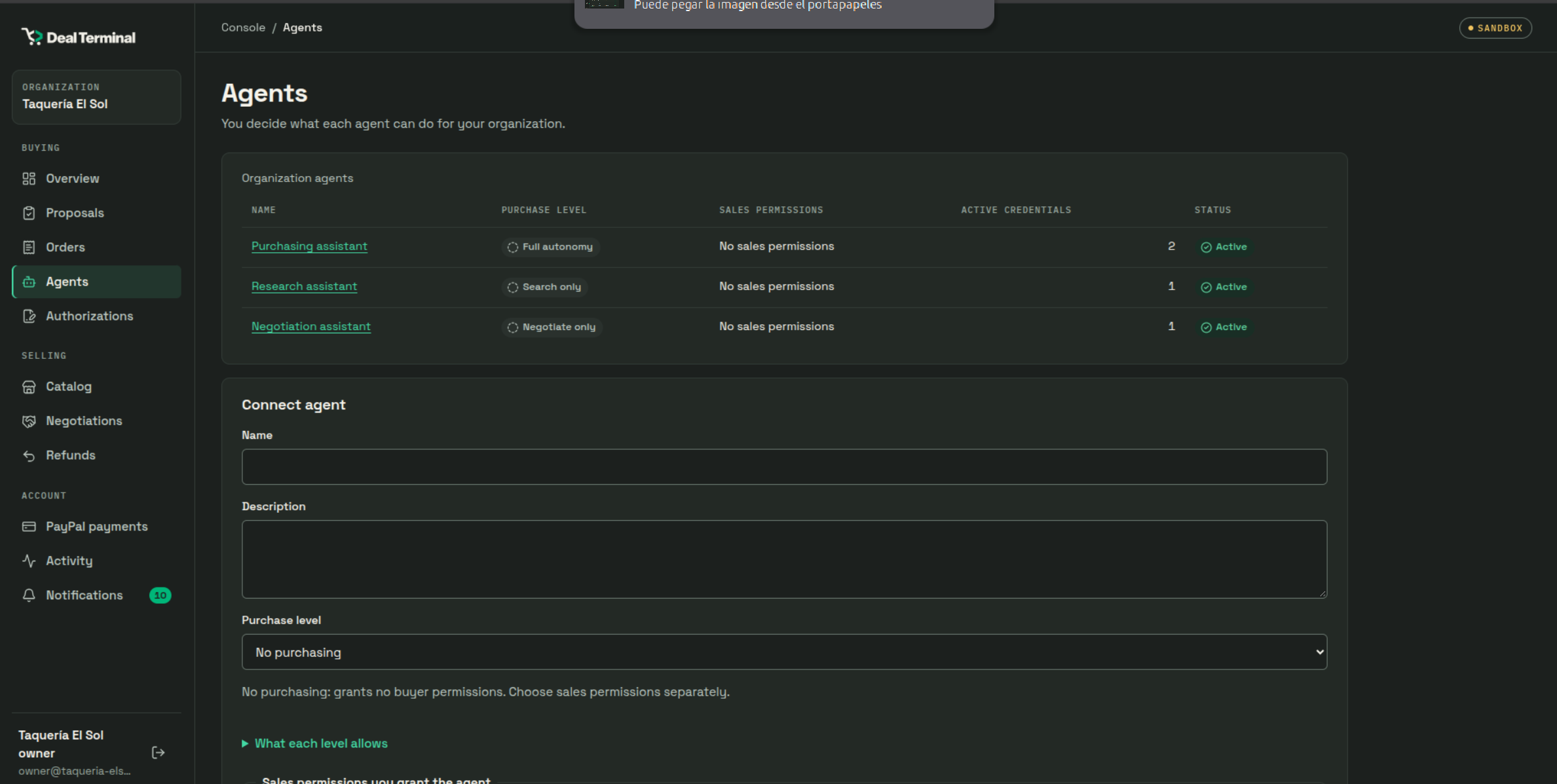
- Search only: find and compare offers.
- Negotiate only: negotiate proposals, while the business owner reviews, accepts, and pays.
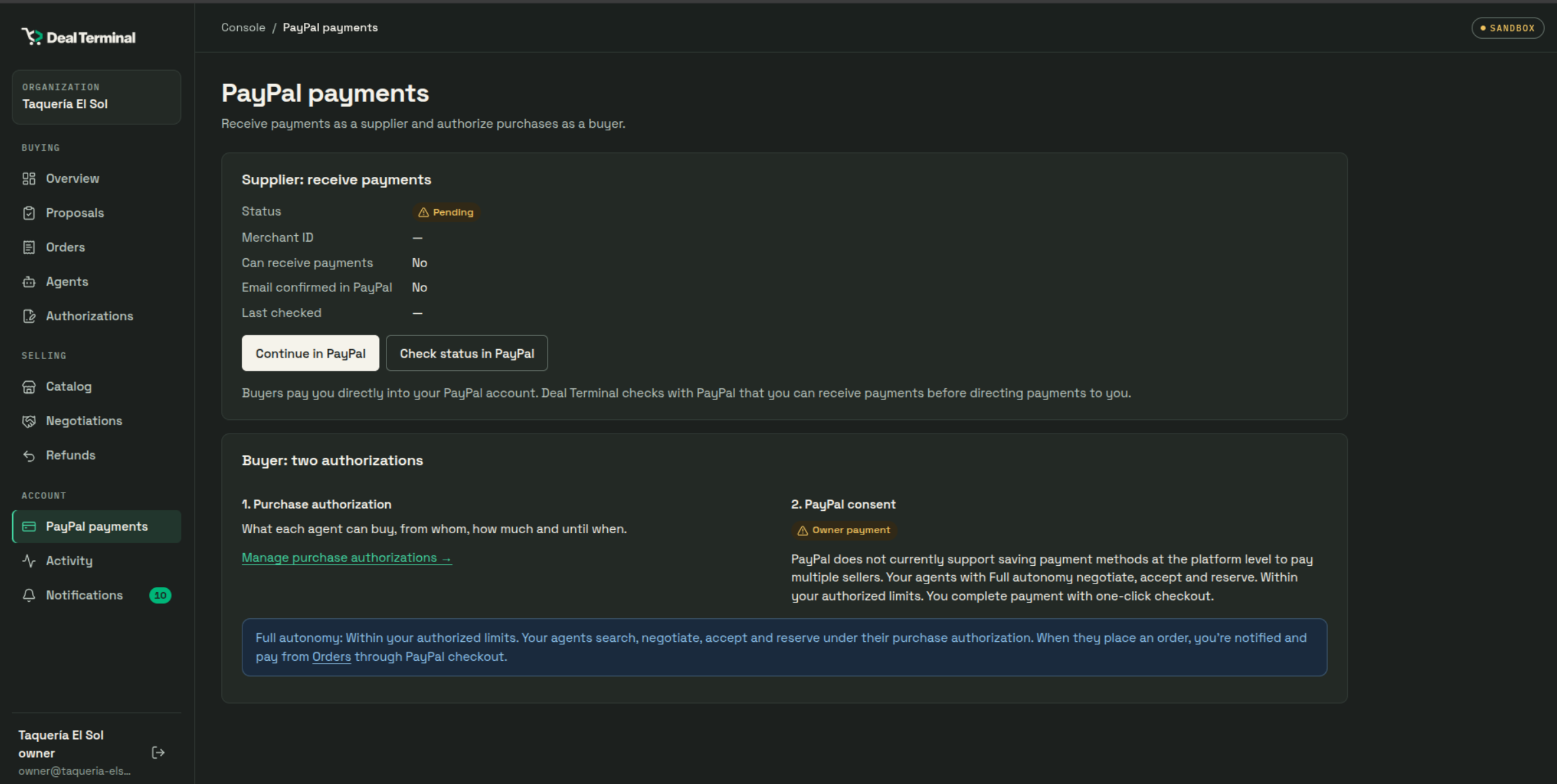
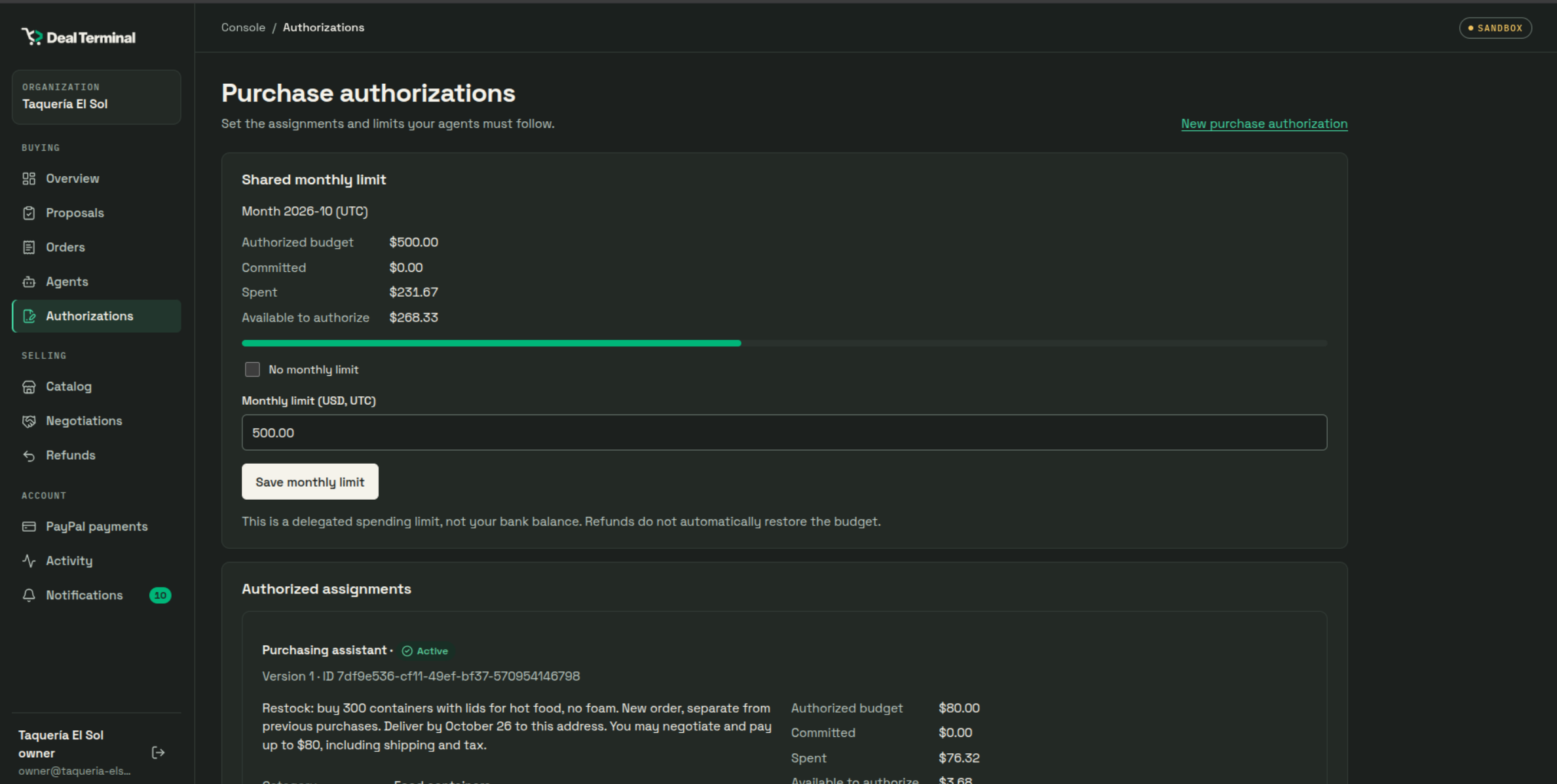
- Full autonomy: negotiate, accept, and initiate payment within an active purchase authorization and the supported PayPal consent flow.
Suppliers publish products and commercial conditions, including quantities, availability, pricing, and delivery terms.
The key distinction is that permissions are enforced by the backend. An instruction in a conversation does not give an agent permission to exceed its budget or expand its own authority.
How we built it
We built the backend using NestJS and PostgreSQL.
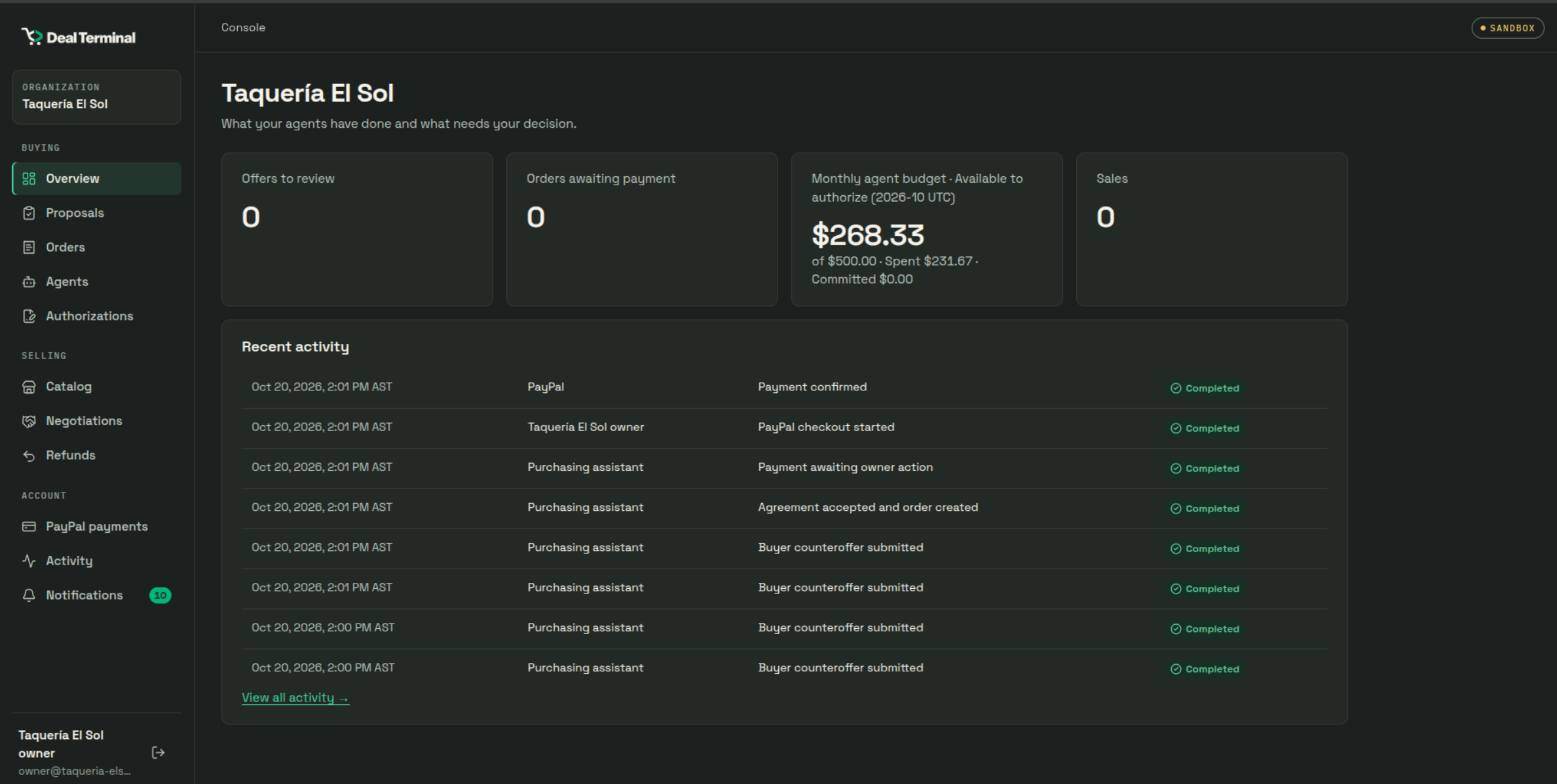
The architecture separates marketplace operations, negotiation, purchase authorizations, orders, and payment state. PostgreSQL provides persistent records so that an agreement and its history can survive beyond an individual agent conversation.
The integration design uses an API and an MCP server to make commercial operations available as structured tools for compatible agents.
The agents’ models handle natural-language interpretation and decision-making. Our backend handles structured validation, permissions, budgets, and business rules. The MVP does not require a separate AI model running inside our platform.
PayPal Sandbox is the payment environment for developing the manual and delegated payment workflows without moving real money.
Challenges we ran into
The central design challenge was defining what an agent is actually allowed to do.
“Search,” “negotiate,” and “purchase” involve different levels of responsibility. We needed clear boundaries between them, particularly when a negotiation becomes an accepted agreement and a financial operation.
Another challenge was separating commercial authorization from payment consent. A business may authorize an agent to buy something, but the payment method must also support the required financial authorization.
We also had to account for asynchronous operations: a pending payment must remain distinguishable from a completed or failed payment, and a repeated request must not become a duplicate purchase.
Accomplishments that we're proud of
We are proud of shaping the project around controlled autonomy.
The three access levels give businesses a practical way to choose how much responsibility to delegate. They can begin with research, allow negotiation, or authorize complete purchases within defined limits.
We also designed Deal Terminal as reusable infrastructure. Its value can extend beyond one interface: different applications and agents can participate through shared commercial tools and rules.
What we learned
Agent autonomy depends on more than model intelligence. It also depends on clear permissions, structured agreements, reliable records, and payment handling.
We learned to distinguish between what an agent proposes and what the system authorizes. That separation is essential when software acts on behalf of a business.
We also learned that staying within a budget does not necessarily mean obtaining the best deal. Price, delivery, product requirements, and other conditions must remain visible when evaluating an outcome.
What's next for DEAL TERMINAL
Our next priorities are to validate the complete workflows with more agents, strengthen the developer experience, and test the marketplace with businesses and suppliers.
We also want to introduce collective purchasing: combining compatible requests from several businesses to help them reach supplier volume discounts.
Longer term, Deal Terminal can support recurring procurement, additional product categories, and integrations with business software—all while preserving explicit authorization and traceability.
Built With
- mcp
- nestjs
- paypal
- postgresql

Log in or sign up for Devpost to join the conversation.