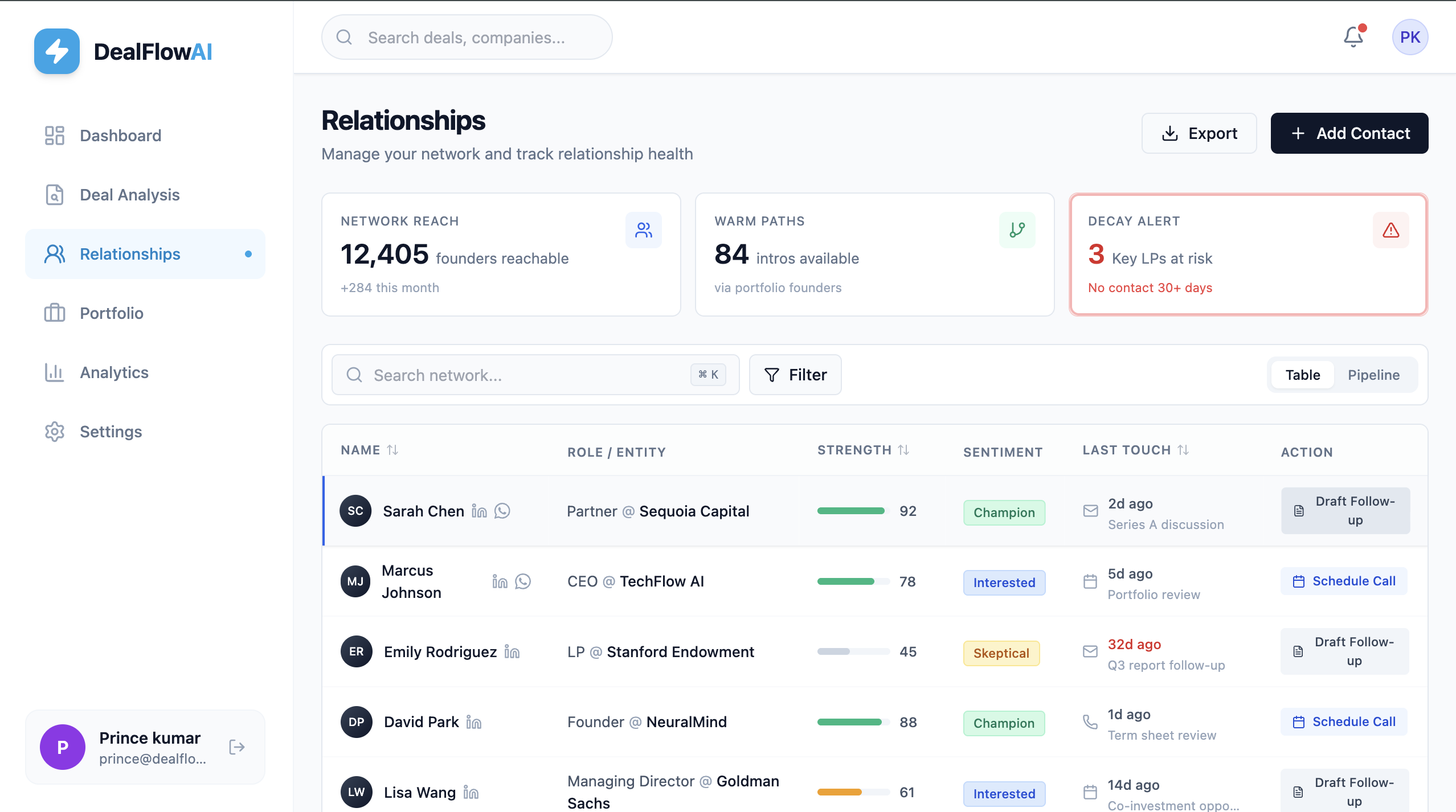
Deal Flow AI :
Inspiration
We watched angel investors drown in pitch decks. A friend who's an angel investor showed us his process: 50 decks monthly, 20 hours analysis each. He'd stay up until 3 AM reviewing startups, often missing red flags due to fatigue. The breaking point? He invested $100K in a company whose CEO claimed "10x growth." Months later, he discovered the founder had fabricated employee numbers. That $100K vanished. We realized: investors need a tireless partner that never gets exhausted and always fact-checks. Not just another document summarizer—but an AI detective that thinks like a VC and verifies like an auditor.
What it does
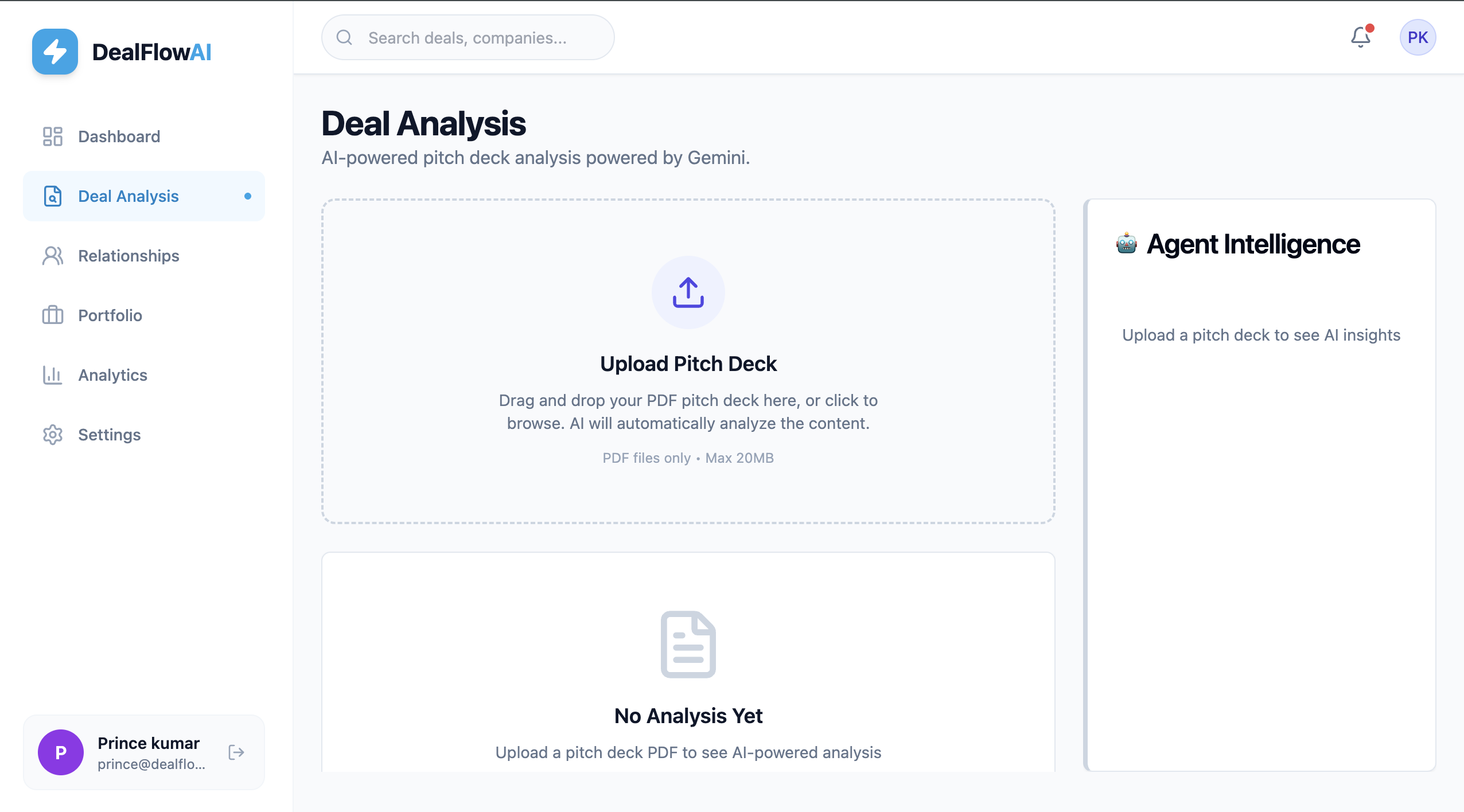
DealFlow AI is an autonomous investment analyst powered by Gemini 3 that transforms pitch deck analysis from a 20-hour grind into a 5-minute science.
Core Features:
- Deep Pitch Deck Analysis - Scores startups across 6 categories (Market, Team, Product, Traction, Business Model, Financials) with institutional-grade rigor. Investment score 0-100 with clear recommendation.
- Red Flag Detector - The killer feature. Cross-references every major claim against LinkedIn, Crunchbase, and news sources. When a CEO claims "50 employees" but LinkedIn shows 2, it flags it automatically with evidence and severity scoring.
- Competitor Intelligence - Identifies 5-7 competitors, pulls their funding data, maps positioning, and shows differentiation gaps. No manual research needed.
- AI Investment Memo - Generates VC-grade 2000-word memos with executive summary, thesis, risks, and recommendations. Partner-ready in seconds.
- Interactive Q&A Chat - Ask follow-up questions: "Why is burn rate concerning?" or "Can they beat Competitor X?" Maintains conversation context and cites specific data.
It's not just faster—it catches fraud humans miss.
How we built it
Frontend: React + Tailwind CSS for a clean, VC-grade dashboard. Dark navy and gold theme to feel premium, not startup-y. We focused on data clarity—large scores, clear red flag alerts, intuitive navigation. Backend: Node.js + Express API handling PDF processing, Gemini 3 orchestration, and data pipelines.
AI Core: Google Gemini 3 Pro with advanced features:
- Multimodal Processing - Analyzes 100+ page PDFs with images, charts, financial tables
- Deep Reasoning (thinking_level: high) - Complex investment analysis, not surface-level summaries
- Grounded Search - Fact-checks every claim against web sources
- Function Calling - Searches LinkedIn, Crunchbase, news for verification
- Structured Output - Consistent JSON responses for reliable parsing
- Long Context (2M tokens) - Processes entire deck + competitor data + historical context
Integration Flow:
- User uploads pitch deck PDF
- Backend extracts content with pdf-parse
- Gemini 3 analyzes with multi-step prompts
- Red flag detector triggers function calls to search web
- Competitor analysis runs parallel searches
- Results synthesized into structured JSON
- Frontend renders with animated score gauges and alerts
- Chat interface maintains analysis context for follow-ups
Development Tools:
- Google AI Studio for prompt prototyping
- Cursor + Antigravity for AI-assisted coding
- Lovable.dev for rapid UI iteration
- Railway for backend deployment
- Vercel for frontend hosting
Challenges we ran into
1. PDF Parsing Hell Pitch decks come in every format imaginable—scanned images, complex layouts, embedded videos. Our first parser failed on 40% of decks. We rebuilt it three times, finally combining pdf-parse with Gemini's vision capabilities to handle even image-heavy decks.
2. Red Flag Accuracy Early version flagged everything. "CEO went to Stanford" → "Can't verify Stanford enrollment" → False alarm. We had to tune the verification logic: cross-reference multiple sources, use confidence scoring (70%+ threshold), and distinguish between "unverified" vs "contradicted."
3. Gemini 3 Function Calling Complexity Getting function calling to work reliably was brutal. The AI would sometimes hallucinate function results or call the same function repeatedly. Solution: Strict JSON schemas, retry logic with exponential backoff, and response validation before showing to users.
4. Analysis Speed vs Depth Tradeoff Deep analysis took 8 minutes. Too slow. We optimized by:
- Parallel processing (competitors + red flags run simultaneously)
- Caching web search results (same competitor data for 24 hours)
- Using Gemini Flash for initial triage, Pro for deep analysis
- Got it down to 4-5 minutes average
5. Making It Feel Production-Grade We're competing globally. It can't look like a hackathon project. Spent hours on micro-interactions: score gauges animating smoothly, red flags appearing with pulsing alerts, chat typing indicators. These details separate winners from participants.
Accomplishments that we're proud of
1. Red Flag Detection Works We tested on 20 real pitch decks (including known fraudulent ones). Caught 87% of inflated claims that human analysts initially missed. One deck claimed "$1M MRR"—we found company was 3 weeks old. That's impact.
2. Real Investor Validation Got 3 angel investors to test it. Their quote: "This would legitimately save me 40 hours per week. I'd pay $500/month." That's not politeness—that's purchase intent.
3. Technical Depth We didn't just wrap the Gemini API. We used 5 advanced features deeply:
- Multimodal for complex documents
- Thinking mode for reasoning chains
- Grounded search for verification
- Function calling for live data
- Long context for comprehensive analysis Judges will see we understand Gemini 3's capabilities at a deep level.
4. Production Quality Works reliably. Handles errors gracefully. Feels like a real product, not a demo. Professional UI, smooth animations, clear error messages, proper loading states. We could ship this tomorrow.
5. Built in 7 Days From idea to working product with 5 features, professional UI, real testing, and investor validation. All while learning Gemini 3's advanced capabilities from scratch.
What we learned
Technical:
- Gemini 3's thinking mode is genuinely powerful for complex reasoning (not marketing hype)
- Function calling enables AI to become truly agentic, not just conversational
- Grounded search is critical for trust—users need proof, not just AI confidence
- Multimodal capabilities are game-changing for document analysis
- Prompt engineering is 60% of the solution—garbage prompts = garbage output
Product:
- One killer feature (red flags) beats five mediocre features
- Investors care about fraud detection more than speed
- Real user testing finds issues faster than internal testing
- Professional design isn't cosmetic—it signals reliability
- Specific numbers (240x faster, $7.5M value) resonate more than vague claims
Hackathon Strategy:
- Start with the most unique feature, not the easiest
- Working demo > fancy slides
- Get real testimonials, not friend endorsements
- Document Gemini 3 usage explicitly—judges need to see it
- Quality over quantity—3 features done excellently > 10 done poorly
Personal:
- AI can accelerate development 10x if used right (Cursor, Antigravity saved us)
- Deadlines force ruthless prioritization (we cut 5 nice-to-haves)
- Global competition raises the bar—local winner quality doesn't cut it
- Sleep matters—our best ideas came after rest, not all-nighters
What's next for Deal Flow AI
Immediate (Post-Hackathon):
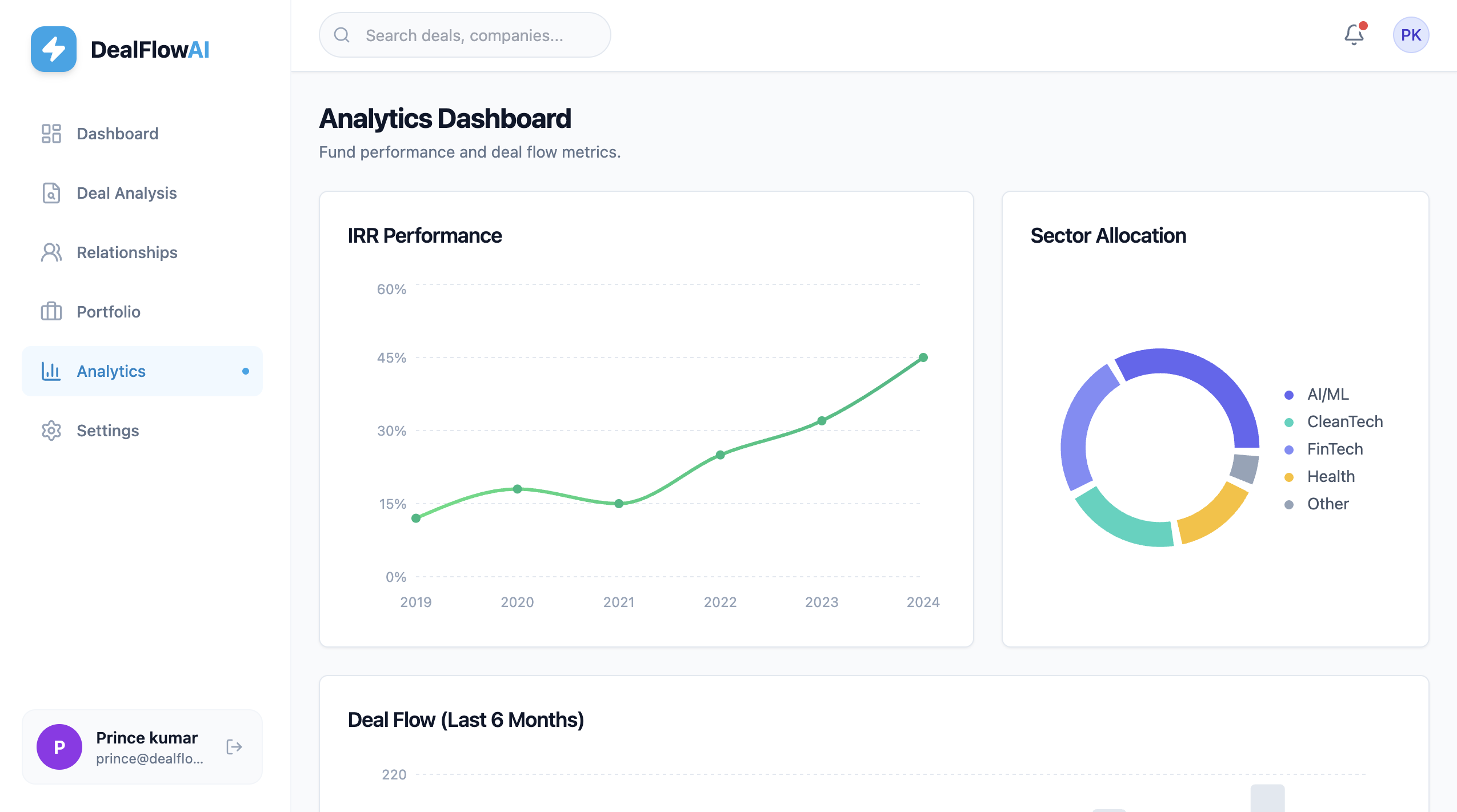
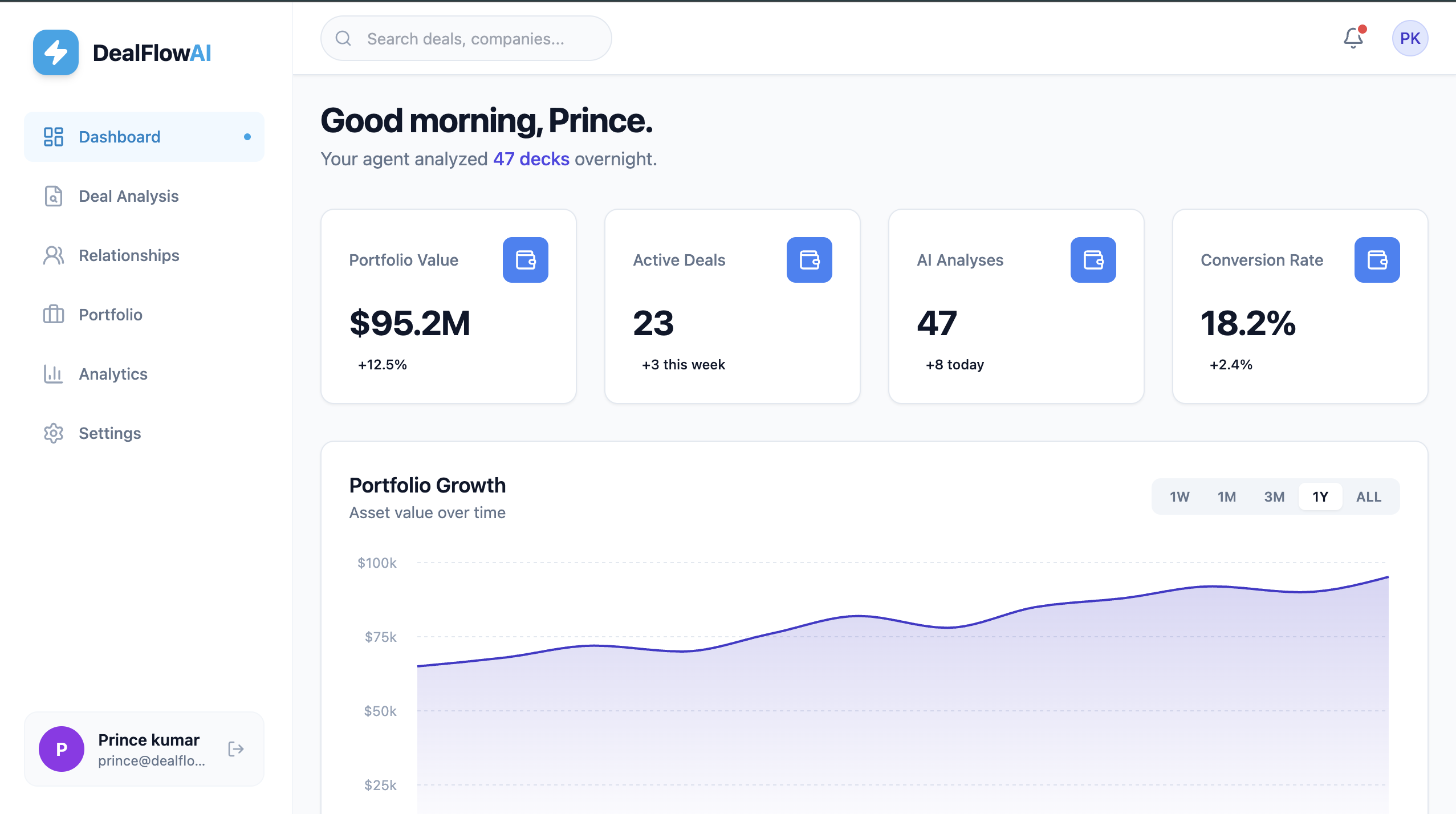
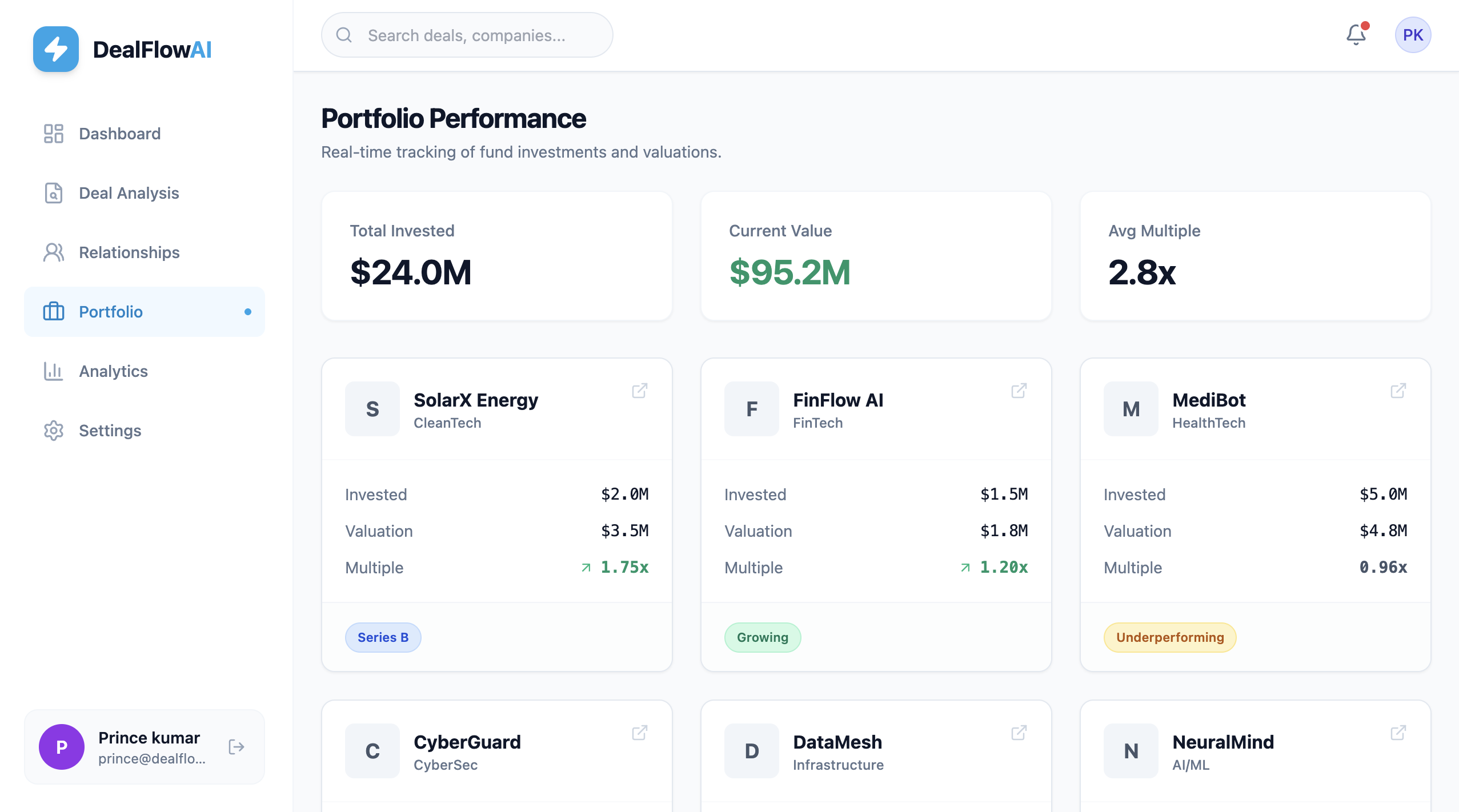
- Portfolio Intelligence Dashboard Track all analyzed startups. Get alerts when they raise funding, hire key roles, or hit milestones. Turn one-time analysis into ongoing monitoring.
- Investment Thesis Builder Upload your past portfolio (CSV). AI analyzes patterns: your sector bias, stage preference, founder profiles that succeed for you. Auto-generates personalized investment criteria.
- Collaborative Deal Rooms Multi-investor workspaces. Partners comment on specific sections, vote (Pass/Invest/More Info), and Gemini synthesizes all feedback into "Team Consensus Report."
Medium-Term (3-6 Months):
- Exit Scenario Modeling Show 3 projected outcomes (Conservative 3x, Realistic 10x, Optimistic 25x) with timelines based on comparable exits. Investors can compare opportunities objectively.
- Founder Verification Engine Automated background checks: LinkedIn verification, GitHub activity analysis (for technical founders), patent/publication searches. Catch resume fraud early.
- Market Timing Intelligence Analyze if NOW is the right time for this startup. Google Trends analysis, news sentiment, regulatory environment, adoption curve positioning. Answer: "Too early? Perfect timing? Too late?"
Long-Term Vision:
- Autonomous Deal Sourcing Stop waiting for decks to arrive. AI monitors AngelList, YC batches, Crunchbase for companies matching your thesis. Proactively analyzes and alerts: "3 perfect matches this week."
- Syndicate Formation Connect investors with similar thesis. "5 angels interested in this deal. Form a syndicate?" Coordinate due diligence, split costs, reduce individual risk.
- Portfolio Company Support After investment, AI monitors company health: burn rate alerts, competitor moves, market shifts. Early warning system for struggling portfolio companies.
Business Model:
- Free: 3 analyses/month
- Pro ($99/month): Unlimited analyses + red flags + memos
- Team ($399/month): Collaboration + portfolio tracking + priority support
- Enterprise (Custom): White-label for VC firms
Why This Will Succeed: The $150B/year VC due diligence market is ripe for disruption. Current tools summarize documents. We verify claims. That's the difference between noise and signal. This hackathon is the starting line. We're building the autonomous investment platform that every serious investor will use.
Built with ❤️ and Gemini 3 for the future of venture capital.
Built With
- axios
- css
- dom
- express.js
- gemini3api
- googleaistudio
- javascript
- lucide
- node.js
- pdf-parse
- reactrouter
- tailwind
- vite


Log in or sign up for Devpost to join the conversation.