
Deadstock Live Lab: Material-Constrained Co-Design Atelier "DESIGN WITH WHAT EXISTS." Transforming surplus textile remnants into 100% traceable, circular fashion capsules through multimodal vision and real-time collaboration.
💡 Inspiration Every year, the global fashion industry produces over 92 million tons of textile waste. In ateliers, sample rooms, and warehouses around the world, millions of meters of premium, high-grade fabric sit idle as "deadstock"—surplus bolts, mill end-runs, and cutting-room remnants. Most of this material is incinerated or landfilled simply because traditional fashion workflows design collections before sourcing fabric, making irregular, limited-yardage inventory difficult and expensive to utilize.
At the same time, the boom in generative AI fashion has focused almost entirely on ungrounded image synthesis: generating photorealistic renders from text prompts without any connection to real-world physics, yardage limits, or physical availability. These tools encourage the consumption of virgin resources rather than solving the waste crisis.
We asked ourselves: What if AI wasn't allowed to imagine new fabric? What if we forced generative intelligence to design strictly within the boundaries of what already sits on our cutting tables?
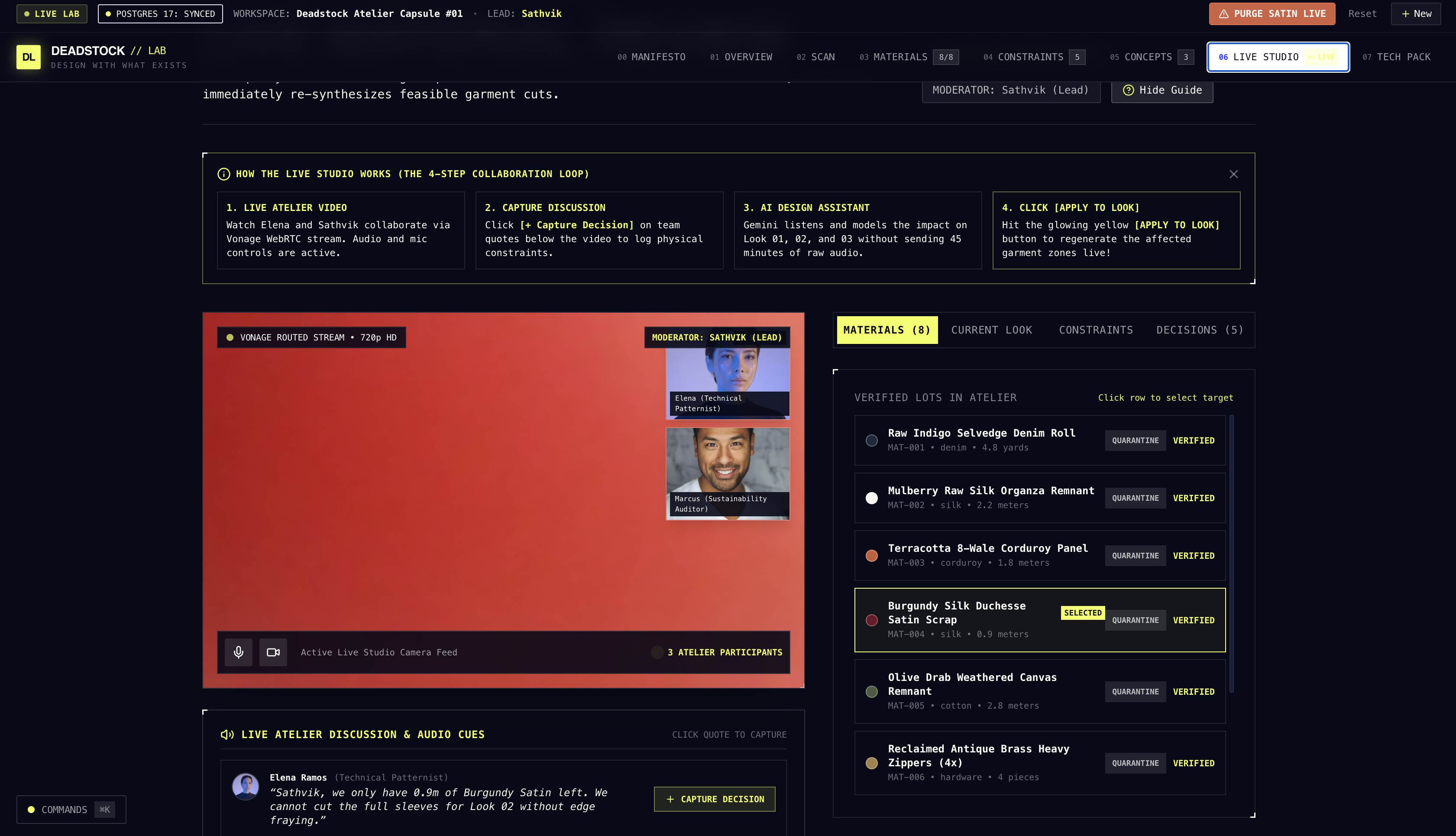
That question gave birth to Deadstock Live Lab—a real-time, circular co-design studio where Google Gemini multimodal vision authenticates physical surplus remnants, a deterministic Constraint Engine guarantees zero virgin materials, and Vonage Video brings designers and technical patternmakers together in an interactive creative war room.
🧵 What It Does Deadstock Live Lab transforms the circular design workflow into a seamless 5-stage pipeline:
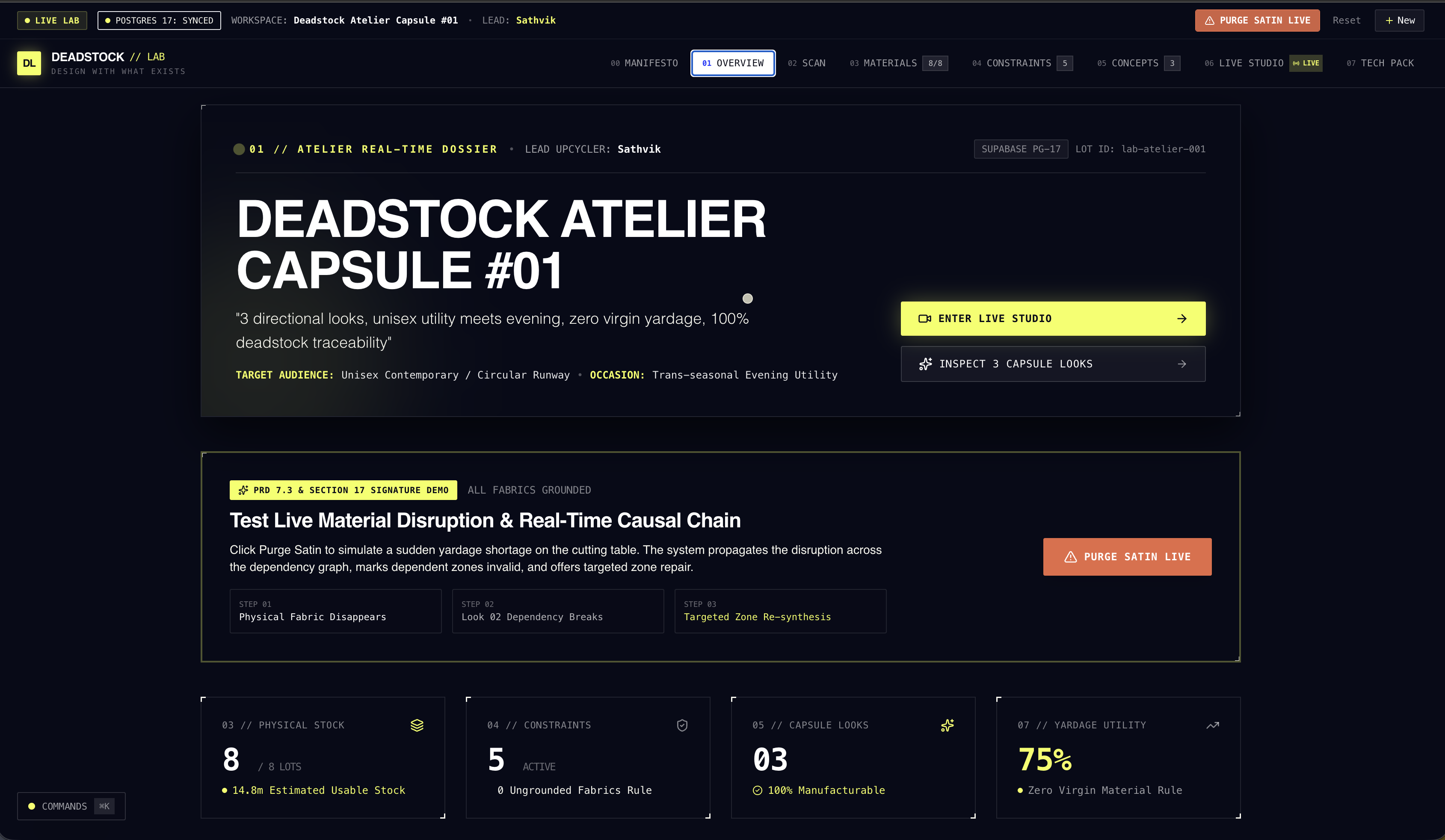
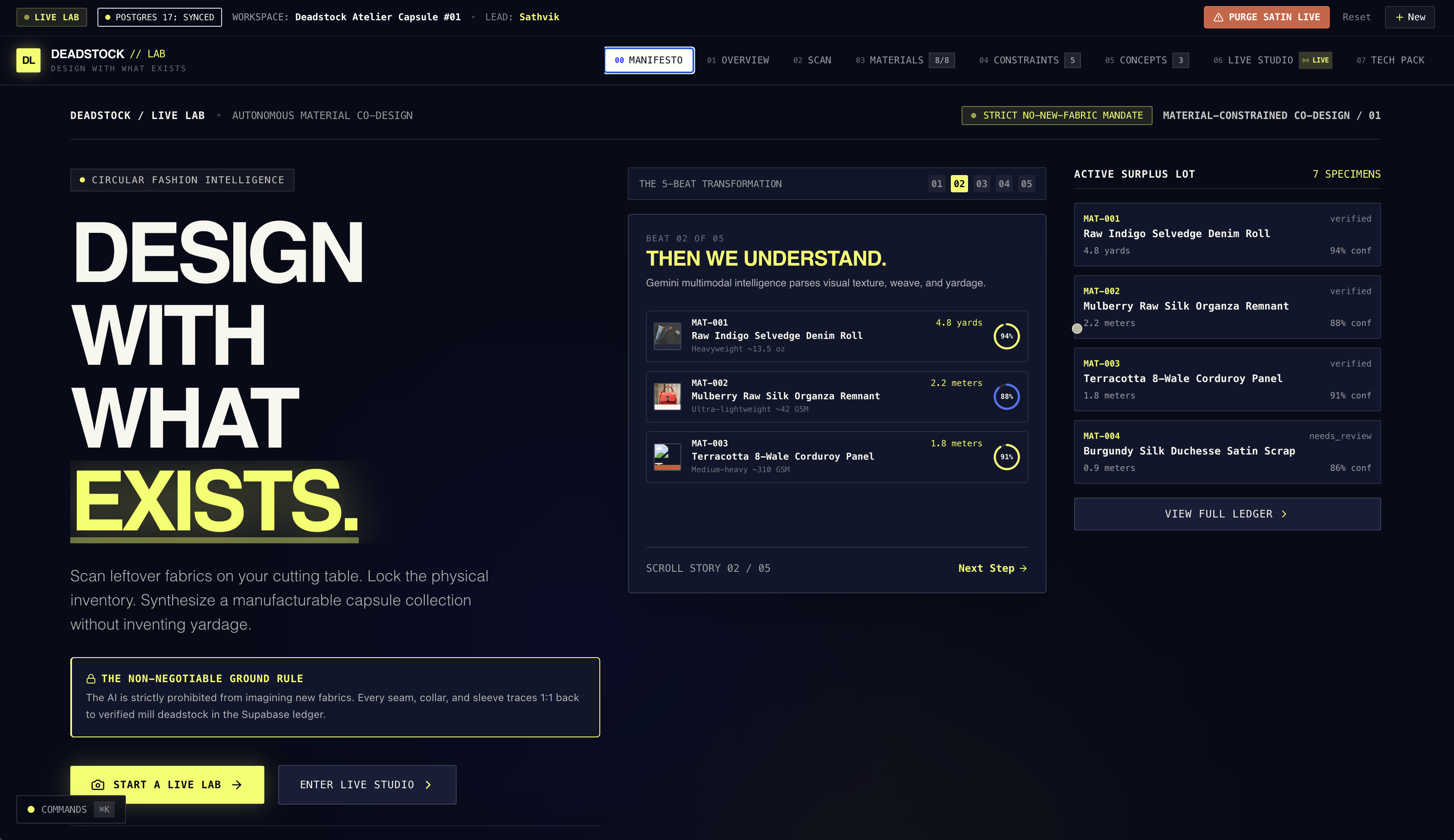
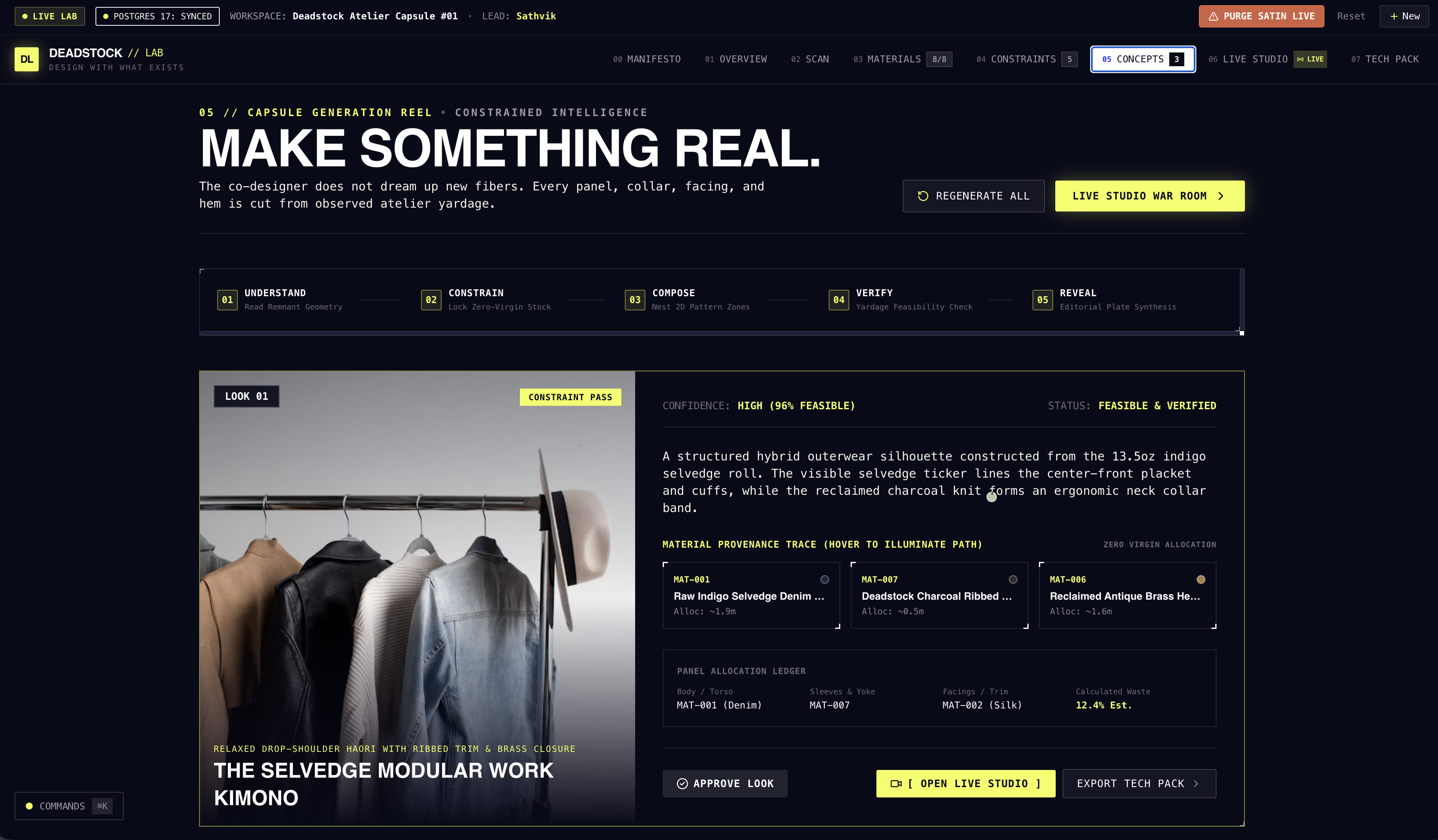
Physical Material Scan & DNA Authentication: Designers point their camera at raw fabric remnants. Powered by Google Gemini multimodal vision, the system extracts the weave pattern (e.g., 3/1 right-hand twill, slub filament), dominant color swatch, weight class, and estimated usable yardage into an authoritative material ledger. Inviolable Constraint Enforcement: Hard constraints forbid ungrounded virgin textiles, lock silhouette maximums, and enforce verified inventory usage. Soft constraints allow designers to weight aesthetic harmony, minimize cutting waste, and bias toward modular or gender-neutral silhouettes. Manufacturable Capsule Generation: Gemini synthesizes complete garment collections where every single panel, collar, yoke, facing, and sleeve is explicitly mapped to an identified surplus lot. Signature Material Trace: Clicking or hovering over any garment region illuminates an animated trace line connecting the digital design back to the physical roll specimen. Live Studio & Causal Disruption Engine: Teams review the capsule in real-time over Vonage WebRTC. If a fabric is purged (e.g., discovering dry rot or insufficient yardage), the dependency graph propagates the conflict immediately: dependent looks turn amber, while untouched designs remain locked. Designers can then perform targeted, surgical zone regeneration without re-synthesizing the entire collection. 100% Traceable Manufacturing Tech Pack: Produces an exportable engineering dossier and printable lookbook detailing cut allocation, yardage consumption, and signed decision audit trails. 📐 Mathematical Formulation: Material Allocation & Waste Minimization To ensure that generative concepts never exceed physical yardage and to mathematically optimize off-cut efficiency, the atelier solves a constrained 2D remnant allocation problem 🛠️ How We Built It We designed Deadstock Live Lab as an award-winning, editorial fashion-tech experience with a robust, production-grade distributed architecture:
Frontend & Design System: Built on Next.js 15 App Router and TypeScript. Rather than a generic SaaS dashboard, we engineered an editorial interface following strict fashion-tech motion guidelines: industrial corner notches, custom magnetic cursor with contextual states (INSPECT, TRACE, JOIN), kinetic display typography, scanline reticles, and high-contrast fluorescent yellow (#F2FF55) against ink night (#080A18). Motion & Interactions: Choreographed using Framer Motion for state transitions, drawer reveals, and dynamic SVG particle trace paths linking garment zones to fabric swatches. Multimodal Artificial Intelligence: Integrated Google Gemini (gemini-3.6-flash) via @google/genai utilizing structured JSON schema output validation for zero-shot textile weave analysis, property estimation, and constraint-aware pattern panel composition. Real-Time Video Collaboration: Powered by Vonage Video WebRTC API (OpenTok) with secure server-side JWT authentication, custom publisher settings (720p HD, automatic gain control), and live multi-participant video streams with visual speaking rings. Persistence & Causal Graph: Backed by Supabase PostgreSQL 17 via connection poolers, maintaining authoritative state for verified material inventory, active constraint rules, generated looks, and a cryptographically traceable decision ledger signed by Lead Upcycler Sathvik. 🧗 Challenges We Faced Eliminating Hallucinatory Bias in Generative Models: Standard LLMs naturally invent fantasy materials (e.g., suggesting cashmere trims when only denim and twill exist). We solved this by designing a strict two-pass validation pipeline: Gemini generates candidate panel allocations bounded by rigid JSON schemas, followed by our deterministic client-side constraint validator that cross-examines proposed yardage against live database records. Real-Time Causal Invalidation in Multi-User Sessions: Propagating material purges across concurrent video participants required precise state synchronization. When a collaborator quarantines a bolt over Vonage video, our dependency graph pinpoints the exact cut zones that break without destroying the remaining collection, enabling surgical zone repairs. WebRTC Stream Reliability & Audio Handling: Implementing low-latency multi-party video alongside dynamic canvas overlays required careful lifecycle management to prevent ICE candidate gathering timeouts and ensure seamless camera unmounting across screen transitions. Balancing Editorial Aesthetics with Technical Rigor: Bridging high-fashion editorial art direction with dense industrial tech-pack tables required creating bespoke components like MaterialDNA, ConstraintBadge, and TraceLineOverlay rather than relying on standard UI component kits. 🧠 What We Learned Scarcity Drives Cohesive Design: Counter-intuitively, severely restricting the AI's available materials created significantly more unique, cohesive, and artful garment silhouettes than open-ended text prompts ever did. Transparency Builds Creative Trust: Fashion directors and patternmakers are hesitant to trust AI black boxes. By visually rendering the exact line between a jacket's sleeve and the physical roll of twill on the shelf—and providing a clear "Why the AI Thinks This" explanation—we transformed AI from an unpredictable threat into an intuitive creative assistant. Circular Fashion is an Optimization Problem: The bottleneck in sustainable fashion isn't creative willpower; it is the friction of matching irregular physical yardage to complex 2D pattern cuts in real time. 🚀 What's Next for Deadstock Live Lab Direct 2D/3D CAD Export: Generating direct DXF/AAMA cutting files and CLO3D/Browzwear digital twin files directly from validated garment zone mappings. Computer-Vision RFID Yardage Tracking: Integrating smart atelier cutting tables equipped with overhead depth cameras and RFID bolt scanners to automate remnant measurement during fabric unrolling. Cross-Brand Atelier Surplus Exchange: Enabling textile mills and luxury houses to list quarantined remnants directly into Deadstock Live Lab workspaces worldwide to achieve true zero-virgin circularity.
Built With
- artificial-intelligence
- canvas
- circular-economy
- computer-vision
- fashion-tech
- framer-motion
- gemini-api
- generative-ai
- google-gemini
- multimodal-ai
- next.js
- node.js
- opentok
- postgresql
- react
- rest-api
- structured-outputs
- supabase
- sustainability
- svg
- tailwindcss
- typescript
- vonage
- vonage-video-api
- webrtc

Log in or sign up for Devpost to join the conversation.