-
-
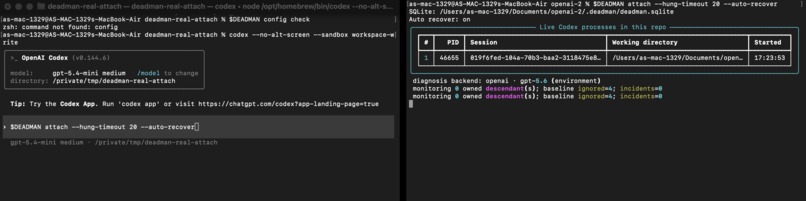
Healthy monitoring (Codex idle, no task)
-
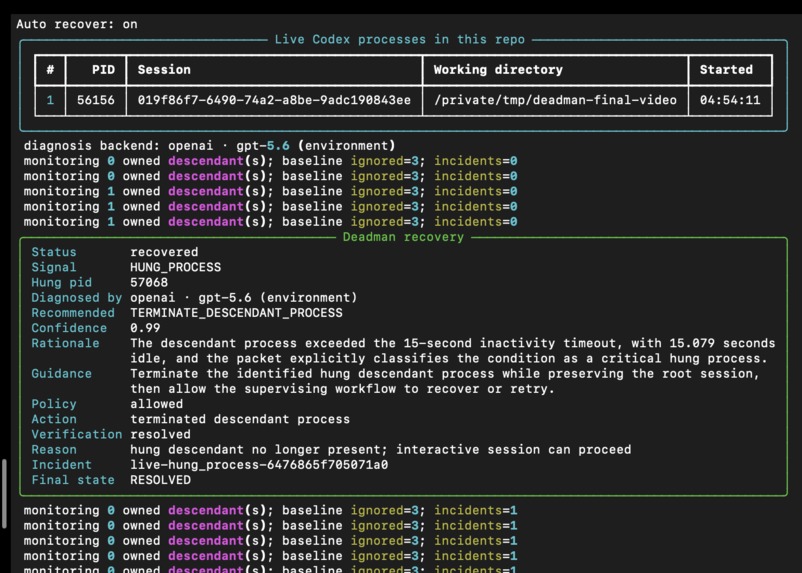
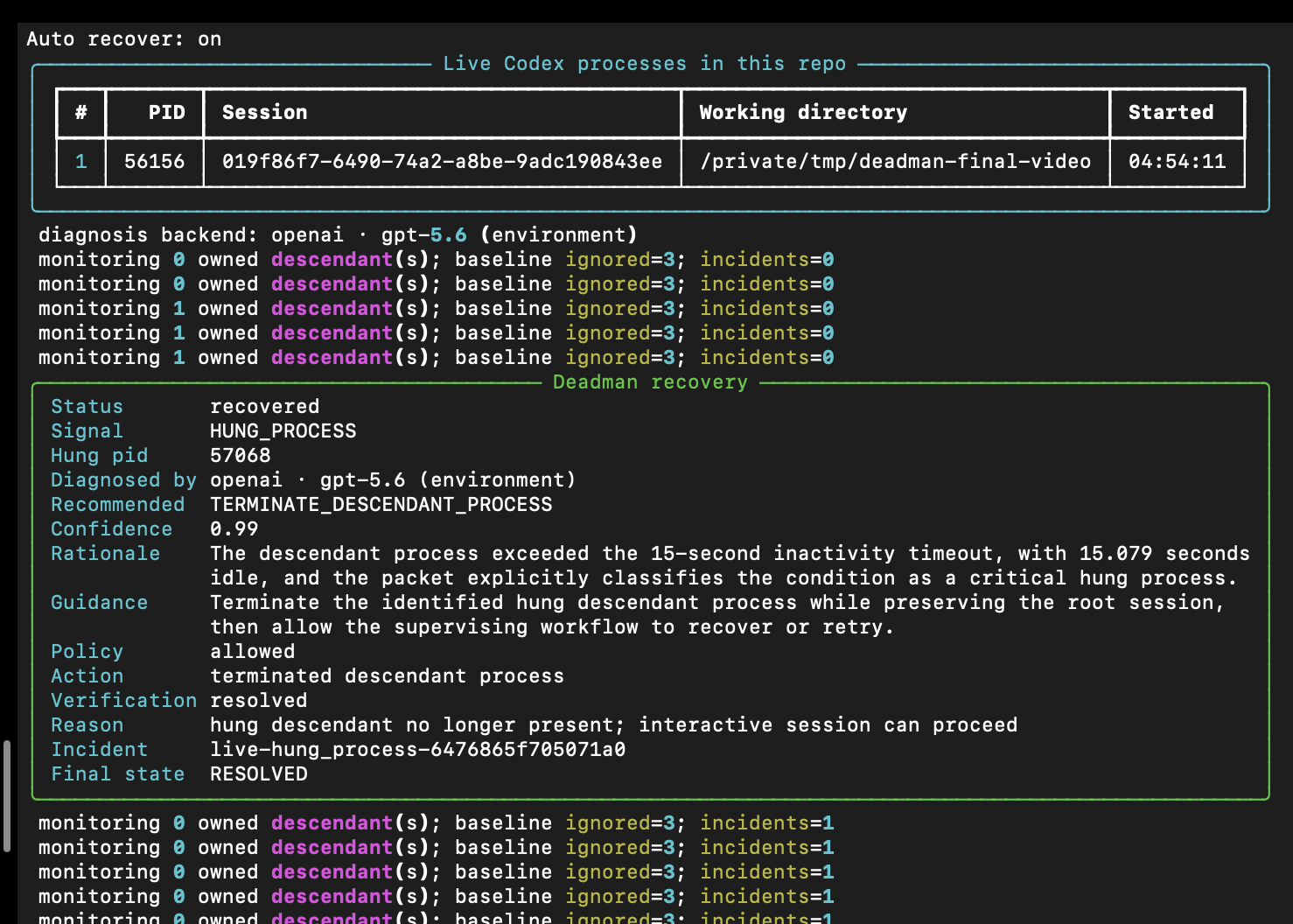
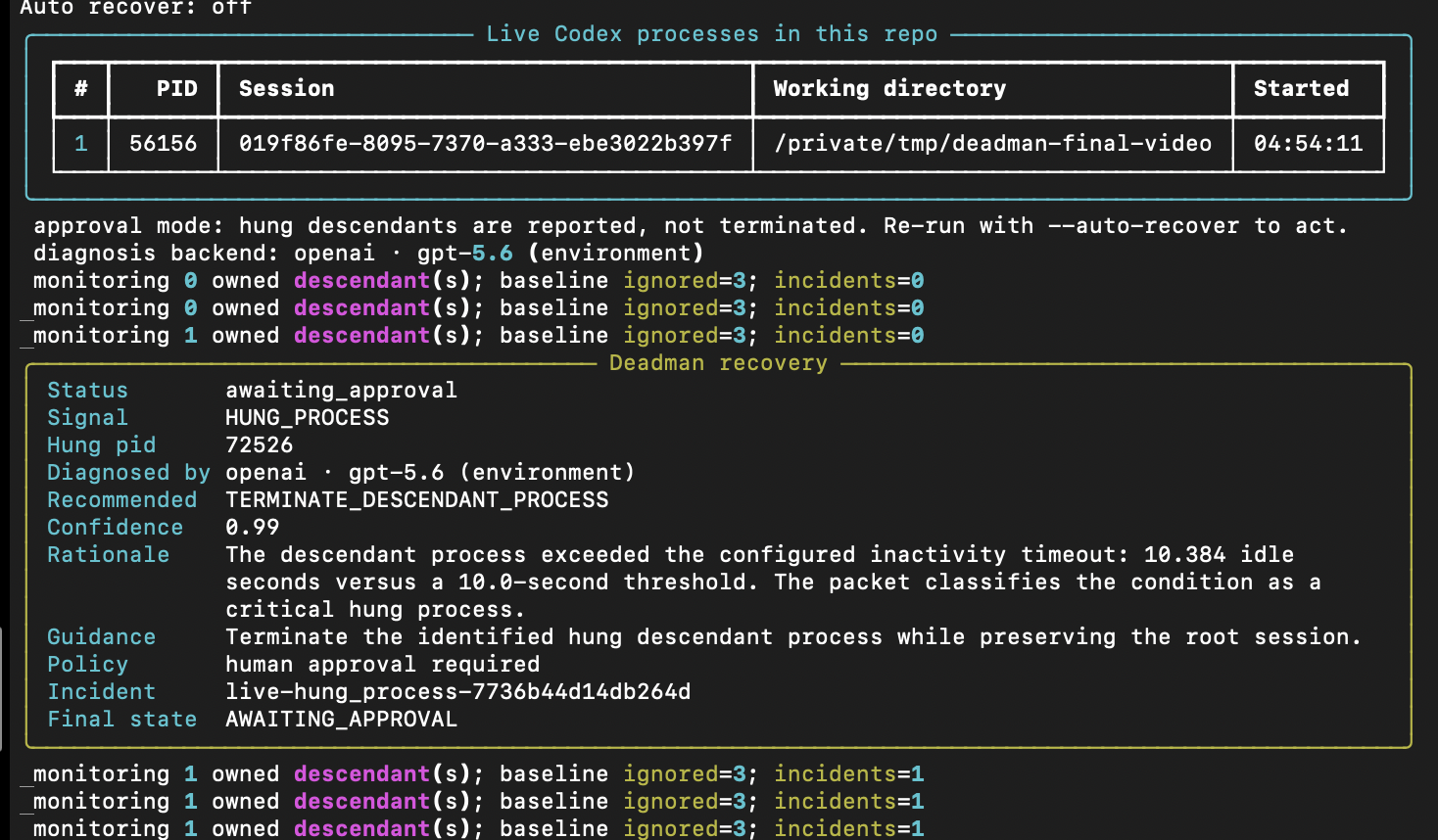
GPT-5.6 diagnoses the hang; Deadman safely recovers only owned descendants.
-
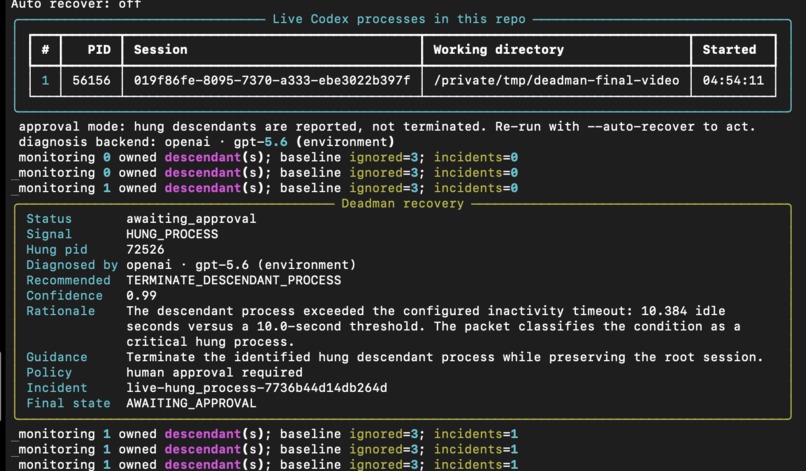
Without explicit permission, Deadman records evidence and waits for approval.

Deadman
Inspiration
Autonomous coding agents can work for long periods, but a single silent child process, wedged development server, or unbounded retry loop can stop all useful progress. The agent may still appear active while it is only waiting. Developers then return to a stalled session, wasted time, and no trustworthy way to recover it without killing the entire agent.
We built Deadman around one question: how can an independent supervisor detect that an autonomous coding loop is genuinely stuck, recover only what is safe to recover, and prove that the intervention worked?
What it does
Deadman is a local safety supervisor for Codex coding sessions. Its control loop is:
Observe -> Detect -> Diagnose -> Recover -> Verify -> Report
Deterministic code watches session events and operating-system process trees. When a detector finds a supported failure, Deadman sends GPT-5.6 a compact evidence packet. The model can recommend one typed action, but it receives no shell, filesystem, process-control, or session-control tools.
Every recommendation must pass deterministic policy and process-ownership checks. Deadman can then terminate only a freshly proven descendant process, verify that the failure was resolved, and store the complete evidence chain in SQLite. If ownership or verification is uncertain, it refuses the action and escalates instead.
Deadman supports several workflows:
deadman runlaunches and supervises a non-interactive command such ascodex exec --json.deadman agentlaunches an interactive Codex TUI inside a supervised PTY on macOS and Linux.deadman attachdiscovers and supervises a Codex TUI already running in another terminal in the same repository.deadman watchreads persisted Codex session evidence without controlling processes.deadman replay,deadman demo, anddeadman reportprovide deterministic, credential-free evaluation paths.
Automatic recovery is off by default. It must be explicitly enabled with --auto-recover.
How we built it
We used Codex throughout both product design and implementation. A Codex web planning thread helped us explore the failure model, reject unsafe plugin-style control, and choose an independent supervisor architecture. The main Codex implementation thread then helped build and repeatedly test the adapters, detectors, typed diagnosis schema, policy engine, process executor, verification gates, SQLite incident state machine, CLI modes, replay fixtures, reports, and cross-platform behavior.
The system is written in Python using Typer for the CLI, Rich for terminal output, Pydantic for strict model-response validation, SQLite for durable evidence, and psutil for process ownership and recovery. Live diagnosis uses the OpenAI Responses API with GPT-5.6. Deterministic replay and fixture diagnosis keep the core evaluation path usable without credentials.
The architecture deliberately separates intelligence from authority. GPT-5.6 interprets bounded evidence and recommends an action. Deterministic code decides whether that action is permitted, executes it, and verifies the result.
Challenges we ran into
The hardest problem was safe process identity. Early process classification could mistake the Codex root for a Python-related target when the prompt itself contained the word Python. We fixed this by classifying executable identity and proving ancestry from the live Codex root instead of relying on command text.
Process ownership can also change between detection and recovery. A child may exit, become a zombie, or be reparented before Deadman acts. Deadman therefore rechecks ownership immediately before intervention. This occasionally produces an escalation instead of a recovery, but that is the correct outcome when safety cannot be proven.
Interactive terminal supervision introduced additional challenges: PTY sizing, ANSI output, nested process trees, terminal passthrough, and keeping the Codex TUI alive after recovering its hung tool process. We also had to distinguish persisted session evidence from live process ownership. A session file is useful for observation, but it is not sufficient authority to terminate a process.
Cross-platform support required a clear boundary. The core data model, replay, reporting, watch, attach, and managed run workflows support macOS, Linux, and Windows. The PTY-backed agent command remains macOS/Linux-only because Windows requires a separate ConPTY implementation.
Accomplishments that we're proud of
We demonstrated a real two-terminal recovery against a live Codex TUI. Codex started a silent Python parent and sleeping child. Deadman attached from another terminal, detected the hung process, obtained a typed diagnosis, proved ownership, terminated the two-process descendant tree, verified resolution, and recorded the incident while the Codex TUI remained open.
We are equally proud of the refusal path. During a live package-install test, the target changed before intervention. Deadman refused to terminate it because it was no longer a proven descendant and recorded an escalated incident. Safe refusal is a product feature, not a failed demo.
Other completed work includes:
- Strict evidence-reference validation and typed GPT-5.6 output.
- Automatic recovery disabled by default.
- Verification that can fail and force escalation.
- Durable incident timelines and terminal reports.
- Credential-free replay and demo workflows for judges.
- Live supervision of Codex sessions launched either by Deadman or independently.
- A test suite covering detection, policy, ownership, recovery, verification, persistence, CLI behavior, and platform boundaries.
What we learned
An agent saying that it is working is not the same as measurable progress. Reliable supervision must use independent evidence from events, time thresholds, and the operating-system process tree.
We also learned that diagnosis and authority should remain separate. A model is useful for interpreting evidence and selecting among constrained recovery strategies, but deterministic policy must retain control of every side effect.
Finally, escalation is a valid recovery outcome. A supervisor that always acts is dangerous. A trustworthy supervisor must be able to say, "I detected a problem, but I cannot prove that this action is safe."
What's next for Deadman
The next version will add a dedicated progress ledger and live monitor UI for multiple concurrent Codex sessions, with signal thresholds, policy decisions, verification state, and incident timelines visible in one place. We also plan workload-aware timeout policies so long installs and builds are not treated like silent synthetic hangs.
Further work includes committed failed-verification scenarios, richer postmortem generation, prevention-rule proposals after verified recovery, budget controls for long autonomous runs, and native Windows ConPTY support for interactive supervision.
The long-term goal is for Deadman to become a dependable local control layer for long-running autonomous coding workflows: independent of the agent, conservative about authority, and accountable for every intervention.


Log in or sign up for Devpost to join the conversation.