-
-
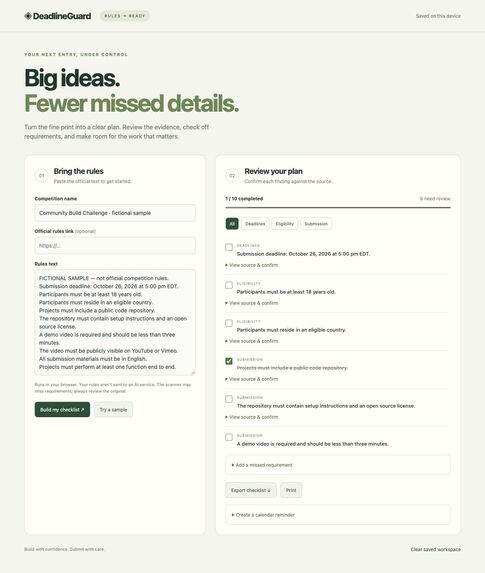
Working DeadlineGuard checklist with source evidence, review controls, and exports.
Inspiration
Competition entrants need to turn lengthy rules into concrete actions while focusing on their project. DeadlineGuard explores a clearer way to review deadlines, eligibility conditions, and submission requirements.
What it does
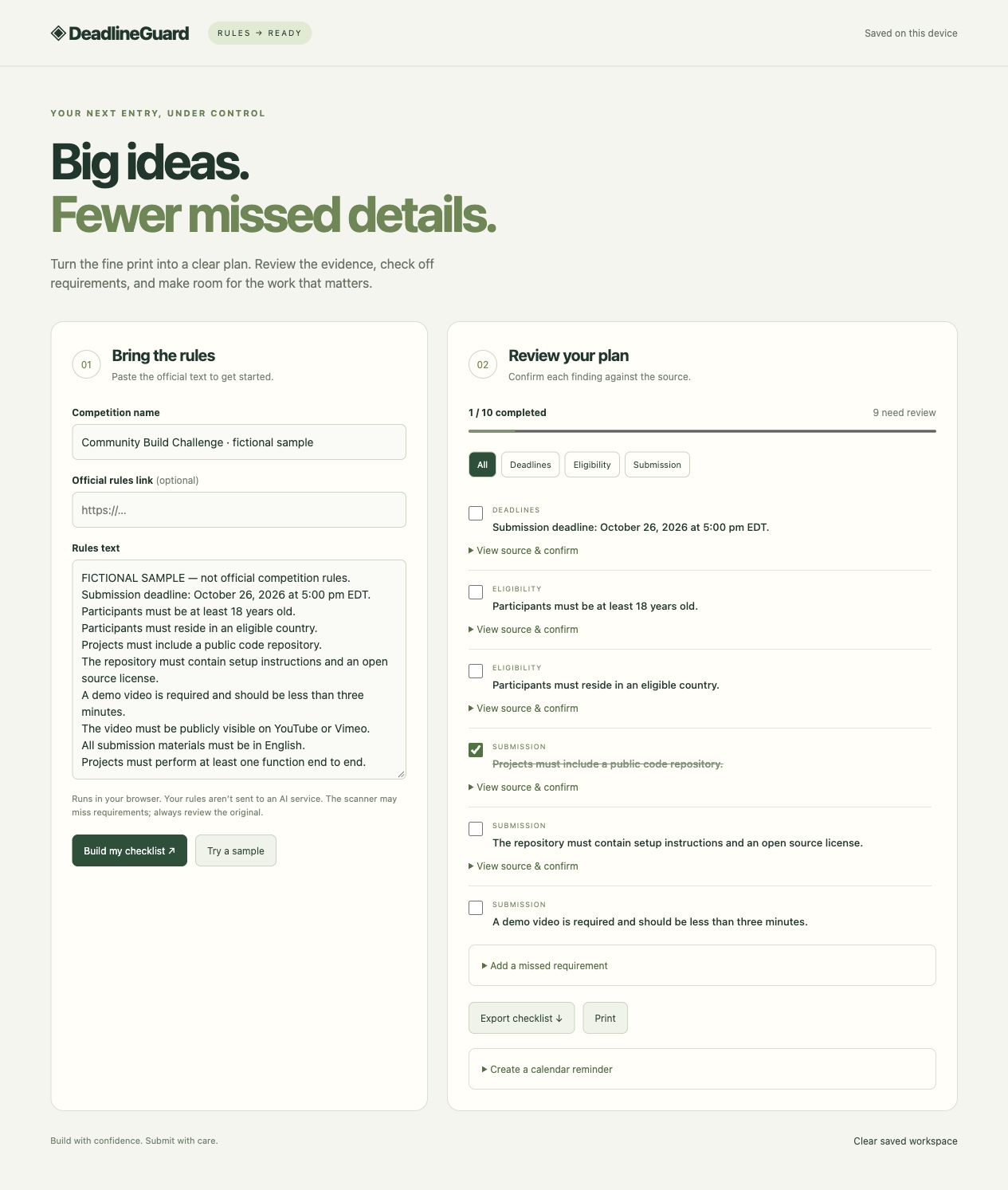
Paste English rules and scan them into a categorized checklist. Every suggested item keeps its original source wording. Source review and task completion are tracked separately. Users can add missed requirements, filter categories, return to saved progress, export a Markdown checklist, and create a calendar file from a manually confirmed deadline.
How it was built
HTML, CSS, and browser JavaScript power the application; Node.js provides local preview and tests. Codex assisted development using the Devpost Learn Skill Pack. The public repository includes scope.md, prd.md, spec.md, setup instructions, tests, and an MIT license. Original application code was built on October 10, 2026. No API keys or paid services are required.
Challenges and verification
Keyword scanning can miss or misclassify requirements. The app preserves source evidence and offers manual additions so users can check results. Calendar export requires a confirmed date, time, and UTC offset rather than guessing from ambiguous text. Seven automated tests passed, including date validation and timezone conversion. Browser checks covered scanning, source review, completion, reload persistence, filtering, manual additions, downloads, and mobile layout. Tests also passed on a fresh public GitHub download.
Current limits and next steps
This is a deterministic text-scanning proof of concept, not an AI semantic interpreter or a guarantee of complete compliance. It does not fetch rules URLs, decide eligibility, monitor rule changes, or send background notifications. Calendar files must be imported into a calendar app. Future work could explore semantic extraction while keeping the evidence-first review workflow.
