-
-
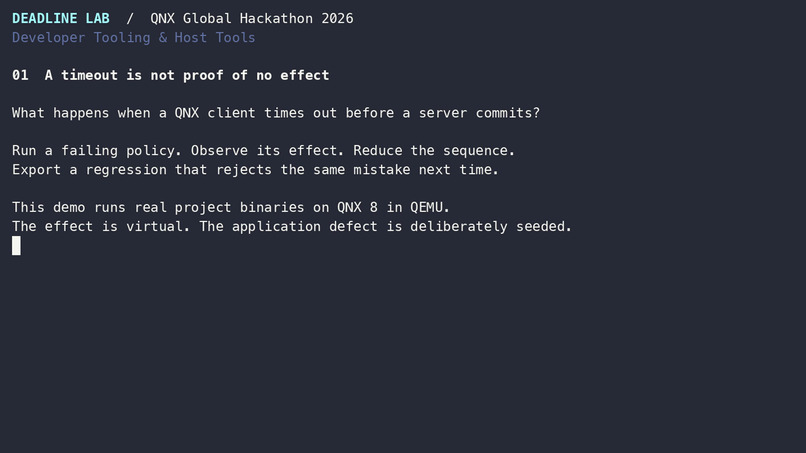
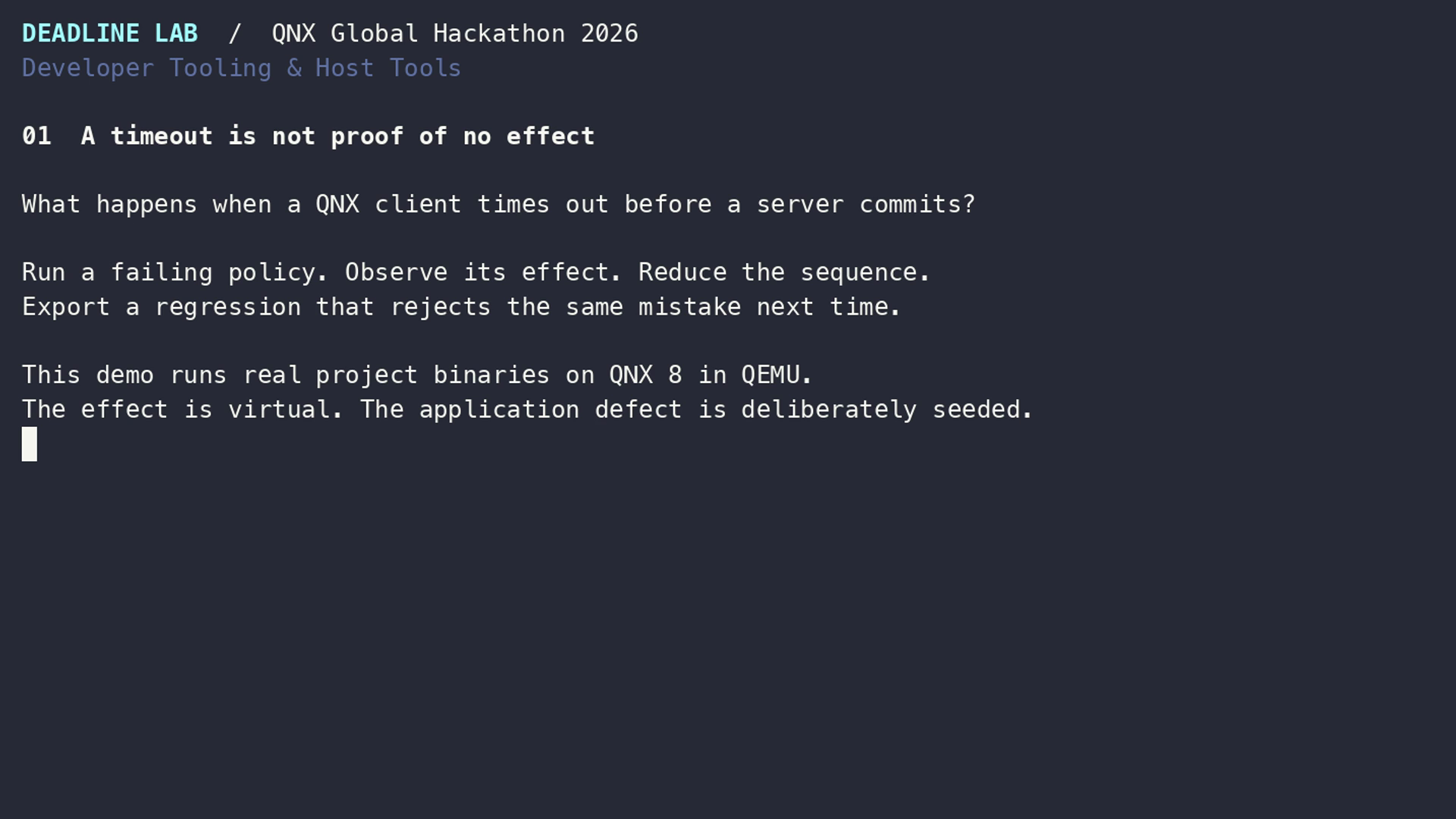
Deadline Lab runs native QNX cancellation checks and exports replayable regressions.
Inspiration
What it does
How we built it
Challenges we ran into
Accomplishments that we're proud of
What we learned
What's next for Deadline Lab
Inspiration
A timeout is easy to see. Whether the operation still changed something is harder to establish. Recovery tests also become difficult to maintain when the useful failure is buried in a long history of retries and restarts.
Deadline Lab makes that failure smaller and keeps the evidence attached. The goal is a regression a developer can understand and replay.
What it does
Deadline Lab runs bounded failure scenarios, records virtual effects through a separate observer, checks an explicit application contract, and reduces a reproducible failing sequence. It exports regression suites with JUnit output. Every native run also includes a healthy request, so rejecting all work cannot pass. Missing or inconsistent observations remain INCONCLUSIVE.
The QNX demo contrasts a reference cancellation policy with a deliberately flawed ignore_unblock policy. The reference handles the unblock request before the virtual commit. The negative control ignores it and produces the unwanted effect. Both still service the separate healthy request.
How it was built
The target programs are C11, compiled using the genuine QNX SDP 8 toolchain. The tested configuration uses qcc 12.2.0, gcc_ntoaarch64le, and QNX 8.0.0 AArch64 in QEMU with two CPUs and 512 MiB RAM. The development environment is Ubuntu 24.04 in a container on an Apple Silicon Mac.
QNX-specific code uses TimerTimeout, message passing, unblock pulses and MsgInfo. A C collector launches the project binaries, observes effect frames through a separate pipe, and exports bounded capture files. Python analysis, reduction and JUnit generation stay on the host. The target needs no Python or source checkout.
Captures retain source and binary hashes, ABI details, raw logs and effect observations. The checker re-evaluates these records instead of trusting a summary. An offline prepare/run/import route supports file transfer without requiring SSH on the target. The repository also contains the original POSIX process-fault workflow and an independent, unmodified nginx HTTP/file adapter for Linux.
Results
The native QNX acceptance workflow completed five reference/negative pairs with all ten expectations met. The reducer shrank five scripted calls to one timed call, with the healthy probe kept separately. Five exported-regression replay pairs passed, and substituting the flawed candidate caused the regression to fail as intended. The offline route also imported a genuine native reference/negative pair with verified provenance.
All 159 Python tests and three C test programs passed. The C programs also ran on QNX, checking 1,052 core assertions, nine effect assertions and four SHA-256 vectors. The public v0.6.0 release includes raw evidence and JUnit reports. Release packaging independently rechecks the native canary against the current executable source before marking it verified.
Challenges and lessons
The SDK installation needed case-sensitive Linux storage. A case-insensitive shared Mac folder caused conflicting SDK filenames. Booting the AArch64 image also required matching VirtIO packages and a disk descriptor from the same generated image set.
The application lesson is more important: a client timeout alone cannot establish cancellation. The checker requires an actual unblock observation before the effect, plus a successful healthy operation. This distinction prevents a missing activation or broken server from looking like a successful test.
Try it
Source and MIT licence: https://github.com/Whyme-Labs/deadline-lab
Step-by-step QNX codelab: https://github.com/Whyme-Labs/deadline-lab/blob/main/docs/qnx-codelab.md
Source and evidence release: https://github.com/Whyme-Labs/deadline-lab/releases/tag/v0.6.0
With your own licensed SDK and target, the codelab walks through compilation, deployment, paired captures, reduction and regression replay. Linux workflows can be checked with ./scripts/verify-container.sh.
Scope and next steps
The demonstrated defects are deliberately seeded in our application fixture or gateway policies. No QNX or nginx vulnerability is claimed. Effects are virtual, and QEMU is not used to claim physical safety or hardware latency bounds. Reduction establishes empirical deletion minimality within the scenario grammar, not a globally shortest concurrent history.
The next steps are a fresh developer reproduction and an adapter for an independent QNX application. Neither has been demonstrated yet. ChatGPT and OpenAI Codex assisted with implementation, documentation and testing; the reported results come from executed programs and retained evidence.
