-
-
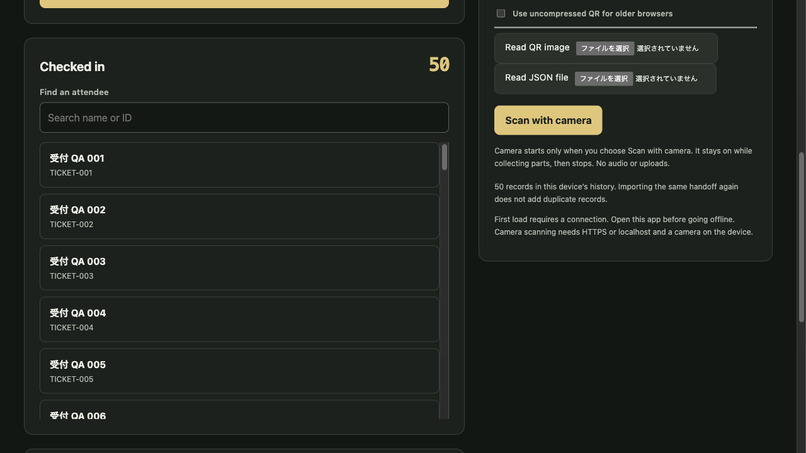
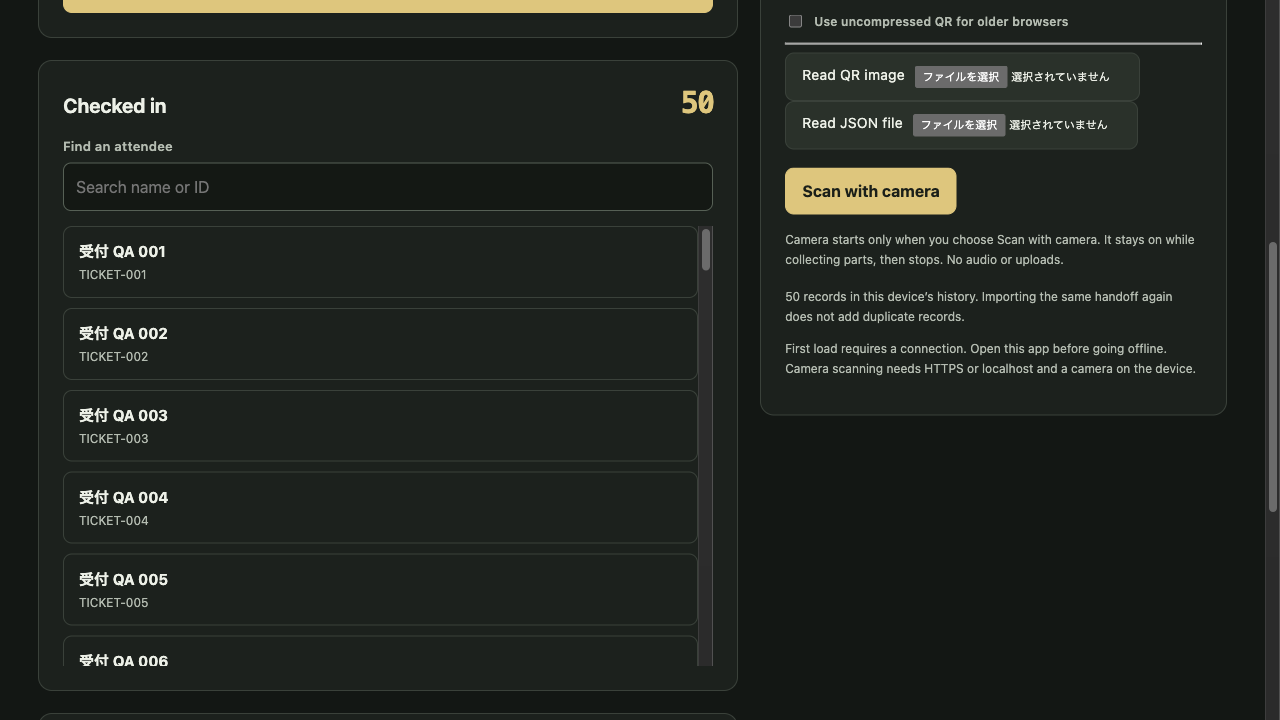
Reception: local check-ins with one count per attendee and a preserved event history.
-
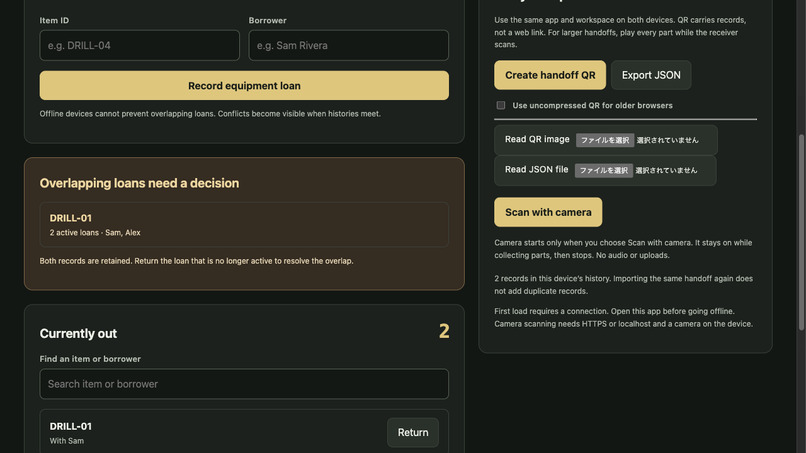
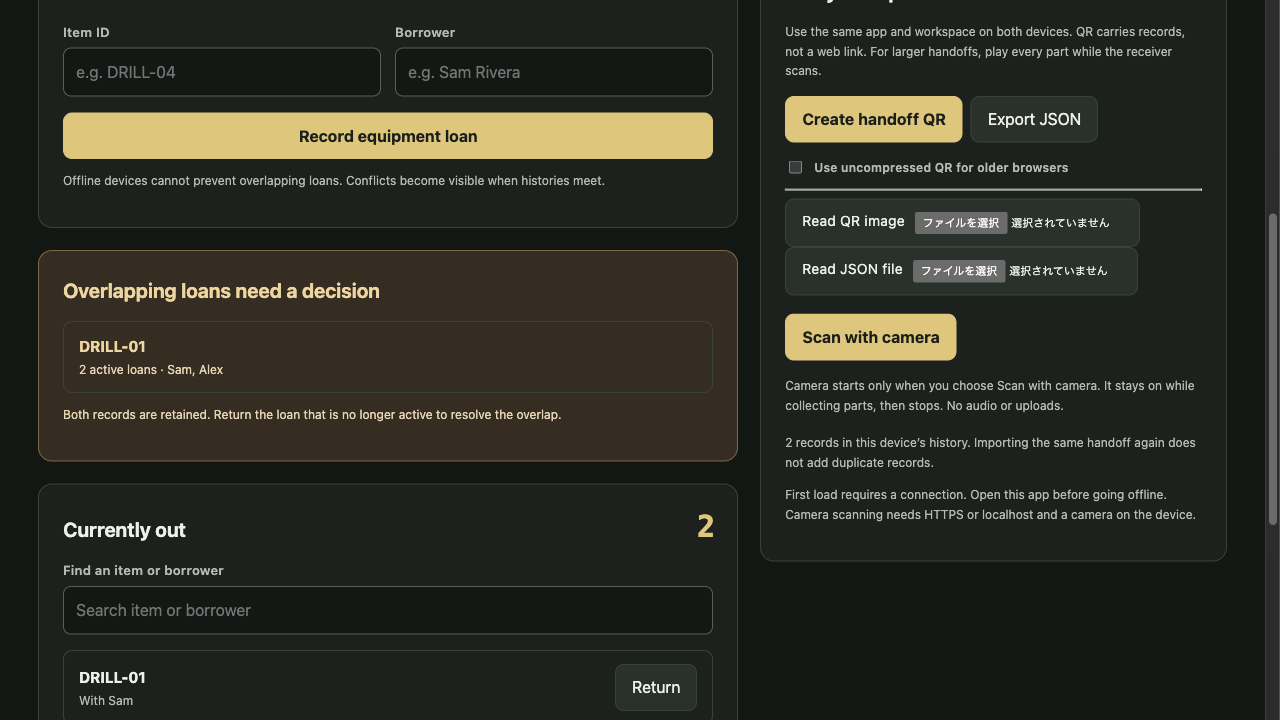
Lending: both overlapping loans remain visible after the handoff.
-
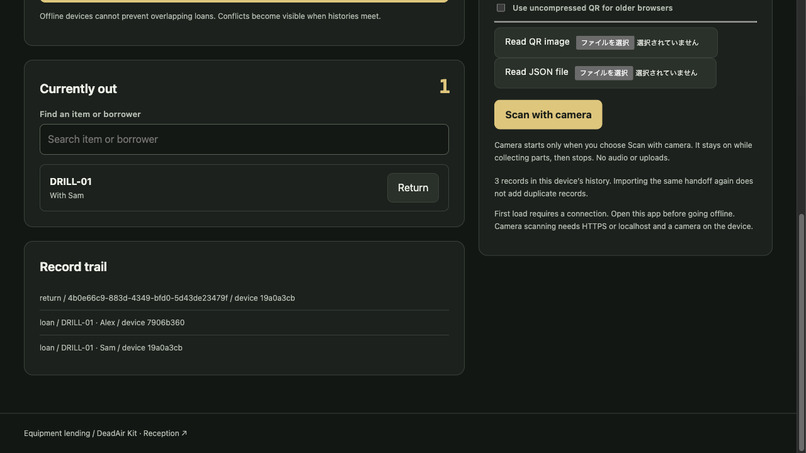
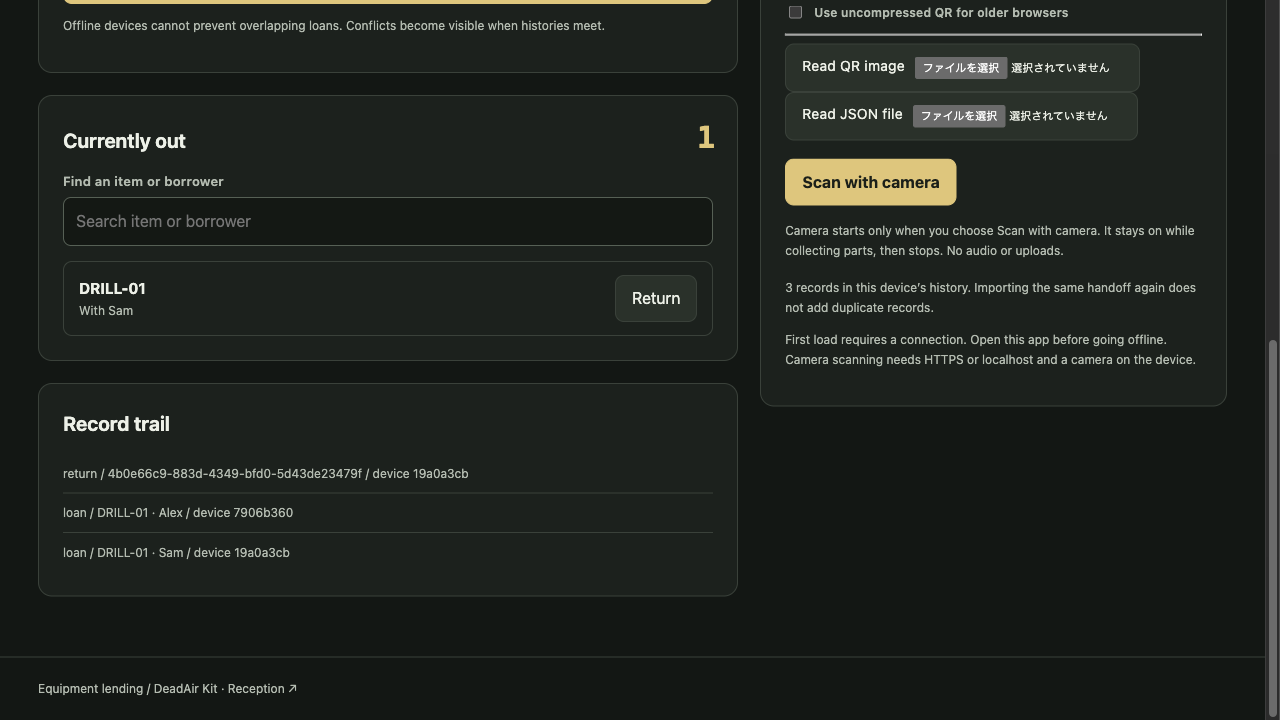
An explicit return resolves the selected loan while preserving the audit history.
Inspiration
A small event desk or equipment room still has work to do when its connection fails. Local records let each desk continue, but disconnected copies eventually disagree. DeadAir Kit explores a practical handoff: carry the actual records when the desks meet, preserve the evidence, and show the decisions that require a person.
What it does
Reception records check-ins, counts each attendee once and keeps every original event. Equipment lending records loans and returns. If two disconnected desks lend the same item, exchanging histories retains both loans and surfaces the overlap. Returning the selected loan resolves it, and carrying that return back brings the copies into agreement.
Small histories fit a single QR. Larger ones become numbered parts with collection progress. Parts may arrive out of order or repeat; incomplete handoffs never commit records. A complete, validated handoff shows a preview and requires an explicit import. The measured 50-record Japanese sample uses 3 compressed QR parts, or 19 without compression. Size depends on the records. QR image import and JSON backup work alongside the implemented camera scanner.
A skeleton and two distinct apps
The two distinct interfaces are in apps/reception and apps/lending. They reuse a pure append-only event engine, namespace validation, bounded transport and camera lifecycle. Operation-ID union makes repeat imports idempotent. Different contents under the same ID are rejected. Legitimate parallel loans remain visible until the operator resolves them. A service worker precaches runtime assets after an initial connected load, and browser storage retains records locally. No account, data backend or runtime AI service is needed.
How Kiro was used
Kiro CLI 2.37.1, with its auto model, generated the initial engine, engine tests and project steering. Independent review discovered mixed-namespace and order-dependent naming counterexamples. Kiro fixed those and added four regression cases. For camera handoff, Codex prepared requirements before implementation; Kiro read them, wrote the initial design/tasks, generated the first scanner and five media-stub tests, and partially wired the UI. Codex finished the feature after service throttling, fixed lifecycle races and added focused regressions.
Codex authored the app interfaces, lending projection, multi-QR protocol and controls, packaging and independent browser checks. Root .kiro steering and specs record the actual work. We do not claim IDE workflows, hooks, MCP usage or features that were not used.
Challenges we ran into
Disconnected copies cannot globally prevent a double loan. We preserve the disagreement and make the operator's resolution explicit. QR handoffs also need bounded reassembly, duplicate-part handling, a corruption checksum, namespace checks, and validation before any saved data changes. Camera startup and cancellation can race, so the scanner releases late streams and serializes frame validation.
Accomplishments that we are proud of
Two complete workflows run from one starter. Independent browser-origin QA transferred exactly 50 sample records using actual generated QR images while the source server was stopped and the receiver was offline. Repeats added zero records; missing parts saved nothing; an unrelated workspace was rejected. Loan conflict and resolution propagated between independent copies. The current suite has 49 passing tests. Browser camera checks used synthetic canvas video streams, not physical camera hardware.
What we learned
The merge is only part of the product. A useful handoff needs progress, a review step, visible conflicts, a recoverable fallback and an honest description of what the evidence establishes. A reusable skeleton must support distinct projections rather than merely changing labels.
What's next for DeadAir Kit
Physical phone/camera testing, first-time-user feedback and incremental handoffs. Handoffs currently exchange the bounded full history. The prototype does not encrypt records or authenticate peers, and initial connected loading is required. QR images contain actual names and records; use sample data when trying the public prototype.
Try it out
- Initially open the same app on both clients with a connection and use the same workspace name.
- Record check-ins or equipment loans. Create a handoff QR; larger histories have numbered parts.
- On the receiver scan the sequence, or download each QR PNG and use Read QR image. Review the complete handoff, then Import records.
- Repeat the import to see zero new records. For lending, make independent loans for the same item, exchange histories, return the selected loan, and carry the resolution back.
- Load before going offline. Browser storage is local to each origin. Two origins on one computer are independent copies, not two physical-device validation.
Judge walkthrough
https://github.com/tokuitao/deadair-kit-kiroween-2026/blob/main/JUDGE-GUIDE.md Download the fictional sample pack and use two independent browser sessions. Reception combines five check-in events into four attendees. Lending preserves two overlapping loans, then carries an explicit selected return back. The sample files seed each desk; the handoff uses QR PNGs generated by the working app.
Reusable starter and Kiro workflow
Starter guide · Actual Kiro workflow · MIT licensed
