
Inspiration
The internet was built to connect people.
Every day, we turn to online communities for advice, recommendations, and conversations with real people. These discussions shape what we buy, what we believe, and what we perceive as popular opinion.
But what if the people we're talking to aren't who we think they are? What if they're not even real people?
We were inspired by the Dead Internet Theory, the idea that much of the internet is increasingly populated by bots and artificially generated content. While the theory itself is debated, the underlying problem of astroturfing and coordinated manipulation is very real.
A comment section filled with praise can create the appearance of genuine consensus, even when that support may be artificially amplified. This is especially concerning when people rely on social media to make purchasing decisions.
We wanted to build something that helps people recognize these patterns and make their own informed decisions.
What It Does
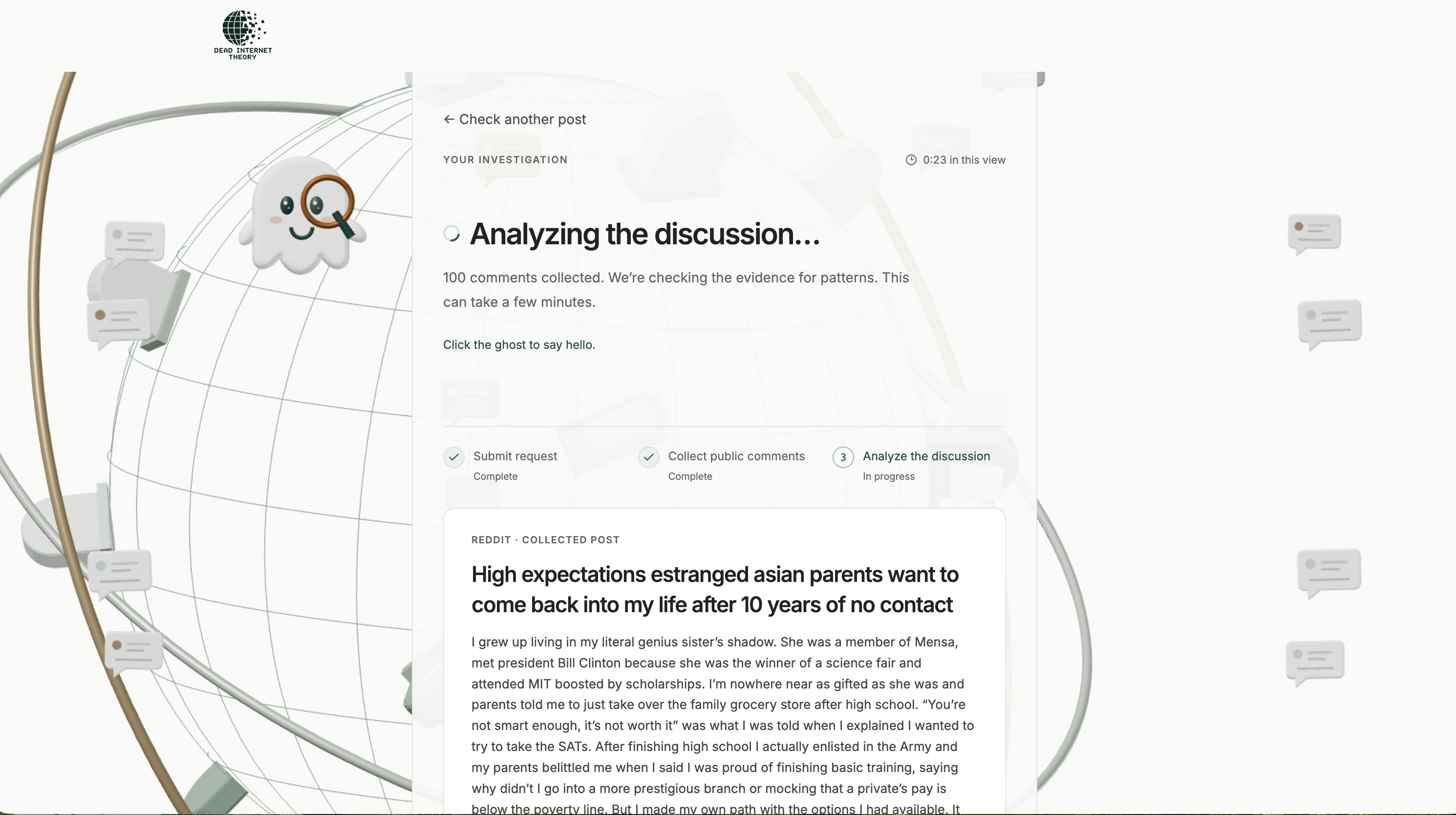
Dead Internet Theory is a browser extension and web application that investigates social media discussions for signs of artificial or coordinated activity.
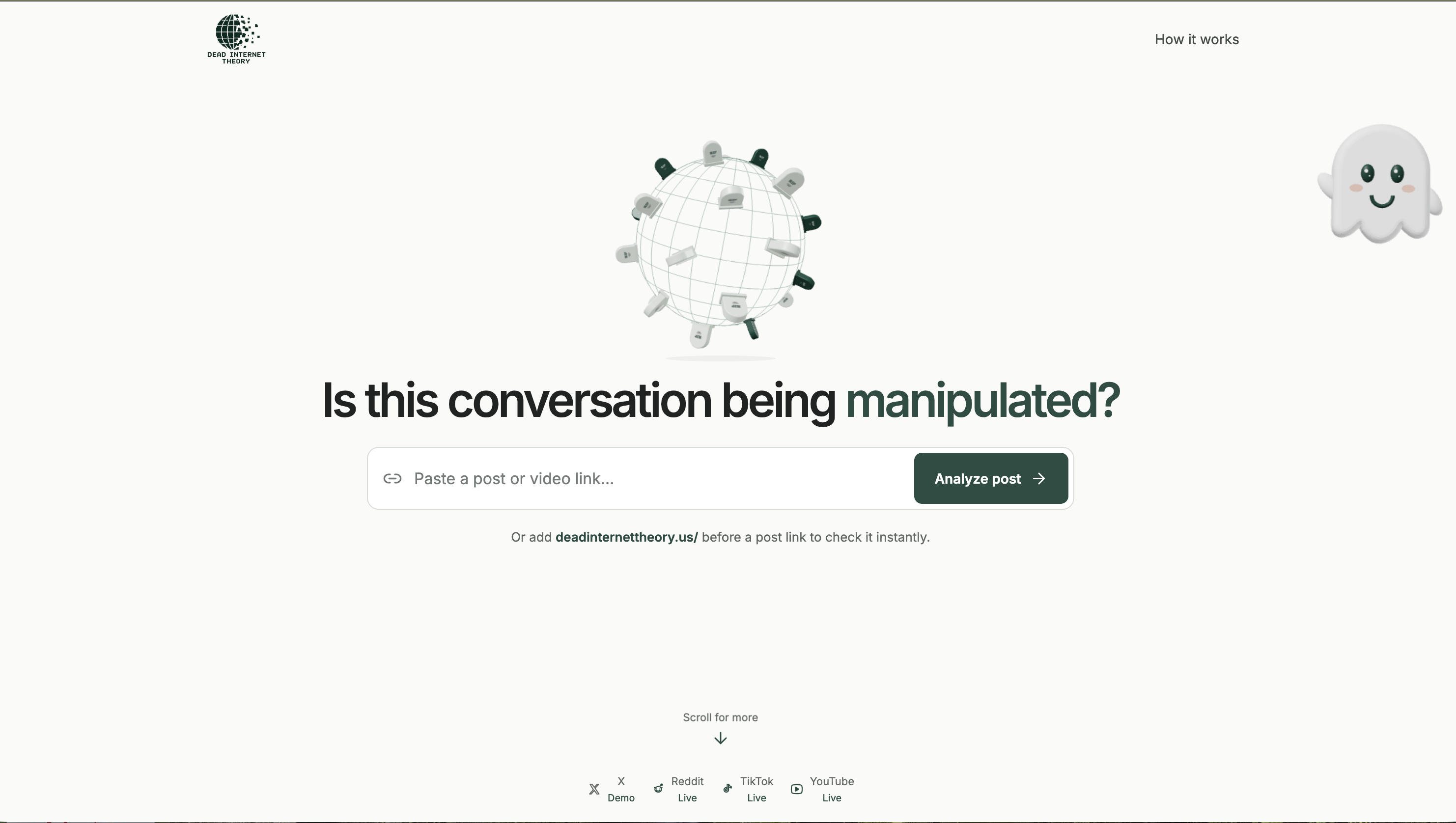
Users can analyze posts from Reddit, X, TikTok, and YouTube through our website or directly from our Chrome extension.
Our system examines signals such as:
- Copied praise: Similar recommendations repeated across different accounts.
- Low-effort flooding: Large amounts of generic or repetitive positive comments.
- Suspicious account behavior: Unusual patterns in available posting histories and recommendations.
- Commercial signals: Shop-style usernames, promotional language, and potentially coordinated endorsements.
- Unnatural language: Wording patterns that may warrant closer inspection.
Instead of simply labeling a discussion as fake, we generate an interactive investigation report with a 0–100 suspicion index, explanations, and evidence linked to the original comments.
Users can explore discussion threads, compare wording, examine posting patterns, and understand why specific activity was flagged.
Our goal isn't to tell people what to believe. It's to give them the evidence to decide for themselves.
How We Built It
We built Dead Internet Theory using React, TypeScript, Convex, Apify, Anthropic Claude, CREAO, and Three.js, with the website deployed on Vercel.
Collecting data with Apify
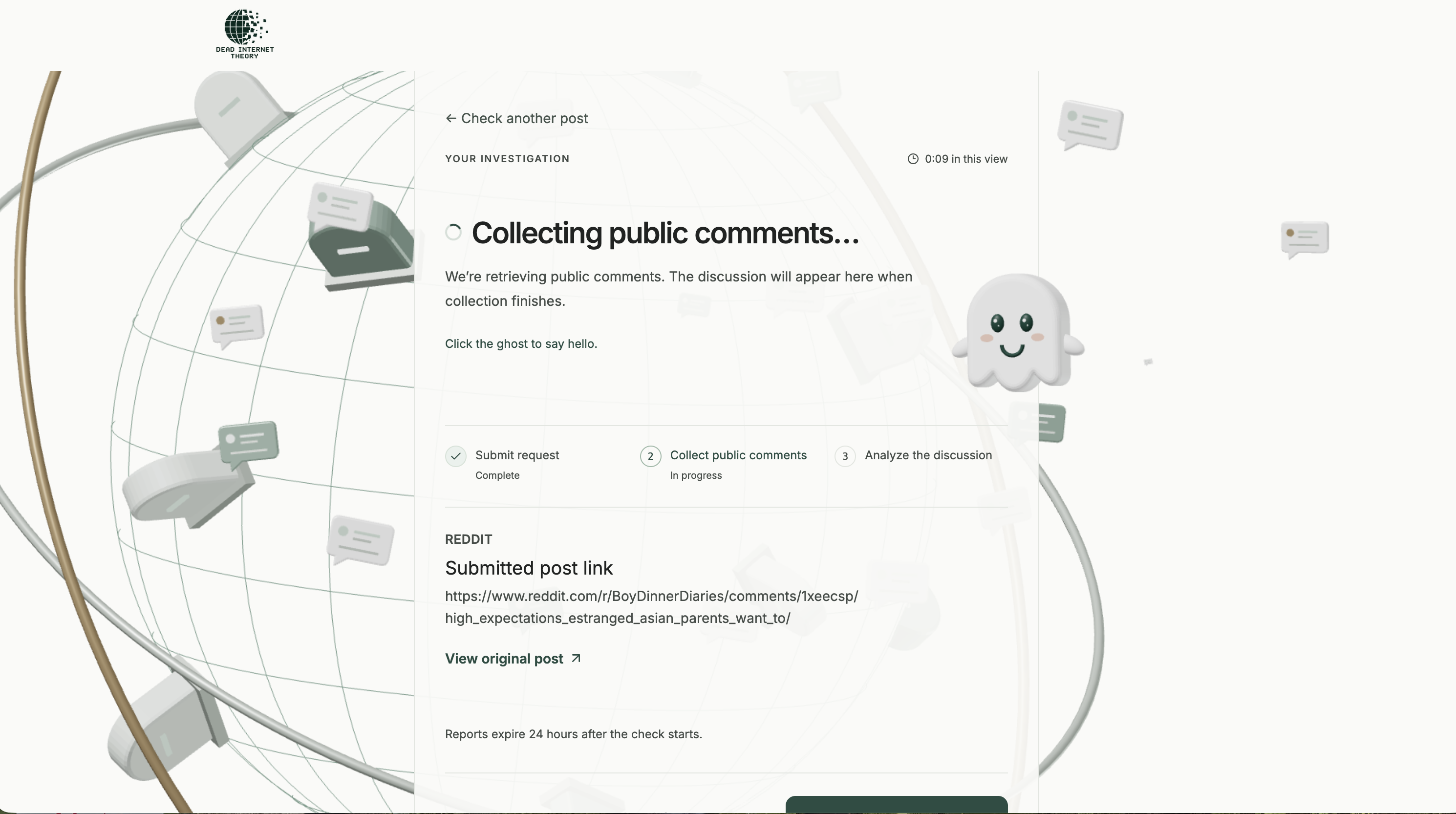
One of our first major challenges was collecting usable data across four very different social media platforms.
Each platform structures its discussions, replies, timestamps, and account information differently. We initially struggled to retrieve enough consistent context for meaningful analysis.
Apify was a major turning point. Its Actors allowed us to collect publicly available discussion data across platforms without having to build and maintain a separate scraping system for each one.
We normalize that data into a shared discussion graph containing comments, authors, reply relationships, timestamps, and available account histories.
Understanding context with Anthropic Claude and CREAO
Detecting suspicious activity isn't as simple as searching for repeated words.
Two people might genuinely recommend the same product. A new account isn't automatically a bot, and enthusiastic language doesn't necessarily mean a comment is artificial.
We used Anthropic Claude to interpret comments in context, identify recommendations, classify opinions, and evaluate available account behavior.
Another major challenge was giving our inference system enough context to make useful assessments rather than treating each comment independently.
We integrated CREAO for an alternative agent-based analysis and scoring workflow, allowing us to explore more context-aware approaches to evaluating discussions and their supporting evidence.
We combine model-generated assessments with deterministic scoring rules, evidence validation, and safeguards for missing information. Our final index is an explainable measure of observed signals, not a definitive probability that a discussion is manipulated.
We use CREAO to assess potential coordinated promotion in social media discussions. After collecting a public post and its comments, our backend sends the agent a bounded evidence packet containing recommendation text, reply context, measured patterns, and available public account history.
The CREAO agent applies our astroturfing rubric and returns proposed rule matches tied to specific evidence IDs. Our code validates those references and recomputes the final scores, keeping each finding traceable to the comments behind it.
- Shared agent run: Dead Internet Theory — Astroturf Analyst https://agent.creao.ai/share/02dddfa5410c9d0642e24f5fc8691d8c
- Agent ID: ecc896fc-80ba-457f-9075-4c3cdb3e0bc4
Orchestrating investigations with Convex
A complete investigation involves multiple asynchronous stages: collecting discussions, retrieving available histories, analyzing content, evaluating signals, and generating reports.
We used Convex to manage these jobs, persist investigation data, handle retries, and cache completed analyses.
This was especially valuable because full investigations can take several minutes. When someone investigates a previously analyzed discussion, our system can reuse the completed results instead of repeating expensive collection and inference work.
Making investigations accessible with GoDaddy
We registered deadinternettheory.us through GoDaddy Registry.
We chose the name because the Dead Internet Theory itself is an intriguing and attention drawing concept. Whenever someone feels like they're experiencing a lack of humanity on the dead internet, we want them to remember where to investigate it. The .us domain also reminds us that as humans on the internet, we need to stick together. As us.
We also made the domain part of the product itself.
Users can prefix a supported social media post URL with deadinternettheory.us/ to open an investigation directly, without needing to install our extension.
Building the experience
Our Chrome extension brings investigations directly into the user's browsing experience through a sidebar, while the full website offers detailed reports and interactive visualizations.
We also used Three.js to create a visual identity around the Dead Internet Theory, including a fragmented and gravestone covered wireframe globe and animated elements that reflect the atmosphere of an increasingly artificial internet.
We wanted the experience to be engaging without sacrificing the clarity of the evidence.
Challenges We Faced
Cross-platform data collection: Reddit, X, TikTok, and YouTube expose very different types of information. Apify helped us create a workable ingestion pipeline, but differences in available metadata and account histories required careful handling.
Providing enough context for AI analysis: Individual comments can be misleading when viewed in isolation. We worked with Claude and CREAO-based workflows to reason about discussion context, recommendations, and available account behavior.
Avoiding misleading conclusions: We had to distinguish suspicious patterns from proof of manipulation. We built evidence references, scoring safeguards, and explicit limitations into our reporting system.
Handling long-running investigations: Collecting and analyzing a discussion can take several minutes. Convex helped us coordinate asynchronous jobs and reuse completed reports, improving the experience for repeated investigations.
Making complex findings understandable: We didn't want users to receive an unexplained AI-generated score. We spent significant time building interactive reports that connect findings back to observable evidence, and the original academic papers that provide the backbone of our techniques.
What We Learned
Our biggest lesson was that detecting suspicious activity is much harder than detecting unusual text.
Real people repeat themselves, agree with each other, and get excited about products. Coordinated promotion can also involve real humans rather than automated accounts.
This pushed us toward building a system focused on observable evidence and transparency, rather than claiming to definitively distinguish humans from bots.
We also learned how much engineering goes into making an AI application dependable: normalizing inconsistent data, handling asynchronous workflows, validating model output, and keeping expensive operations manageable.
Most importantly, we learned that the value of AI isn't always in providing an answer. Sometimes it's in helping people ask better questions.
What's Next
We want to make Dead Internet Theory faster, expand the depth of our cross-platform analysis, and evaluate our detection methods against labeled examples to better understand false positives.
We're particularly interested in helping shoppers navigate potentially manipulated recommendations. Before spending money on a product, someone should be able to investigate whether the apparent consensus around it deserves a closer look.
Beyond shopping, we see applications in online communities, public discussions, and anywhere people depend on the opinions of others.
The internet is becoming increasingly automated, but genuine human connection is still worth protecting.
On the dead internet, humans have to look out for each other.
Built With
- anthropic
- apify
- chrome
- claude
- convex
- creao
- godaddy
- javascript
- openapi
- react
- three.js
- typescript
- vercel
- vite


Log in or sign up for Devpost to join the conversation.