Inspiration
I grew up on the radio. Late night DJs on stations like 99.1 HFS and DC101 taught me that a voice in the dark can make you feel less alone. That job is gone now. Stations run on automation and playlists, and nobody is awake on the other end.
I've also made over eleven hundred songs. Almost all of them are instrumentals, so the only words are the titles, and every title is a time capsule of a night I lived through.
DEAD AIR brings back the thing that died: a late night DJ, reading real time capsules, to whoever is still awake.
What it does
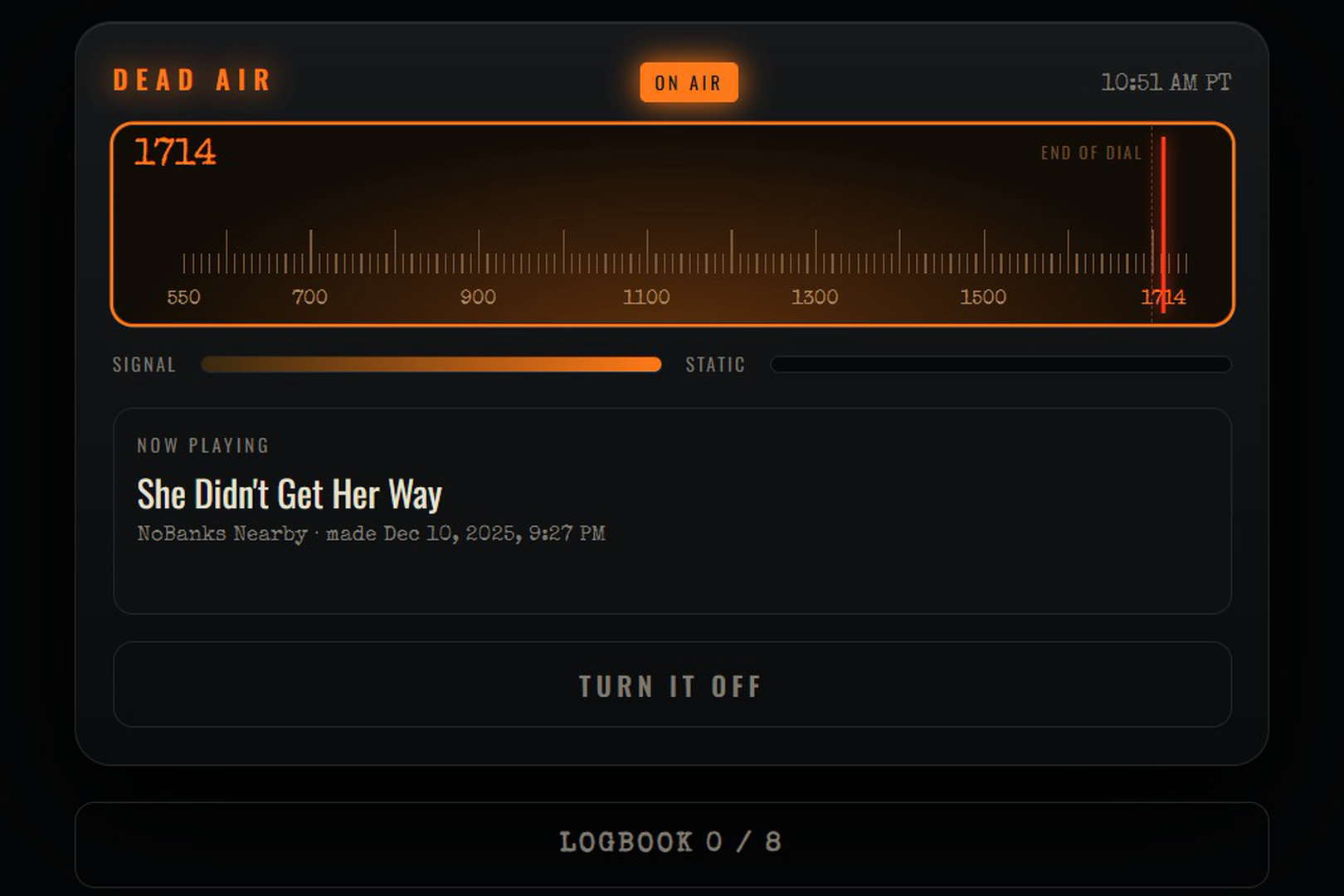
- Tune in. Turn an analog dial through static. Past the end of the AM band, at 1714, the signal locks and you're live.
- Live for everyone at once. Every listener hears the same song at the same moment, like real radio.
- Dead John hosts. He talks over song intros and stops right before the music turns, back-sells, time-checks, runs ads for businesses that can't exist, and complains about Marty, the engineer who never answers.
- The songs are letters. Dead John reads each title like a letter he found in the station mailbox.
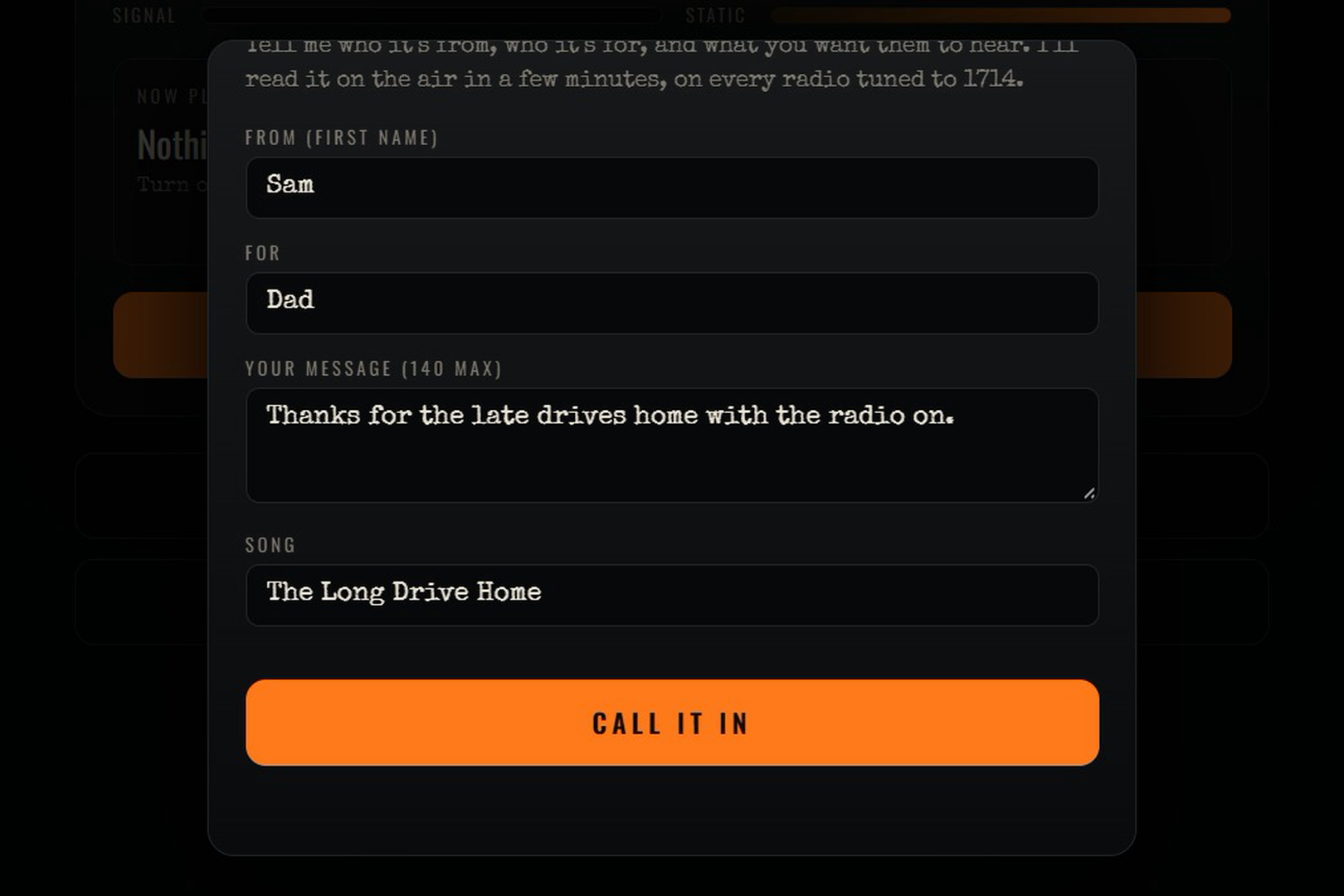
- Call the station. Send a request and a dedication. A few minutes later Dead John reads it on the air, on every radio.
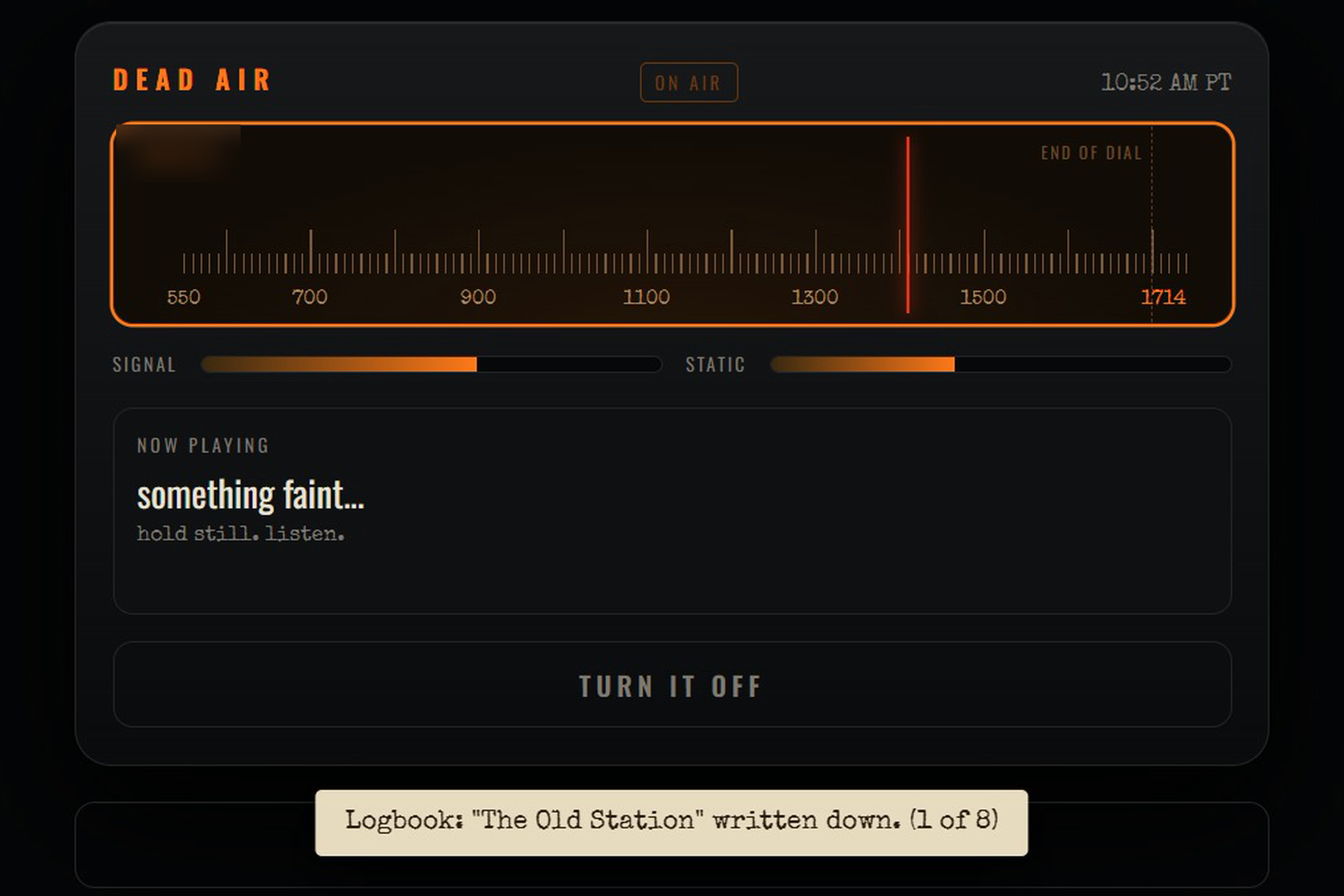
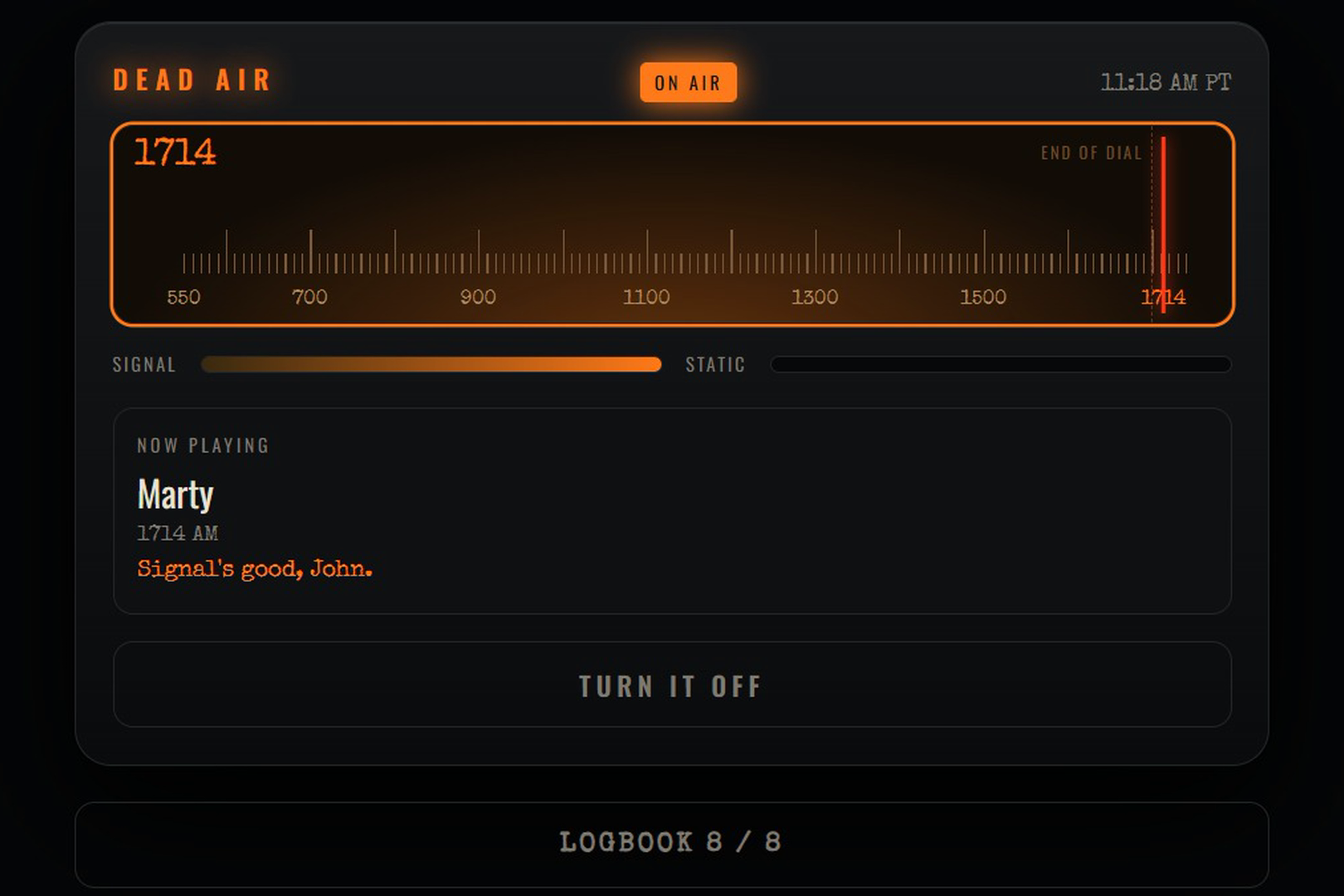
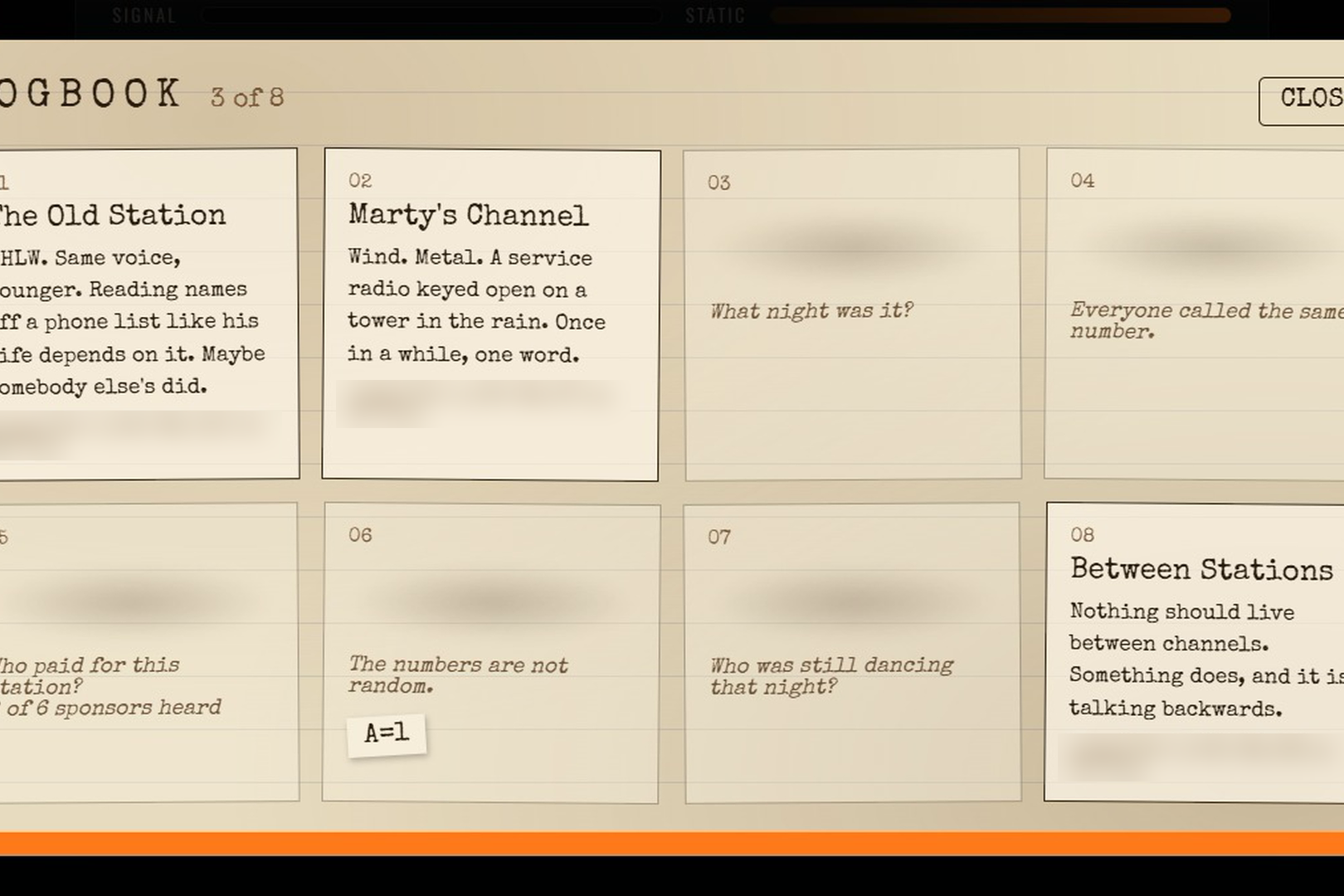
- The Hunt. Most of the dial is static. Some of it isn't. Find the faint signals, fill your Logbook, decode the midnight numbers station, and piece together what happened the night the tower went down. Finish it and someone answers who never has before.
- Works like a radio. Background play, lock-screen controls and installable on a phone.
How I built it with Kiro
I used Kiro CLI headless (kiro-cli chat --v3 --no-interactive), one spec at a time, driven from scripts. I paired it with Claude Code: Kiro wrote the specs and the core of each feature; Claude Code ran the Kiro jobs, reviewed every result against the source and real data, fixed what failed review, and did the integration and the demo tooling. Nothing Kiro produced was accepted on its own summary.
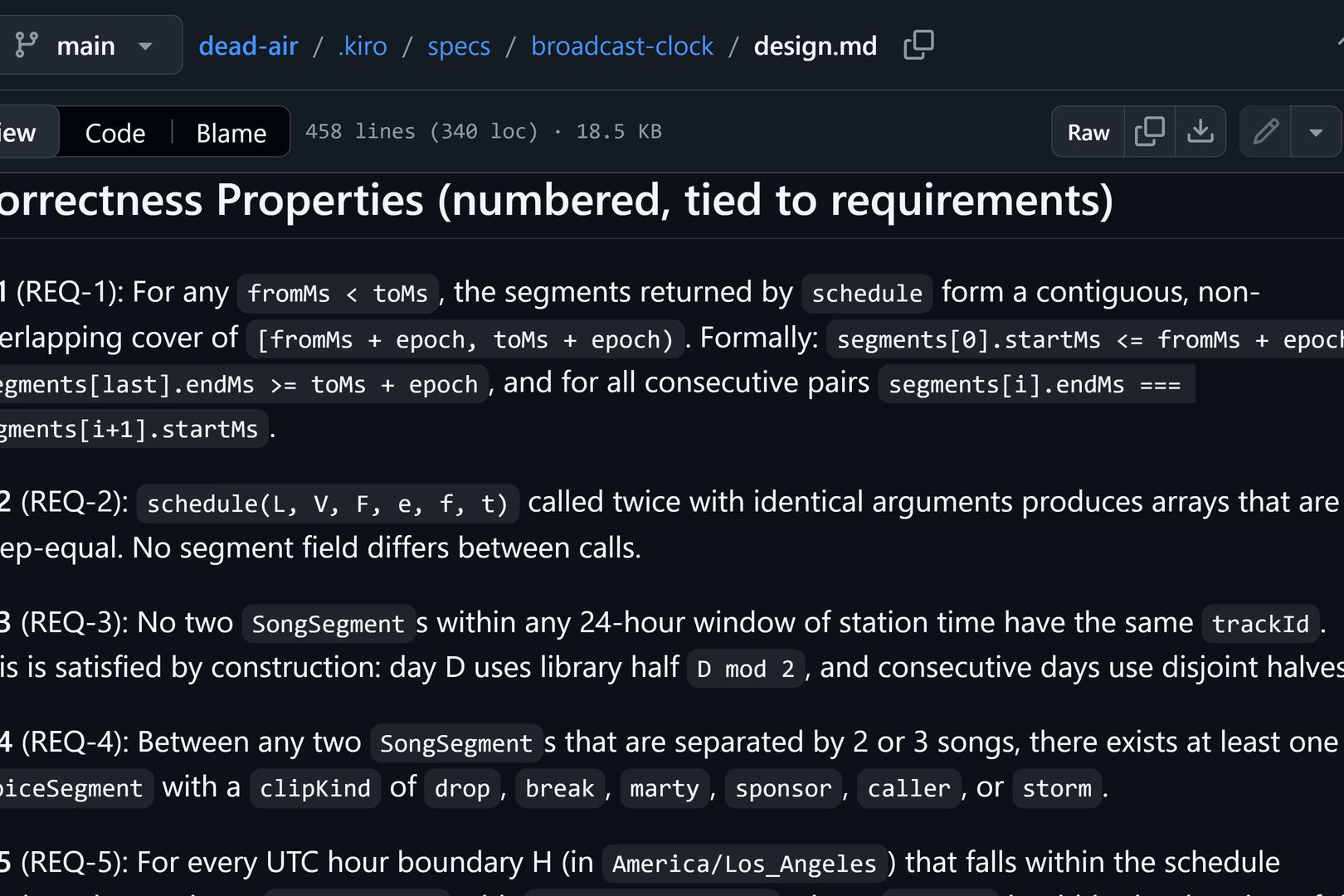
Spec-driven development: 7 specs, each with EARS requirements, a design with numbered correctness properties, and tasks:
station-library: a CLI that analyzes and encodes 1,101 songs (two-pass loudnorm, talk-up detection). 1,101 in, 0 errors.talkup-bugfix: finding where each song's intro "turns" so Dead John stops talking right before it.broadcast-clock: the whole station as a pure function of time. Los Angeles station days (DST safe: Nov 1 is 25 hours), no song repeats within 24 hours, hourly IDs, a midnight numbers station, an Emergency Broadcast in the small hours.tuner-player: the analog dial, AM filter chain, ducking and a lookahead scheduler.the-hunt: the hidden-signal engine. The browser only asks "anything at the frequency I'm on?" and gets audio or nothing, so the dial can't be scraped.request-line: a listener's dedication, read on every radio a few minutes later. Key property: a request only changes what airs after its time, so nobody hears a different past.live-stream: a server-mixed stream so phones keep playing in the background.
Compared to vibe coding, the specs gave me something to hold the agent to. Every review round was "here is the requirement, here is what the real data says."
Steering: 6 docs. dead-john.md is the DJ's bible (backstory, voice, real DJ craft, hard rules), always included. audio.md is scoped with fileMatch to the audio code (loudness, ducking, fades). product.md, style.md, tech.md and structure.md keep everything on brand and in place. Kiro described Dead John correctly on its first run with no extra prompt.
Hooks: 5 command hooks. Library tests run when library code is saved, station tests when station code is saved, a PreToolUse guard keeps audio files and secrets out of the repo, a Dead John lint checks every script for banned words and em dashes, and a task can't be marked done unless the tests pass. Live test: I asked Kiro to write an mp3 into the repo and its own hook stopped it.
MCP: a dead-air-station MCP server with six read-only tools (whats_on, find_track, talkup_window, day_summary, library_stats, signal_check), so Kiro can ask the live station questions while building. Asked what was on 1714 and when the Emergency Broadcast airs today, Kiro called the tools and answered correctly.
Property-based testing (fast-check): strict tiling of any day in a 10 year window, no song repeats inside 24 hours, a talk-up always ends exactly on the post, no voice line back to back, time-pinned lines only at their time, no hidden signal outside its lock window, and the special broadcast exists for exactly one minute on DST days. One test fails the build if a hidden frequency ever appears in client code. 136 station tests, 37 web tests, 30 library tests and 4 studio worker tests pass on a fresh clone.
PBT is where the hard cases live: unit tests check a few days, the properties check every day, including both DST days, and a featured song with a long intro next to a station break, which a property now pins after we fixed an overlap there.
Kiroween credits: with the bonus credits, Kiro closed out the last specs: tests for the live stream (it found a real bug: turning the radio off didn't cancel a pending retry), and a sync pass that checked every task against the code with file and line evidence.
Architecture: the schedule needs no streaming server. The station is a deterministic schedule laid on a clock. Your browser asks "what's on at this moment?" and plays from that offset. Nothing to crash at 3 AM. Phones that need to keep playing with the screen locked get an optional server-mixed stream of the same schedule.
The voice: Dead John is my own cloned voice, rendered on my laptop with an open source model for zero dollars a month. Every line goes through a picker: several takes, a Whisper check that the words came out right, and the best one airs.
Challenges
- Green tests are not proof. The first library build passed every test while the talk-up detector returned the fallback value for every real song (the tests only used synthetic tones). Measuring real WAVs by hand found the real cause: stereo audio read as mono, so every "half second" window was a quarter second.
- Time is hard. Station days are Los Angeles days, and our first live night was a 25 hour day. Everything goes through time zone math with property tests on both DST days.
- Sounding human. On its first all-night run Dead John said "Don't touch that dial" twice in a row. A clip rotation now keeps every line resting before it can air again.
- Agent output needs review. Several builds claimed every task done while the UI was an empty box. Every Kiro result was checked in a real browser before it was accepted.
Accomplishments
- A radio station that is a pure function of time and ran all night on its first night.
- 1,101 original songs analyzed and encoded by a Kiro-built tool, each with its own talk-up window.
- A DJ with a real personality, in my own cloned voice.
- A hidden story with eight Logbook pages, a real numbers code and a finale where someone finally answers.
What I learned
Specs are how you keep an agent honest. Steering gave the project one voice across every spec. Small, cheap hooks caught more problems than any long prompt.
What's next
A real phone number for the request line. More hidden stations. Listener time capsules.
Music
Every song on DEAD AIR is an original by NoBanks Nearby, owned by the artist. No third-party music.
Built With
- claude-code
- cloudflare
- express.js
- fast-check
- ffmpeg
- kiro
- kiro-cli
- mcp
- node.js
- python
- qwen3-tts
- typescript
- vitest
- web-audio-api
- whisper
