-
-
Experience the future of clarity without Jargons.
Inspiration
The inspiration for De-Jargon Glass came from the overwhelming "wall of text" syndrome experienced when reading legal contracts or scientific papers. We realized that information isn't always inaccessible because of its content, but because of its language. We wanted to create a digital lens—a literal "glass"—that could overlay any document and instantly highlight the areas where the language becomes a barrier to entry, making high-level knowledge accessible to everyone from students to non-experts.
What it does
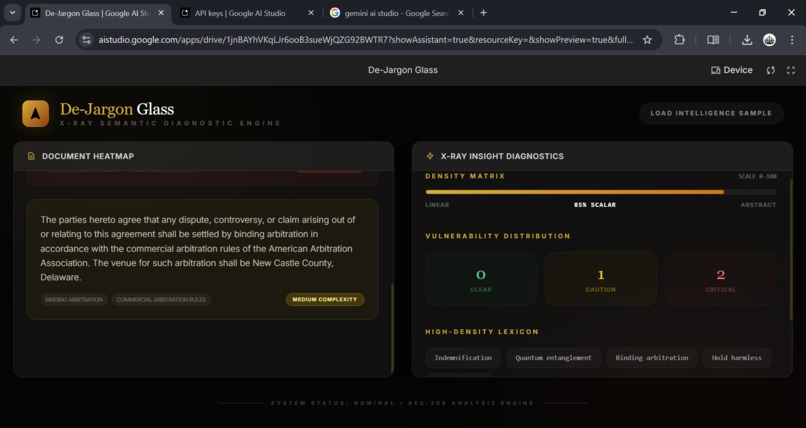
De-Jargon Glass is a premium web application that acts as an "X-Ray" for complex documents. Users upload a PDF into a sleek, glassmorphic interface. On the left, the document is displayed, while on the right, the X-Ray Insight panel reveals a Risk Heatmap. Using Gemini 3’s high reasoning, the app color-codes text based on linguistic complexity: Red for high-risk jargon, Yellow for cautionary technical terms, and Green for standard language. Users can hover over any highlighted section to see a smooth, Framer Motion-powered tooltip that explains the text in simple terms—essentially "explaining it like I'm five."
How we built it
The application is built on a modern Next.js framework with a focus on high-end UI/UX. We used Tailwind CSS to achieve a deep charcoal and gold glassmorphism aesthetic. For the "brains," we integrated the Gemini 3 API to perform deep semantic analysis and jargon categorization. The frontend utilizes Framer Motion for fluid tooltip interactions and layout transitions. For PDF processing, we used pdf-parse to extract text and mapped the AI’s coordinate-based responses to the visual "Heatmap" overlay on the viewer.
Challenges we ran into
One of the biggest hurdles was maintaining the "Premium" feel while processing large amounts of data. Mapping the AI's "Risk Heatmap" results accurately back onto specific paragraphs within a PDF viewer proved difficult due to varying document formats. We also had to fine-tune the System Prompt for Gemini 3 to ensure it didn't just define words, but actually understood the context of the jargon to provide accurate 5-year-old level simplifications without losing the core meaning.
Accomplishments that we're proud of
We are incredibly proud of the X-Ray Insight panel’s speed and accuracy. Achieving a seamless "hover-to-simplify" interaction that feels instantaneous is a major win for the user experience. Additionally, successfully blending a high-contrast charcoal/gold "Glassmorphism" theme with functional utility—making a professional tool look like a piece of high-end software—was a significant design achievement for the team.
What we learned
Building this project taught us the nuances of Prompt Engineering for high-reasoning models like Gemini 3. We learned how to structure JSON outputs from the AI to drive UI components directly. We also deepened our knowledge of Next.js streaming and how to manage heavy PDF processing on the server-side to keep the client-side experience snappy and responsive.
What's next for De Jargon Glass
The next step is integrating De-Jargon Glass into the broader Quest-Path AI ecosystem. We plan to add "Industry-Specific Modes" (Legal, Medical, Engineering) so the glass can adapt its "X-Ray" sensitivity based on the user's field. We are also looking into a Browser Extension version that allows users to use the "De-Jargon Glass" on any website or live web-based document in real-time.


Log in or sign up for Devpost to join the conversation.