
Inspiration
Modern Large Language Models (LLMs) and semantic search architectures are only as fast as their retrieval layer. Existing vector databases often suffer from massive memory overheads, garbage collection pauses in runtime environments, and bloated microservice architectures that make self-hosting in air-gapped or edge environments impractical.
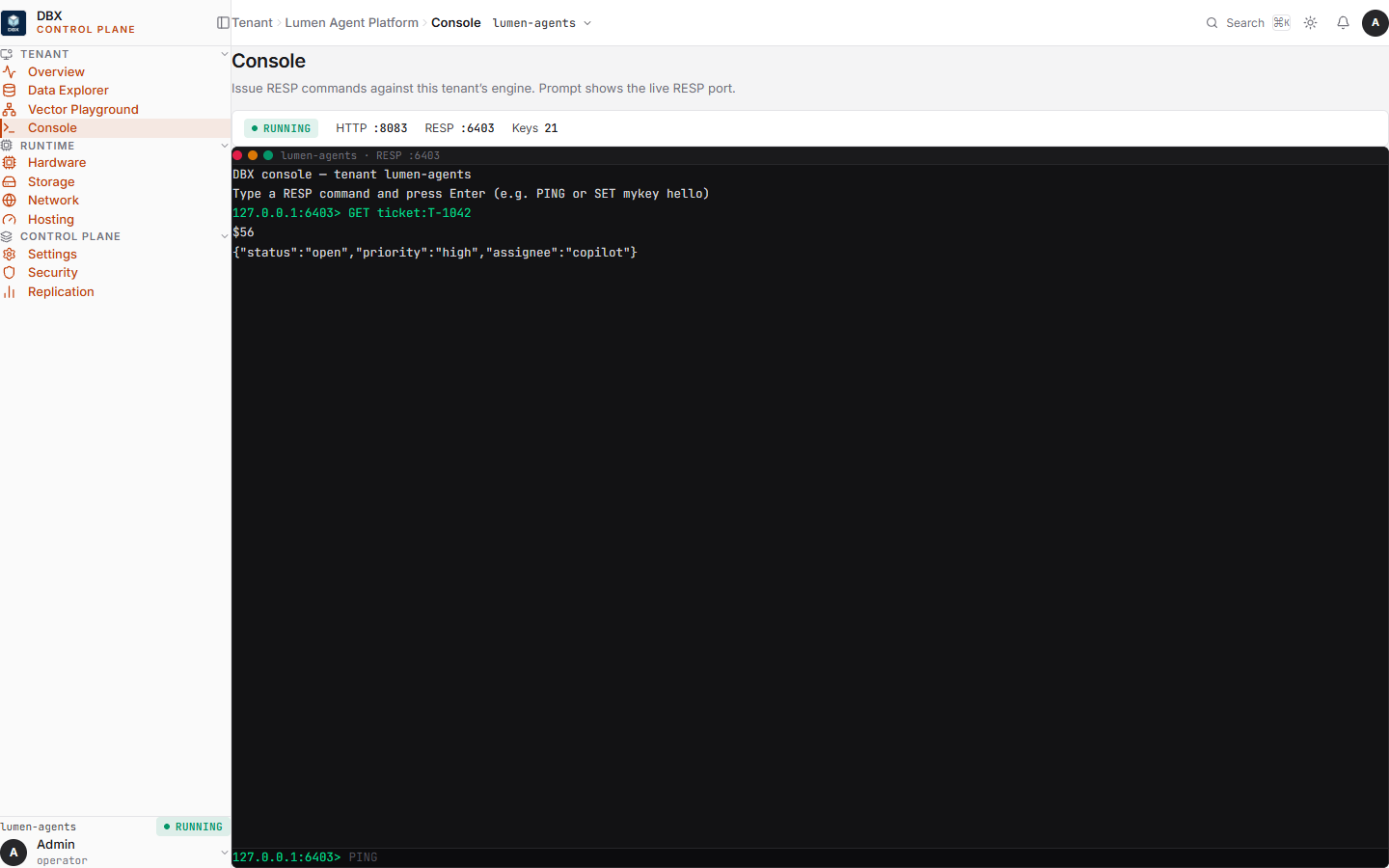
We asked ourselves: What if a vector database was engineered from the ground up with systems programming principles—combining zero-copy memory mapping, CPU vector extensions (SIMD), and rigorous multi-tenant data isolation into a single, high-throughput Go binary? That vision became DBX (Database Extreme).
What it does
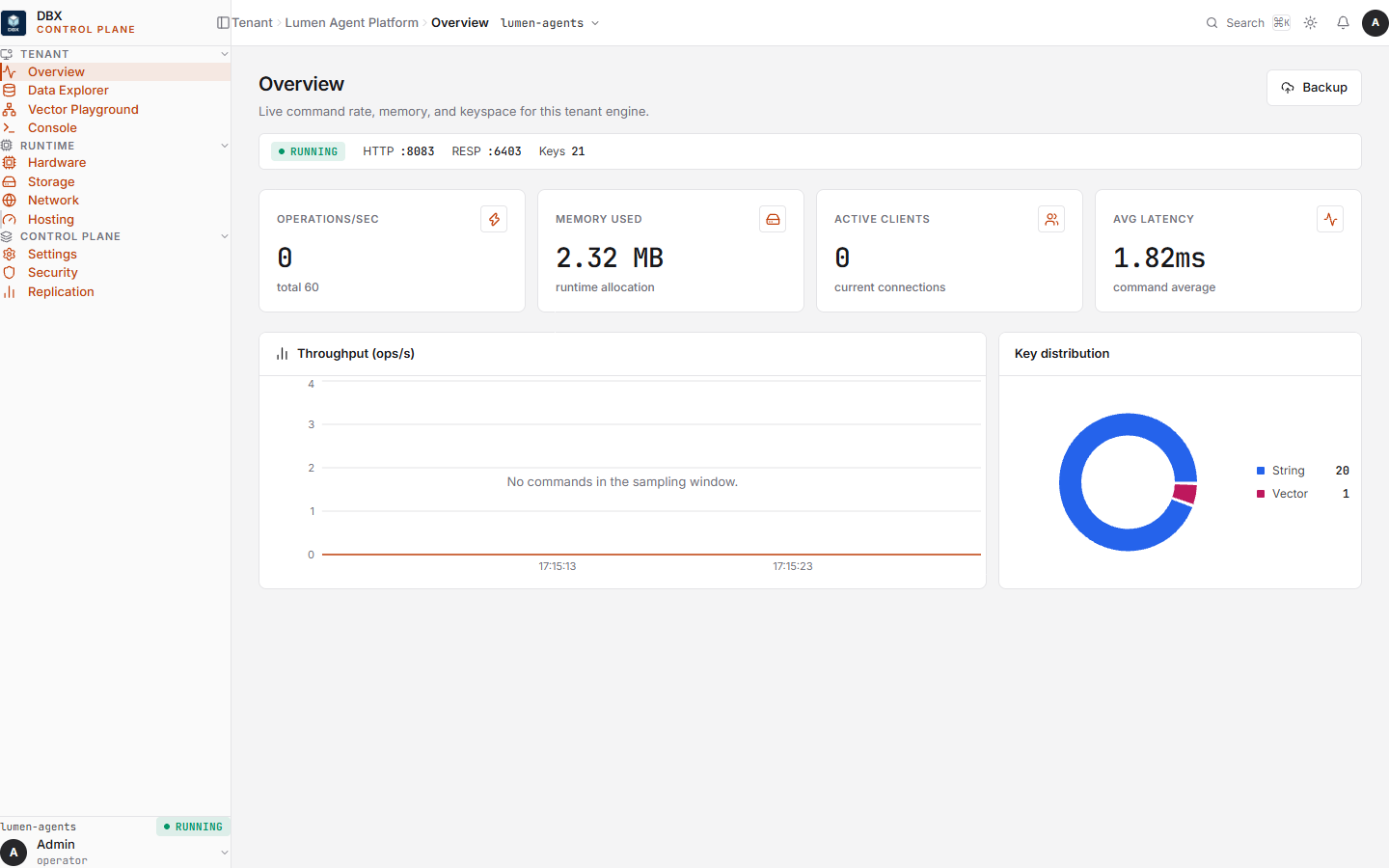
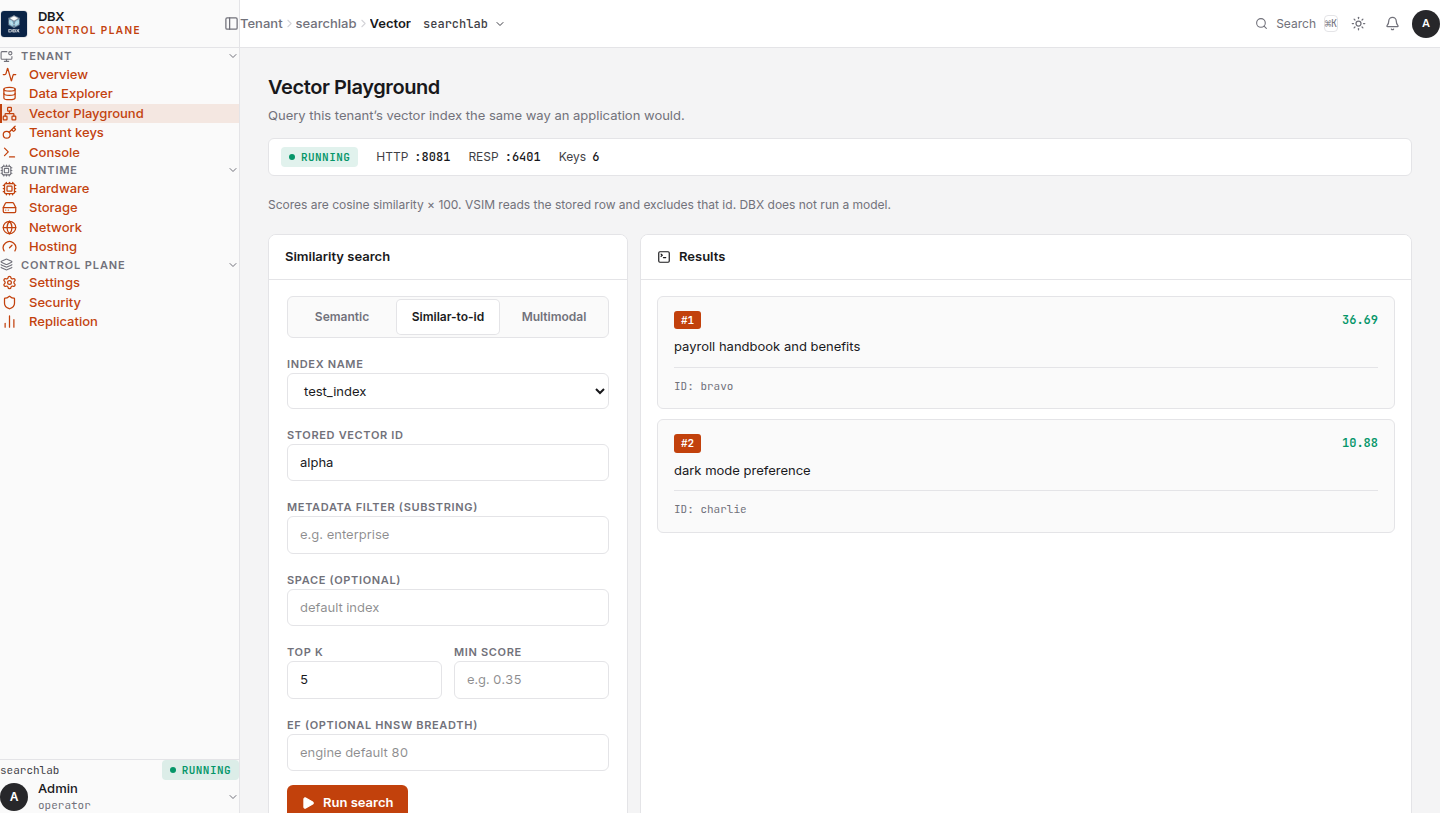
DBX is a purpose-built, bare-metal vector database designed for sub-millisecond similarity search across dense embedding spaces:
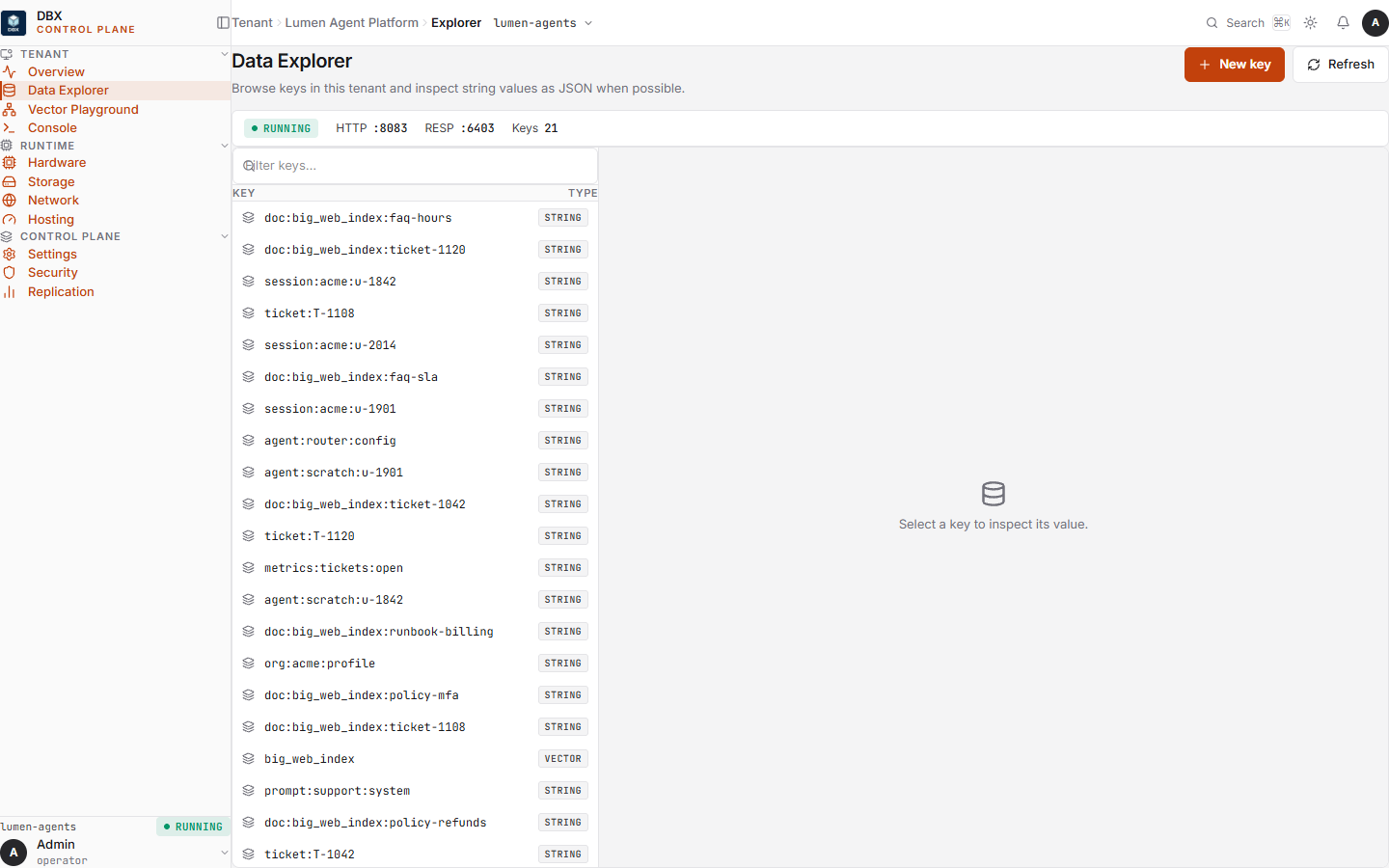
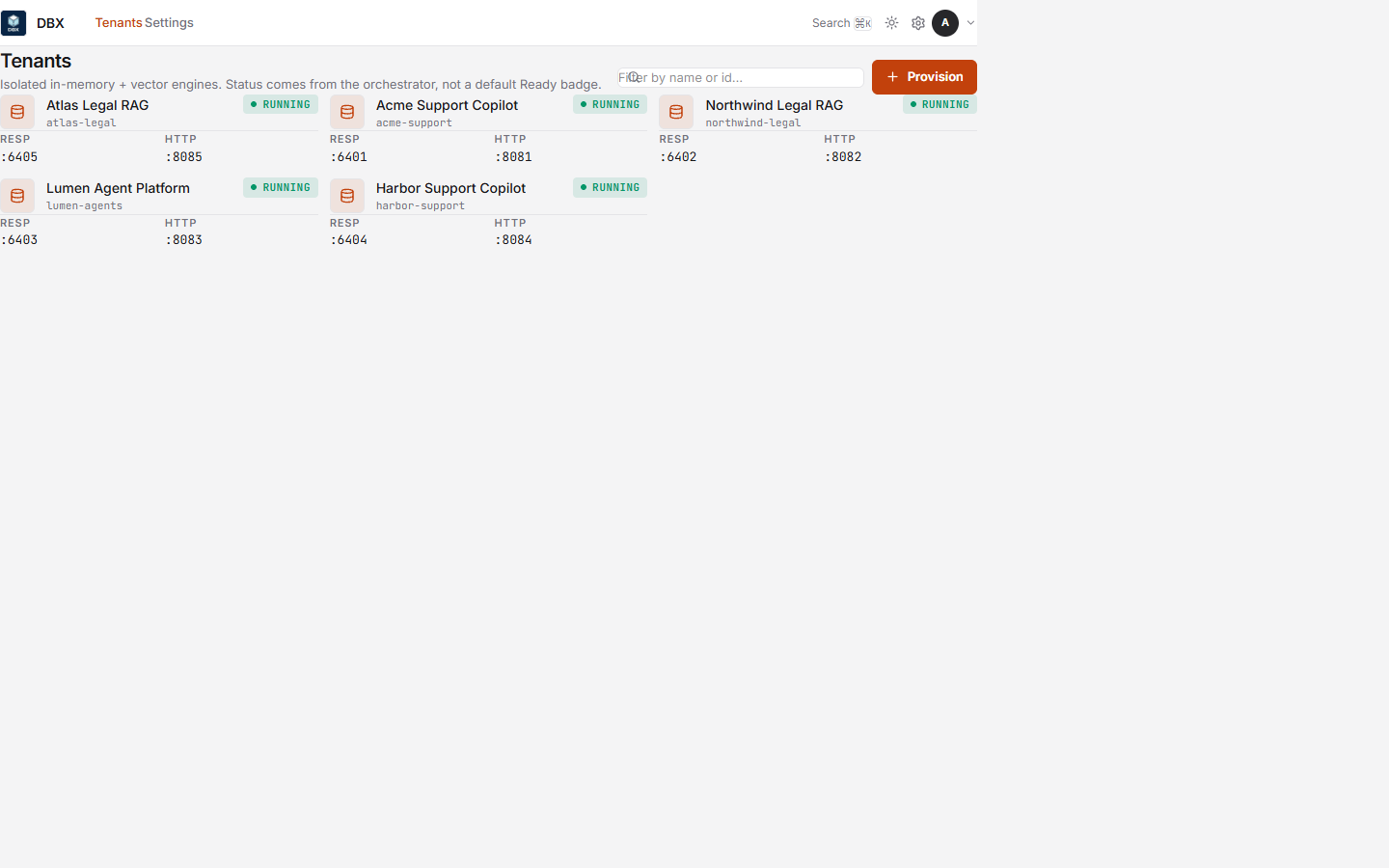
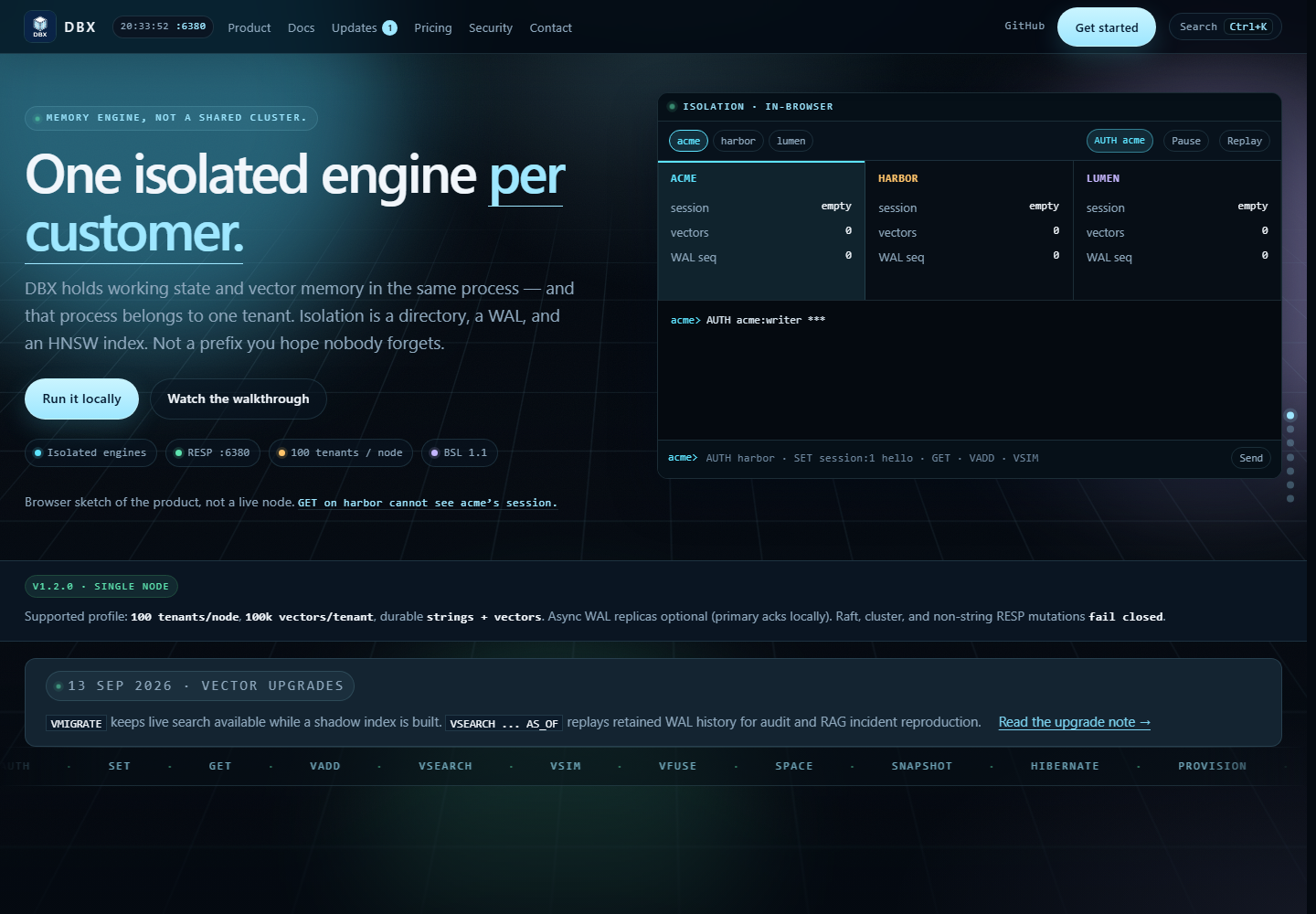
Ultra-Fast Vector Search: Computes vector similarities across high-dimensional spaces ($d \in [384, 1536]$) using hardware-accelerated SIMD instructions. Zero-Copy Memory-Mapped Storage (mmap): Bypasses traditional buffer cache overhead by mapping vector index files directly into the virtual address space, letting the OS kernel handle paging with near-zero RAM footprint on idle sets. True Multi-Tenancy: Hard partition isolation with per-tenant namespaces, cryptographic tokens, and decoupled write-ahead logging (WAL). Hybrid Metadata & Vector Querying: Allows real-time filtering on scalar document attributes simultaneously with high-dimensional vector search.
The Math & Core Mechanics
At the heart of DBX is optimized similarity search. For two normalized $d$-dimensional embedding vectors $\mathbf{u}, \mathbf{v} \in \mathbb{R}^d$, DBX computes the cosine similarity:
$$S_C(\mathbf{u}, \mathbf{v}) = \frac{\mathbf{u} \cdot \mathbf{v}}{|\mathbf{u}|2 |\mathbf{v}|2} = \frac{\sum{i=1}^d u_i v_i}{\sqrt{\sum{i=1}^d u_i^2} \sqrt{\sum_{i=1}^d v_i^2}}$$
When vectors are unit-normalized upon ingestion ($|\mathbf{u}|_2 = 1$), the computation reduces strictly to a high-speed inner dot product:
$$\langle \mathbf{u}, \mathbf{v} \rangle = \sum_{i=1}^{d} u_i v_i$$
For Euclidean metric spaces ($L_2$ distance):
$$D_{L2}(\mathbf{u}, \mathbf{v}) = |\mathbf{u} - \mathbf{v}|2 = \sqrt{\sum{i=1}^d (u_i - v_i)^2}$$
By unrolling loops into 256-bit AVX2 / NEON vector registers, DBX processes 8 single-precision floating-point (float32) elements per cycle, dropping latency from $O(d)$ sequential scalar cycles to near-instantaneous hardware parallel execution.
How we built it
Core Engine: Written in Go for concurrent orchestration and clean networking, interfacing with low-level assembly/SIMD intrinsics for numerical matrix operations. Storage Layer: Custom file-backed format using memory mapping (syscall.Mmap) paired with sequential append-only Write-Ahead Logs (WAL) for ACID guarantees without GC pressure. Clustering & Routing: Built-in lightweight orchestrator node handling distributed partition re-balancing, live telemetry, and zero-downtime shard snapshots. API & Protocol: Dual-interface support featuring a low-overhead REST/JSON API alongside a high-throughput binary protocol for mass batch vector ingestions.
Challenges we ran into
Go Garbage Collection & Vector Memory: Storing millions of 1536-dimensional float slices in managed Go heap triggered frequent GC stop-the-world pauses. We solved this by moving primary vector payloads off-heap into memory-mapped contiguous byte regions, reducing GC tracking overhead to virtually zero. Cross-Platform SIMD Optimization: Ensuring arithmetic precision and performance parity across both x86_64 (AVX2/FMA) and ARM64 (NEON) architectures required strict assembly boundary testing. Concurrent Multi-Tenant Write Contention: Preventing tenant ingestion spikes from starving read queries required implementing fine-grained lock striping and lock-free atomic pointer swaps on index segments.
Accomplishments that we're proud of
Bare-Metal Performance with Zero GC Overhead Unlike Java- or Python-based vector engines that suffer from heavy Garbage Collection (GC) pauses during sustained loads, DBX is built in Go with off-heap memory-mapped (mmap) storage. The Go GC never inspects vector payloads, guaranteeing predictable, sub-millisecond p99 query latency under high concurrency.
⚡ Hardware-Native SIMD Vector Math DBX exploits CPU vector extensions (AVX2 / AVX-512 on x86_64 and NEON on ARM64) to execute 8 to 16 floating-point calculations per CPU cycle. This hardware-level parallelism computes dense cosine and Euclidean distance metrics in nanoseconds without requiring expensive dedicated GPUs.
💾 Zero-Copy Storage Engine (mmap + Kernel Paging) Instead of consuming gigabytes of RAM maintaining a bulky in-process buffer pool, DBX leverages the OS virtual memory manager. Vector segments are mapped directly from disk, delivering:
Instant startup times (no waiting for multi-gigabyte vector files to load into RAM). Near-zero idle memory footprint, paging in only hot vector partitions.
- 🏢 Native, Hard-Isolated Multi-Tenancy Most vector databases treat multi-tenancy as an afterthought (simple row-level filtering). DBX embeds multi-tenancy at the architectural core:
Dedicated partition boundaries and isolated Write-Ahead Logs (WAL) per tenant. Cryptographic access control tokens ensuring complete cryptographic and physical data isolation for enterprise/SaaS applications.
- 📦 Lightweight, Single-Binary Deployment (Zero Dependency Bloat) No ZooKeeper, no Kafka, no external key-value stores. DBX compiles down to a single, statically linked binary that runs seamlessly on bare metal, local developer machines, edge servers, or Docker containers in under 30MB.
What we learned
Memory hierarchy is king: Sequential memory access and cache-line alignment ($64$-byte cache lines) yield significantly higher real-world speedups than complex algorithmic approximations with scattered memory access. Operating system kernels are powerful caches: By delegating paging to mmap with intelligent MADV_WILLNEED and MADV_DONTNEED hints, we achieved performance rivaling complex custom buffer pool managers with a fraction of the code complexity.
What's next for DBX-Database Extreme
Quantization: Implementing Product Quantization (PQ) and Scalar Quantization (SQ8) to compress vector dimensions by $4\times\text{--}8\times$ with $<1%$ recall degradation. GPU Acceleration: Adding CUDA kernels for ultra-large batch indexing workloads. Dynamic HNSW Graph Rebuilding: Background graph optimization algorithms for real-time edge pruning during continuous streaming ingestion.


Log in or sign up for Devpost to join the conversation.