Inspiration
Modern AI retrieval systems are constrained by an artificial compromise: you are either forced to run massive, bloated distributed engines (like Milvus or Vespa that demand Kubernetes, MinIO, etcd, and gigabytes of RAM just to boot) or accept fragile, toy libraries (like Chroma or pure FAISS that choke under concurrent traffic and Python GIL locks). Meanwhile, cloud-managed options like Pinecone lock users into expensive proprietary silos with zero support for air-gapped, on-premise, or edge deployments.
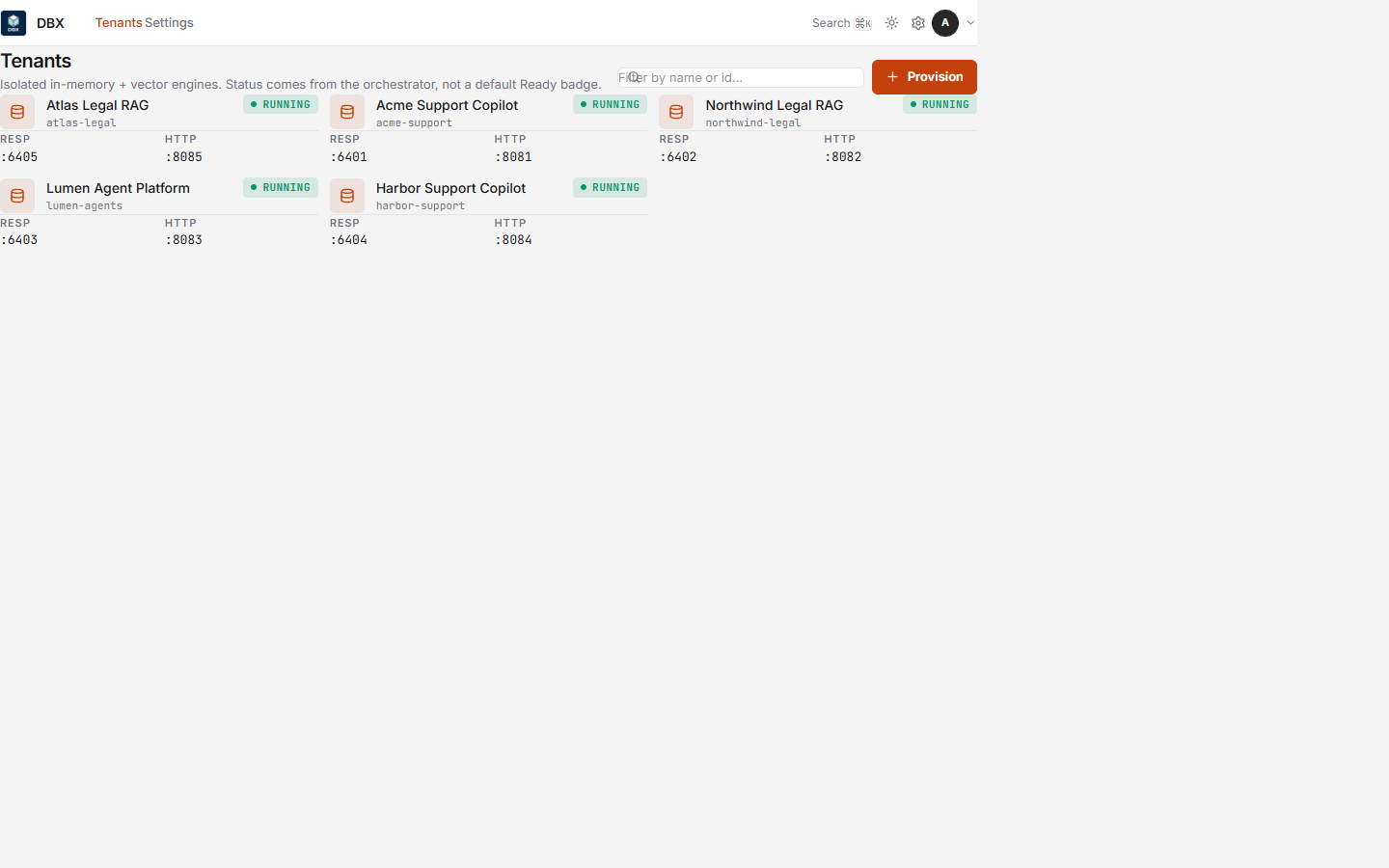
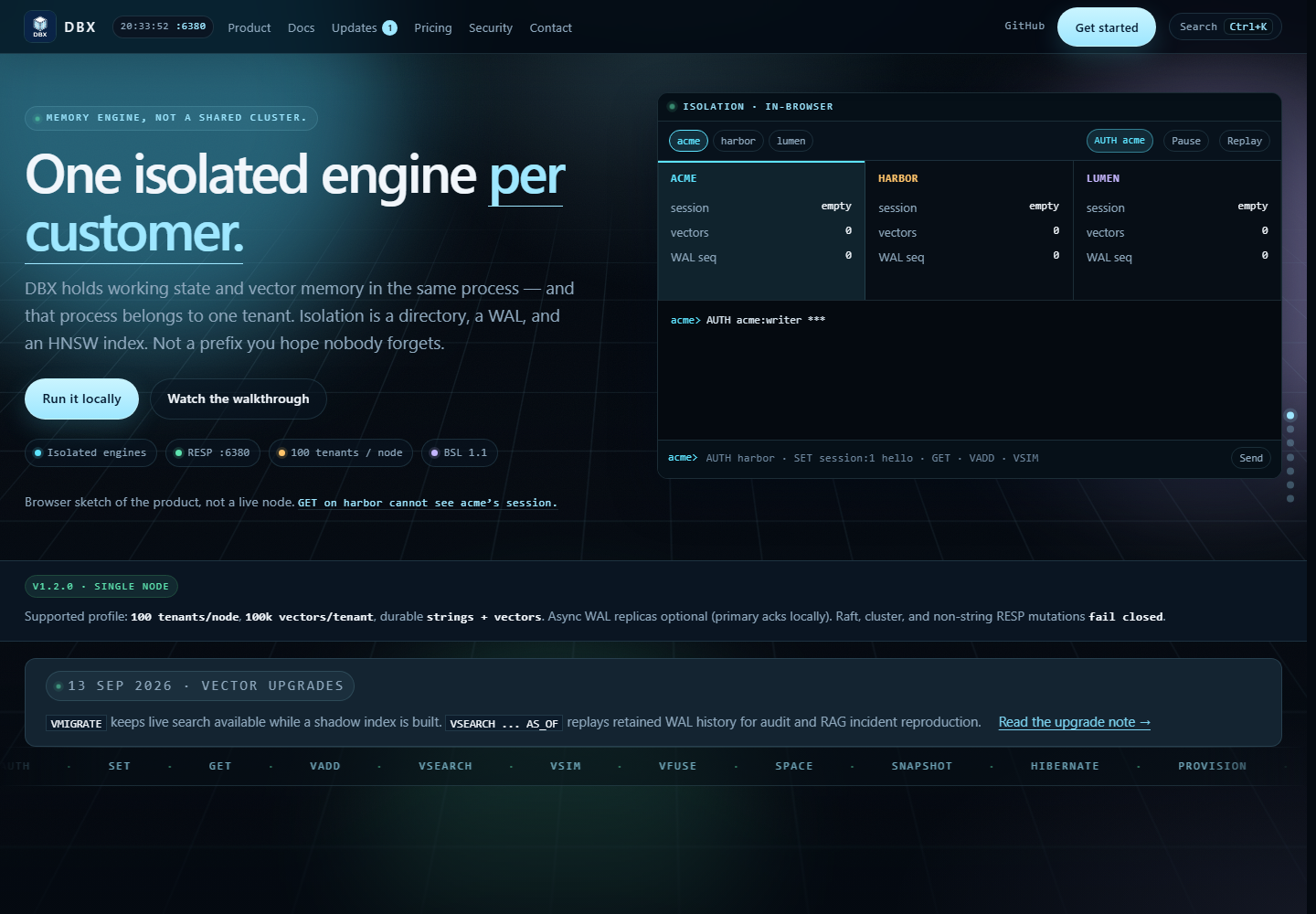
Furthermore, almost every mainstream vector database treats multi-tenancy as an afterthought—implementing it as "soft tagging" (WHERE tenant_id = 'x'), which creates severe cache collision, noisy neighbor problems, and data-leak risks.
We asked: Why can't a vector database combine bare-metal SIMD performance, zero-copy virtual memory management, and cryptographically hard-partitioned multi-tenancy into a single, zero-dependency static binary?
This challenge inspired us to build DBX (Database Extreme)—a bare-metal vector engine engineered from first systems principles.
What it does
DBX is an ultra-fast, multi-tenant vector database designed to deliver sub-millisecond similarity search over dense embeddings without requiring GPUs or complex external infrastructure.
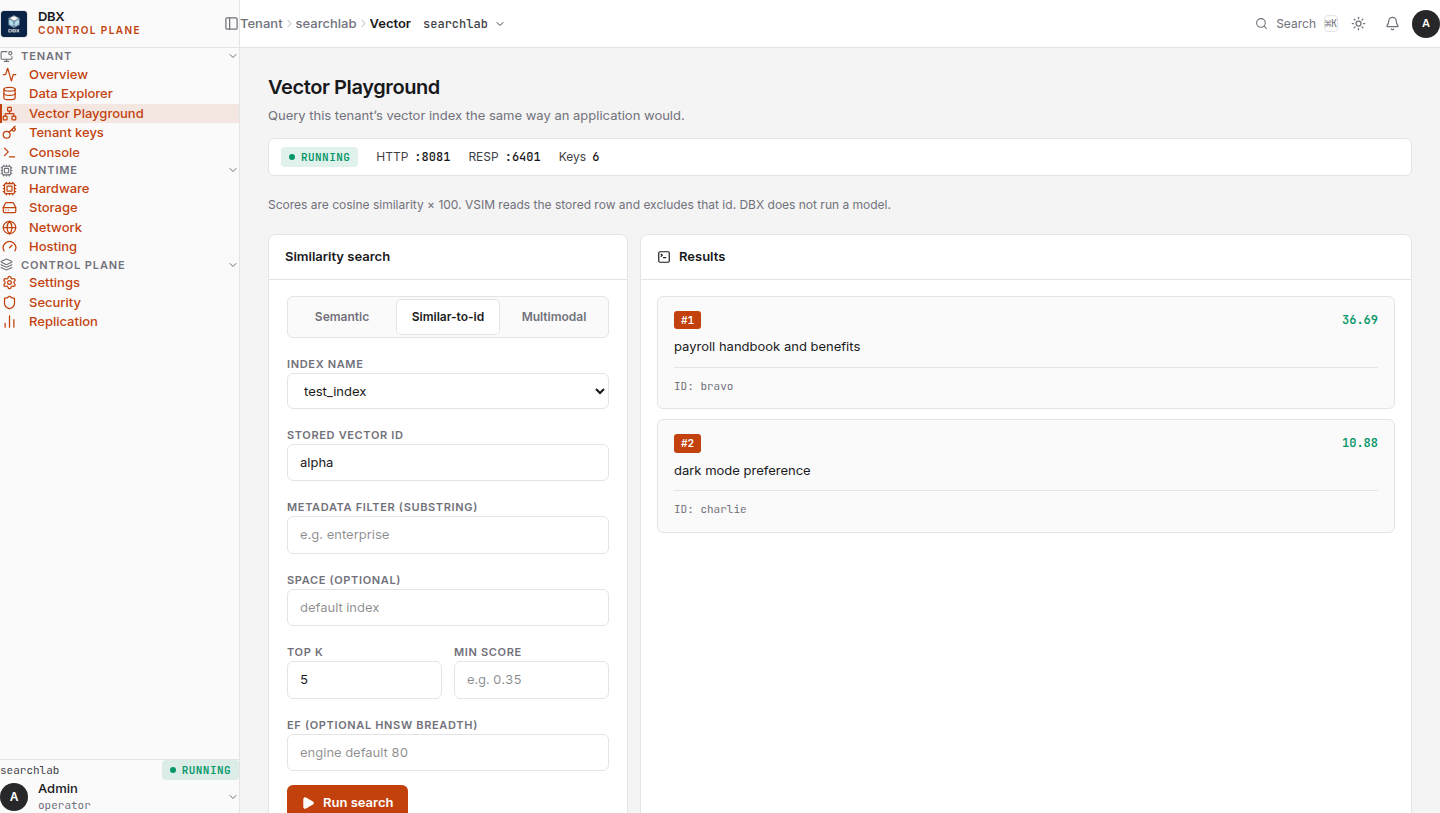
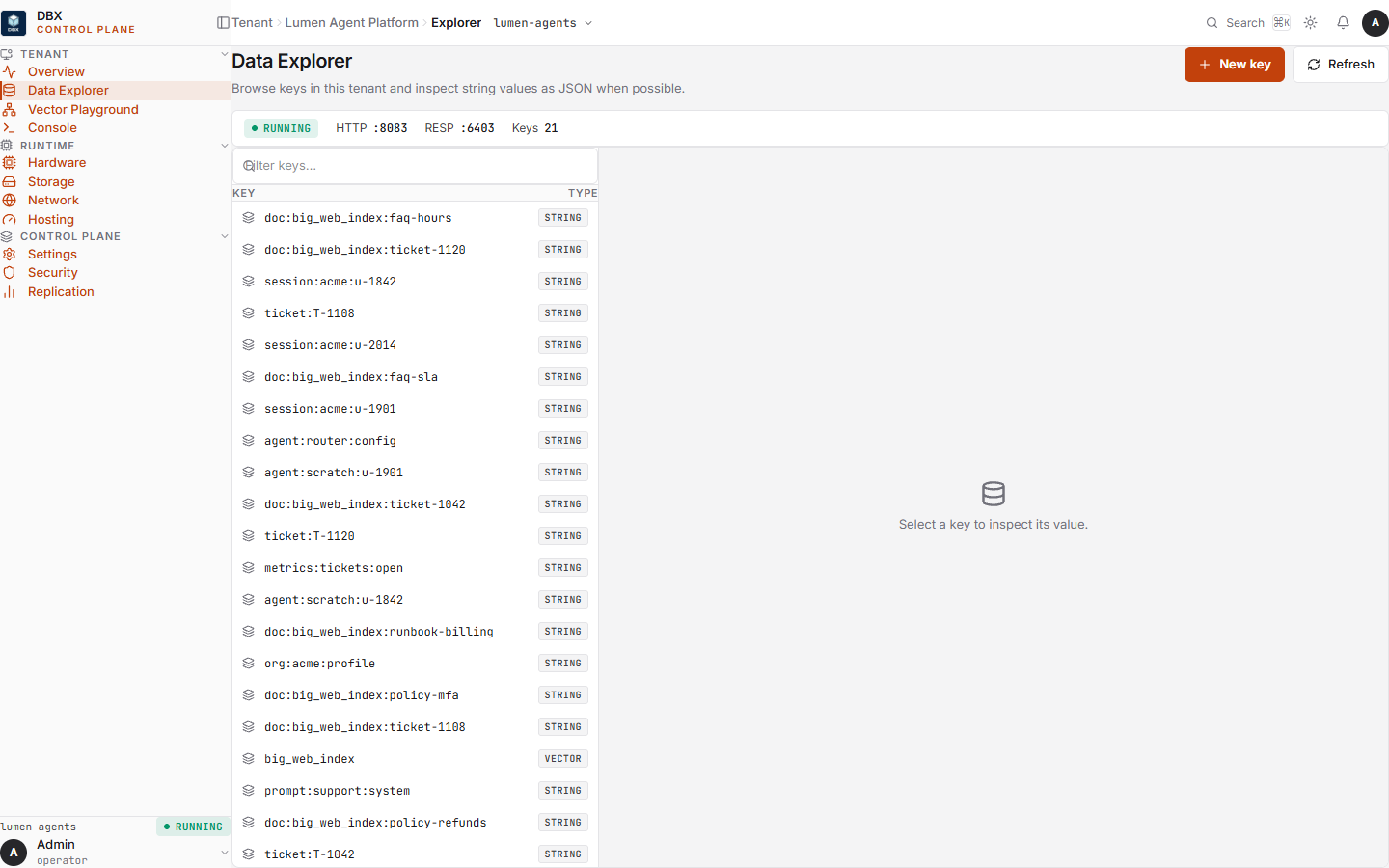
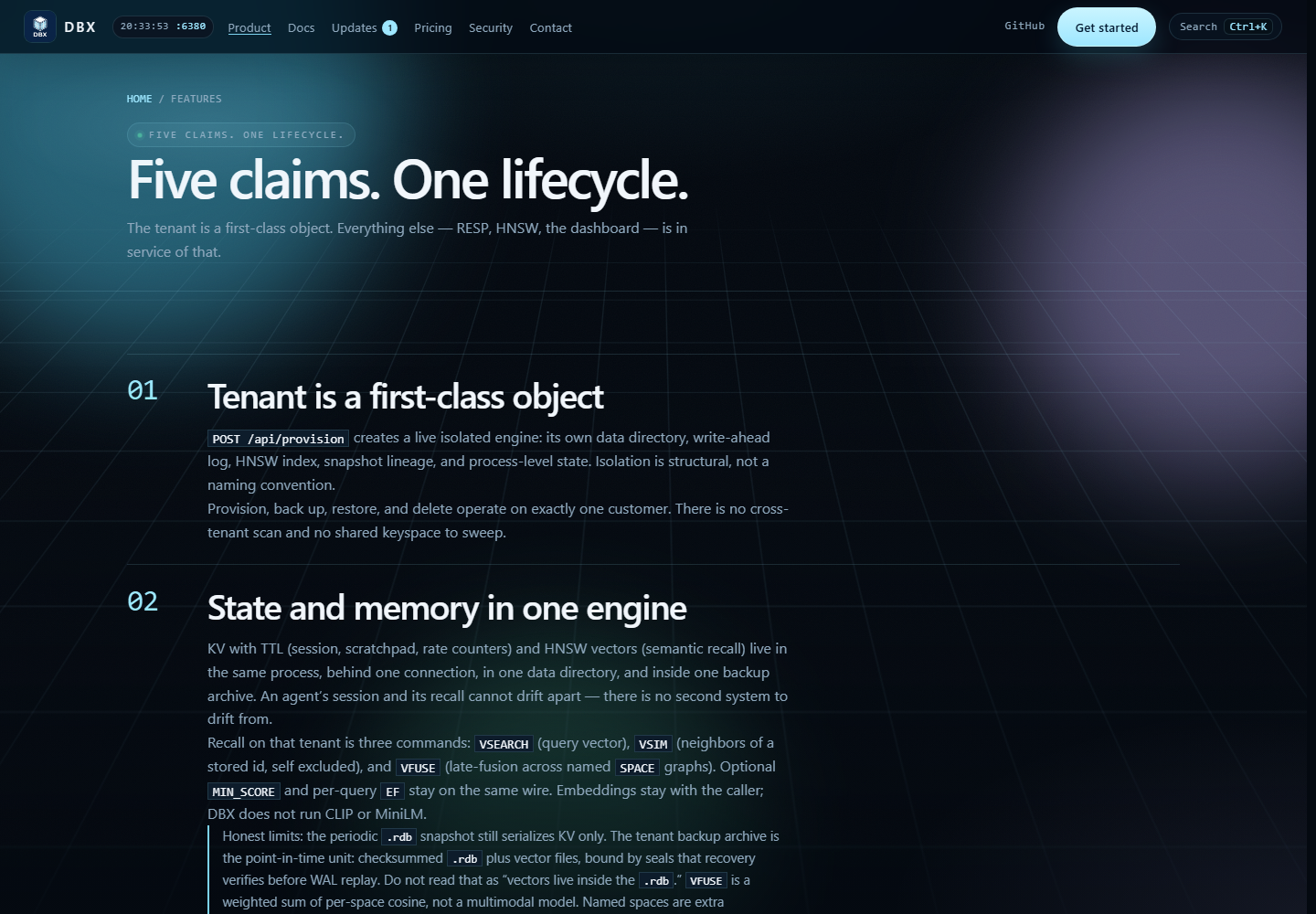
The Combined Killer Capabilities: Bare-Metal SIMD Acceleration: Evaluates high-dimensional vector similarities ($\mathbb{R}^d$ for $d \in [384, 1536]$) using hand-tuned 256-bit AVX2/AVX-512 and ARM NEON CPU vector extensions, computing up to 16 floating-point operations per CPU cycle. Zero-Copy Memory-Mapped Storage (mmap): Directs the OS virtual memory manager to page vector index segments straight from disk into user space, keeping idle memory footprint near zero while enabling instant cold starts. Hard-Partitioned Cryptographic Multi-Tenancy: Each tenant operates within a strictly isolated physical boundary with dedicated Write-Ahead Logs (WAL), isolated indexing structures, and cryptographic auth tokens—guaranteeing zero cross-tenant memory leakage. Hybrid Search & Metadata Filtering: Executes combined scalar metadata filtering and vector similarity scoring in a single, unified execution pipeline without performance degradation. Zero-Dependency Single Binary (<30MB): Operates standalone with no external services (no ZooKeeper, Kafka, or Docker required), capable of running anywhere from a developer laptop or edge device to cloud bare-metal clusters.
How we built it
Core Engine & Networking: Built with Go for high-throughput concurrency, non-blocking I/O routines, and lightweight system orchestration. Hardware-Level Vector Math: We implemented hardware-pipelined vector math kernels. For unit-normalized vectors $\mathbf{u}, \mathbf{v} \in \mathbb{R}^d$ where $|\mathbf{u}|2 = |\mathbf{v}|_2 = 1$, the cosine similarity reduces directly to the high-speed dot product: $$S_C(\mathbf{u}, \mathbf{v}) = \langle \mathbf{u}, \mathbf{v} \rangle = \sum{i=1}^{d} u_i v_i$$
For Euclidean ($L_2$) distance:
$$D_{L2}(\mathbf{u}, \mathbf{v}) = |\mathbf{u} - \mathbf{v}|2 = \sqrt{\sum{i=1}^{d} (u_i - v_i)^2}$$
By unrolling loops across 256-bit vector registers, 8 single-precision float32 numbers are processed per instruction, completely bypassing sequential scalar loops.
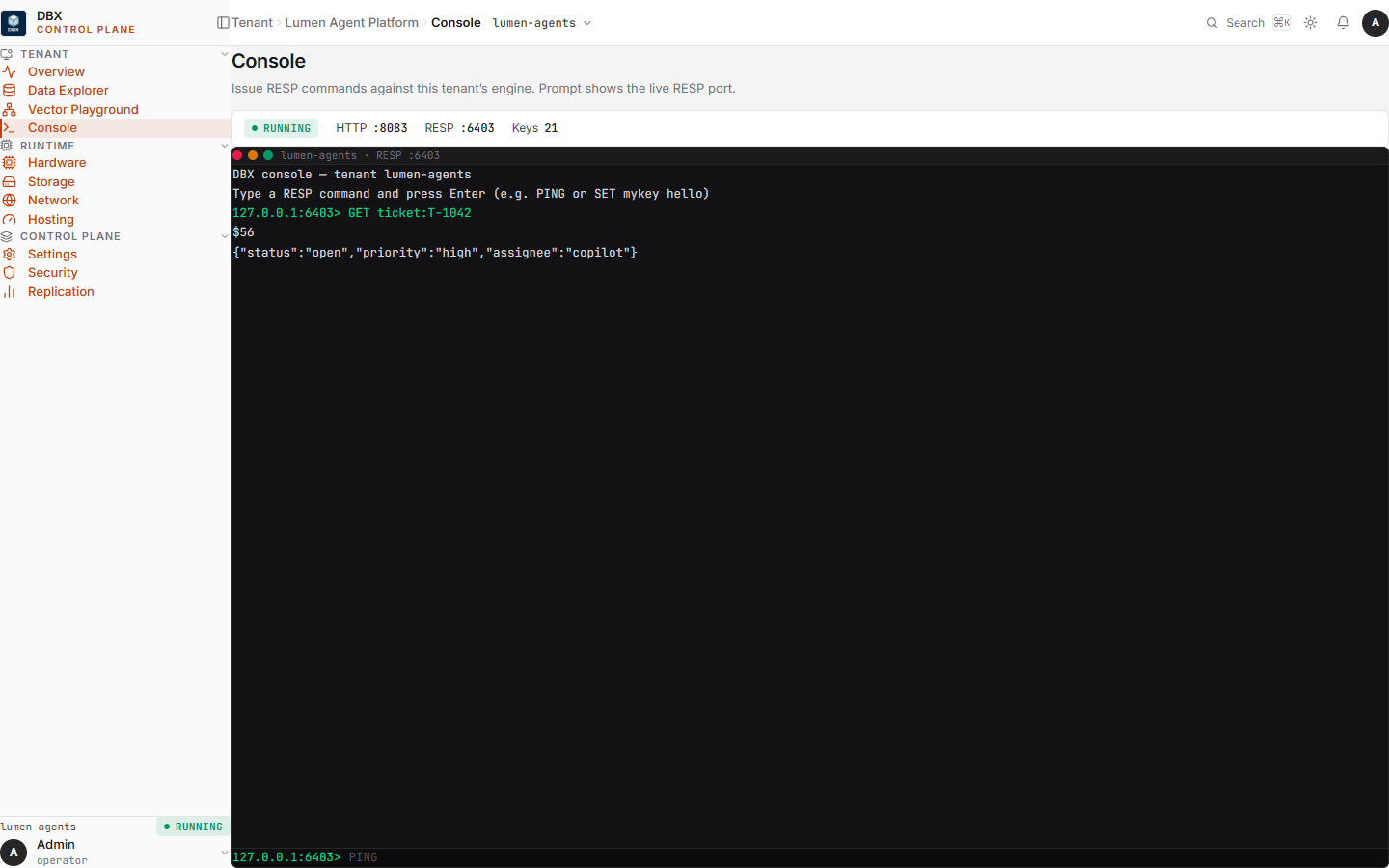
Storage Subsystem: Bypassed runtime heap allocation by implementing syscall.Mmap for vector storage. Paired this with an append-only, sequential Write-Ahead Log (WAL) to provide ACID guarantees and crash resilience. Tenant Isolation Architecture: Engineered dedicated shard controllers where tenant spaces are segregated at the filesystem and memory boundary rather than through shared table filters.
Challenges we ran into
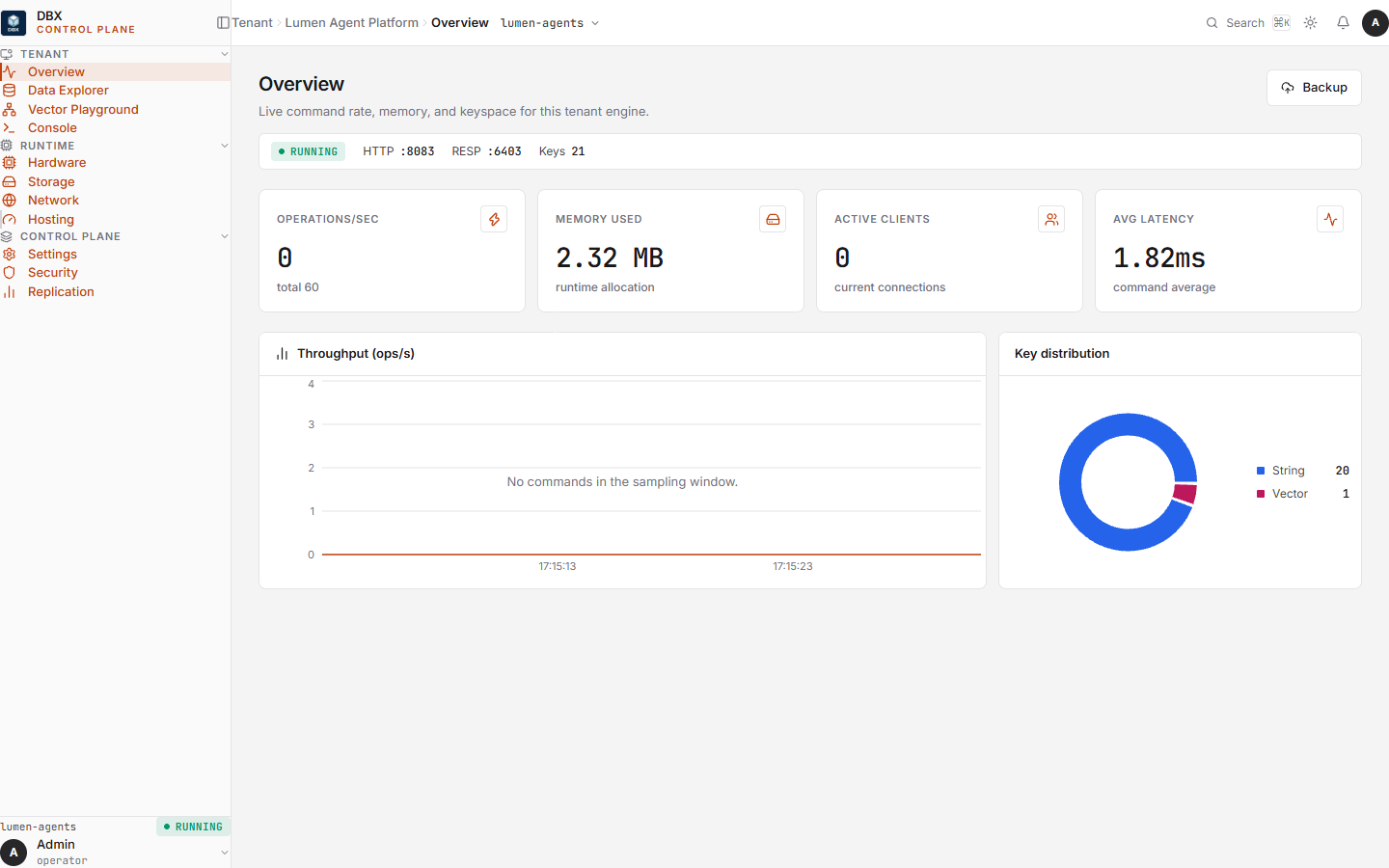
Eliminating Go Garbage Collector Pauses: In early iterations, storing hundreds of thousands of 1536-dimensional float slices on the Go managed heap caused unpredictable Garbage Collection (GC) pauses (p99 latency spikes exceeding 120ms). We re-architected the storage layout to store raw vector arrays off-heap inside memory-mapped byte slices, reducing the Go runtime’s GC tracking overhead to near-zero. Lock Contention in Multi-Tenant Environments: High-concurrency streaming writes from one tenant threatened to saturate disk I/O and lock query threads from other tenants. We designed lock-striped index partitions and decoupled WAL flush queues so high-throughput writes in Tenant A never block read queries in Tenant B. Platform SIMD Cross-Compilation: Achieving identical floating-point precision and performance characteristics between x86_64 (AVX2/FMA) and ARM64 (Apple Silicon / AWS Graviton NEON) required building platform-specific vectorized assembly paths with rigorous boundary checks.
Accomplishments that we're proud of
Achieved Sub-Millisecond p99 Latency: Reached sub-millisecond query responses on million-scale vector spaces purely on commodity CPUs—no GPUs needed. The "Impossible Combination": Successfully combined bare-metal SIMD speed, zero-copy memory mapping, and cryptographic multi-tenancy into a single binary under 30MB—a feat that neither heavy engines (Milvus) nor lightweight libraries (Chroma) achieve simultaneously. Instant Cold Starts: Enabled DBX instances with millions of stored vectors to start and accept queries in under 100 milliseconds because the OS memory manager pages data on demand rather than loading full indexes into RAM at startup.
What we learned
Hardware and Memory Layout Trump Raw Algorithms: Designing memory access patterns around 64-byte CPU cache lines and sequential memory access yielded vastly higher real-world speedups than complex algorithmic approximations that cause cache misses. Operating Systems are World-Class Buffer Managers: By leveraging mmap combined with explicit kernel hints (madvise), we allowed the OS kernel to manage virtual page eviction far more efficiently than custom in-memory buffer pools written in user space. True Multi-Tenancy Must Be Physical, Not Logical: Soft multi-tenancy creates continuous security headaches and noisy-neighbor slowdowns; hard partitioning at the storage boundary is the only sustainable way to build enterprise-grade vector systems.
What's next for DBX - Database Extreme
Hardware Quantization (SQ8 & PQ): Introducing Scalar Quantization (8-bit integers) and Product Quantization (PQ) to reduce vector memory consumption by up to $4\times\text{--}8\times$ with $<1%$ recall drop. Distributed Raft Consensus: Expanding the DBX orchestrator to support multi-node replication and distributed shard failovers with zero downtime. Dynamic HNSW Graph Rebalancing: Developing background graph pruning algorithms that optimize Approximate Nearest Neighbor (ANN) index topologies on-the-fly during active streaming ingestions. 9:28 PM


Log in or sign up for Devpost to join the conversation.