DBrief: Remember What Was Said. Discover What Connects.
Inspiration
I wanted to explore what makes AI agent memory genuinely useful. An agent that remembers a conversation is helpful, but an agent that connects what someone said to real-world records, discovers relationships, and shows where its conclusions came from is much more powerful.
That led me to insurance claims. A claimant might misremember an accident's time, correct an earlier statement, or describe an incident that connects to information elsewhere in a dataset. A traditional database can retrieve a policy, and an LLM can summarize a conversation, but can an agent use persistent memory to connect those pieces of information and investigate intelligently?
That question became DBrief.
What it does
DBrief is an AI insurance claims agent built around a simple distinction: what someone said is not necessarily what the records show.
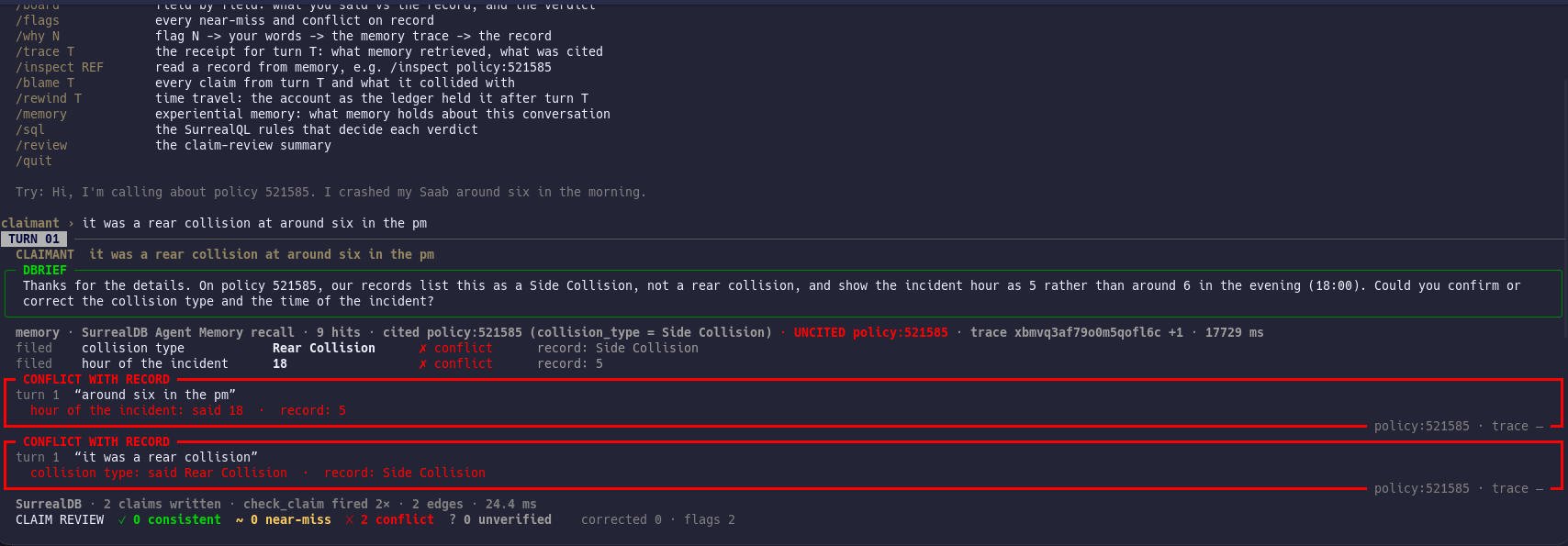
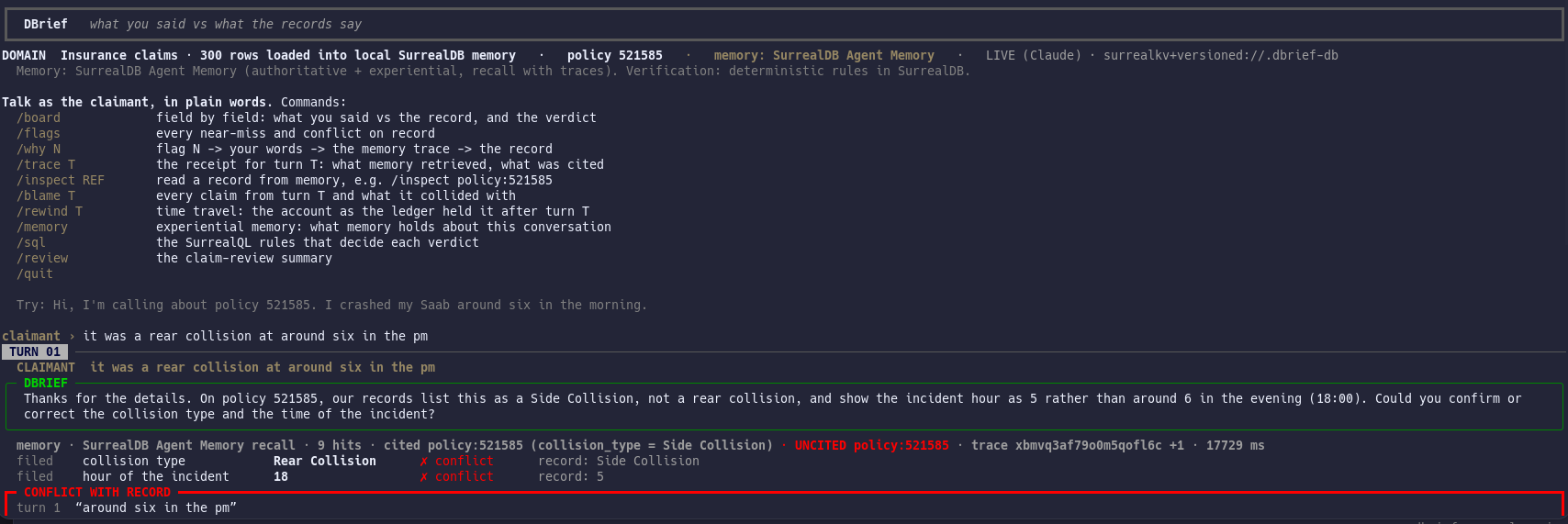
A claimant describes an incident in natural language. DBrief extracts structured claims, checks them against authoritative insurance records, and classifies the results as consistent, near-miss, conflicting, or unverified.
Using SurrealDB and Agentic Memory, I'm building toward something beyond simple lookups: an agent that can recall related information, discover connections between records, remember how a conversation evolves, and trace its findings back to their sources.
When a claimant corrects a statement, the earlier version is preserved rather than erased. When information conflicts, DBrief surfaces the discrepancy without automatically treating a mistake as fraud.
How I built it
I built DBrief by combining an AI agent, SurrealDB-backed memory, and deterministic database checks.
- Conversational memory: Preserves what the claimant actually said across turns and sessions.
- Authoritative records: Keeps source data separate from conversational claims.
- Deterministic verification: Uses explicit database rules to check claims instead of relying on an LLM to decide what is true.
- Knowledge graph: Connects relevant entities and records so the agent can discover information beyond a single policy lookup.
- Traceability: Makes it possible to inspect what the agent retrieved and which records support its findings.
- Historical corrections: Preserves superseded statements so changes in an account remain visible.
The central design decision was to separate language understanding, evidence retrieval, and verification. The LLM interprets what a person says; the database applies explicit rules; and memory helps the agent maintain context and find relevant connections.
Challenges I faced
My biggest challenge was making Agentic Memory essential to the project rather than simply adding a memory layer to a conventional database application.
A basic version of DBrief could retrieve a policy and compare a few fields. To go further, I needed the agent to discover relationships between records, retrieve the underlying evidence, and use those discoveries to guide its investigation.
I also had to balance the flexibility of an LLM with the reliability of deterministic checks. Natural language is ambiguous, records can be incomplete, and a near-match isn't necessarily a contradiction. DBrief needs to communicate uncertainty honestly rather than turn every discrepancy into an accusation.
Finally, I wanted memory to be inspectable. An answer is more trustworthy when I can trace it back to the information the agent actually retrieved.
What I learned
Building DBrief has reinforced my belief that agent memory is most valuable when it changes what an agent can discover and do—not merely what it can recall.
I also learned to treat provenance and uncertainty as core parts of an AI system, not features to add afterward. Remembering a statement, verifying it against evidence, and explaining the relationship between the two are separate responsibilities.
What's next
I want to make DBrief better at discovering connections across claims, using those connections to ask more useful follow-up questions, and exposing retrieval traces that let anyone inspect the evidence behind a finding.
The same approach could extend beyond insurance into compliance, audits, customer disputes, and other workflows where decisions depend on reconciling conversations with records.
My goal with DBrief is simple: build an agent that doesn't just remember what happened, but connects the evidence and shows its work.
Built With
- cli
- python
- surrealdb
- surrealql
