-
-
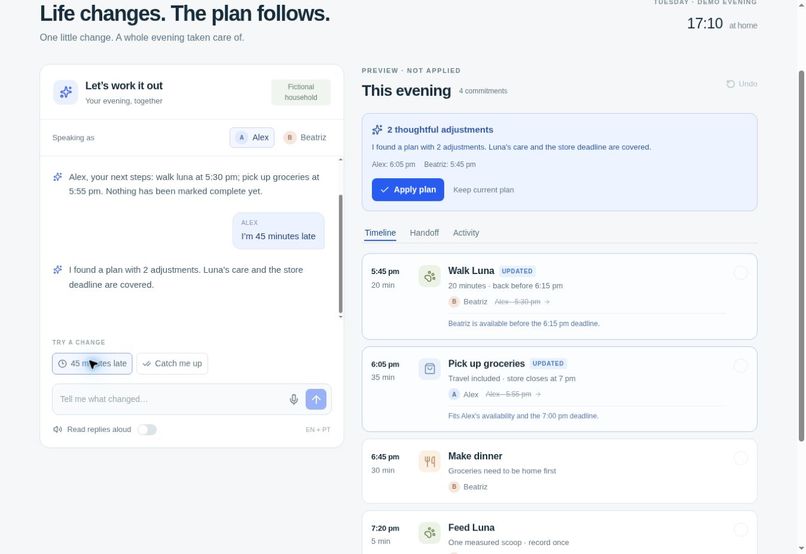
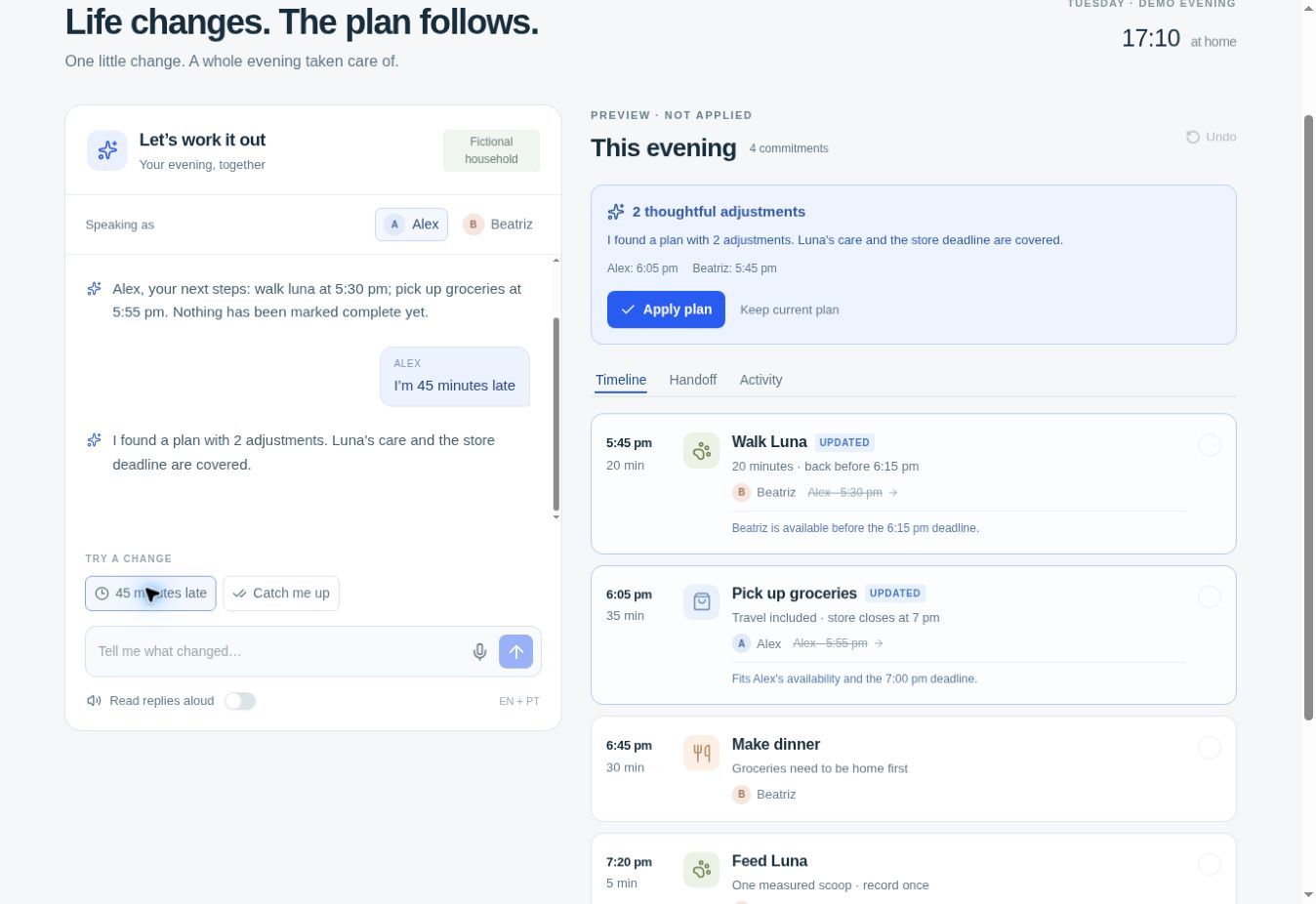
One late arrival creates an explained proposal; the current plan stays unchanged until confirmation.
-
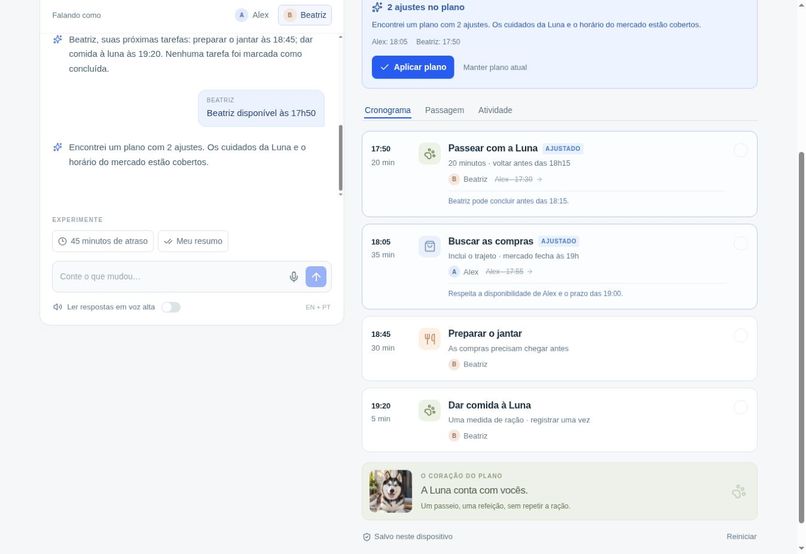
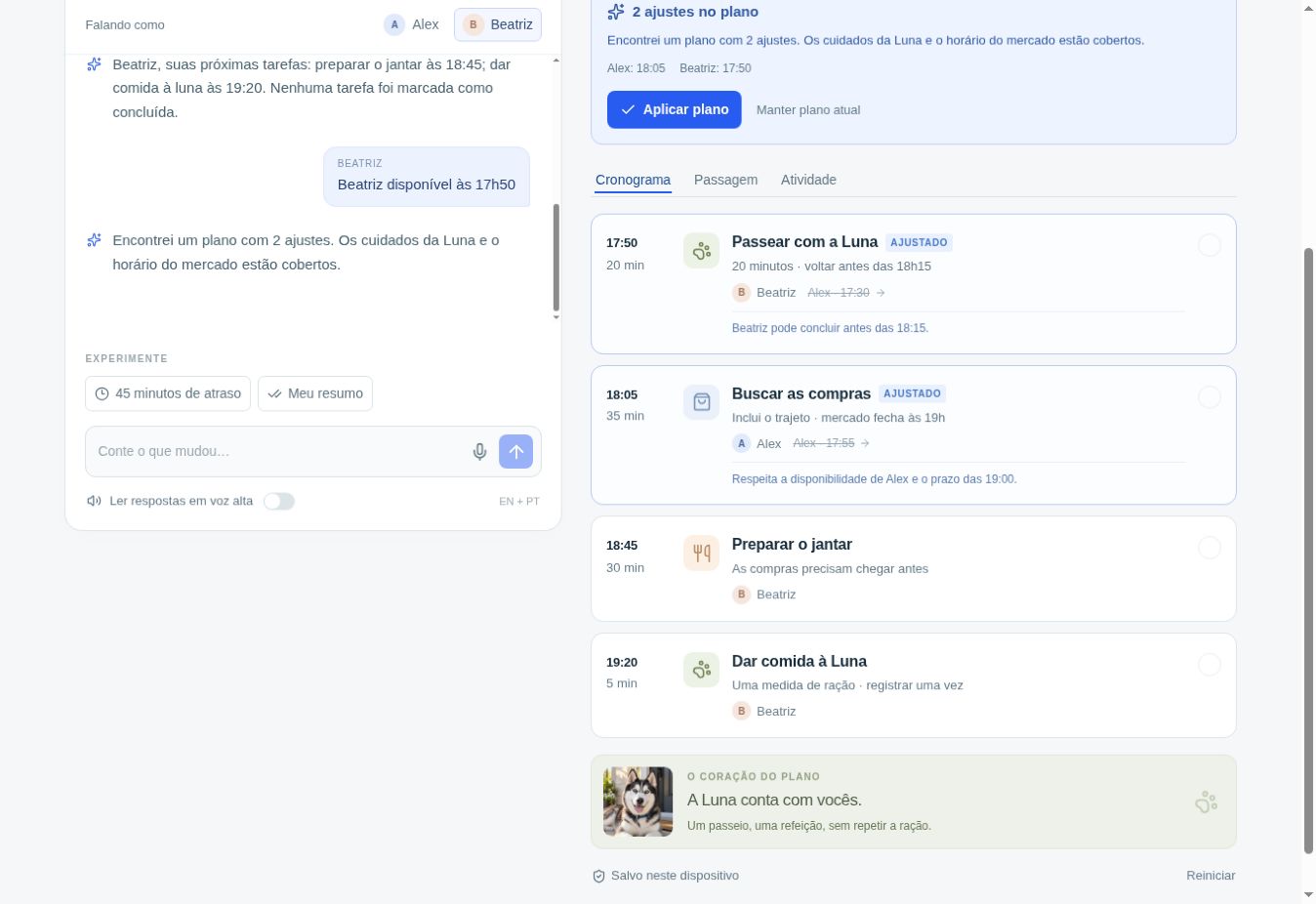
A Portuguese follow-up refines the same pending plan without losing the earlier context.
-
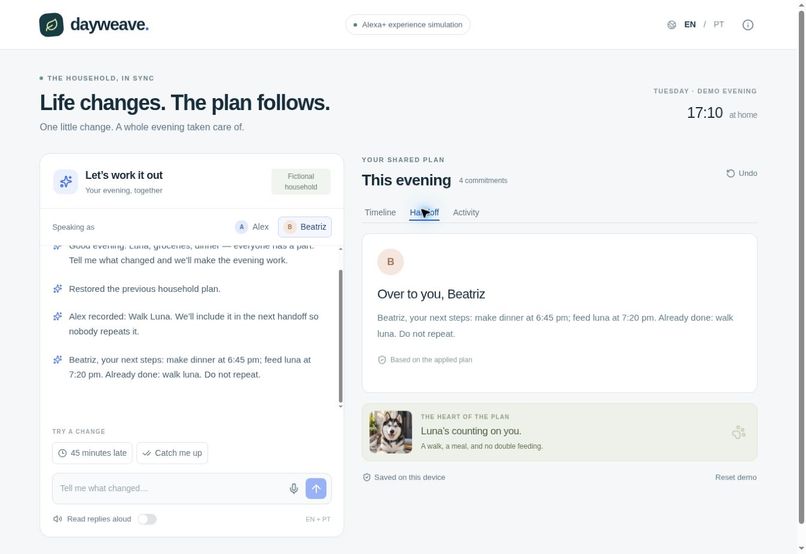
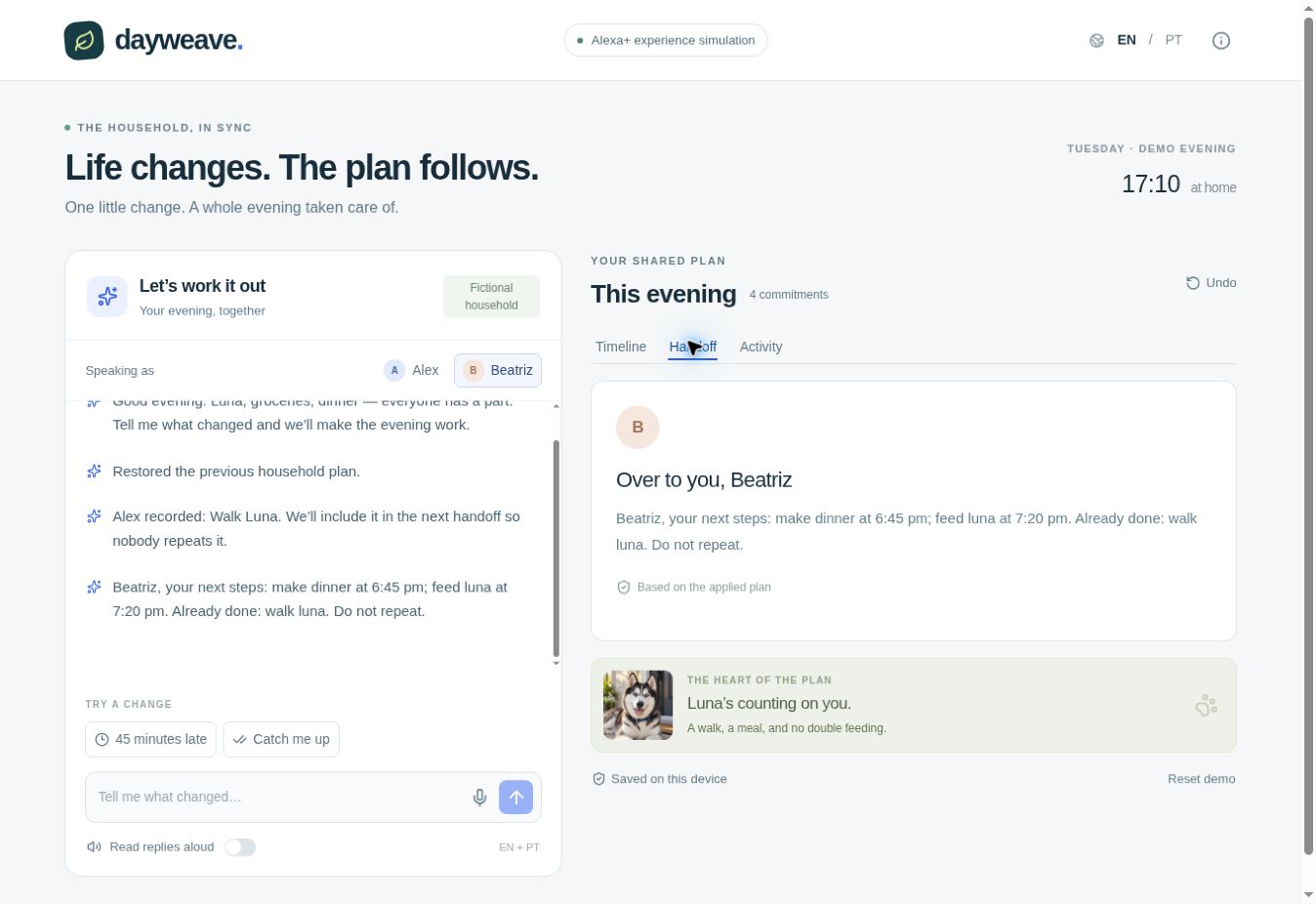
Completed tasks carry into the next person’s bilingual handoff, with a reminder not to repeat care.
-
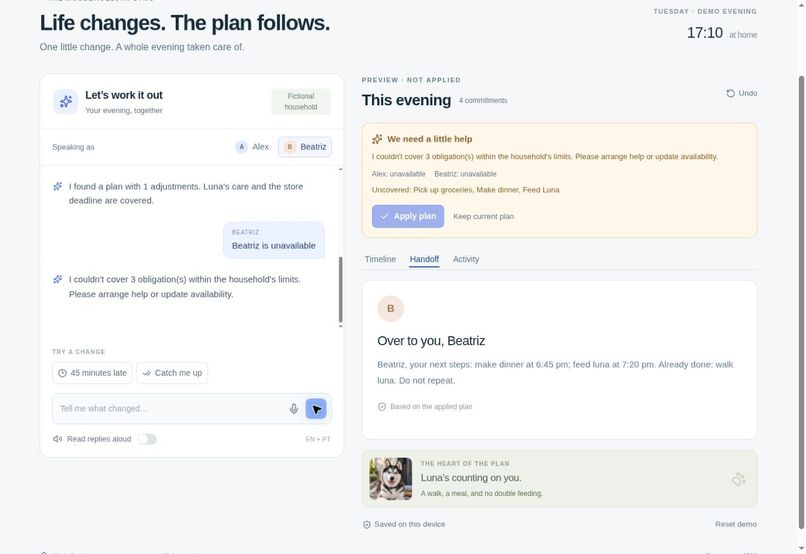
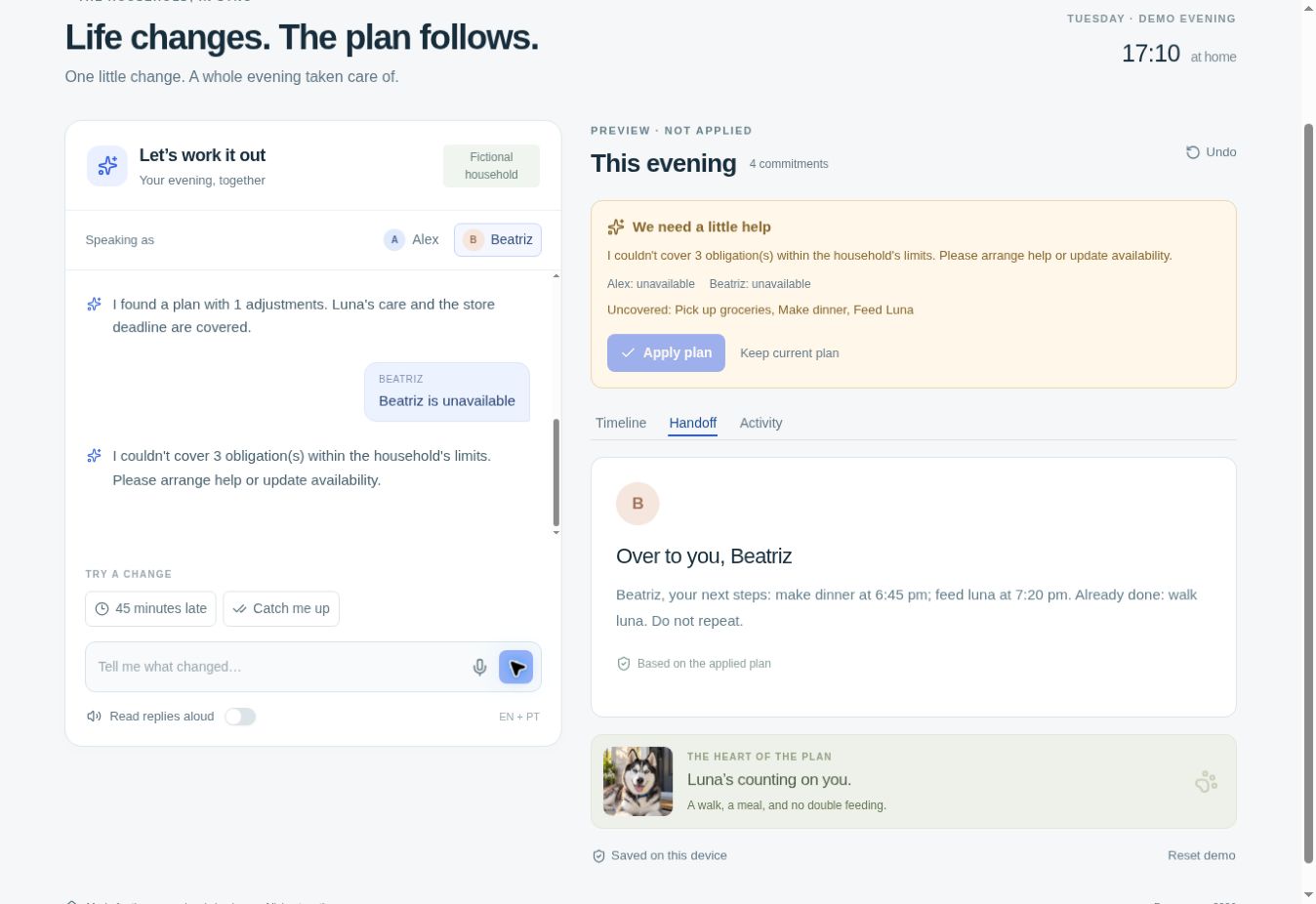
Impossible availability names uncovered obligations and prevents applying an unresolved plan.
Inspiration
Household coordination is a dependency problem disguised as a conversation. “I’m running late” changes who can walk the dog, whether the groceries can arrive before dinner, and what the next person needs to know. Most shared lists leave that replanning work to a person. Dayweave explores an Alexa+ experience that carries the plan across that interruption.
Our fictional household has two people, Alex and Beatriz, and a husky named Luna. The English/Portuguese setting makes the handoff itself part of the problem: people should be able to contribute in the language that feels natural without losing the pending plan.
What it does
Dayweave turns a change in availability into an explained proposal covering four linked obligations. It respects each person's arrival time, task deadlines, eligible owners, nonoverlapping assignments, and the dependency between groceries and dinner. It favors keeping the current plan when possible.
A change stays in preview until a person explicitly applies it. A Portuguese follow-up refines the same pending plan rather than discarding the English request. The applied plan and undo history survive a reload on the same device. Completion records flow into the next person's handoff with a reminder not to repeat finished care. When no valid plan covers the obligations, the interface names the missing coverage and prevents applying that proposal.
How we built it
The working browser prototype uses TypeScript and React, a Next-compatible Vinext/Vite starter, Radix/shadcn UI primitives, Lucide icons and responsive CSS. The domain engine is separate from the interface. A bounded English/Portuguese intent parser produces structured requests; a finite constraint search builds candidate assignments and schedules. Replies are templated and bilingual.
This is explicitly the hackathon's simulation alternative. There is no live Alexa integration, external AI-model call, calendar connection, shopping action, messaging integration or cross-device synchronization. The household data are fictional. Optional voice input uses the browser's speech service after explicit consent and places its transcript into an editable input before sending.
AI assistance was used to develop the concept, implementation, tests, interface copy and submission materials. The fictional Luna illustration was generated with OpenAI image generation. The source is released under MIT; dependencies retain their own licenses.
Challenges
Preserving a multi-person pending proposal across language changes was more important than making a persuasive chat response. We separated draft and committed state, retained pending availability updates, required an explicit Apply action, and added revision checks against stale changes.
We also needed “cannot cover this” to be a first-class outcome. The engine penalizes uncovered care heavily while still reporting the failure honestly. It never turns an unresolved proposal into a committed plan.
Accomplishments
- A working interaction from one late arrival to two explained plan changes.
- Context-preserving English/Portuguese follow-up.
- Device-local persistence with undo that still works after reloading.
- Owner-scoped completion records, duplicate prevention, and dependency checks.
- Explicit failure handling for impossible household availability.
- Nine behavioral tests, including a grid of arrival-time combinations, plus a passing TypeScript check and production build.
What we learned
The most useful assistant behavior is often the transition between a suggestion and a shared commitment. A visible preview, reasons for each edit, one confirmation, and an accurate handoff matter as much as the initial language interaction.
What's next
Connect the same domain actions to an available Alexa+ integration surface; replace the bounded parser with a structured model interface; add authenticated household membership and reliable shared storage; and expand the task model with user-editable rules. Those are planned extensions, not implemented capabilities.
Product and tool feedback
We used the publicly documented simulation route because the published FAQ permits it without a particular SDK or runtime surface. We did not have access to gated Alexa+ preview tools, so we are not claiming to have tested their developer experience.
For a future live integration, useful platform capabilities would include explicit household-member context, a durable plan revision identifier, reversible multi-step updates, and a structured distinction between proposed and committed actions. These are design requests inferred from building this simulation, not defects observed in an Alexa SDK.
- Tools and purpose: TypeScript and React implement the interface and domain model; Vinext/Vite runs and builds the browser prototype; Node tests validate planning behavior. OpenAI assistance supported implementation and submission materials.
- What worked: separating the domain engine from the interface made constraints testable, while draft/commit state preserved context across bilingual follow-ups.
- What needs improvement: broader language understanding and shared household storage are still future work. For Alexa+, documented household identity, plan revisions, and reversible actions would make a live implementation easier to assess.
- Onboarding: the simulation can be installed with the checked-in lockfile and run without API keys or an Amazon developer account. We did not evaluate onboarding for gated Alexa+ tools.
- Would we build again: yes, we would continue this concept when an appropriate Alexa+ integration surface is available, while retaining explicit confirmation and honest failure reporting.
Source code
https://github.com/er9091871-art/dayweave
The repository includes the complete tested 109-file source archive, MIT license, dependency licenses, and setup instructions. Download and extract dayweave-source.zip, open the extracted dayweave folder, and follow the README to run locally.
Demo description
Public demo: https://youtu.be/w98Q6Iu2y-o
The captioned video uses actual screenshots from the functioning browser application. It demonstrates the initial household, an Alex delay, a Portuguese Beatriz follow-up, Apply, reload persistence, Undo, completion handoff, and an impossible-plan response. English captions explain Portuguese interface states. It does not depict a live Alexa device or live Alexa connection.
Built With
- css
- react
- typescript
- vinext
- vite
- web-speech-api
