-
-
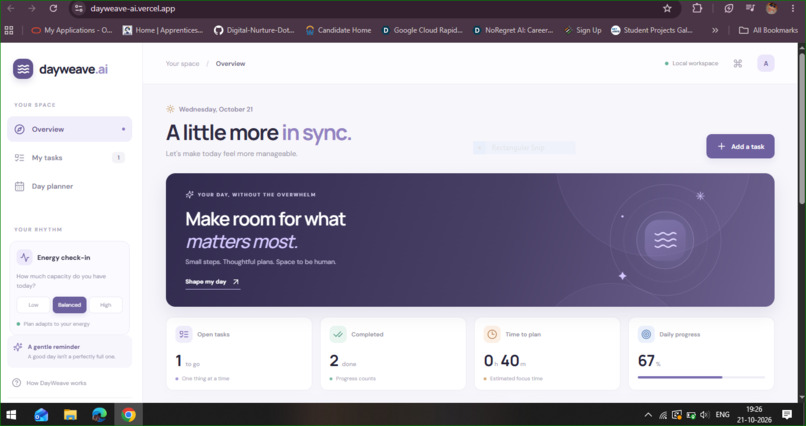
Home page of the deployment
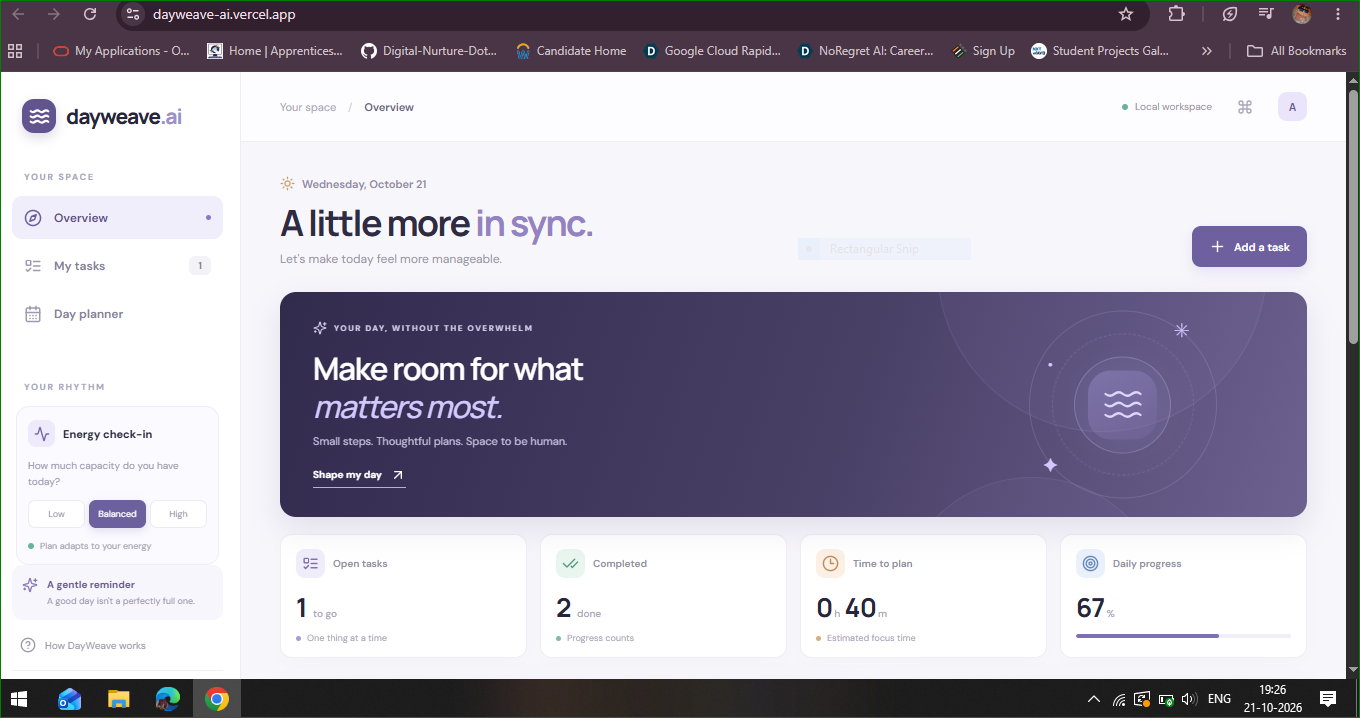
Inspiration:
Productivity isn't just about doing more. Some days I have the energy to tackle difficult tasks; on other days, even a small task can feel overwhelming. I wanted to explore how AI could make daily planning more flexible, personal, and realistic instead of forcing users into rigid schedules.
That idea led to DayWeave AI, an energy-aware productivity assistant designed to help people plan their days around their tasks, priorities, deadlines, and available energy.
What It Does?
DayWeave AI combines task management with AI-powered planning. Users can organize tasks, check in with their energy level, receive planning suggestions, and ask the AI for help managing their workload.
The assistant can prepare proposals to add, complete, or delete tasks, but it does not apply those changes until the user confirms them. This keeps the user in control of actions suggested by the AI.
The project also includes an Alexa+-inspired simulated experience that demonstrates how a conversational assistant could support a productivity workflow in a web application. It is a simulation, not an official Amazon Alexa+ integration.
How I Built It?
The application was built with Next.js, React, and TypeScript. Groq provides the language-model integration through a server-side API route. The application validates task context and AI-generated proposals before returning them to the interface.
The frontend provides the dashboard, task management, energy check-in, daily planning, and assistant experience. Task changes follow a review-and-confirm workflow. The project is hosted on Vercel, with its source code maintained on GitHub.
Challenges I Faced:
One of the main challenges was handling structured responses from the language model reliably. During development, the API returned JSON-generation errors, so we had to investigate the response format and correct the integration.
We also worked through task validation, ambiguous user requests, and the distinction between an AI-proposed action and a change that the user has actually approved. Finally, we connected the repository to Vercel, configured the server-side environment variables, and tested the deployed application.
What I Learned:
Building DayWeave AI taught us that creating an AI-powered product involves much more than connecting a model to a chat interface. Reliable validation, clear user control, error handling, deployment configuration, and testing are all important parts of the experience.
The project also helped us explore how an Alexa+-inspired conversational experience can be demonstrated through a web-based simulation.
What's Next:
We plan to strengthen the project with automated tests, evaluate the planner against different energy levels and task scenarios, and improve the documentation based on what we learn.
Built With
- github
- groq
- large-language-models-(llms)
- next.js
- react
- typescript
- vercel


Log in or sign up for Devpost to join the conversation.