-
-
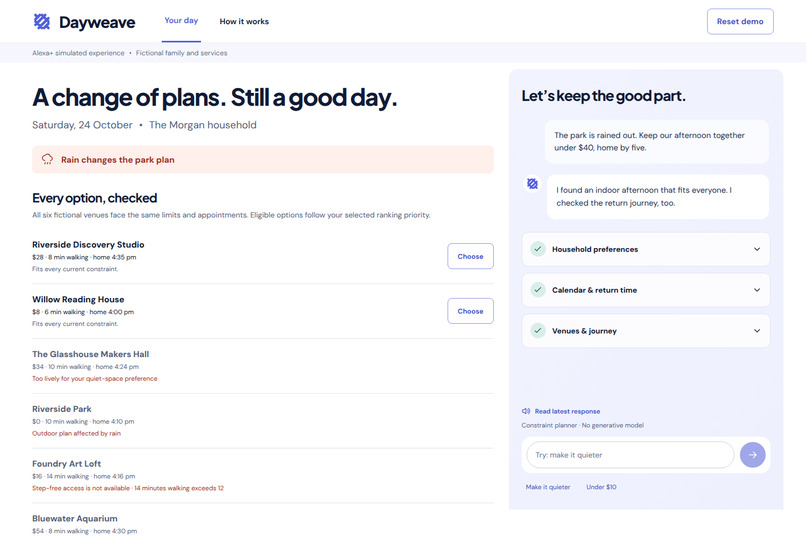
Every venue faces the same budget, access, noise, walking, weather, return-time and calendar checks.
-
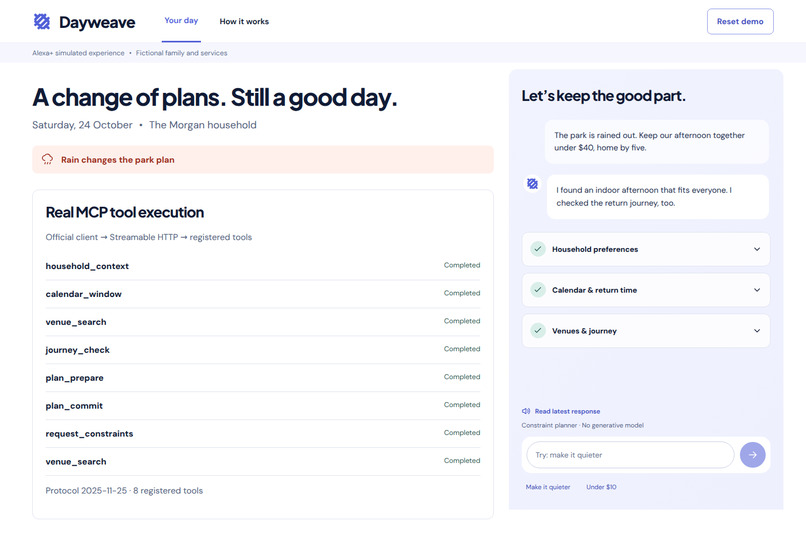
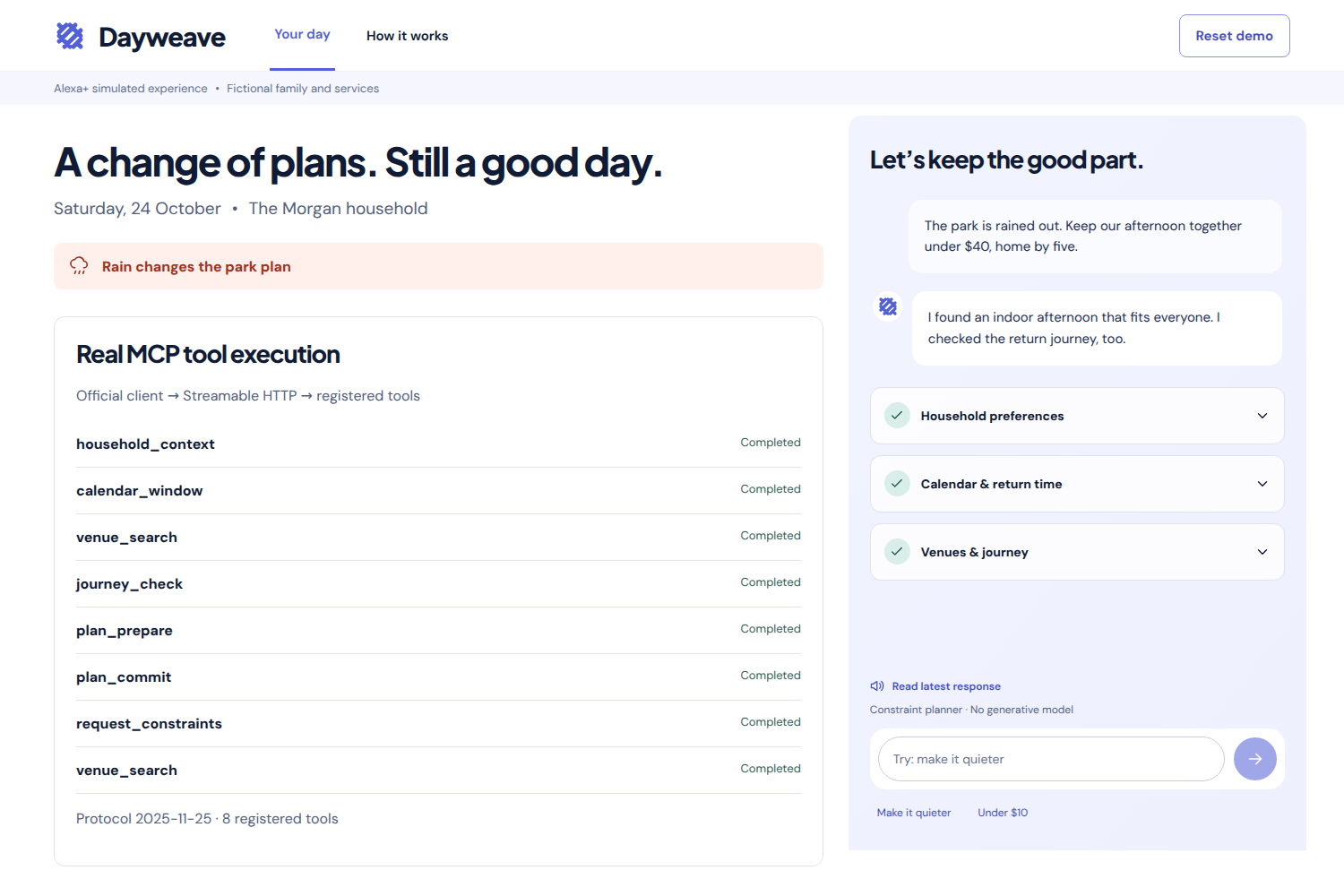
The official MCP client initializes Streamable HTTP 2025-11-25 and executes eight registered tools.
-
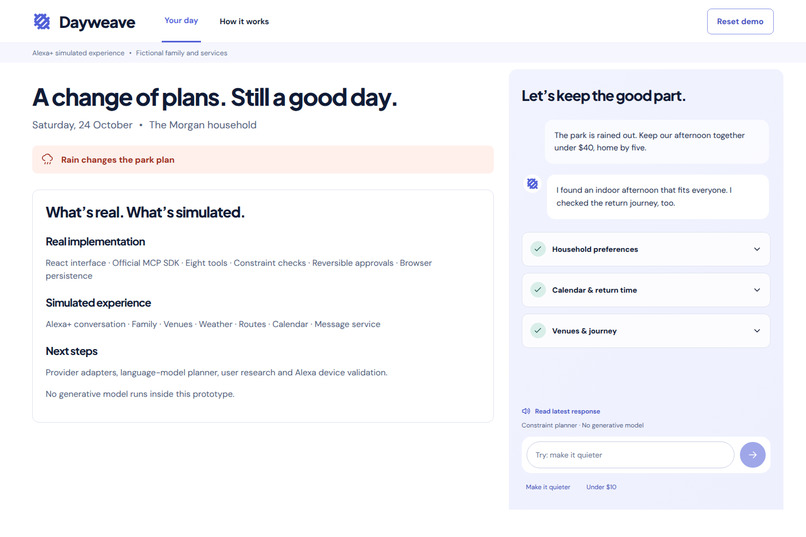
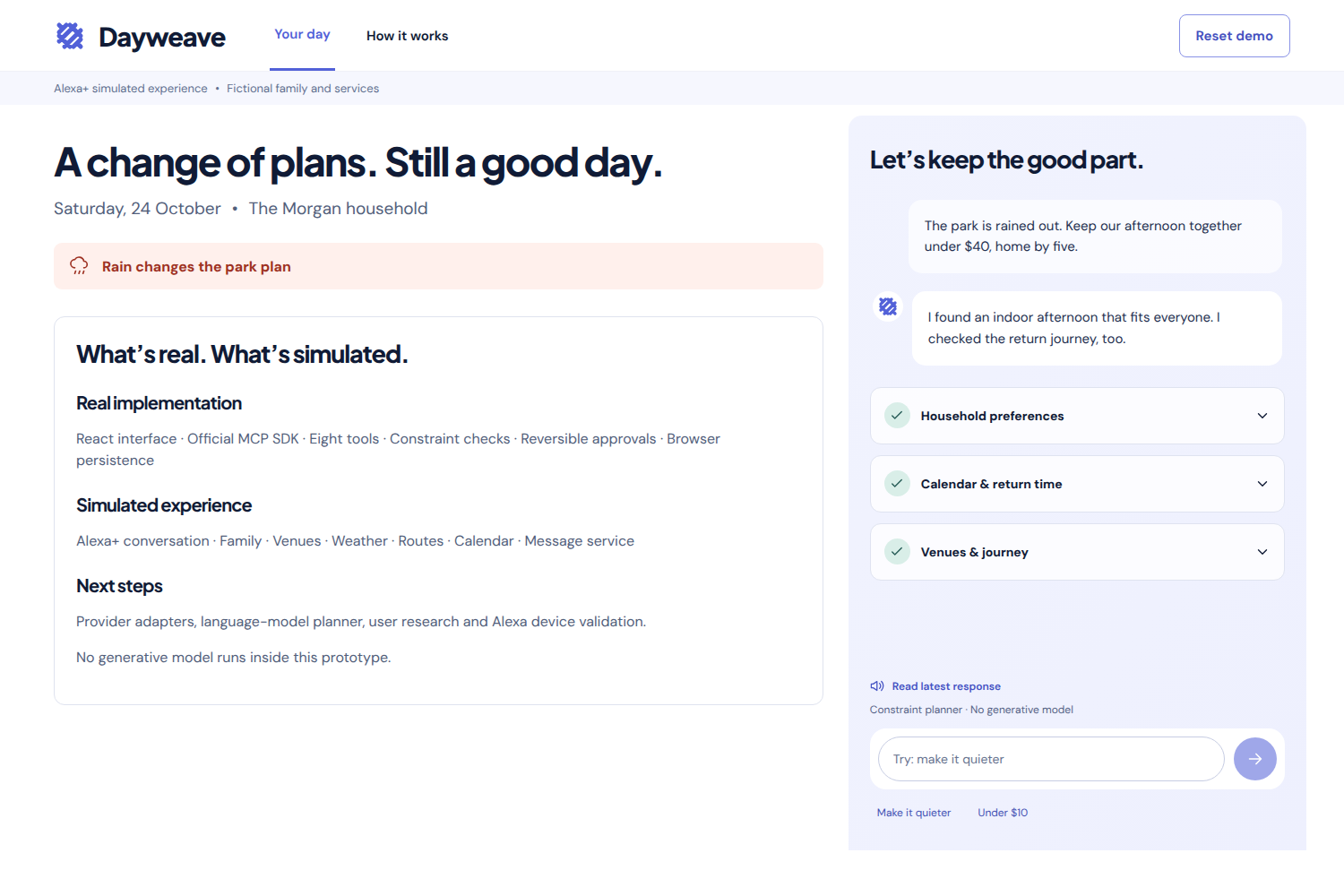
Real React, MCP execution and reversible sandbox behavior. Fictional services and a disclosed deterministic planner.
-
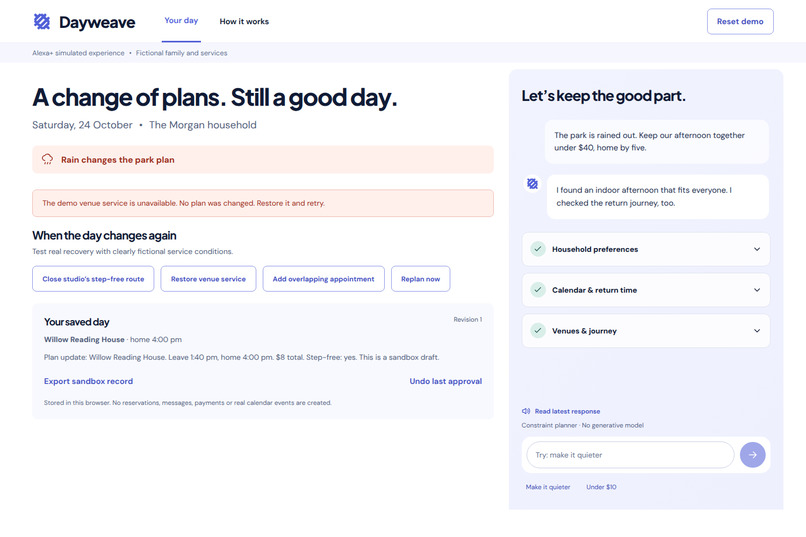
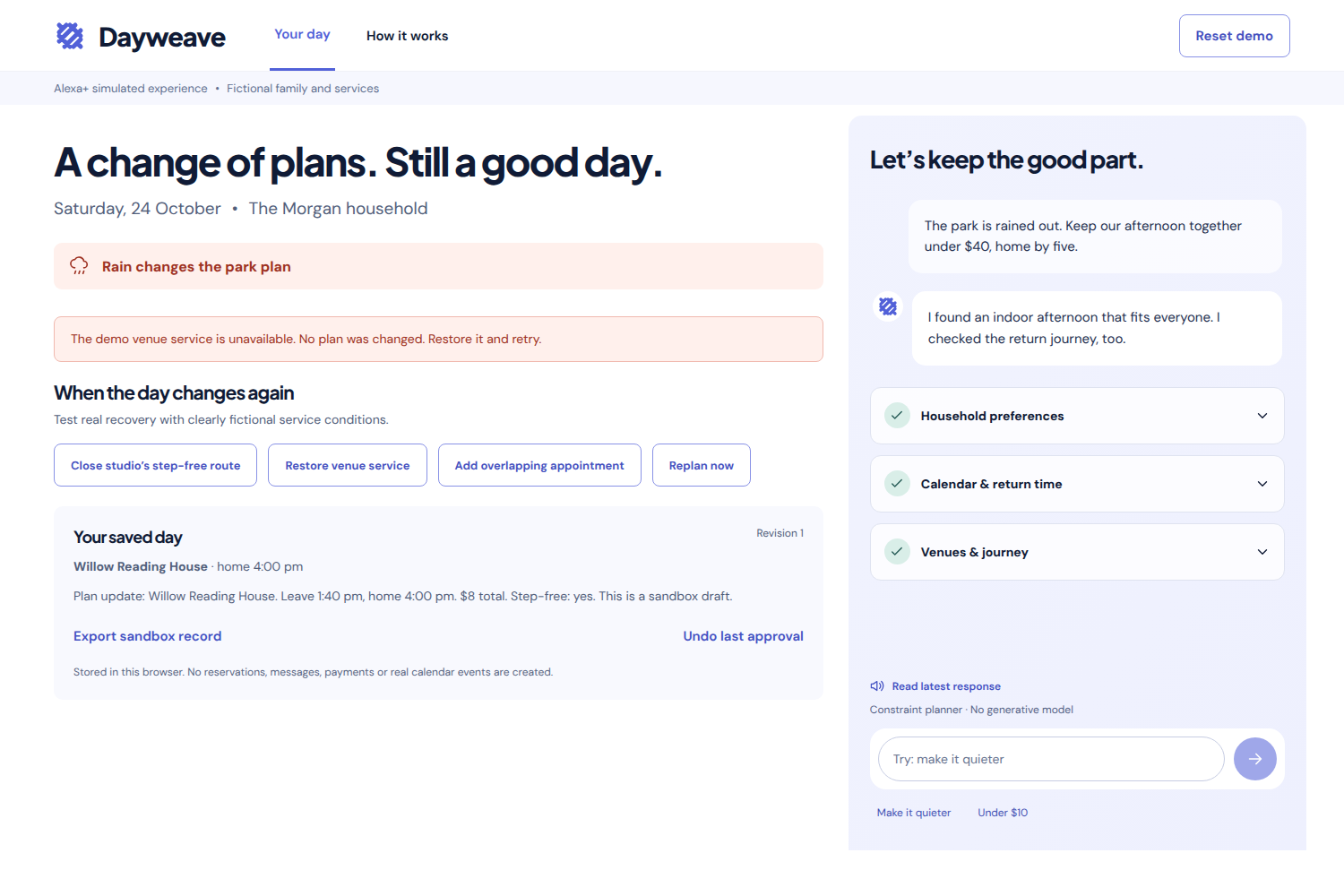
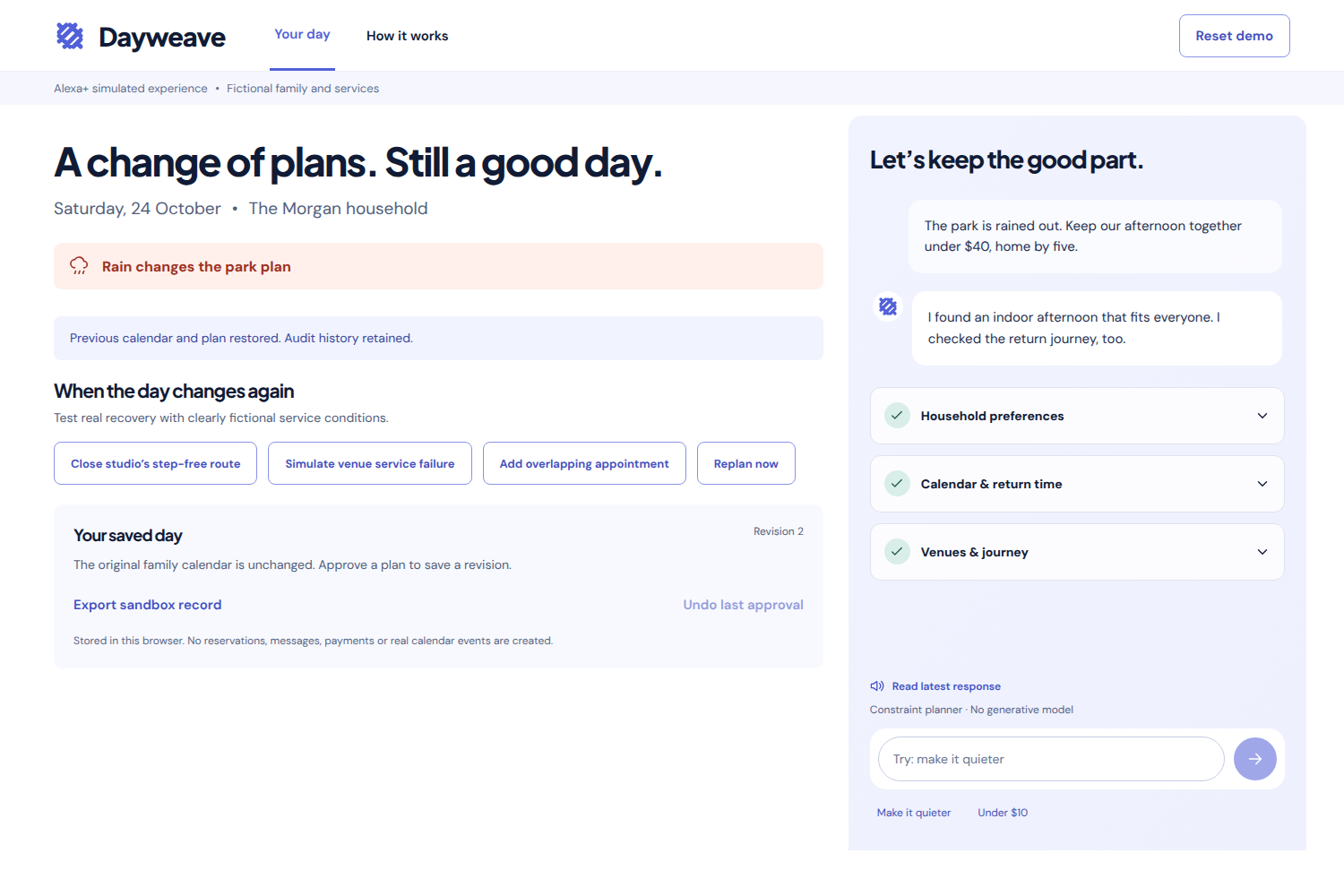
A failed venue service leaves the approved calendar and saved revision intact.
-
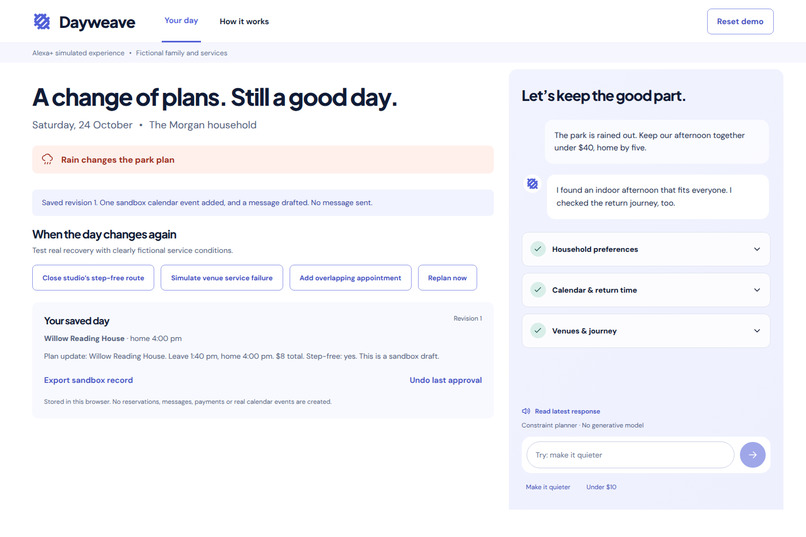
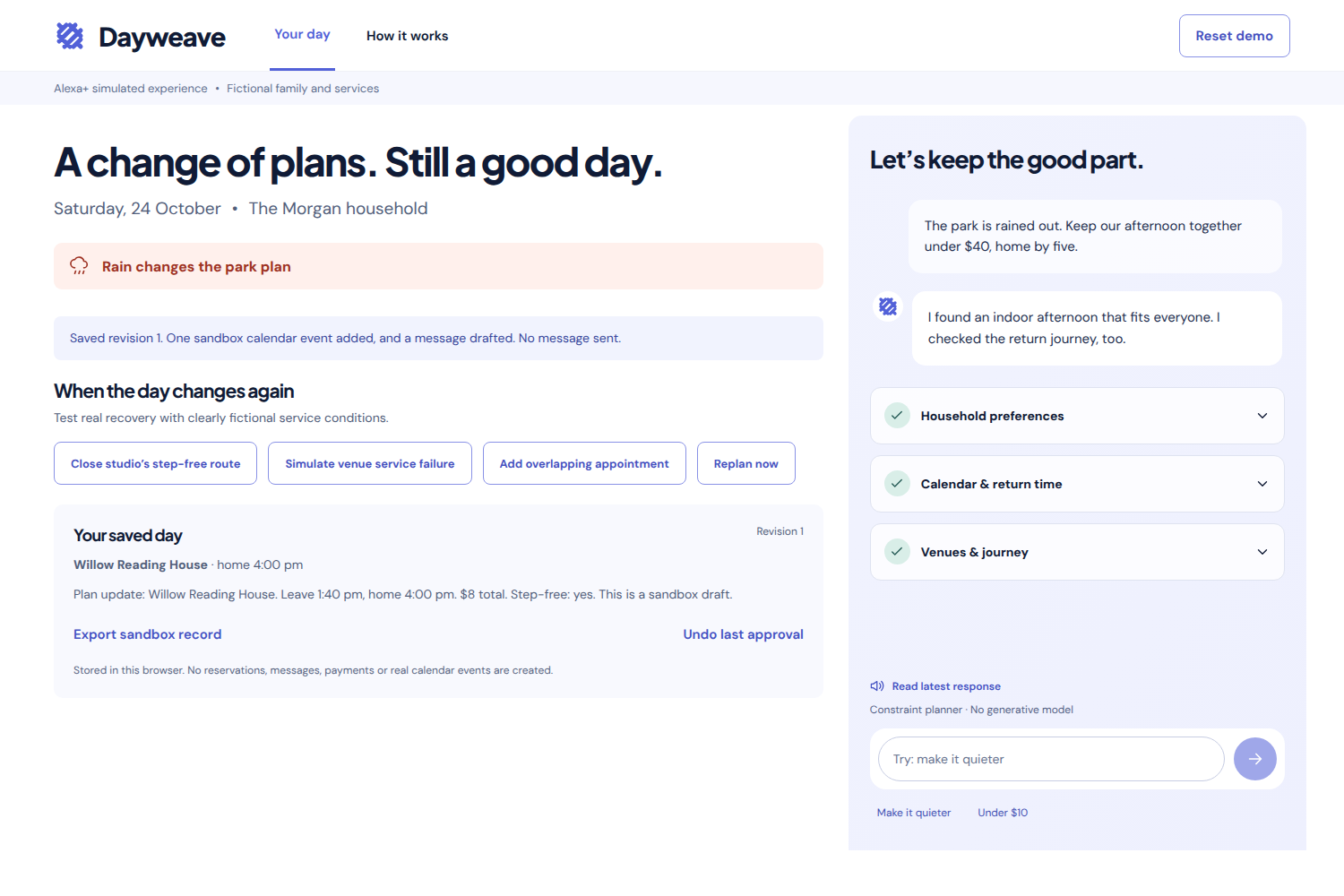
Approval saves one sandbox outing and a family message draft. No real message is sent.
-
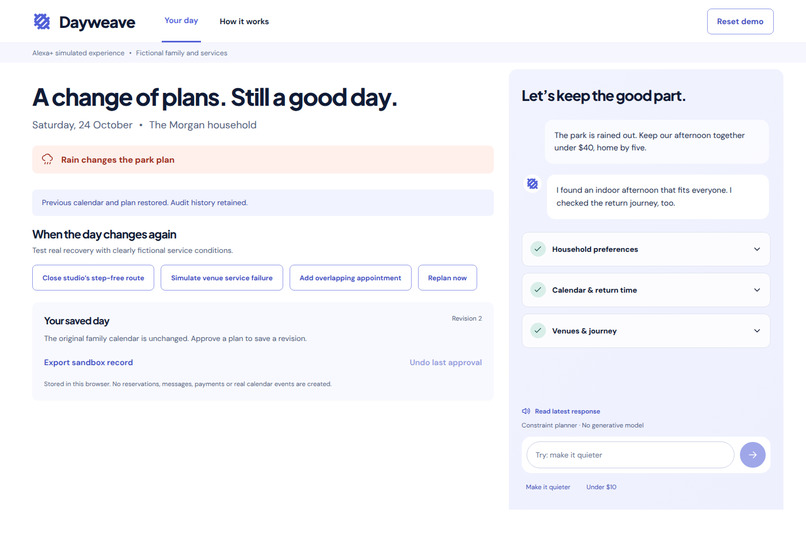
Undo restores the prior outing and draft while preserving current appointments and audit history.
-
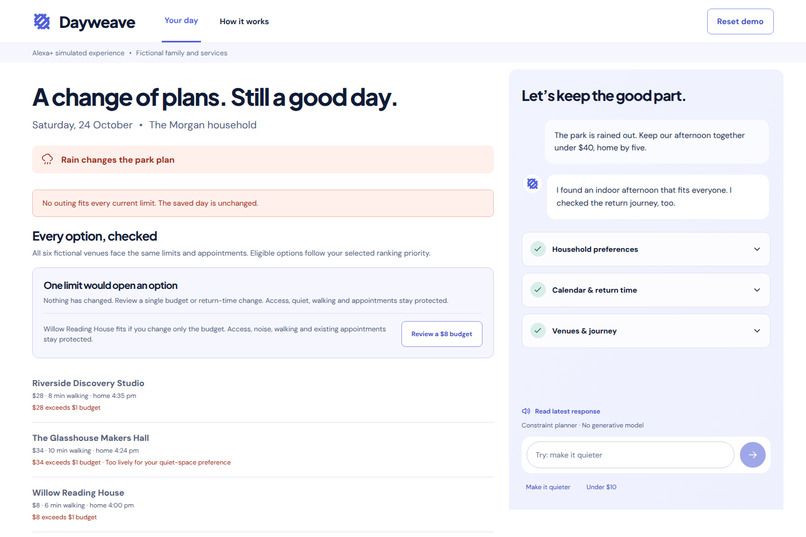
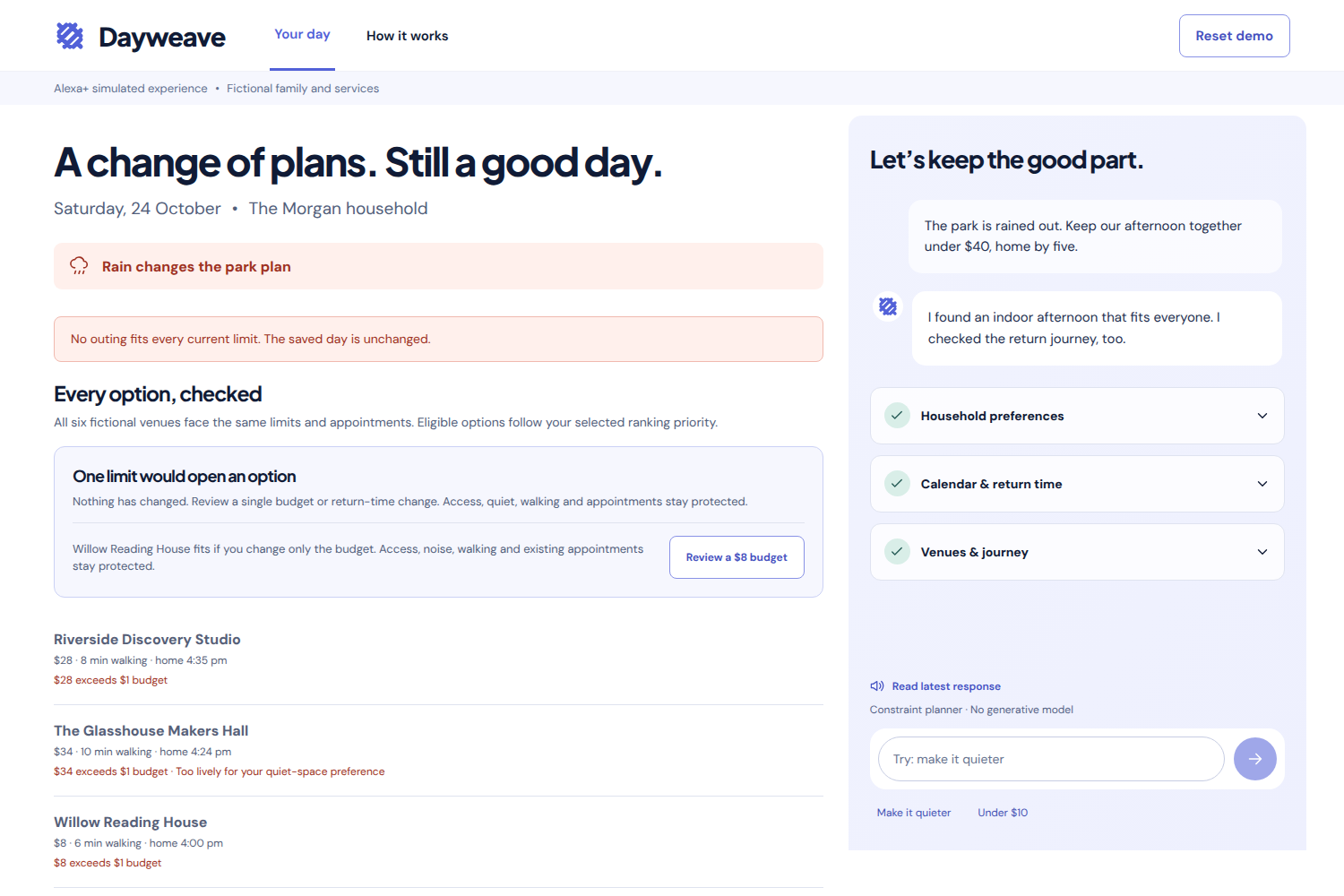
A $1 budget has no fit. Review a single $8 budget repair while access, quiet, walking and appointments stay fixed.
-
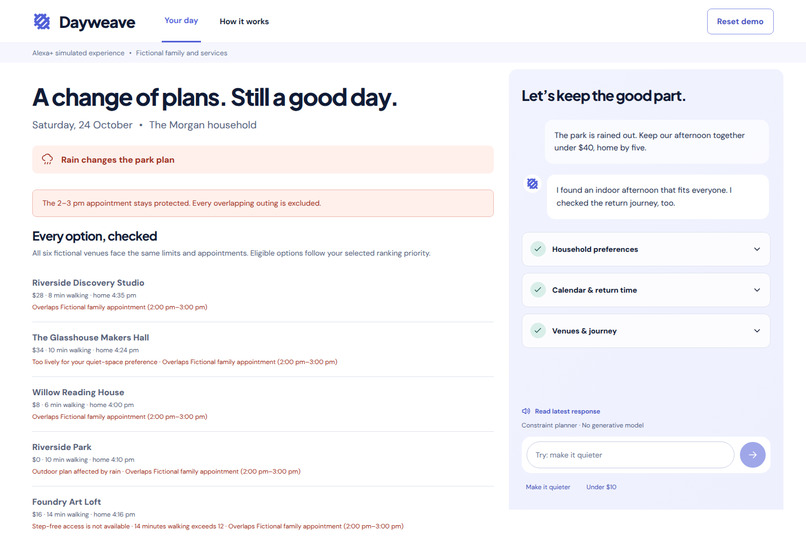
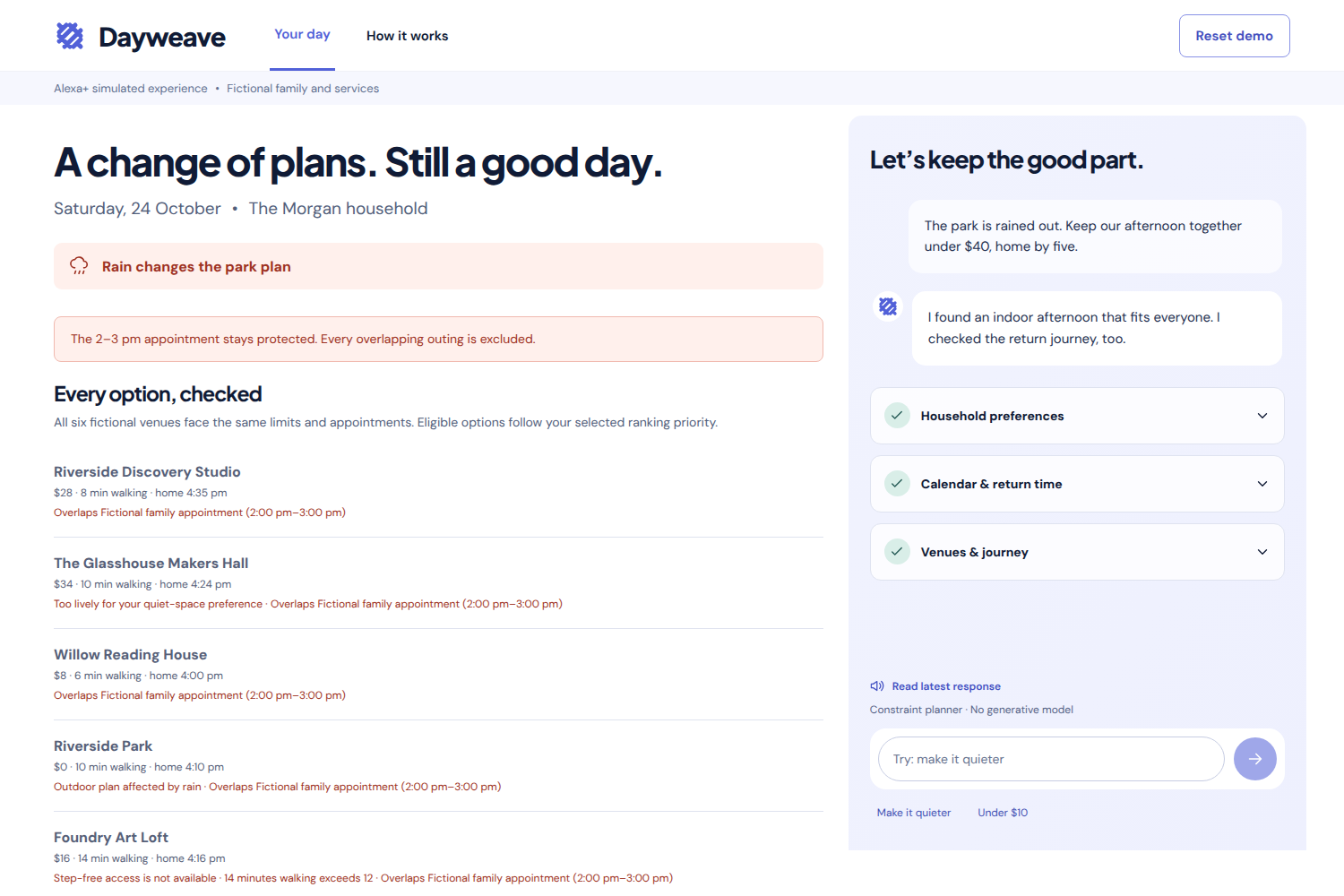
A fictional 2–3 pm appointment excludes overlapping outings. It is never moved automatically.
-
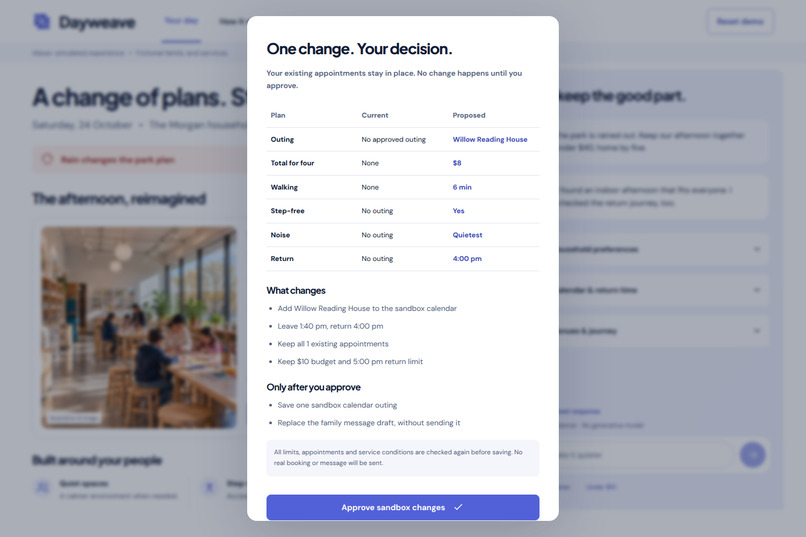
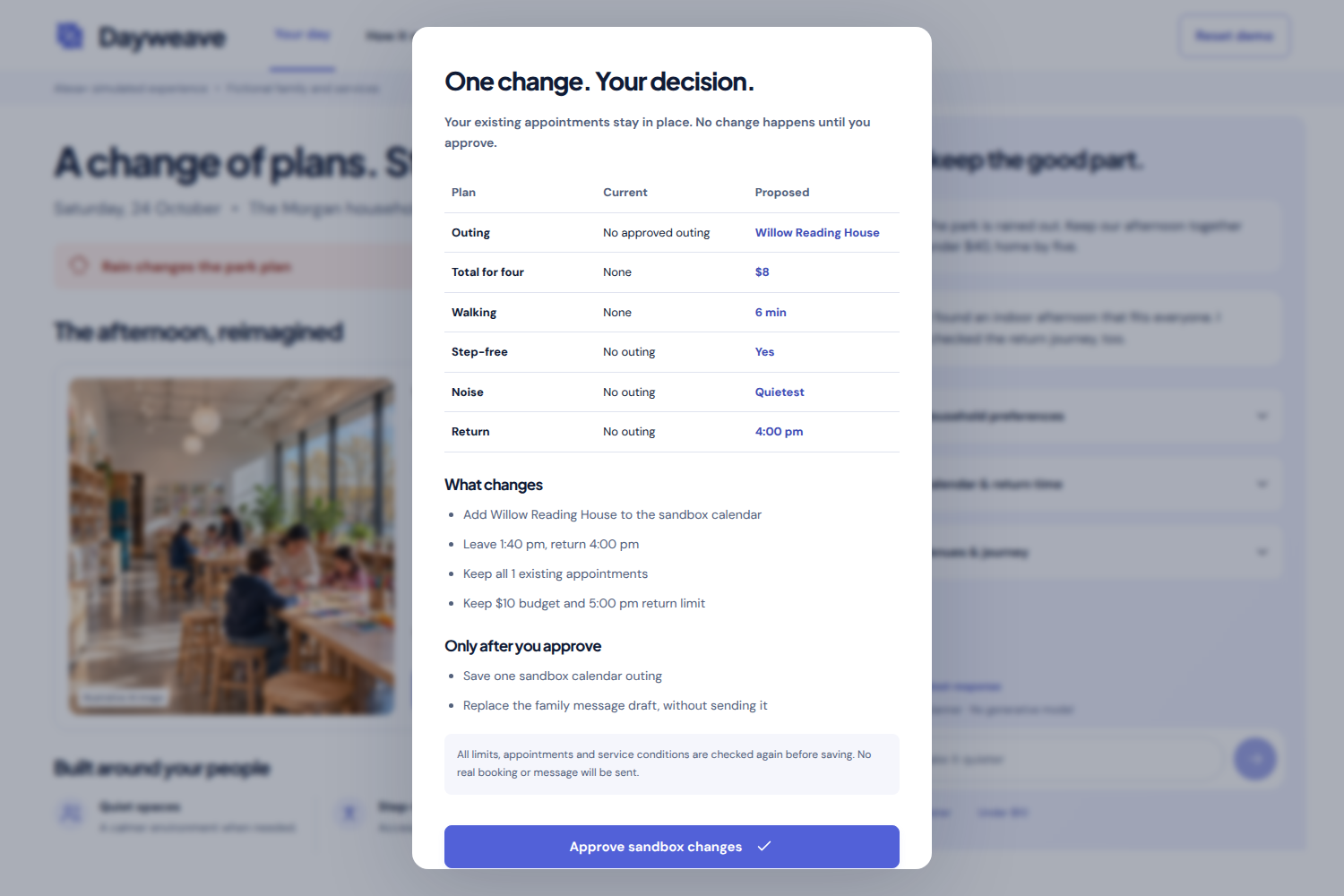
Compare current and proposed venue, cost, walking, access, noise and return time before approval.
-
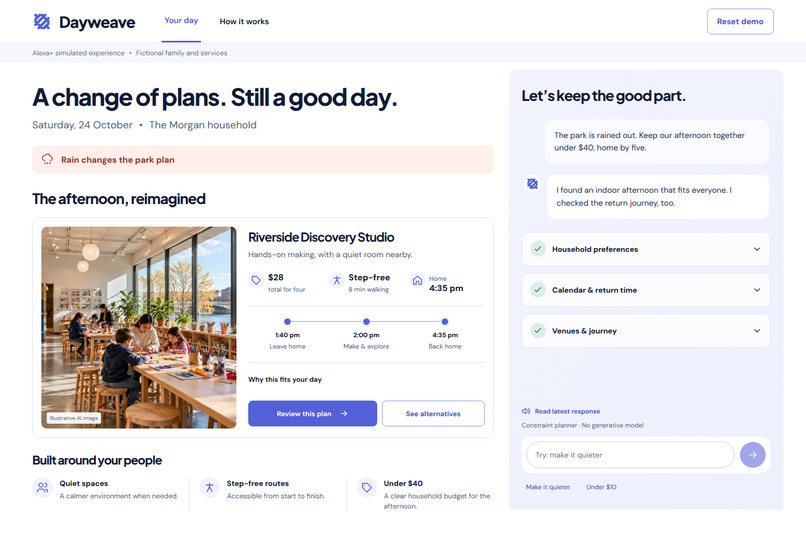
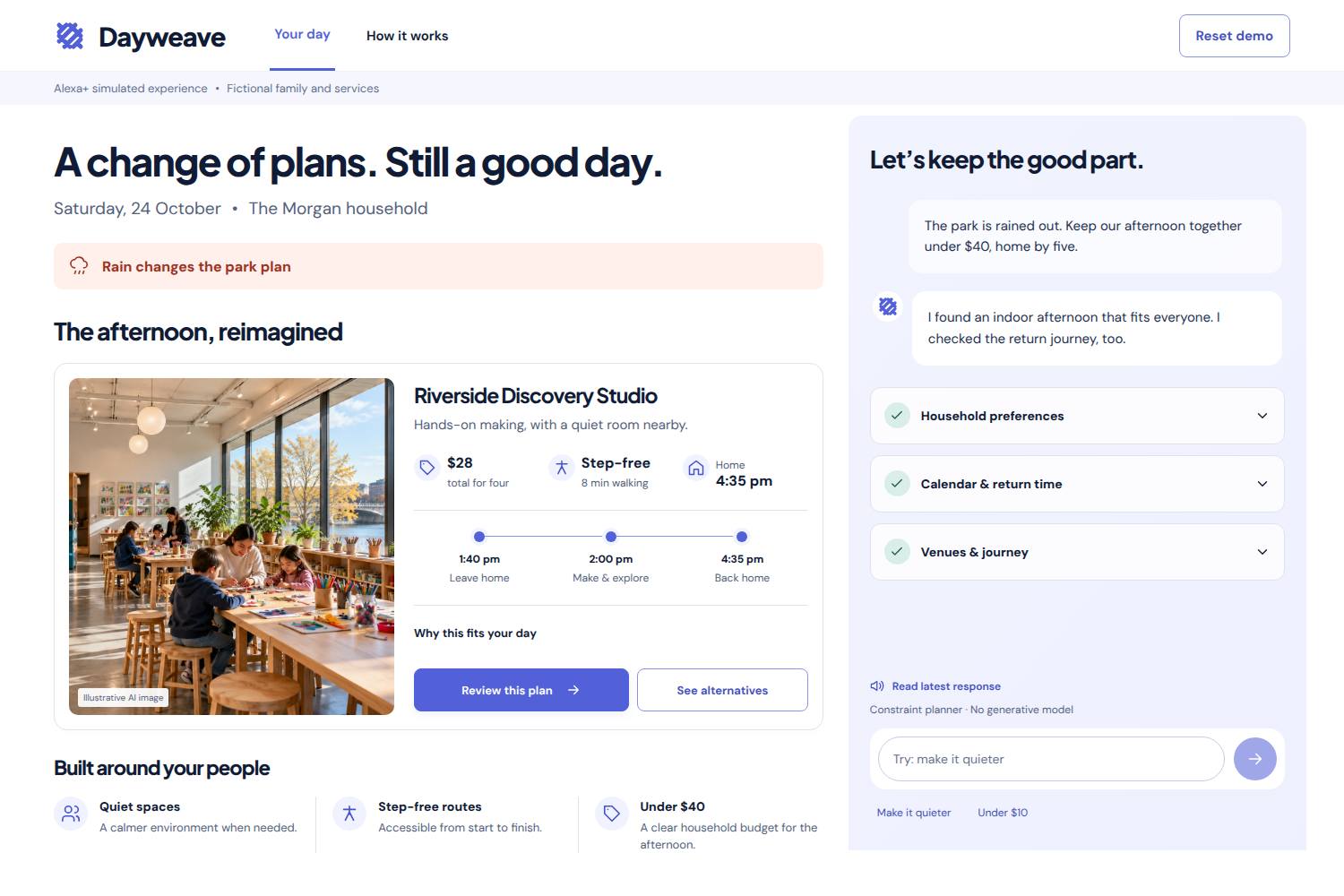
A fictional rainy afternoon, replanned through real MCP tools while preserving household limits.
-
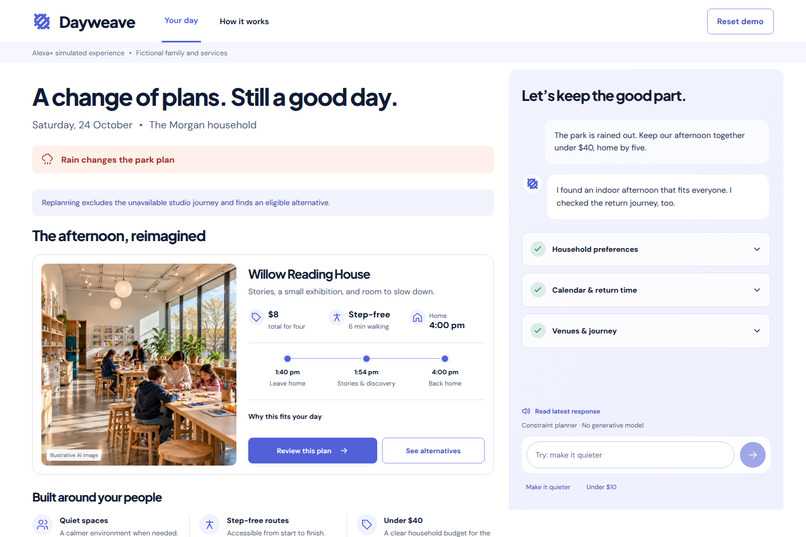
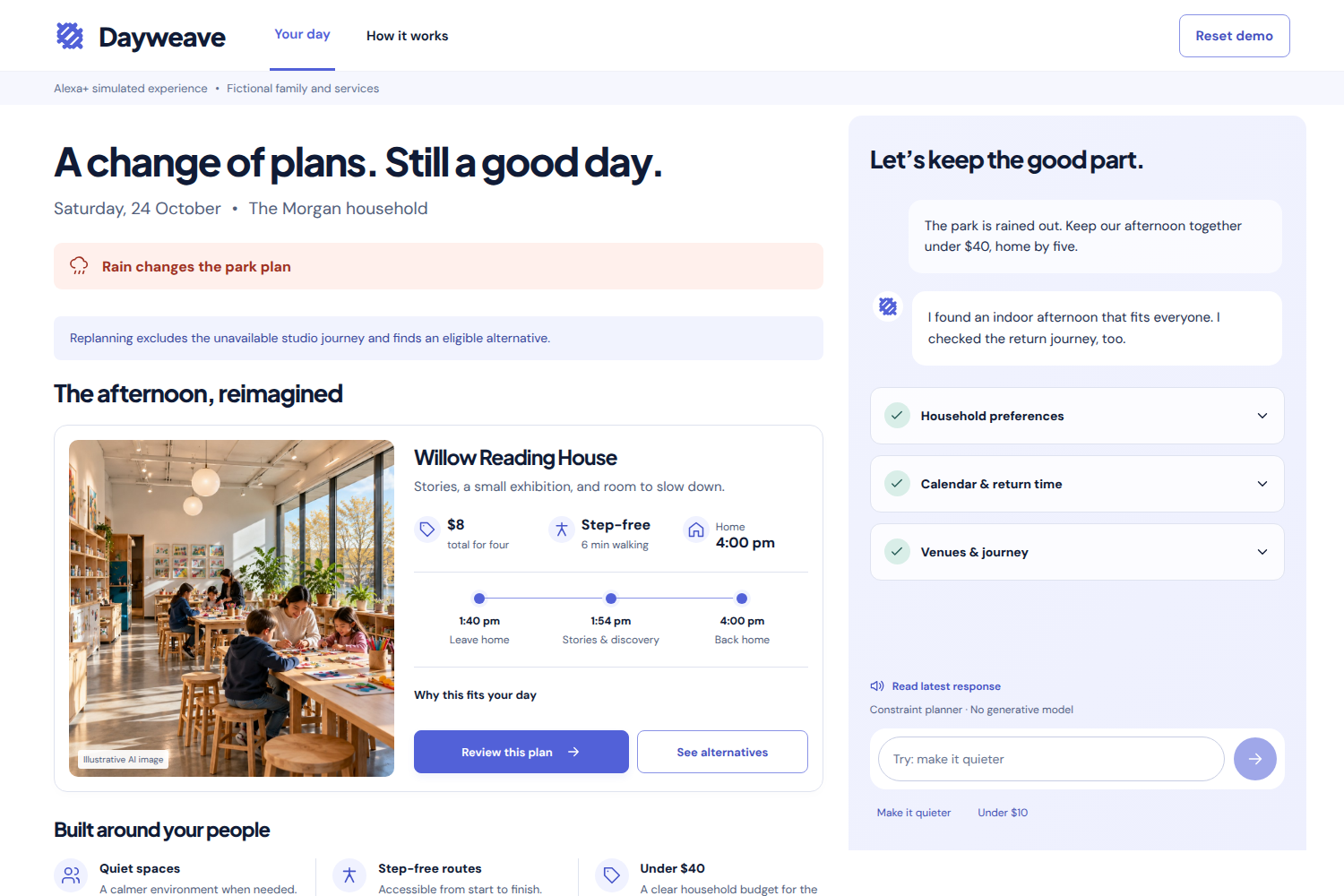
Replanning excludes the closed route and prepares a suitable alternative.
-
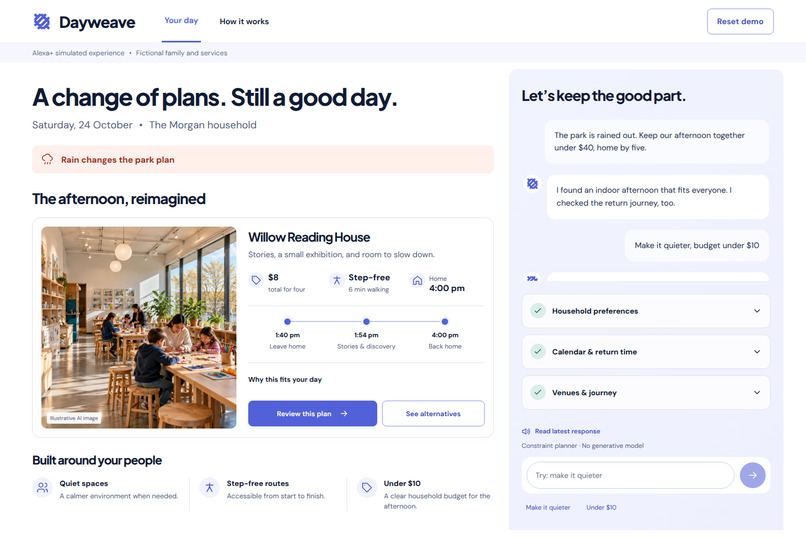
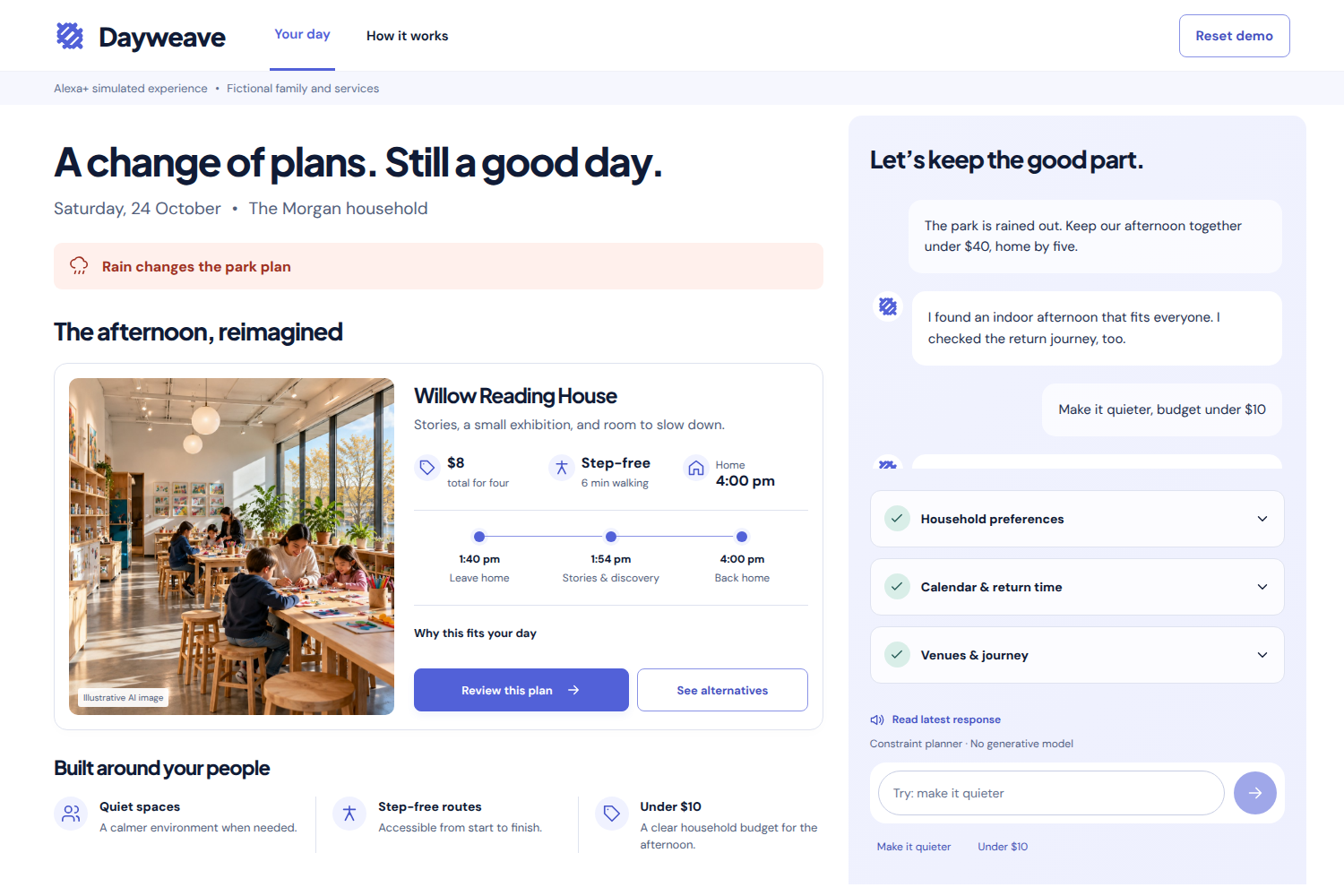
After reviewed preference changes, Willow Reading House fits the quietest-space and $10 limits.
-
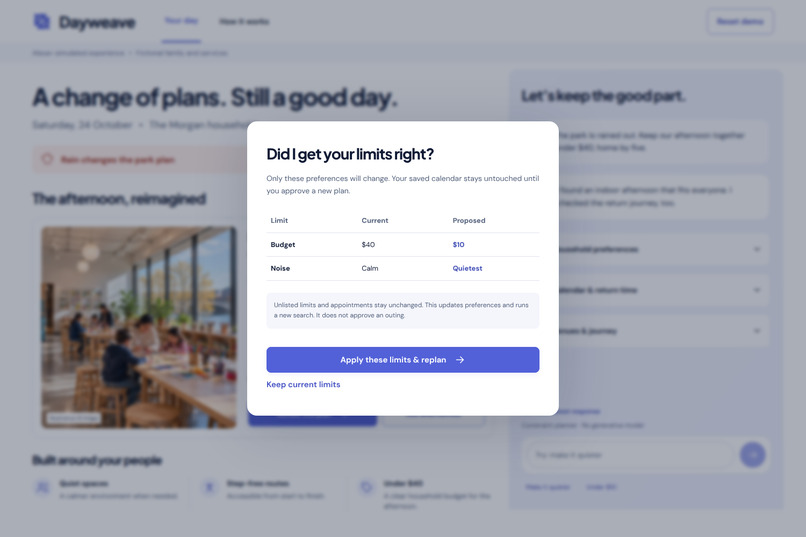
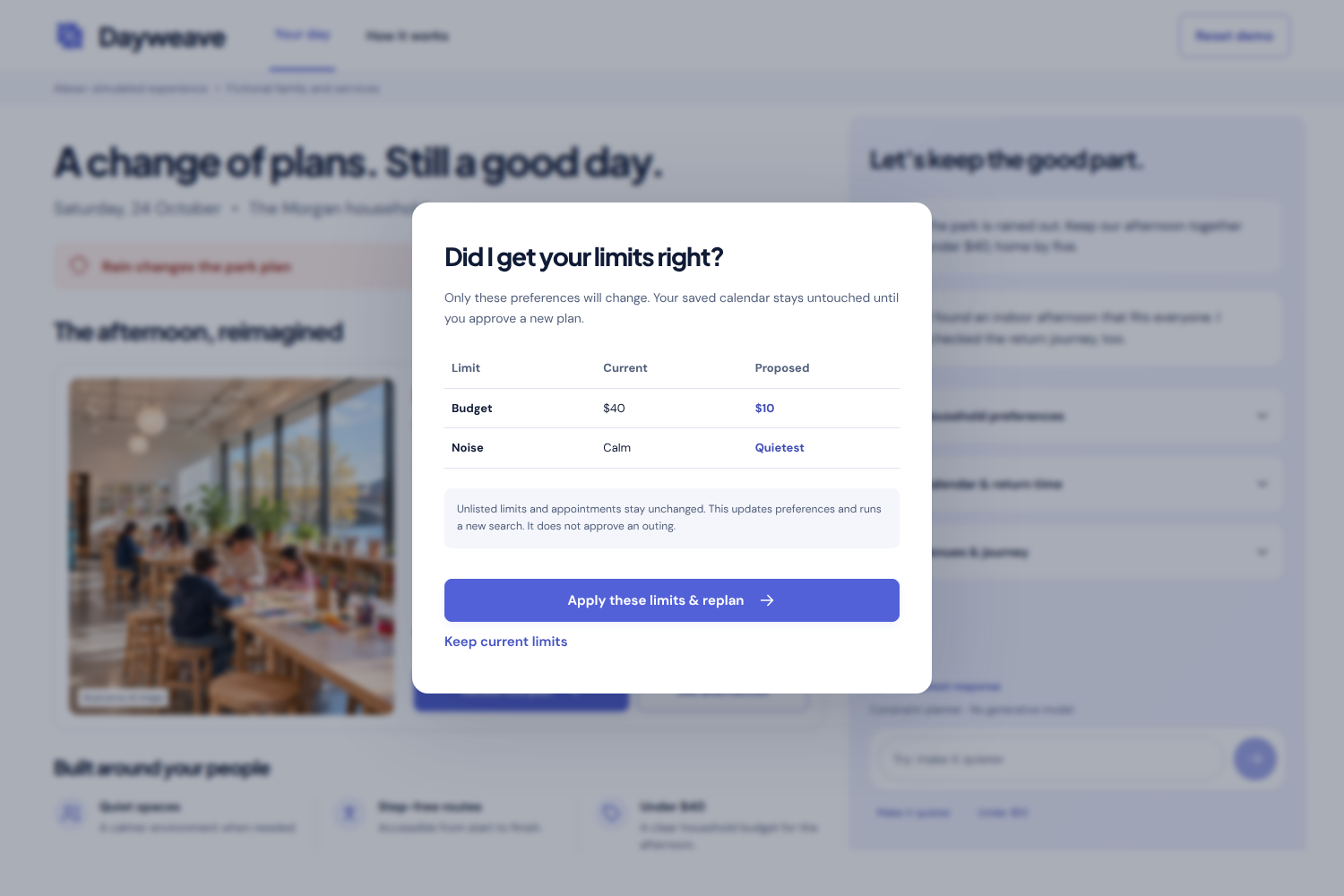
Natural-language changes become explicit before/after limits. Rejecting them preserves current preferences.
-
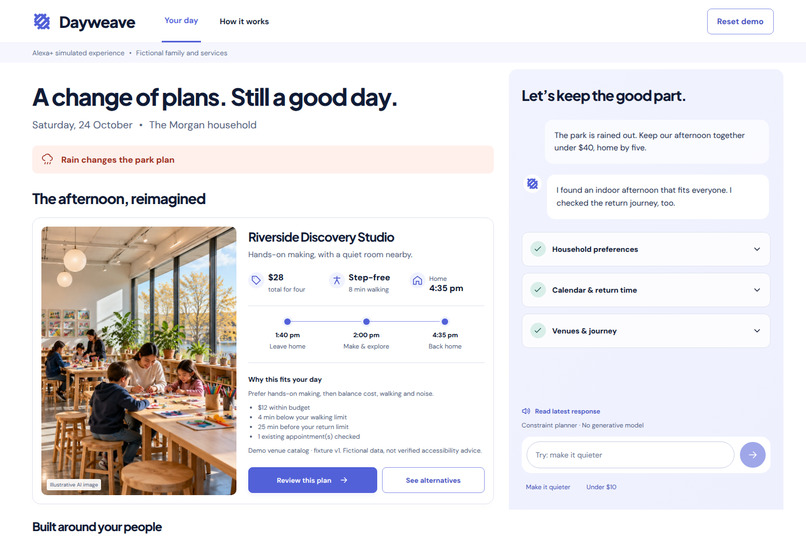
The proposal explains its ranking and shows remaining budget, walking allowance and return-time buffer.
-
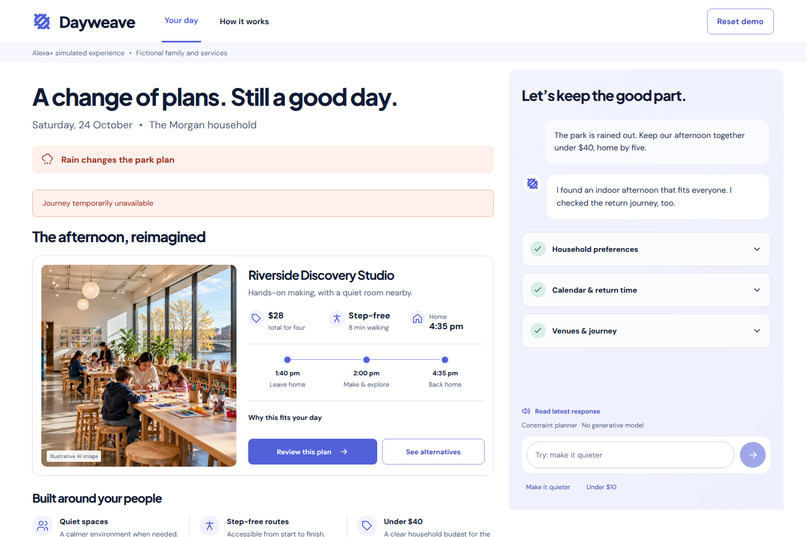
A route closure invalidates a prepared plan. Approval fails without partial changes.
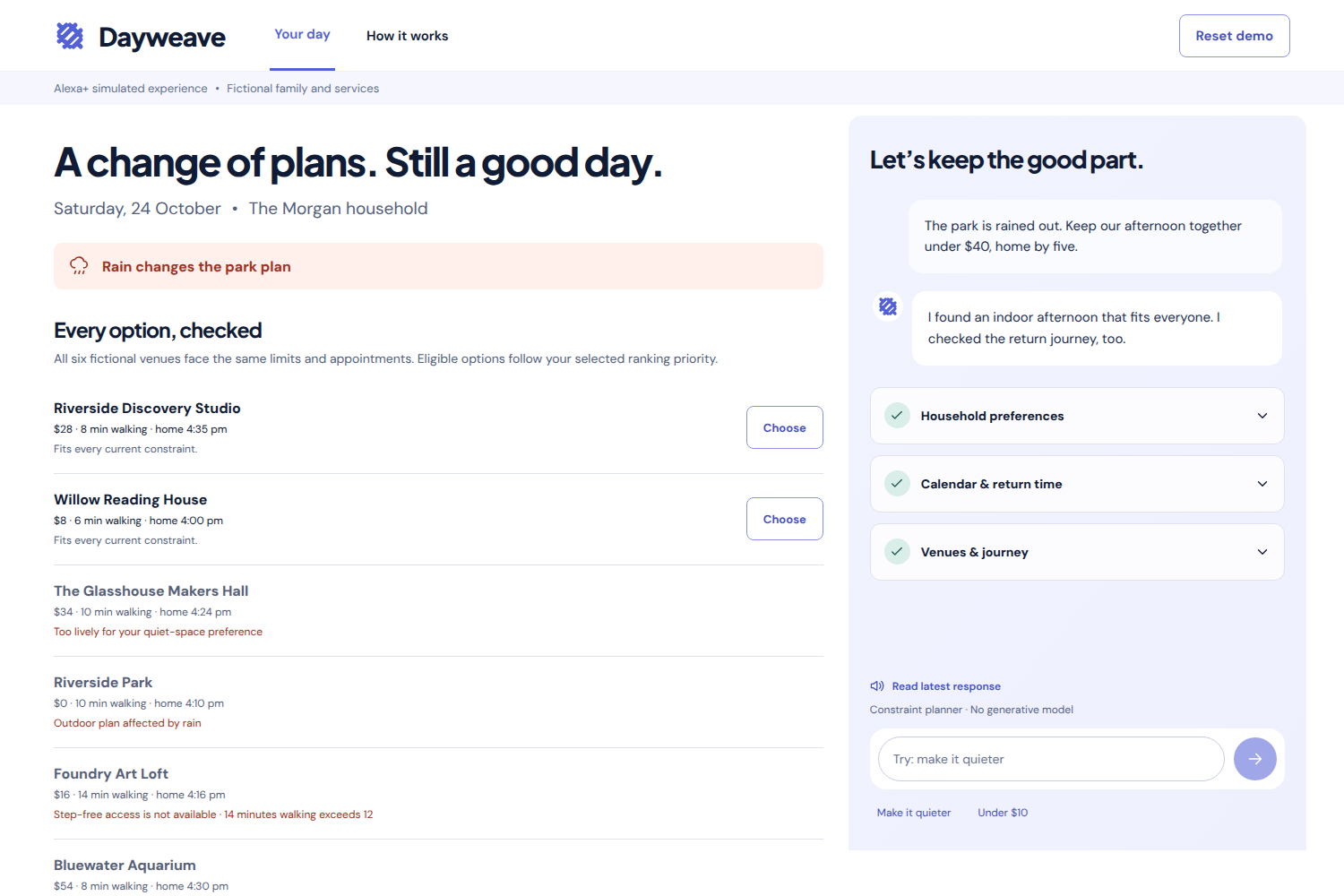
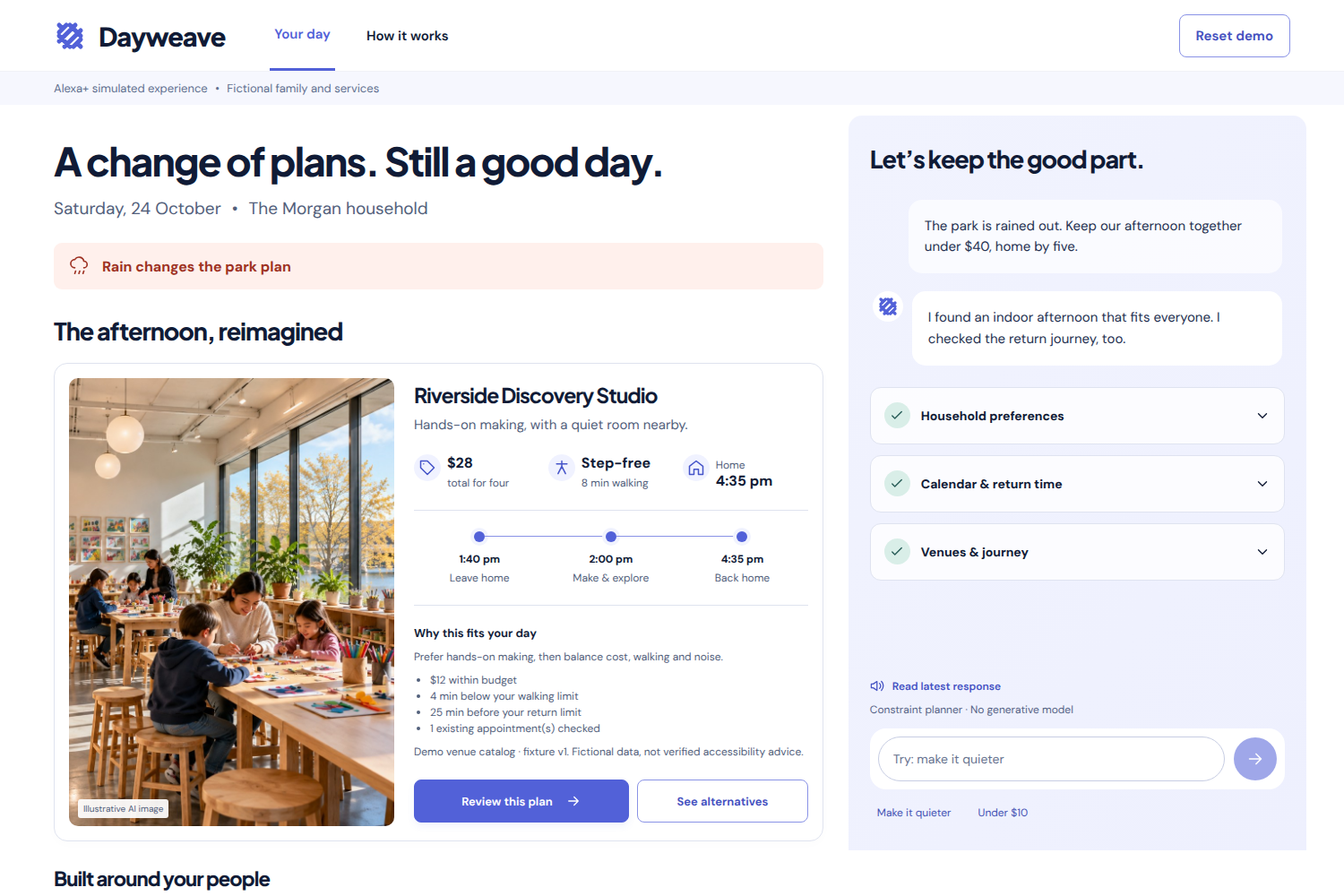
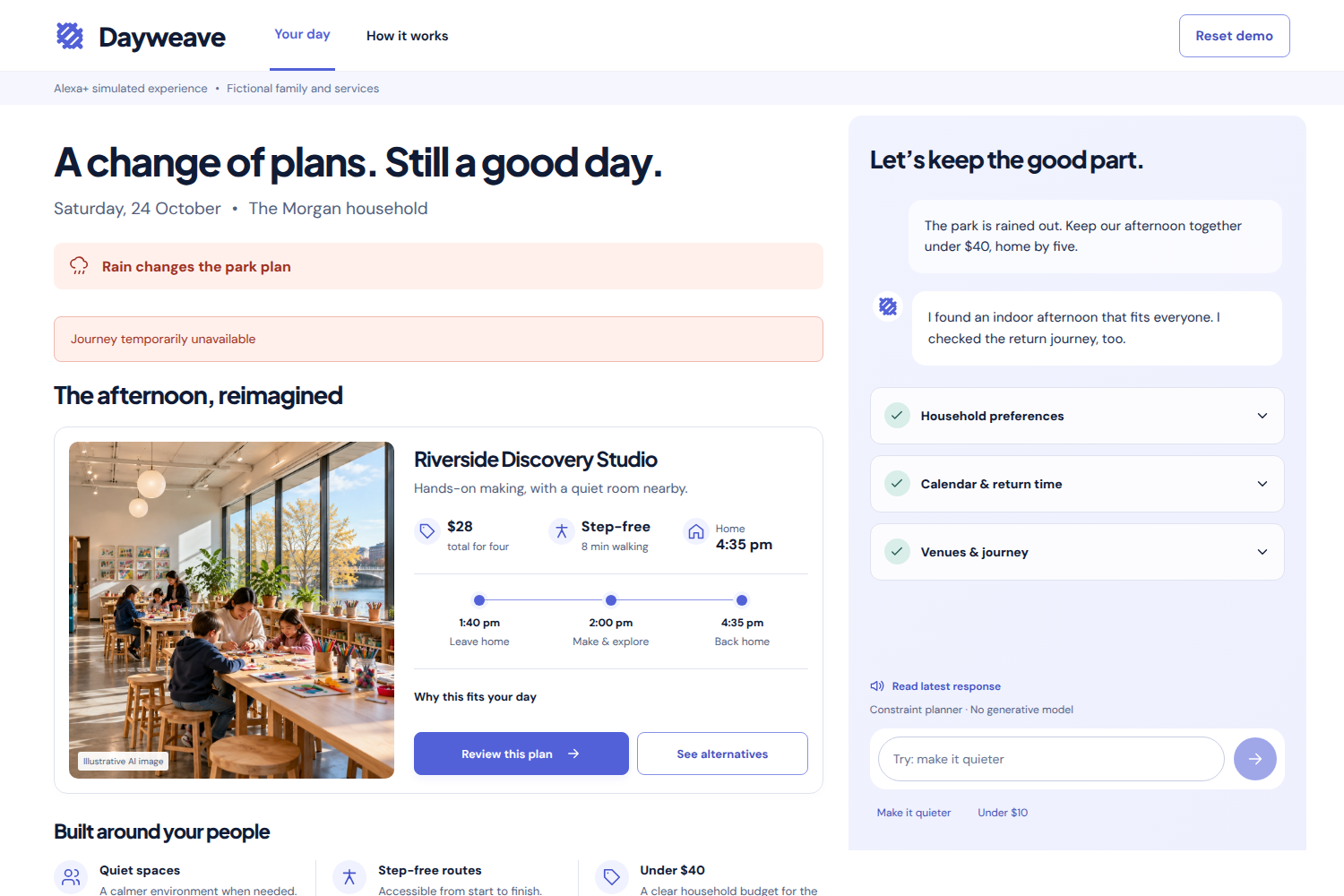
Dayweave: A change of plans. Still a good day.
Elevator pitch
An Alexa+ simulated experience that replans a family afternoon while keeping budget, access, quiet-space and return-time needs together.
Inspiration
A cancelled outing is rarely just a search problem. Someone must reconcile the family's time, money, travel and different needs, then tell everyone what changed. We wanted to explore an assistant that keeps those constraints together across a disruption and explains the tradeoffs.
Who it is for
Households coordinating an outing when budget, mobility access, sensory preferences and fixed appointments all matter. The intended benefit is a clear, reviewable replacement plan with fewer lost requirements. This is a product hypothesis, not a measured customer outcome.
What it does
Dayweave starts with a fictional family whose picnic is rained out. It loads household context and the calendar, evaluates six places, checks the journey, and proposes a feasible indoor afternoon. Each alternative shows why it fits or why it was excluded.
A follow-up such as “Make it quieter, budget under $10” produces a before/after constraint review. Only after the person applies those changes does the system recompute the results. Ambiguous or negated requests leave the limits unchanged and ask for exact input. The family can also edit exact values with accessible form controls. Before anything changes, a review shows the proposed calendar entry and message draft.
If nothing fits, Dayweave computes single-limit budget or return-time repair options. It does not relax access, noise, walking or appointments. Each repair goes through the same limit review.
Approval is explicit. A factual current/proposed table shows the venue, cost, walking, access, noise and return time. The tool rechecks current conditions, saves a revision and creates a draft without sending it. If a route closes after the plan was prepared, the old approval fails without partial changes. Changed conditions visibly mark prior evidence as needing recheck. Undo reverses only the approved outing and draft while retaining appointments added or edited afterward. Replanning, retry and a reviewable export complete the workflow.
How we built it
The React interface is connected to a self-hosted MCP service using the official TypeScript SDK and Streamable HTTP protocol 2025-11-25. Eight registered tools perform context lookup, calendar reading, venue evaluation, journey checks, plan preparation, approval, undo and supported request parsing. The UI uses the official MCP client for initialization, the initialized notification, discovery and tool calls. Requests carry the negotiated protocol version.
A deterministic constraint planner excludes any option that violates budget, noise preference, step-free access, walking limits, rain conditions or the return deadline. The person chooses a ranking priority: hands-on making, lowest cost or quietest space. Existing appointments are hard constraints, including travel time. Each proposal exposes budget, walking and return-time margins. Browser storage retains fictional household state and approved revisions separately from the stateless transport.
The visual system uses white, periwinkle and lavender with self-hosted fonts and an original illustrative studio image. The interface includes keyboard focus states, native dialogs, live status text, exact-value inputs, reduced-motion support and visible equivalents for speech output.
Reliability improvements from the final review
Common negations, including curly-apostrophe requests, now request clarification without changing limits. Malformed clock values such as “17:300” and “1730” are rejected as complete tokens. A full calendar rejects a new outing without saving an invalid record, while replacing an existing outing still works. In the reusable companion, stale undo responses and inconsistent protected records now fail even when the independent fixture store is correct. All seven regression groups failed before their fixes and pass afterward.
What we learned
A useful planning assistant needs continuity and transaction design as much as a conversational surface. A plausible suggestion can become invalid between preparation and approval. Rechecking conditions, preventing duplicate writes and retaining a previous revision make the experience easier to inspect and recover.
Validation and limitations
Thirty-eight automated checks pass, including actual React interactions in jsdom, official MCP client integration, calendar conflicts, cautious interpretation, user-selected ranking and explicit repairs, constraint enforcement, no-result behavior, stale approval rejection, idempotency, undo and service failure. A read-only test of the deployed private HTTP endpoint also initialized the official client, discovered eight tools and returned the expected venue results. A production dependency scan was clean after updating the SDK. See VALIDATION.md for the exact scope.
This is an independent Alexa+ web simulation. The conversation uses supported language patterns and templated responses, not a generative model. Family, weather, venues, routes, calendar and message services are fictional. No Amazon-hosted integration, real booking, payment, external message or actual device validation is claimed. The React DOM integration tests exercise the real app and MCP handlers, including explicit limit review, approval, undo, service failure and no-result repair. Full native browser, mobile and device QA remains pending. Automated DOM tests do not establish native focus, mobile layout or device behavior. Local repository setup needs no account, key or paid service. Hosting is optional under the official FAQ.
The video is a rendered walkthrough of actual React components populated from executed MCP outputs, not a continuous screen recording. Synthetic narration and generated imagery are disclosed.
Next steps
Connect verified venue and journey providers, add authenticated server-side household storage and account linking, integrate a language-model planner with strict tool validation, test with intended households, and validate the experience on Alexa devices.
Team and AI disclosure
Adeel Falak Sher is the project representative and submission owner. Raouf Khalid is the listed Devpost team member with an assigned testing and demo-review role; completed participation is not independently verified. These are assigned roles, not claims of completed work.
Codex assisted research, product definition, implementation, tests, documentation and video composition. OpenAI Image Generation created the concept and studio illustration. Hyperframes renders the 1080p video. AI Doc Maker generated the English narration. The application itself runs no generative model.
Track
Alexa+ simulated web experience. New project created during the hackathon window. The source and rules reviews led to calendar enforcement, interpretation review, transparent ranking, actionable no-result repair, strict per-tool schemas, complete MCP initialization and appointment-preserving undo. We are entering the Open Source mini challenge with the new public MIT-licensed MCP Rehearsal companion. AWS Builder is not entered.
Additional open-source contribution
MCP Rehearsal is a new, separate MIT-licensed developer tool created during this hackathon. Its ten repeatable application contract checks exercise approval, duplicate-key replay, stale context, injected service rejection and scoped undo. Deliberately broken examples demonstrate that failures are detected. Twenty companion self-tests pass. Dayweave vendors the pinned source and uses it against its real MCP handler; all ten contracts and four read-only protocol/discovery checks pass. The report covers returned/client-carried fictional state, not live provider effects, browser storage, security certification or every MCP feature. The companion needs no account, key or paid service. Version 0.1.1 adds an independent-store regression and returned-state checks, input-preserving undo and finite-JSON proposal validation. See docs/OPEN-SOURCE-CONTRIBUTION.md for the immutable contribution URL and reuse instructions.
Built With
- alexa-plus
- esbuild
- hyperframes
- javascript
- model-context-protocol
- node.js
- react
- zod

Log in or sign up for Devpost to join the conversation.