-
-
Platform Logo
-
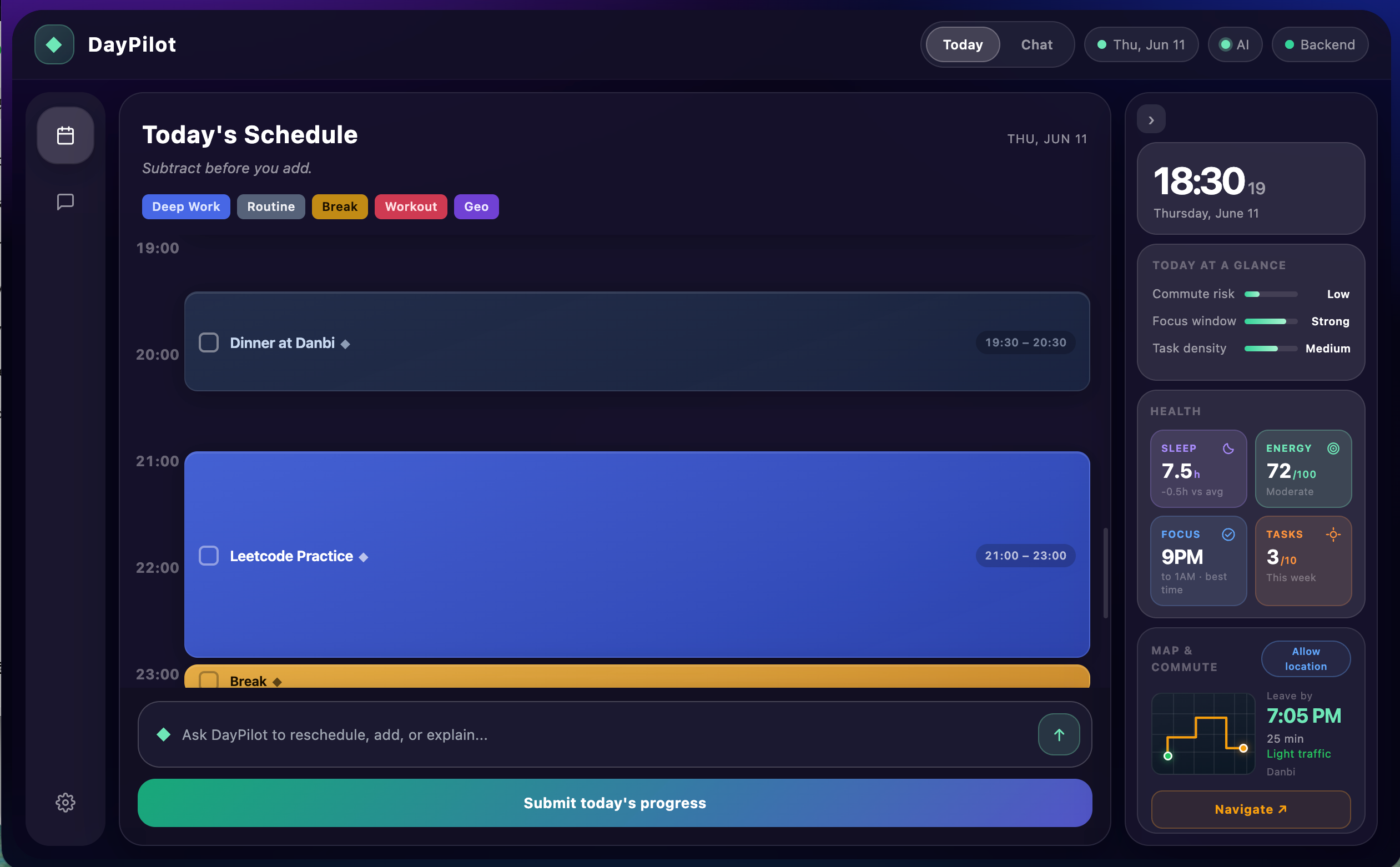
Main Page
-
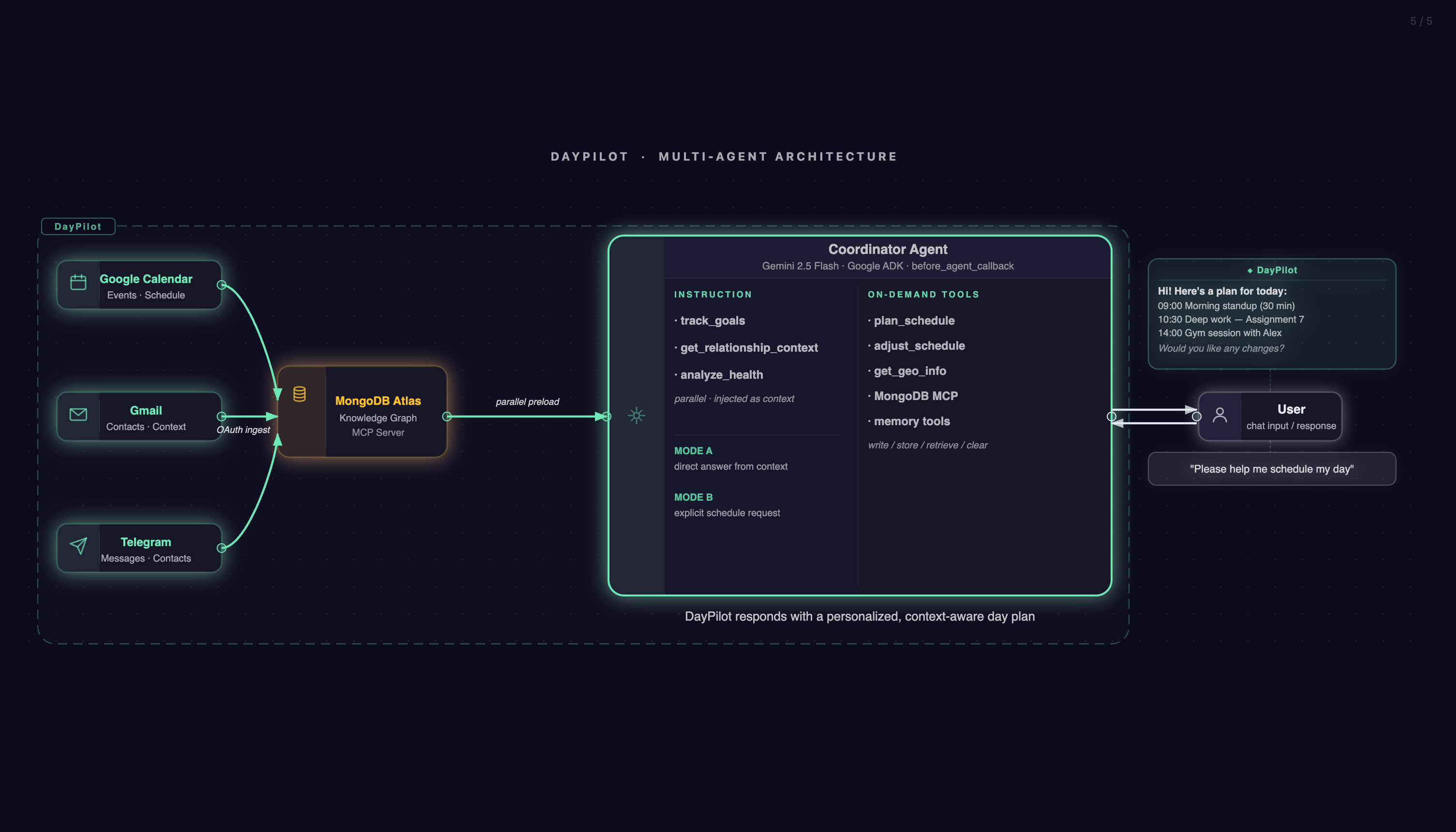
Multi-agent Architecture
🌅 Inspiration
Life is overwhelming. Between classes, work, workouts, relationships, and long-term goals — when things get busy, health suffers first and goals quietly fall apart.
The tools we have today don't talk to each other:
- 📅 Google Calendar knows your meetings
- 🏃 Your fitness app knows you're tired
- 🗺️ Google Maps knows the traffic
- But none of them know what matters to you today
Existing schedulers (Motion, Reclaim, Akiflow) are reactive by design — they arrange what you tell them. They don't adapt when your energy is low. They don't notice your streak is at risk. They don't know your partner's birthday is in 8 days.
We built DayPilot because no existing tool is willing to think for you.
What It Does
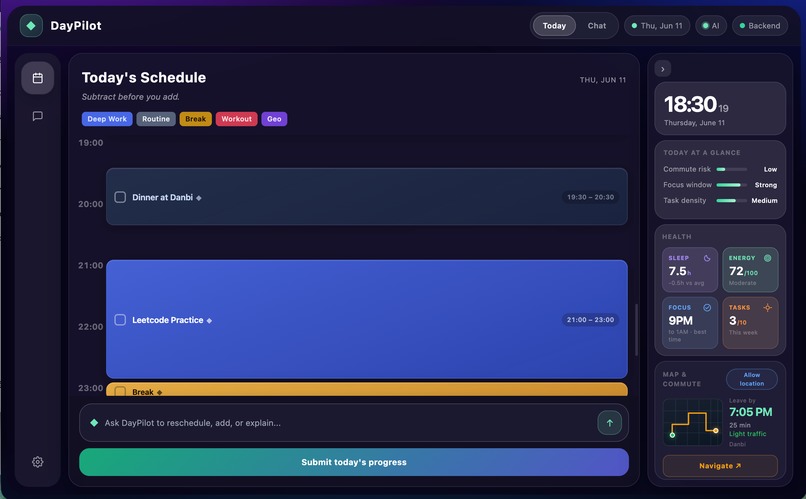
DayPilot is an AI-powered daily life OS — it connects your health, calendar, location, and goals into one intelligent system that plans your day, adapts when life changes, and learns who you are over time.
🔌 Cold Start — Zero Onboarding
- Connect Google once (Calendar + Gmail + Contacts)
- DayPilot builds a personal Knowledge Graph: people, goals, events, focus patterns
- No forms. No configuration. You've already told the world who you are — DayPilot just listens.
☀️ Every Morning — 3 Proposals
- 💪 Most Productive — optimized for deep work and goal progress
- 😌Most Relaxed — adapted to low energy or poor sleep
- ⚡ Fastest — everything packed efficiently
- Each proposal is context-aware: health data, goal progress, and commute times are all pre-loaded before you even ask
🏔️ Throughout the Day — Real-Time Replanning
- Add a last-minute meeting → the entire day restructures in seconds
- Commute recalculated, blocks shifted, nothing forgotten
🌙 End of Day — Closed Feedback Loop
- Mark what you completed; unfinished tasks are automatically rescheduled
- Long-term goal progress is cumulative — skipping a day never erases what you've built
🏗️ How We Built It
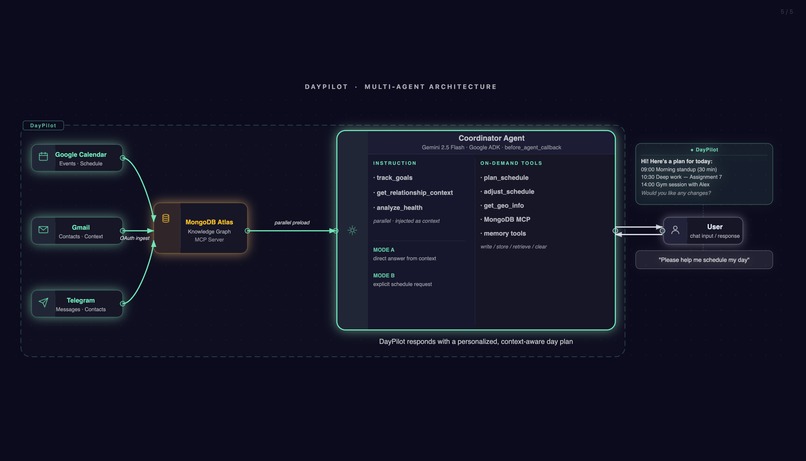
Built on Google Agent Development Kit (ADK) with a single Coordinator Agent (Gemini 2.5 Flash) backed by 12 specialized tool functions:
| Tool group | Role |
|---|---|
🧠 analyze_health |
PsychoBio pipeline — energy level, focus window, cognitive load |
🗺️ get_geo_info |
Multi-segment commute via Google Routes API |
🎯 track_goals |
Tracks weekly progress, assesses urgency |
🔗 get_relationship_context |
Surfaces upcoming important dates with suggestions |
💾 retrieve_relevant_memories / write_entity_to_memory / store_conversation_memory |
Embeds & retrieves past conversation insights |
📋 plan_schedule / adjust_schedule / clear_pending_reschedule |
Generates 3 optimized strategies + real-time adjustment |
Key architectural decisions:
- ADK
before_agent_callbackpreloads 3 context streams in parallel before every turn — Gemini gets rich context, not just a prompt - Knowledge Graph in MongoDB Atlas (entities, goals, preferences, 3072-dim vector embeddings)
- Direct graph queries via MongoDB MCP Server using
MCPToolset - Every tool call, LLM invocation, and pipeline node traced via OpenTelemetry → Dynatrace
- Deployed on Google Cloud Run — serverless, auto-scaling
🧱 Challenges We Ran Into
1. Learning the Google ADK paradigm Early on we spread agent logic across multiple files, which led to unpredictable behavior. The key insight: high cohesion per agent — keep all tools, prompts, and callbacks for one agent in one place.
2. Drawing clean boundaries between tools Overlapping responsibilities between tools caused unpredictable behavior. We settled on the Coordinator as the single orchestrator — all routing, input parsing, and delegation happens there. Each tool does one thing and returns a structured result.
3. Prompt engineering for quality and efficiency Getting reliable, structured schedule output required many iterations. We also had to be disciplined about when to call the LLM vs. a deterministic tool — packaging frequent operations as tools reduced both latency and output variability.
4. Reducing inference latency Using Dynatrace distributed traces, we profiled every agent turn and optimized aggressively:
- Parallel preloading with
asyncio.gather - 30-min TTL cache for relationship context, 10-min for health state
- Gemini 2.5 Flash-Lite for preload tools where the full model wasn't needed
🏆 Accomplishments That We're Proud Of
- ✅ Shipped a complete, production-deployed agentic system on Google Cloud Run
- ✅ Actually using it ourselves — measurably better at managing time and staying healthy as students
- ✅ Built self-aware observability: DayPilot can query its own Dynatrace telemetry in natural language and tell you exactly why a response was slow
📚 What We Learned
- 🔧 Google ADK — single-agent + tool architecture,
before_agent_callback,MCPToolset, tool boundary design - ☁️ Google Cloud — Cloud Run, OAuth 2.0, Routes API, Gemini API
- 📊 Dynatrace — end-to-end distributed tracing for agentic systems, OpenTelemetry, DQL, MCP self-monitoring
- 🤖 Agent development patterns — prompt engineering, tool vs. LLM decision-making, caching, parallel preloading
- 🤝 Team collaboration — clear ownership per sub-system, incremental shipping under time pressure
🚀 What's Next for DayPilot
1. 🎯 Onboarding Phase Before first use, a short conversation where users share their priorities, energy patterns, and goals directly — combining active preference signals with our passive data ingestion for far more accurate first-day schedules.
2. 🌐 Native Google Extension A browser extension that lets the scheduling agent follow you across apps — surface suggestions in context, push finalized schedules to Google Calendar, schedule meetings on your behalf, and handle the entire planning loop without ever leaving your browser.
Built With
- dynatrace
- fastapi
- gemini-2.5-flash
- gmail-api
- google-adk
- google-calendar-api
- google-cloud-run
- google-oauth-2.0
- google-routes-api
- javascript
- mcp
- mongodb-atlas
- mongodb-atlas-vector-search
- mongodb-mcp-server
- opentelemetry
- python
- vertex-ai


Log in or sign up for Devpost to join the conversation.