Inspiration
People often spend too much time organizing their day instead of actually getting work done. Unexpected meetings, changing priorities, tight deadlines, and fluctuating energy levels can quickly make a carefully planned schedule ineffective.
This inspired us to build DayPilot AI — Your Day, Intelligently Orchestrated, an AI-powered personal assistant inspired by the vision of Alexa+, designed to help people plan, adapt, and manage their day more intelligently.
What it does
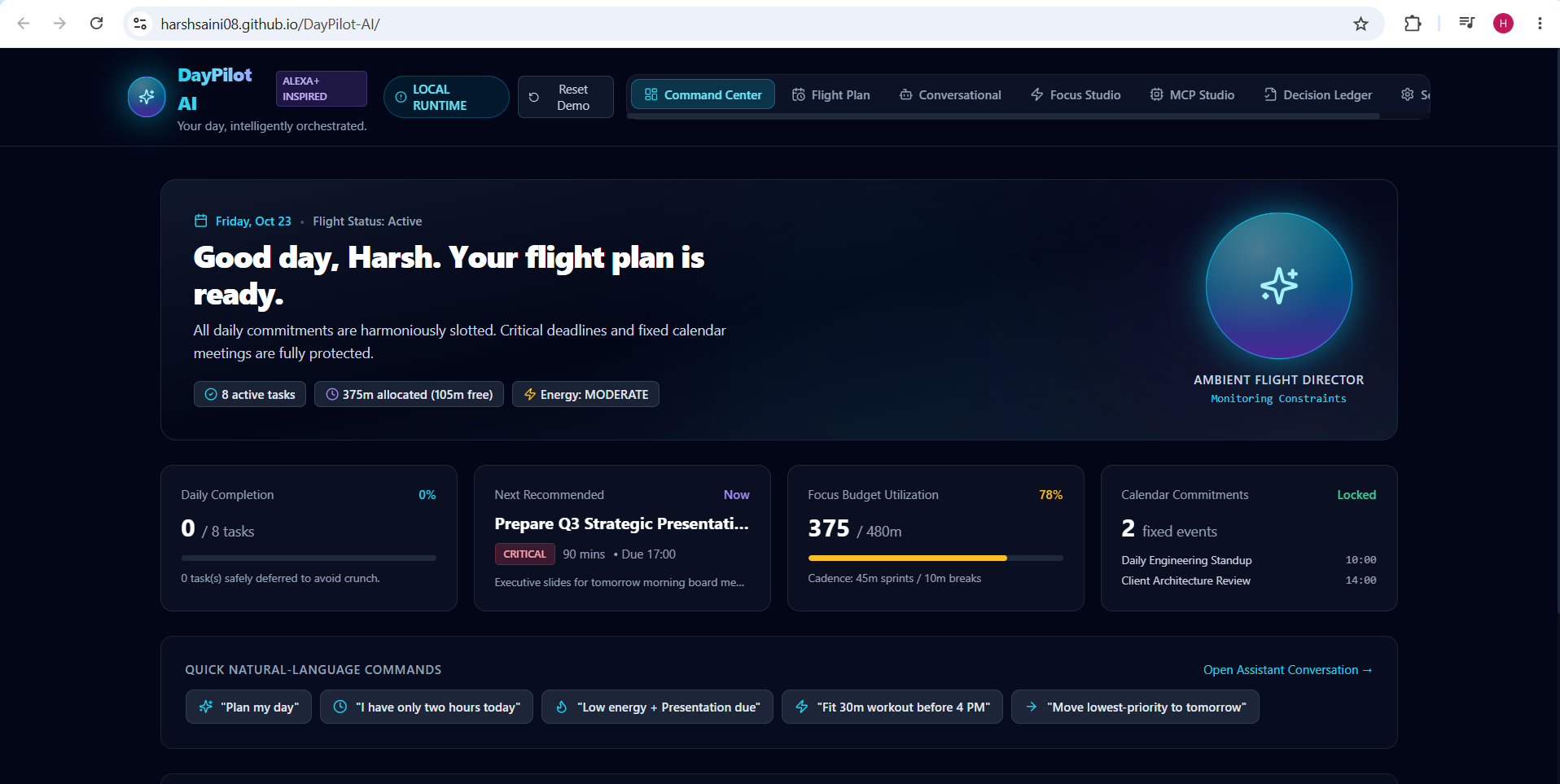
DayPilot AI goes beyond a traditional to-do list by combining adaptive scheduling, focus management, and transparent AI-assisted actions in one interface.
Key features include:
- Adaptive Day Planning: Reorganizes proposed schedules when available time or priorities change.
- Focus Studio: Helps users structure focus sessions around their energy levels, workload, and deadlines.
- Conversational Assistant: Allows users to express planning needs in natural language.
- MCP Integration Studio: Demonstrates how the Model Context Protocol can connect an assistant with external tools.
- Decision Ledger: Makes proposed and completed actions easier to inspect, with approval and undo workflows designed to keep users in control.
How we built it
DayPilot AI uses React and TypeScript for its web interface, a Node.js-based architecture for tool integration, and a deterministic scheduling engine to handle planning constraints.
The scheduling approach considers task priorities, deadlines, available time, and fixed commitments. The MCP integration layer demonstrates a structured way to expose tools to an AI assistant, while the approval workflow and Decision Ledger emphasize transparency and user control.
The current prototype uses sample scheduling data to demonstrate its core workflows. Live calendar synchronization and broader external integrations are opportunities for future development.
Challenges we faced
One of our biggest challenges was designing an assistant that feels intelligent without making unpredictable changes to a user's schedule. We addressed this by separating scheduling logic from conversational interaction and designing approval-based workflows for important actions.
Another challenge was bringing planning, focus management, and tool integration together in a single interface without overwhelming the user. We focused on making the main workflows understandable, practical, and easy to demonstrate.
What we learned
Building DayPilot AI helped us explore how conversational interfaces, deterministic planning, and standardized tool integration can work together. We also learned the importance of making AI-assisted decisions explainable, reviewable, and reversible.
What's next
Our next steps include integrating live calendar providers, improving scheduling personalization, expanding MCP tool support, and evaluating how effectively the assistant adapts to real-world changes.
Our vision is to help people spend less time reorganizing their day and more time doing meaningful work.
