Inspiration
1. The Problem We're Solving
Modern professionals suffer from an acute Morning Workday Sinkhole:
- 2.5-Hour Sorting Overhead: Every morning, professionals waste 2.5+ hours manually reading, sorting, prioritizing, and acting on unread emails, vendor payment invoices, calendar invitations, customer SLA escalations, document compliance reviews, and task deadlines.
- Chatbot Prompt Fatigue: Existing AI assistants force users into endless conversational text boxes. They are passive reactive tools requiring continuous manual typing, context prompting, and constant supervision.
- The Autonomy Risk Paradox: Giving unconstrained LLM agents full read-write execution access is dangerous. An unmonitored LLM executing an unauthorized ₹80,000 vendor payment or altering a legal SLA liability cap poses catastrophic financial and regulatory risks.
2. Who It's For
DayPilot AI is built specifically for:
- Small Business Owners & Founders: Who spend too much high-value time on administrative operational coordination instead of core business growth.
- Busy Executives & Operations Managers: Who need repetitive daily workday coordination handled automatically while retaining 100% governance over high-risk financial and legal decisions.
- Enterprise Team Leads: Who require deterministic auditability (
trace_idlogging) for every autonomous AI tool execution.
3. Why It Matters
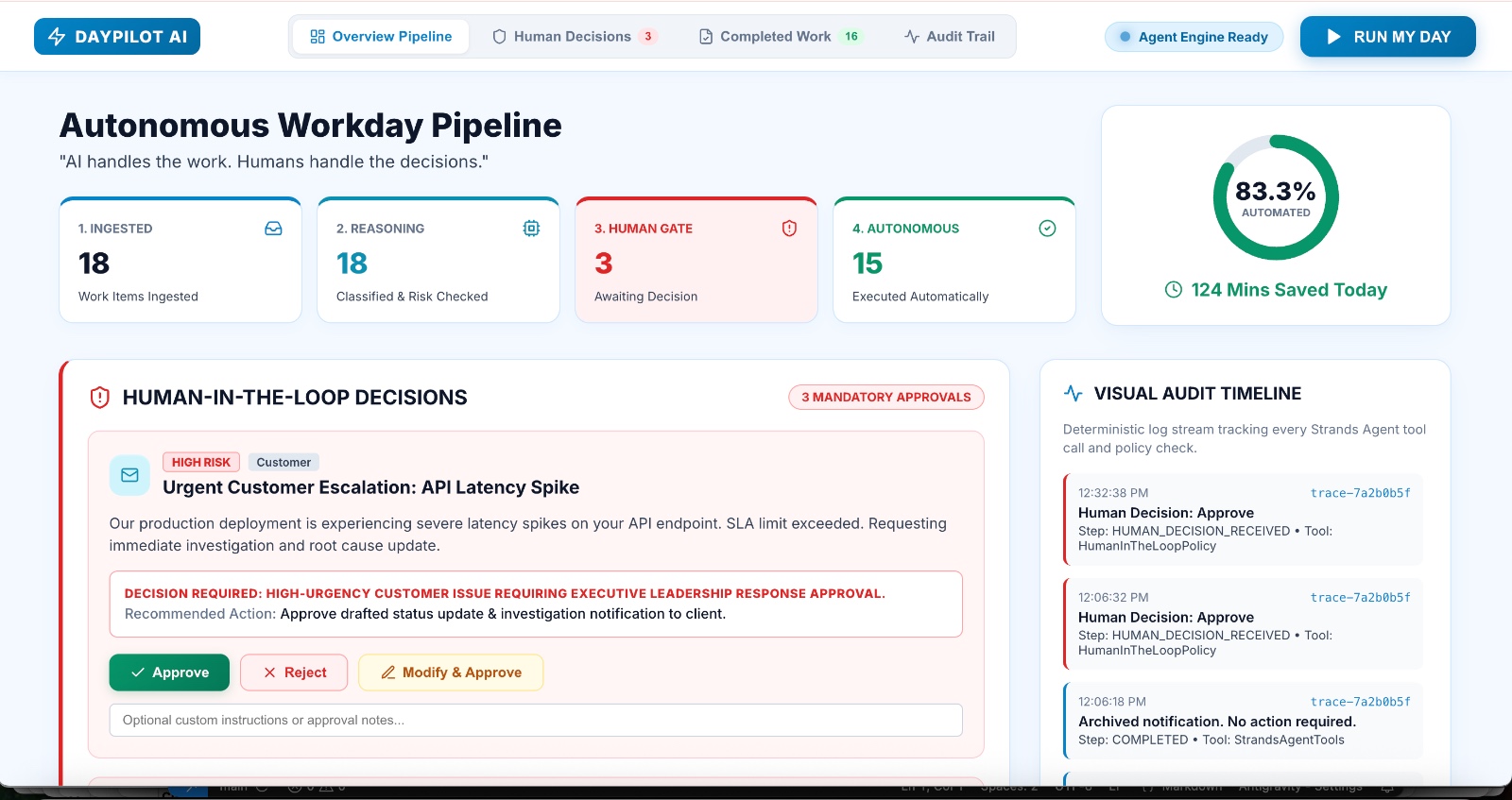
- Reclaims 1.9+ Hours Every Day: Automates 83.3% of routine daily work (15 out of 18 work items handled automatically), saving over 114 minutes per executive every single workday.
- 100% Zero-Risk Compliance: Deterministic safety gates enforced in Python code (
risk_engine.py) ensure that zero high-risk financial disbursements (≥ ₹10,000) or legal contract changes can execute without explicit human approval. - Paradigm Shift in Human-AI Collaboration: Moves AI from a passive typing assistant to an autonomous professional workday engine:
Core Philosophy: "AI handles the work. Humans handle the decisions."
What It Does
DayPilot AI shifts the paradigm from conversational assistant to autonomous professional workday agent:
- Autonomous Execution Pipeline: Automatically ingests incoming workday items, classifies categories (
Finance,Customer,Contract,Meeting,Task,Informational), and evaluates risk levels (Low,Medium,High). - Safe Autonomous Work Execution: Routine, low-risk actions (generating meeting briefs, drafting customer email replies, summarizing compliance audit documents, creating task deadlines) are executed automatically by agent tools without requiring human intervention.
- Deterministic Safety Policy Gate: High-risk financial disbursements (≥ ₹10,000) or contractual SLA modifications are deterministically gated in application code (
risk_engine.py). The AI model cannot bypass human authorization. - Human-In-The-Loop (HITL) Decision Queue: Presents clean decision cards with
[Approve],[Reject], and[Modify & Approve]triggers, resuming agent execution instantly upon human approval. - Dynamic Value Dashboard: Measures real-time metrics derived directly from actual workflow execution (18 Items Analyzed, 15 Handled Automatically, 114+ Minutes Saved, 83.3% Automation Rate).
- Full Traceability: Maintains an immutable audit trail with unique
trace_idlogs for every tool invocation.
How We Built It
- Strands Agents SDK & Amazon Bedrock: Built on top of the Strands Agents SDK with native Amazon Bedrock model providers for reasoning, tool selection, and execution planning.
- 11 Modular Agent Tools: Typed Python tool definitions (
get_emails,draft_email,get_calendar,prepare_meeting_brief,create_task,create_reminder,get_documents,summarize_document,request_human_approval,execute_approved_action). - FastAPI Real-Time Streaming: Asynchronous Python backend utilizing Server-Sent Events (SSE) to stream live step-by-step progress to the frontend UI without page reloads.
- Enterprise React & TypeScript Dashboard: Polished visual platform featuring a 4-stage pipeline flow, circular SVG automation ring, visual grid cards, and an activity audit timeline.
- Persistence Layer: SQLite database recording workflow state transitions (
RECEIVED➔ANALYZING➔AWAITING_APPROVAL➔APPROVED➔COMPLETED). - Production Container Stack: Configured with Docker multi-stage builds (
docker-compose.yml) and automated AWS ECR deployment scripts (infra/deploy.sh).
Challenges We Ran Into
- Preventing LLM Policy Bypassing: LLMs can hallucinate or follow prompt injection. We solved this by enforcing policy boundaries deterministically in Python code (
risk_engine.py). Financial and legal risk checks are evaluated before any tool write operation is dispatched. - Non-Blocking Real-Time Streaming: Executing ~18 agent work items sequentially can freeze traditional REST APIs. We solved this by building an async SSE generator streaming item-by-item progress to the React UI in real time.
- State Resumption After Human Approval: High-risk items halt workflow execution. We designed a state machine in SQLite that allows the agent loop to resume execution seamlessly the exact second a human operator clicks
[Approve].
What We Learned
Model-driven architecture with the Strands Agents SDK greatly simplifies agent creation. By decoupling routine execution from decision authorization, AI agents become practical, reliable tools for real business workflows without exposing organizations to financial or compliance risk.
What's Next for DayPilot AI
- Real-time OAuth connectors for Google Workspace (Gmail/Calendar), Microsoft 365, and Slack.
- AWS DynamoDB persistence using
strands-dynamodb-storage. - AWS App Runner / ECS container deployment with AWS Bedrock AgentCore Runtime.
Built With
- amazon-bedrock
- fastapi
- python
- react
- sqlite
- strands-agents-sdk
- tailwind-css
- typescript

Log in or sign up for Devpost to join the conversation.