-
-
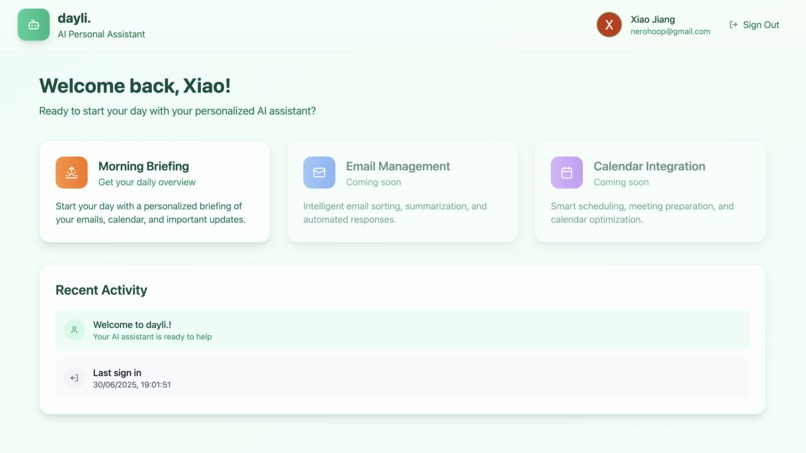
Dashboard
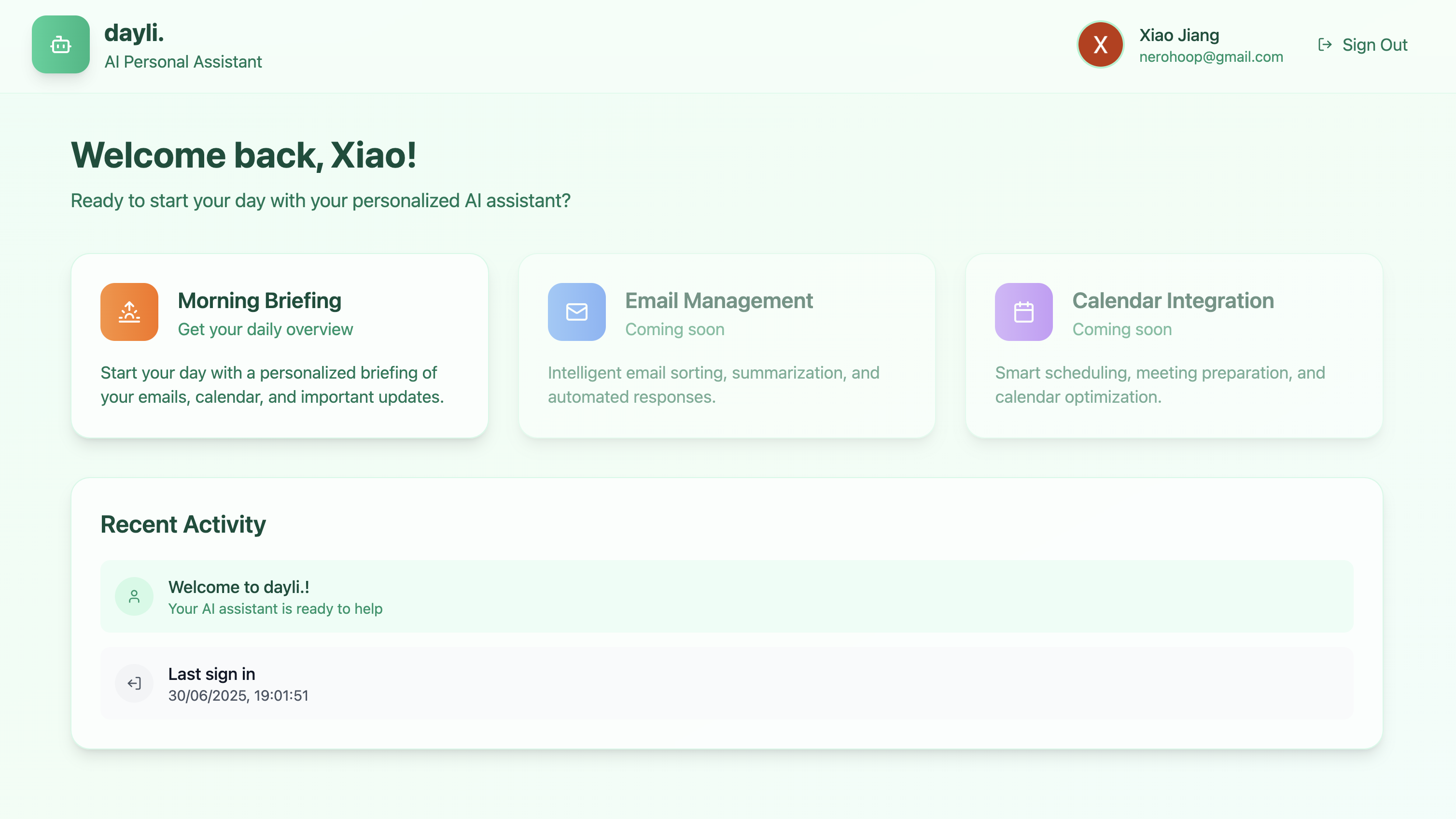
Dayli. Project Story
Project Story
We're busy founders who keenly felt the daily overwhelm of 40+ notifications from email, Slack, and calendars. Sifting through this digital noise is unproductive and stressful, especially when on the go. We realised current tools, while automating tasks, ironically create more fragmentation and screen dependency. dayli. was born from the vision to fundamentally reframe how we consume critical work information. What if you could start your day with a personalised, actionable voice briefing, freeing you from your screen? That's the problem dayli. solves.
Inspiration
The acute pain of digital noise and time scarcity for professionals. We were tired of being tethered to screens, constantly context-switching. We saw an opportunity to leverage "dead time" (commutes, workouts) by making information consumption truly hands-free and proactive, inspired by the efficiency of a personal assistant, but scaled with AI. Softwares out there are built for volume, not focus or clarity. Existing productivity tools are still screen-dependent or platform-dependent, with nothing that truly aggregates all your workflow.
What it does
dayli. is an AI voice assistant. Users connect their digital workspaces. Each morning, dayli. generates a personalised, <2-minute audio briefing summarising key updates and actionable items. It's designed for hands-free listening, providing critical information without requiring screen interaction.
How we built it
We developed a personal assistant designed to transform busy professionals' morning commutes by automatically summarizing their email inboxes and delivering the information as audio briefings. The goal was to help users stay informed without manually sorting through emails while traveling to work.
Our development process began with creating a compelling landing page to validate the concept and communicate our value proposition. We then built a comprehensive authentication system with secure Gmail OAuth integration, allowing users to safely connect their email accounts. The frontend focuses on displaying clear, digestible email summaries with a key innovation: converting these summaries into audio format for hands-free consumption during commutes.
The backend architecture centers on a FastAPI server that orchestrates Gmail integration, AI-powered email summarization using LLM technology, and text-to-speech conversion for audio generation. All user data, summaries, and audio files are securely stored in Supabase. To ensure users have fresh content every morning, we implemented automated cron jobs that generate daily briefings without requiring user intervention.
The result is a smart morning companion that transforms commute time into productive preparation for the day ahead. By combining secure email access, intelligent summarization, and convenient audio delivery, we've created a seamless tool that fits naturally into busy professionals' daily routines, turning static email management into an engaging, accessible experience.
Challenges we ran into
Google Authentication Integration
We faced significant difficulties implementing Google authentication, as the AI assistant was unable to complete the full setup process autonomously. This required extensive manual intervention to properly configure the authentication flow, set up OAuth credentials, and conduct thorough testing to ensure the integration worked correctly.
Unintended Cross-Page Modifications
While making changes to the admin page, the AI would occasionally modify the landing page simultaneously, creating unexpected alterations to unrelated components. This resulted in frequent rollbacks and additional time spent reverting unwanted changes to maintain the integrity of the landing page design and functionality.
Code Generation and Auto-Fix Limitations
The AI sometimes generated code containing errors, and when these issues arose, the automated fix functionality would fail to resolve them even after multiple iterations. This created development bottlenecks where manual debugging and correction became necessary to move forward with implementation.
API Setup Complications
Setting up the API through the current development environment proved problematic, with persistent configuration issues that hindered progress. To overcome these obstacles, we made the decision to switch to Cursor and implement a FastAPI server, which provided a more stable and manageable solution for our backend requirements.
Accomplishments that we're proud of
We successfully built a functional MVP web app demonstrating the core voice briefing experience. We're particularly proud of the seamless integration of AI for personalised content generation and the intuitive hands-free audio delivery.
We conducted 20 user testings, receiving great feedback on how dayli. doesn't just summarise, but distils the most important items across different channels, making it feel like a real personal assistant rather than just a text-to-speech reader. This user testing powerfully validated the "morning debrief" concept.
What we learned
We validated that the core problem of digital overwhelm is deeply felt by our target users. The demand for a proactive, voice-first solution is significant. We also gained valuable insights into the technical complexities of real-time multi-source data synthesis and the critical importance of optimising AI and TTS costs for scalability.
What's next for Dayli.
Next, we'll launch our MVP to acquire real users. We'll then expand cross-platform integrations, including news and other key workflows. Our focus will be to refine our personalisation engine for deeper user understanding and explore interactive voice commands for follow-up actions, moving towards a full-featured AI personal agent.
Built With
- elevenlabs
- fastapi
- google-email
- python
- supabase
- vite


Log in or sign up for Devpost to join the conversation.