-
-
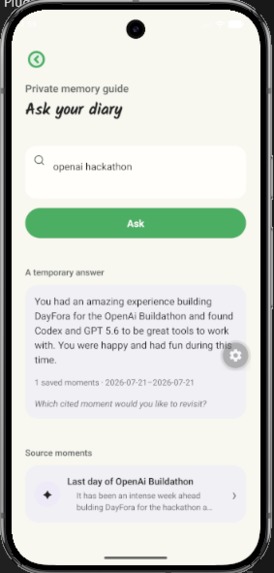
Ask your diary questions using an agent
-
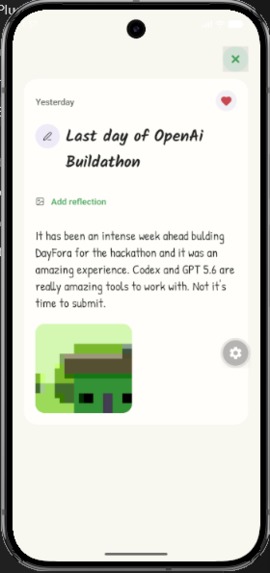
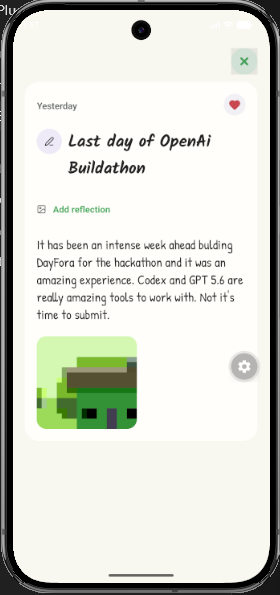
Diary entry detail page
-
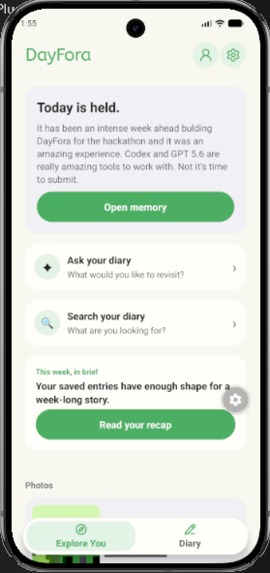
Explore Screen
-
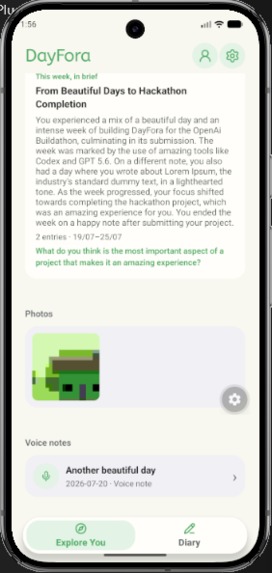
Recap for a week
-
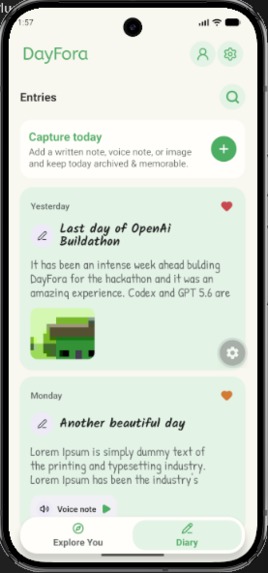
Diary entries



Inspiration
DayFora began as something I have wanted to build for myself for a long time: a simple way to document everyday life and return to it later.
So many meaningful moments disappear because writing a full diary entry can feel tiring. I wanted a space where I could save a thought, a voice note, or a photo as life happens, then reflect on those moments whenever I need perspective.
What it does
DayFora is a private diary for capturing life through short notes, voice recordings, and photos.
Every entry starts with a small user-written title, then the user can add a description, audio, photos, or any combination. Entries save directly in the user’s own voice.
The AI agent helps only when the user asks. It can help rediscover memories, answer questions about past entries, and create source-linked weekly or monthly recaps. It does not rewrite the user’s diary or silently analyze their media.
How we built it
We built DayFora as a mobile-first app using:
- Expo, React Native, and TypeScript for the mobile app
- FastAPI and Python for the backend
- Supabase for authentication, PostgreSQL, Row-Level Security, and private media storage
- LangGraph for the memory-agent workflows
- OpenAI through the backend for source-linked search and recap generation
The experience is organized into two spaces: Diary, for the chronological record, and Explore, for capturing today, searching memories, revisiting past dates, and asking the agent about saved moments.
Challenges we ran into
The biggest challenge was deciding where AI should not be used.
We initially explored automatic transcription, image descriptions, AI-written diary drafts, and activity tracking. But those ideas raised real concerns around privacy, accuracy, language differences, and preserving the user’s authentic voice.
We simplified the product so users save their own entries directly. Voice notes and photos remain original private attachments, while the agent is only used deliberately for search and recap experiences.
Another challenge was avoiding feature overload. Focusing on diary and memory instead of goals, streaks, and activity tracking made the product more focused and human.
Accomplishments that we're proud of
We are proud of creating an AI experience that supports the user without taking over their story.
DayFora keeps the user as the author: entries are saved directly, original media remains private, and AI answers always link back to the diary entries they came from.
We are also proud of reducing the app to a simple, clear flow:
- Capture a moment.
- Save it privately.
- Return to it when it matters.
What we learned
We learned that useful AI is not always AI that does the most.
For something as personal as a diary, trust, clarity, and user control matter more than automation. The best role for the agent is to help people rediscover meaning in memories they already chose to save.
We also learned the value of narrowing scope. Removing extra features helped us focus on building a more intentional and emotionally honest experience.
What's next for DayFora
Next, we want to make DayFora even more useful while protecting the user’s privacy.
We plan to improve memory search, add richer recap experiences, and introduce optional, user-controlled ways to make a specific voice note or photo more searchable. We also want to refine the offline and media experience so capturing a moment feels effortless anywhere.
The long-term goal is simple: make DayFora a private place people can return to and see the story of their life, one day at a time.
Built With
- agents
- android
- expo.io
- fastapi
- groq
- langgraph
- mobile
- openai-api
- postgresql
- python
- react-native
- row-level-security
- supabase
- supabase-auth
- supabase-storage
- typescript

Log in or sign up for Devpost to join the conversation.