-
-
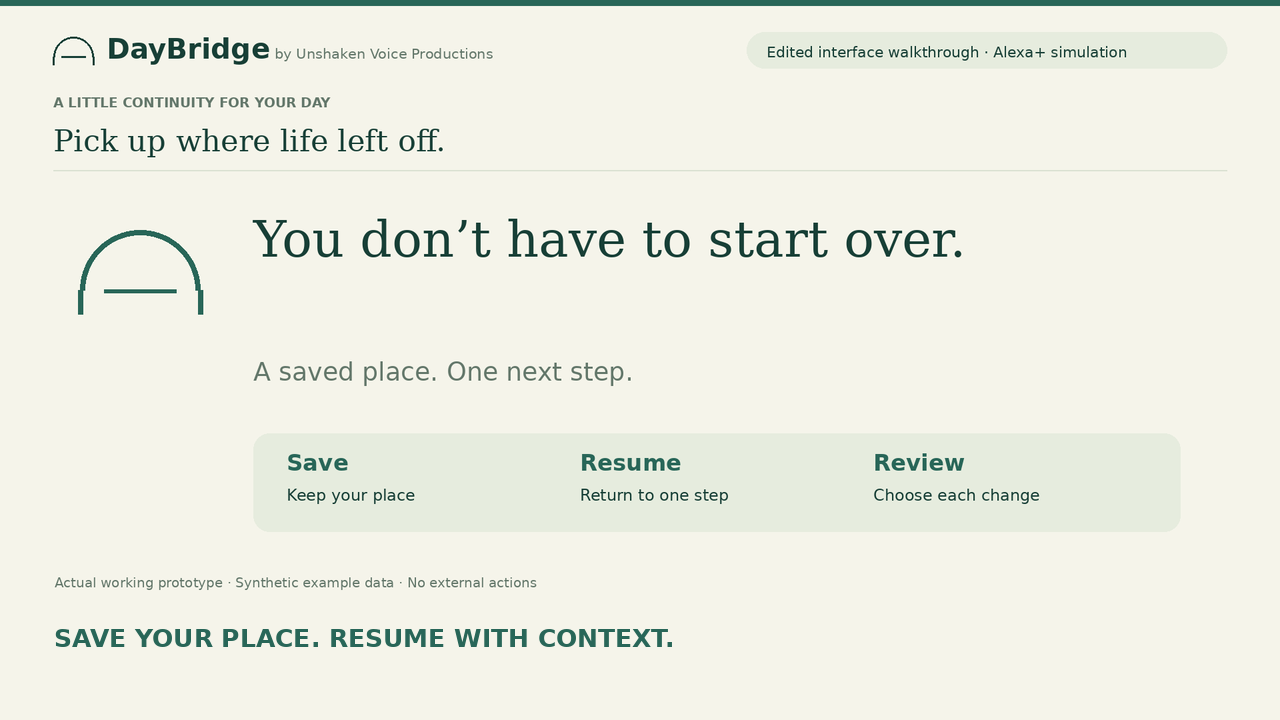
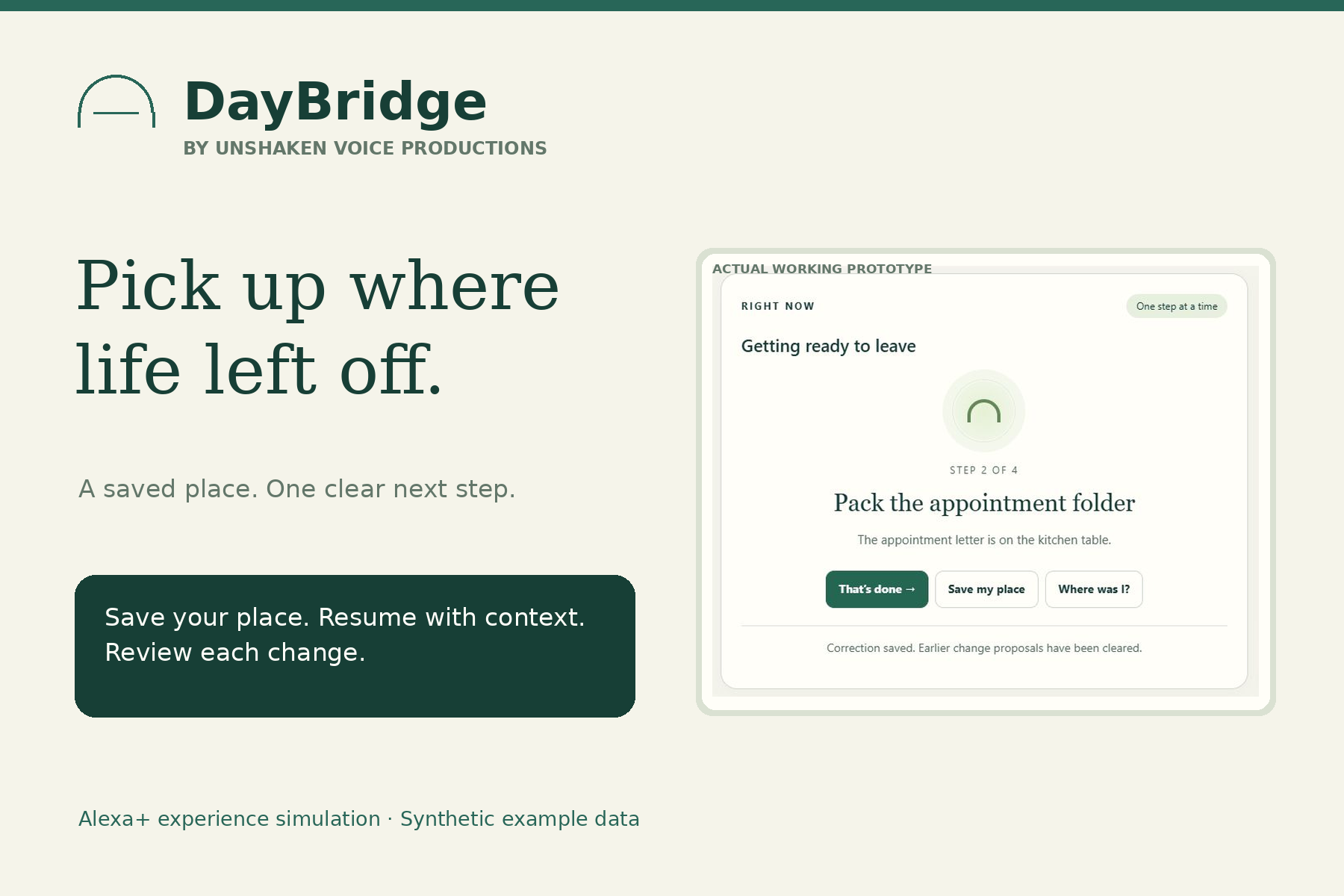
Pick up where life left off. Watch the working prototype walkthrough with ElevenLabs narration and English captions.
-
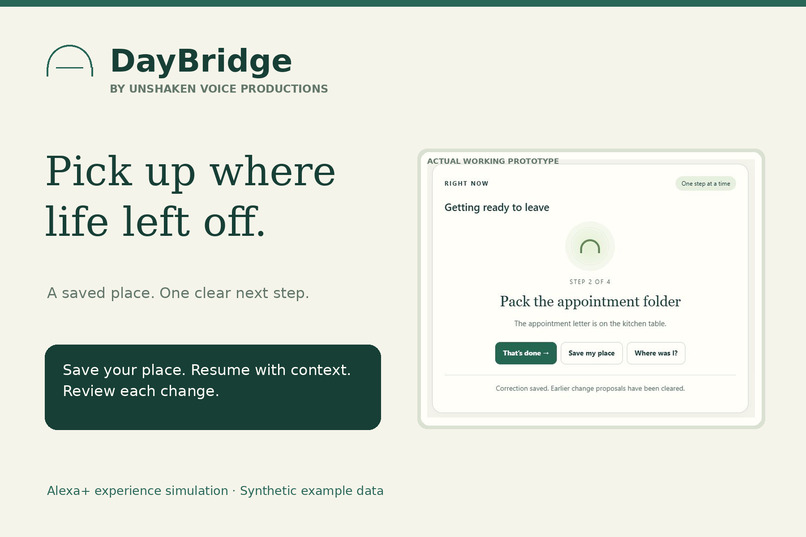
DayBridge: a saved place, one clear next step, and changes you review. Alexa+ experience simulation with synthetic data.
-
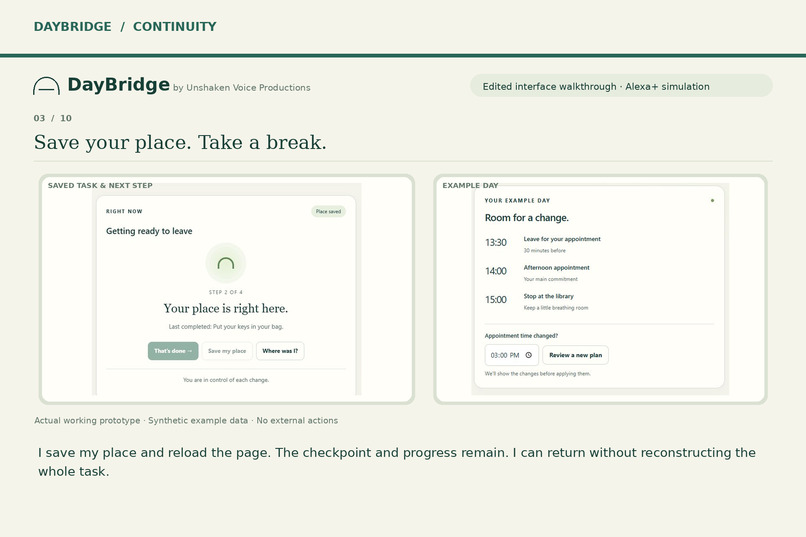
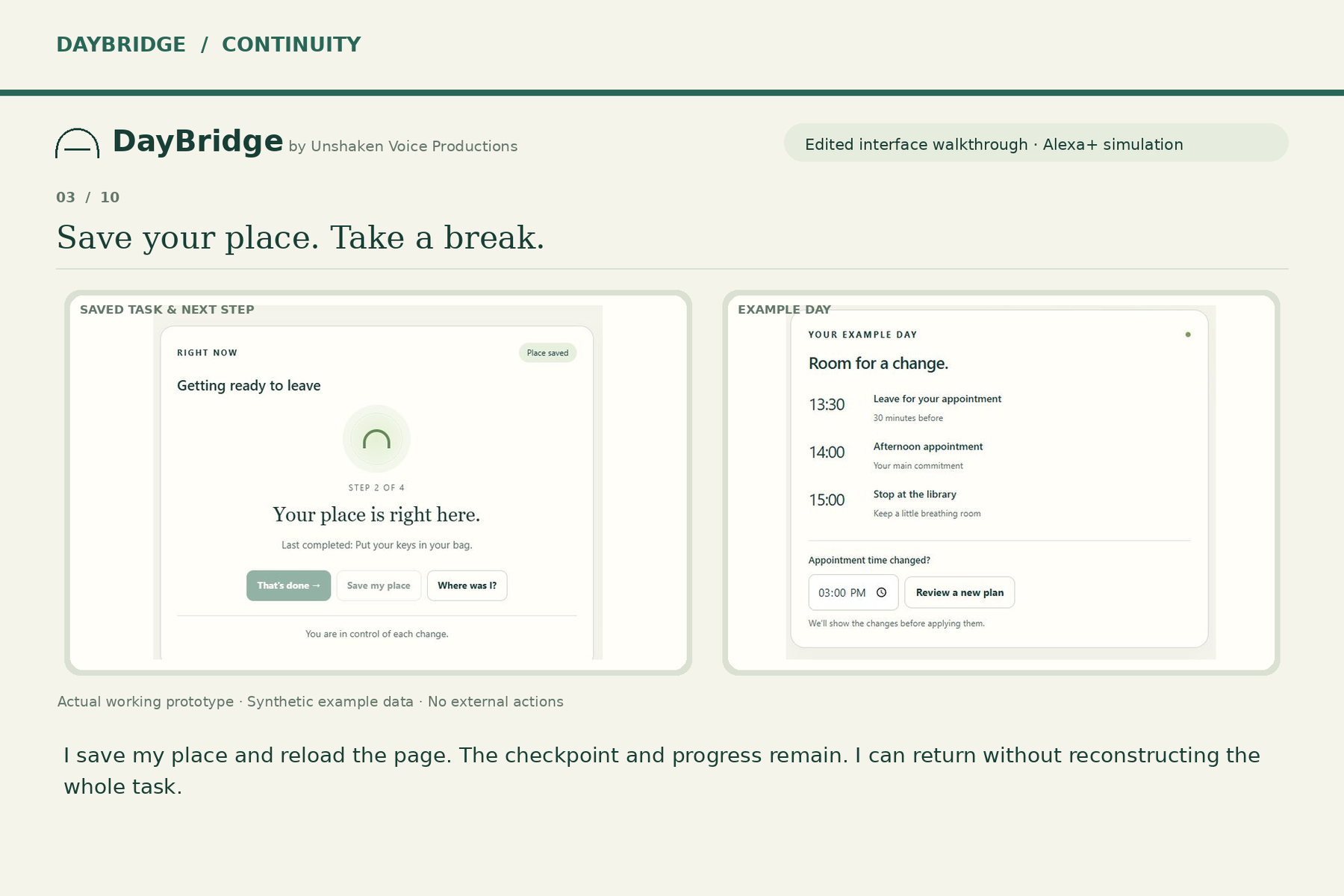
Save your place and return to the next step. Completed progress and the checkpoint persist after reloading.
-
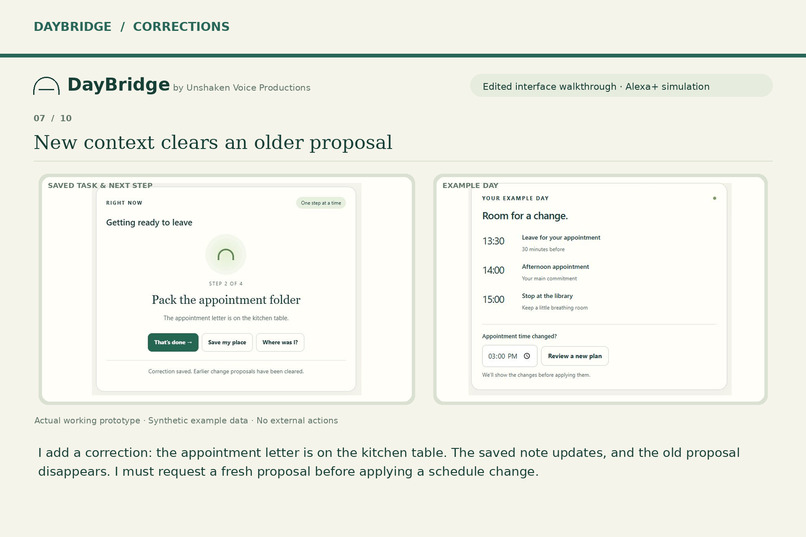
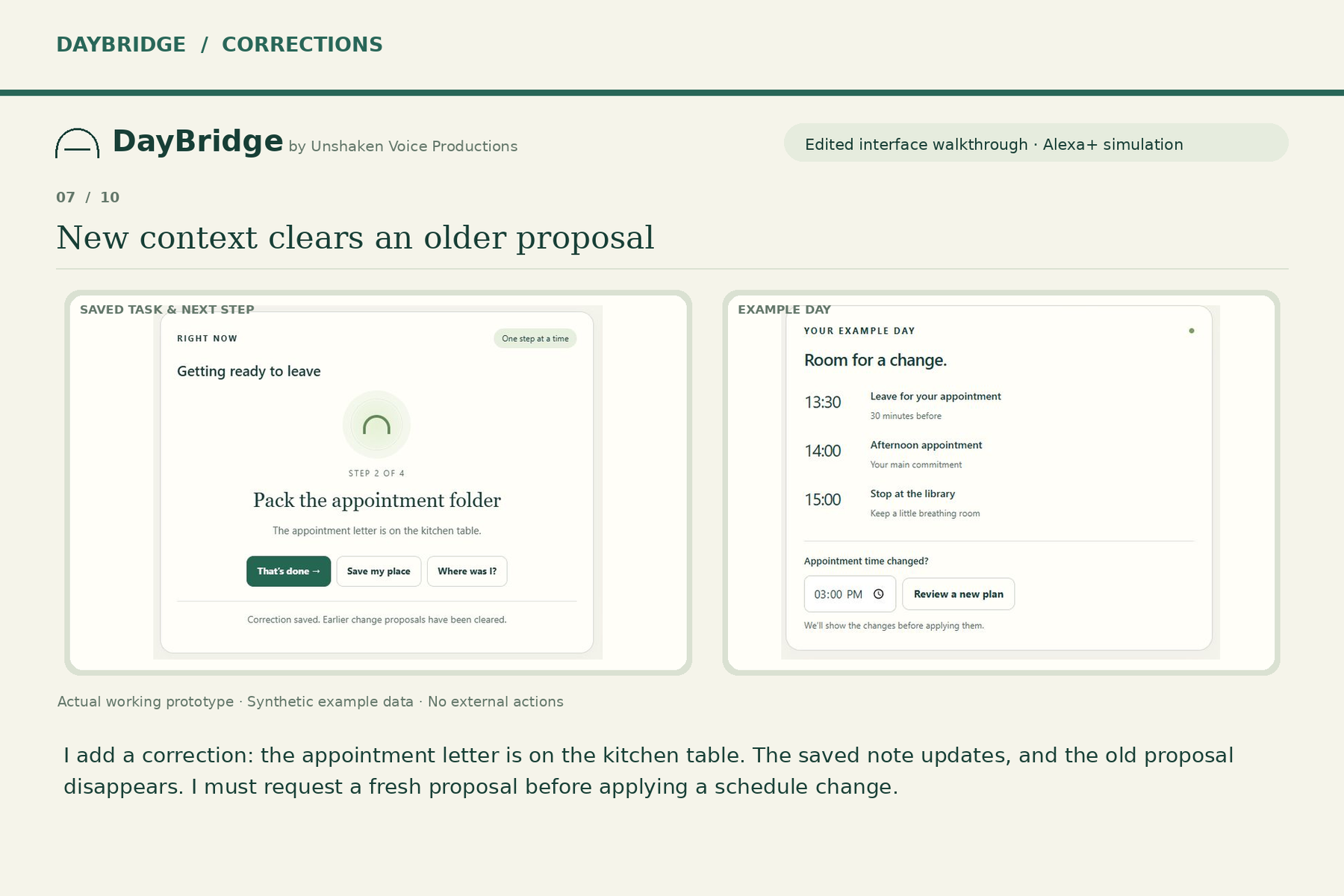
A correction updates the saved note and clears an older proposal. Request a fresh plan before applying a schedule change.
-
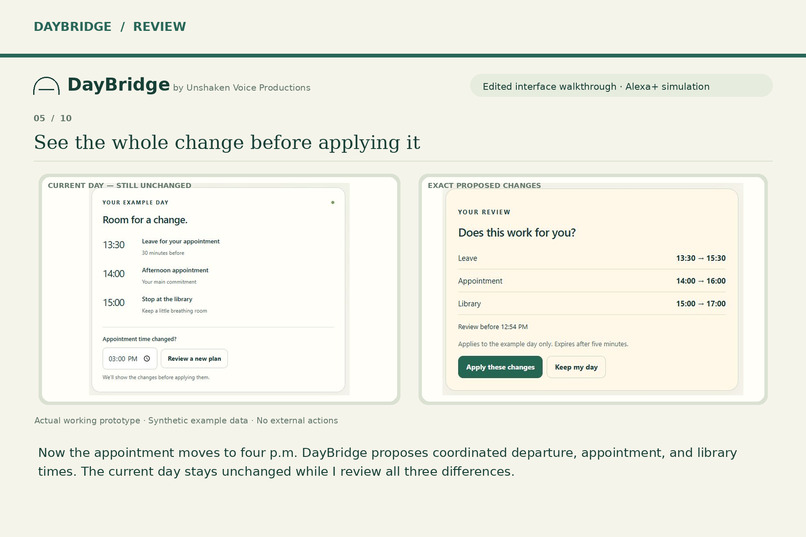
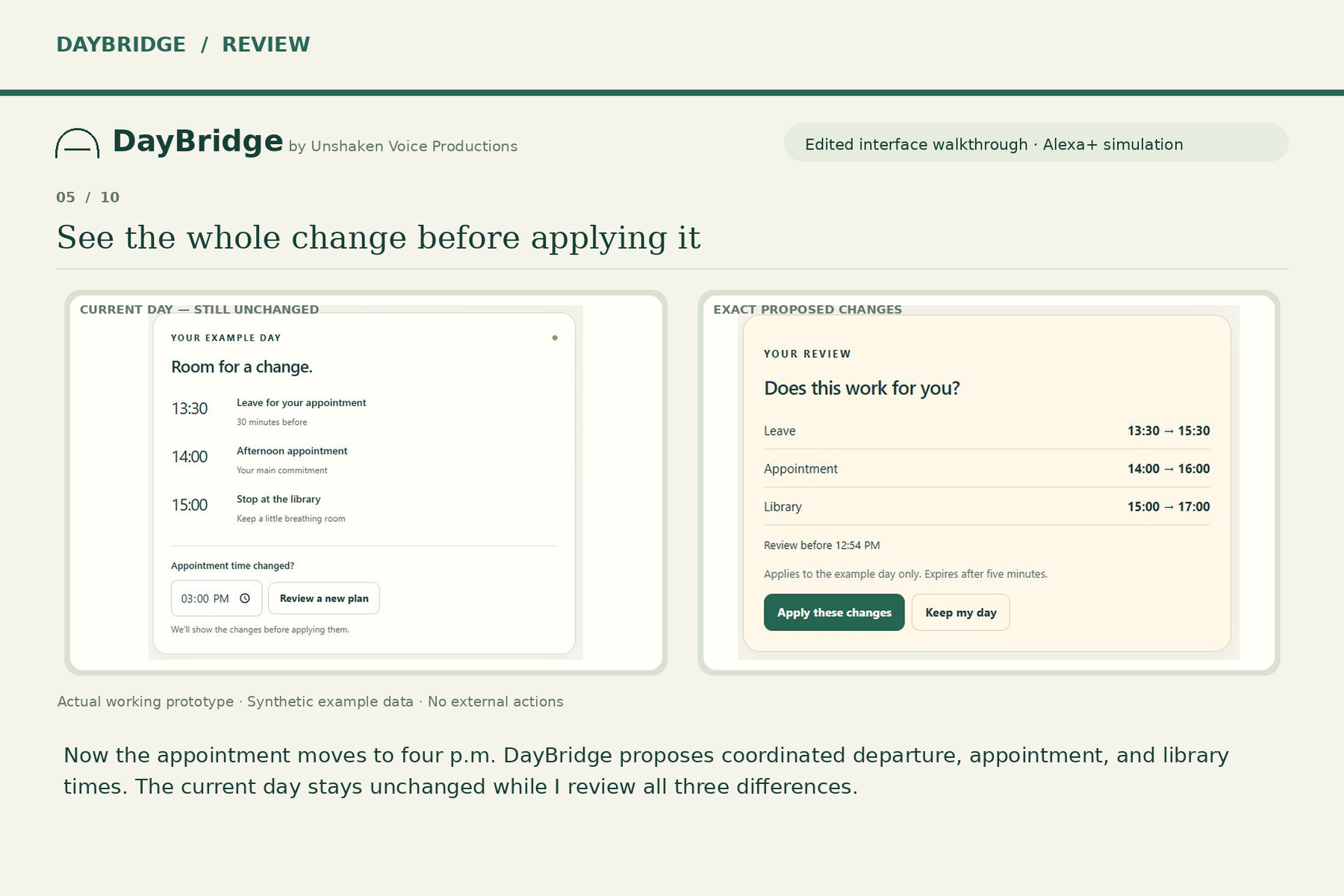
Review departure, appointment, and library times together. Your current day stays unchanged until you apply the proposal.
Inspiration
An interrupted day should not make you start over.
Returning to an ordinary task can mean reconstructing what you finished, what remains, and what changed while you were away. DayBridge explores a calmer return: one saved place and one clear next step.
What it does
DayBridge is a working, browser-based Alexa+ experience simulation built around a synthetic example day.
- Save your place. Complete a preparation step, pause, and keep your checkpoint.
- Resume with context. Reload and return to the next unfinished step.
- Keep a correction. Update the saved note in your own words.
- Review a coordinated change. When an appointment moves, compare the proposed departure, appointment, and library times before applying them.
Your current day stays unchanged while a proposal is under review. A casual conversational “yes” cannot apply it. A correction clears an older proposal; expired proposals are rejected; repeated approval cannot apply the same change twice.
How we built it
The HTML, CSS, and JavaScript interface calls eight local Python tools through a Model Context Protocol (MCP) endpoint. The server implements initialization, tool discovery, and tool calls using Streamable HTTP JSON responses. SQLite transactions preserve the synthetic day and task progress across reloads and server restarts.
A bounded conversational router recognizes documented phrases and asks for clarification when a time is ambiguous. The running prototype requires Python 3.11 or later, with no third-party Python packages or API keys.
What we verified
All 24 automated behavior and transport tests passed on October 22, 2026. JavaScript syntax validation also passed.
We exercised the working browser flow: complete a step → save a checkpoint → reload → resume → propose a new appointment time → review three changes → reject casual approval → save a correction → request a fresh proposal → explicitly apply it → reload and verify persistence.
The demo uses actual interface captures, edited into a walkthrough with English captions and ElevenLabs Roger narration. It is not presented as a continuous screen recording.
Challenges and what we learned
The hardest problem was preserving continuity while making each change understandable. We tied proposals to state revisions and expiry, retained receipts for repeated requests, and separated conversational input from approval.
Implementing the tool boundary also meant the interface exercised working behavior instead of a scripted animation.
Current limits and next steps
This is a local simulation using synthetic data and fixed planning buffers. It has no Alexa hardware integration, runtime language model, connected calendar, or messaging account. Local state is stored in plaintext and is intended only for example data. Optional in-app read-aloud uses browser speech synthesis; the published demo uses ElevenLabs narration.
Next steps are consented usability testing, broader language support, official client interoperability testing, authenticated storage, and narrowly scoped account integrations.
Team and tools
Built during the hackathon window by Unshaken Voice Productions LLC, under Steven Cram’s product direction. ChatGPT/Codex assisted implementation, documentation, and verification. ElevenLabs supplied stock-voice demo narration; no personal voice was cloned.
The private judging repository contains source code, setup instructions, tests, and a friction log. This entry targets the Alexa+ track; no AWS Builder or Open Source mini challenge is claimed.
Built With
- css
- elevenlabs
- html5
- javascript
- mcp
- python
- sqlite

Log in or sign up for Devpost to join the conversation.