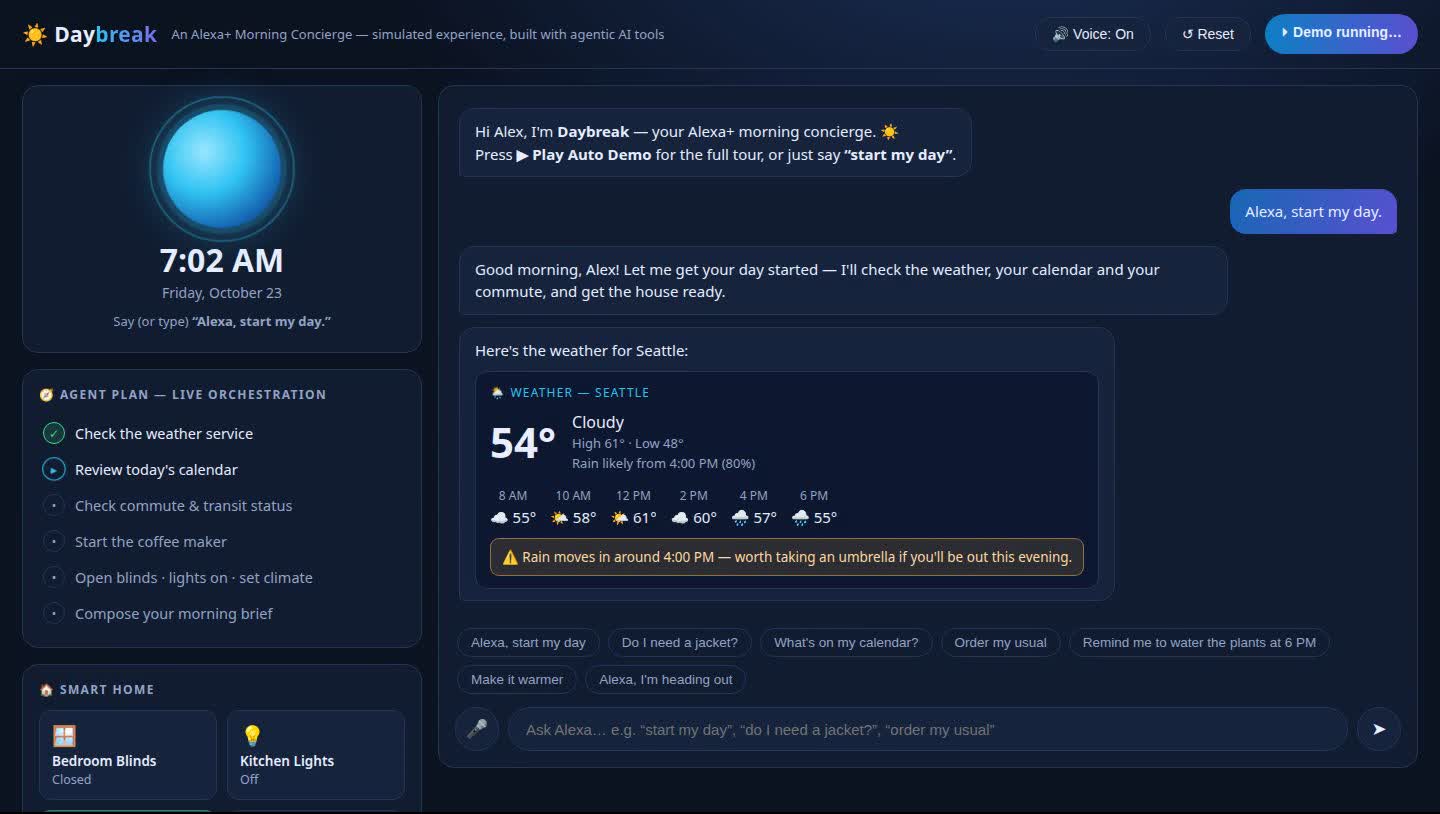
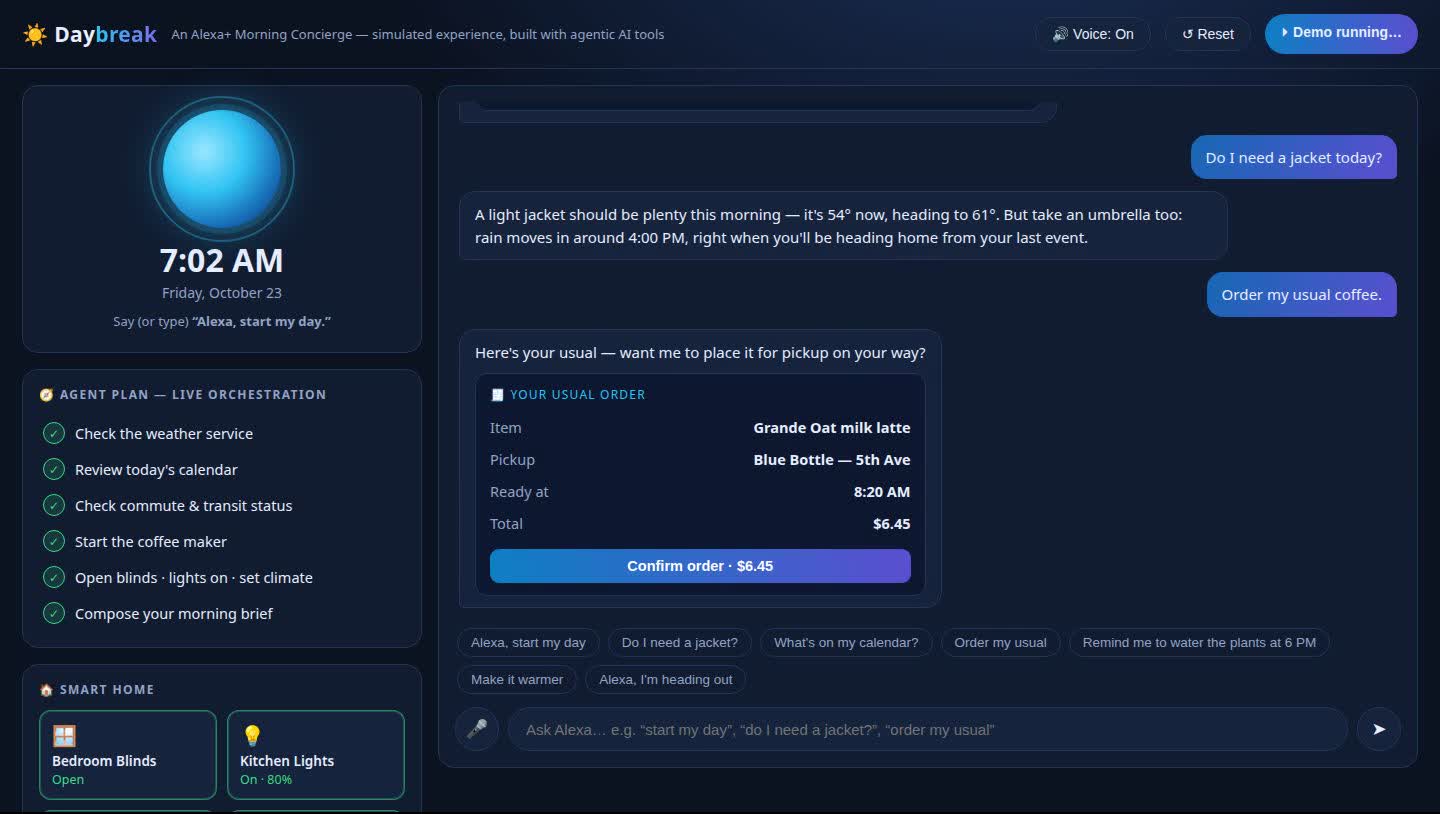
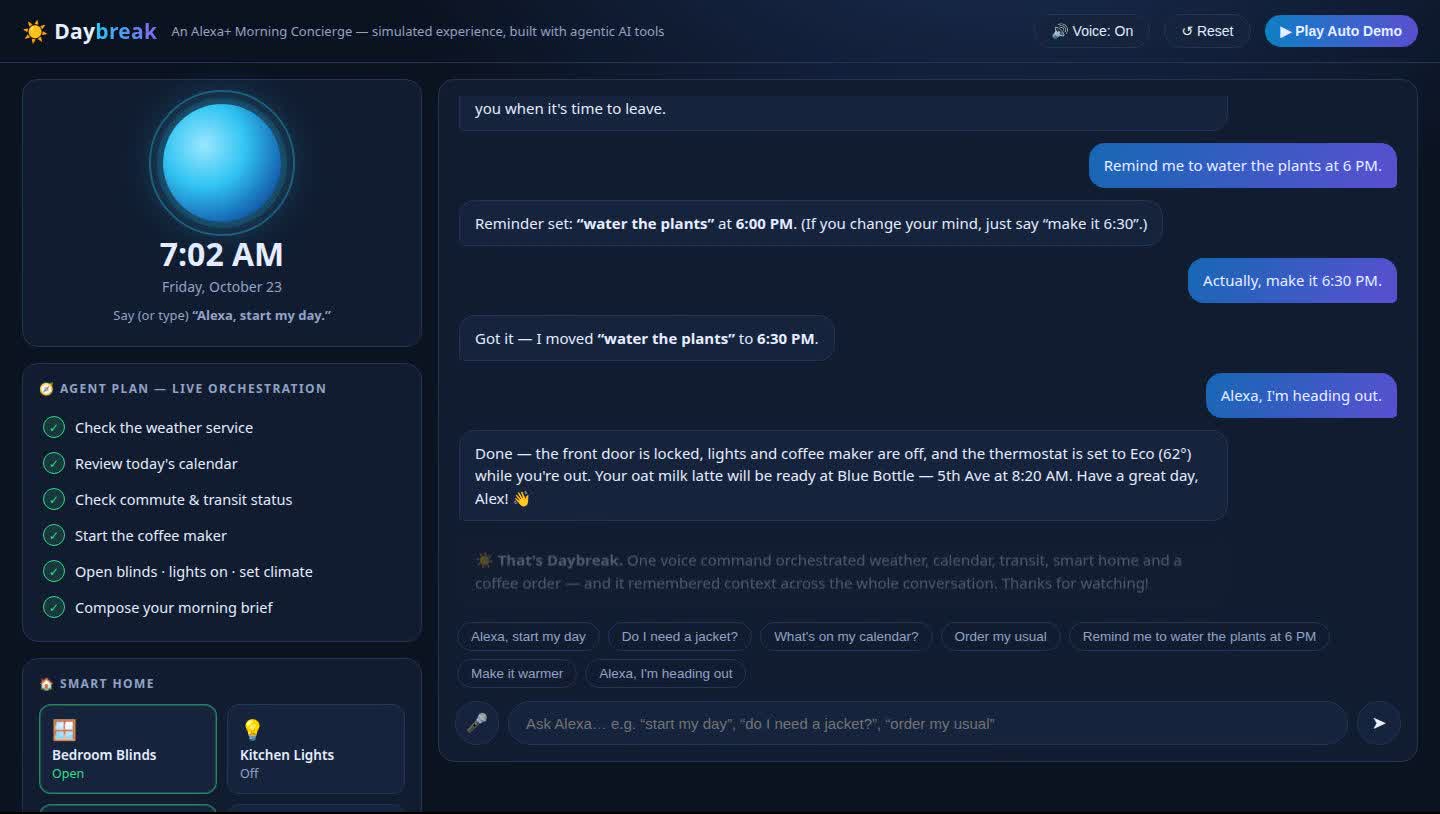
Inspiration Mornings are a dozen micro-decisions scattered across five apps: weather, calendar, traffic, news, the thermostat, the coffee maker. Voice assistants today make you ask for each one separately. Alexa+ promises something different — a conversational agent that orchestrates. Daybreak is my exploration of that promise: what if one sentence, “start my day,” kicked off an agent that plans, acts, and reports back like a good chief of staff? What it does Daybreak is a simulated Alexa+ experience that runs entirely in the browser: Agentic orchestration with a visible plan. “Start my day” generates a six-step agent plan (weather → calendar → commute → coffee → home scene → brief) and executes it live, posting rich cards as each simulated service returns. Proactive insights, not just answers. It cross-references services: rain at 4 PM + an evening commute → “take an umbrella”; a 9:00 meeting + a 24-minute train ride → “leave by 8:20.” Stateful, context-aware conversation. Set a reminder (“…at 6 PM”), then correct it with a bare follow-up (“make it 6:30”) — Daybreak knows what “it” is. Thermostat commands accumulate (“warmer” twice = +4°). “Make it warmer” is correctly not mistaken for a reminder edit. Simulated purchasing. “Order my usual” renders an order card; confirming places the order, and the goodbye routine references it later (“your latte will be ready at 8:20”). Media-rich responses. Weather card with hourly strip and rain alert, agenda card, commute card, and a browsable news carousel. Smart-home scenes. Device tiles (blinds, lights, thermostat, coffee maker, lock) change state as the agent acts; “I’m heading out” runs a full lock-up/Eco scene. Voice in & out (Web Speech API + speech synthesis, both optional), plus a one-click Auto Demo that plays the whole tour in about two minutes. How I built it A single self-contained index.html (no build step, no dependencies): a priority-ordered intent engine, async workflow executors for the morning/goodbye routines, card renderers, a small session state store, and simulated service modules (weather, calendar, transit, news, smart home, ordering) shaped like the integrations a production Alexa+ Agent Skill or MCP server would call — so the simulation maps 1:1 onto a real architecture. The project was built with agentic AI coding tools (ChatGPT Codex and Muse Spark), directed and tested by me; the conversation logic was verified with an automated smoke-test harness that walks the full demo script and asserts device/reminder/order state after every step. Challenges Follow-up disambiguation: “make it 6:30” (edit reminder) vs. “make it warmer” (thermostat) — solved with intent priority plus a context guard that requires a time-like payload for reminder edits. Making a simulation feel like an agent rather than a chatbot: the visible Agent Plan, timed step execution, and device side-effects do the heavy lifting. Keeping everything in one file with zero dependencies so judges can run it by simply opening it. Accomplishments I'm proud of The full morning routine genuinely feels like delegation, not Q&A. Context handling (reminder edits, cumulative thermostat, the order callback in the goodbye scene) survived an automated end-to-end test of the exact demo script. Zero-to-running is literally “open the file.” What I learned Agent UX is mostly about legibility: users trust an agent they can watch working. Showing the plan, the intermediate cards, and the state changes matters as much as the language understanding. What's next Rebuild the same flows as a real Alexa+ Agent Skill backed by a self-hosted MCP server (weather, calendar, transit, smart-home tools), so Daybreak can leave the simulation and run on an actual Echo.
Built With
- chatgpt-codex
- css
- html
- javascript
- muse
- speech-synthesis
- web-speech-api

Log in or sign up for Devpost to join the conversation.