-
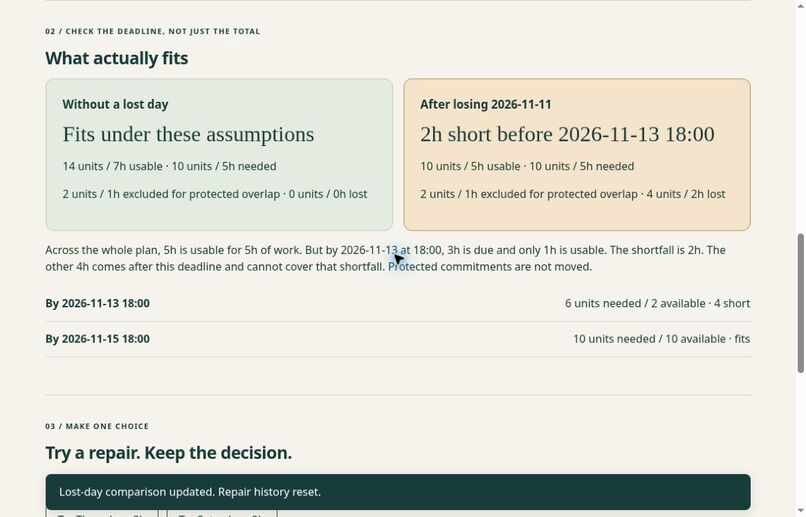
Lose Wednesday: five hours remain for five hours of work, but Friday has a two-hour shortfall.
-
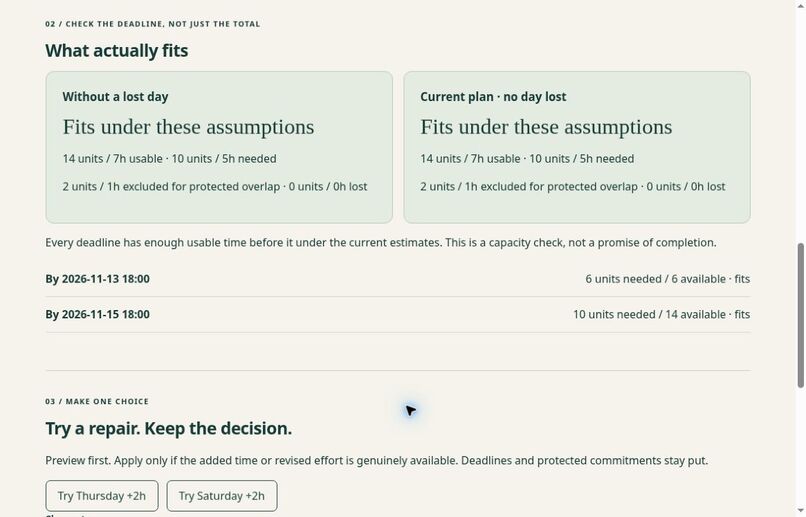
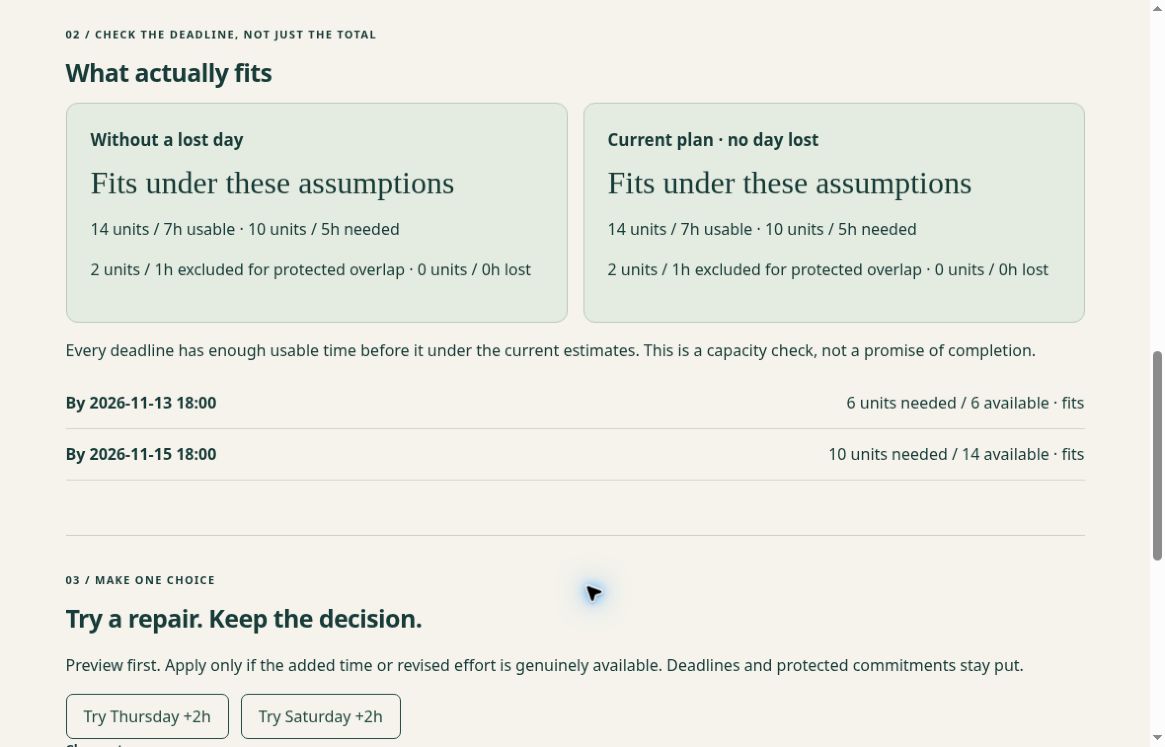
Synthetic baseline: seven usable hours for five hours of work; all deadlines fit under the half-hour model.
-
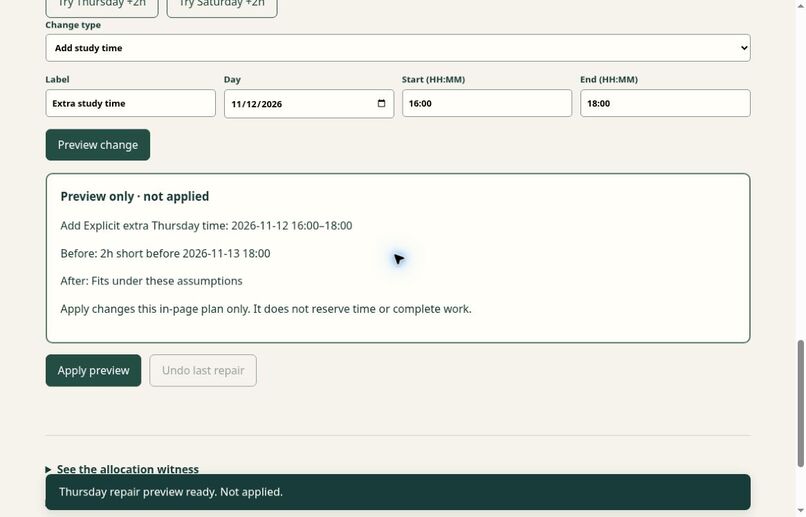
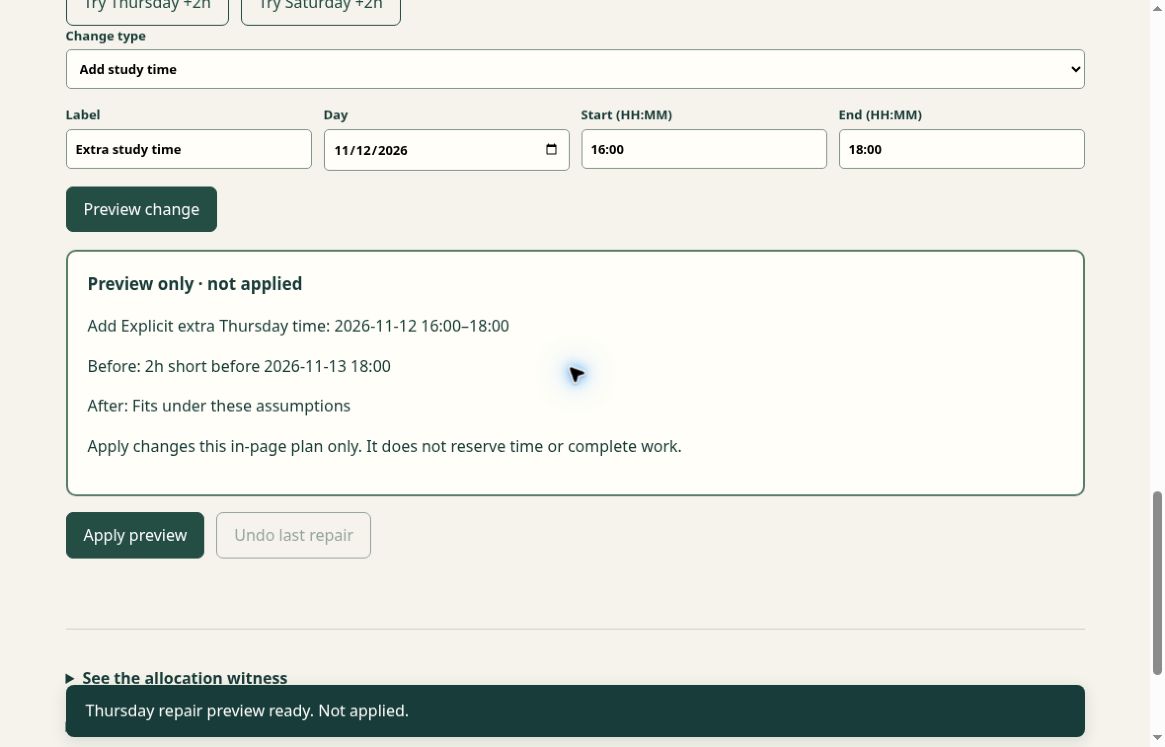
Preview only: genuinely available Thursday time clears the shortfall. Apply is an explicit choice; Undo restores the previous plan.
Inspiration / problem
A weekly total can look reassuring while an earlier deadline is already impossible. DayBack explores one specific question: if Wednesday disappears, what can still fit before Friday without moving protected commitments?
The example is invented, not a personal account or a student research finding. The intended value is to make a planning trade-off visible before someone relies on an unrealistic schedule.
What it does
Enter tasks with estimated remaining effort and deadlines, study blocks, and protected commitments. Compare the current plan with a missed day. DayBack checks available time before every deadline and explains the earliest shortfall, rather than hiding it inside a weekly total.
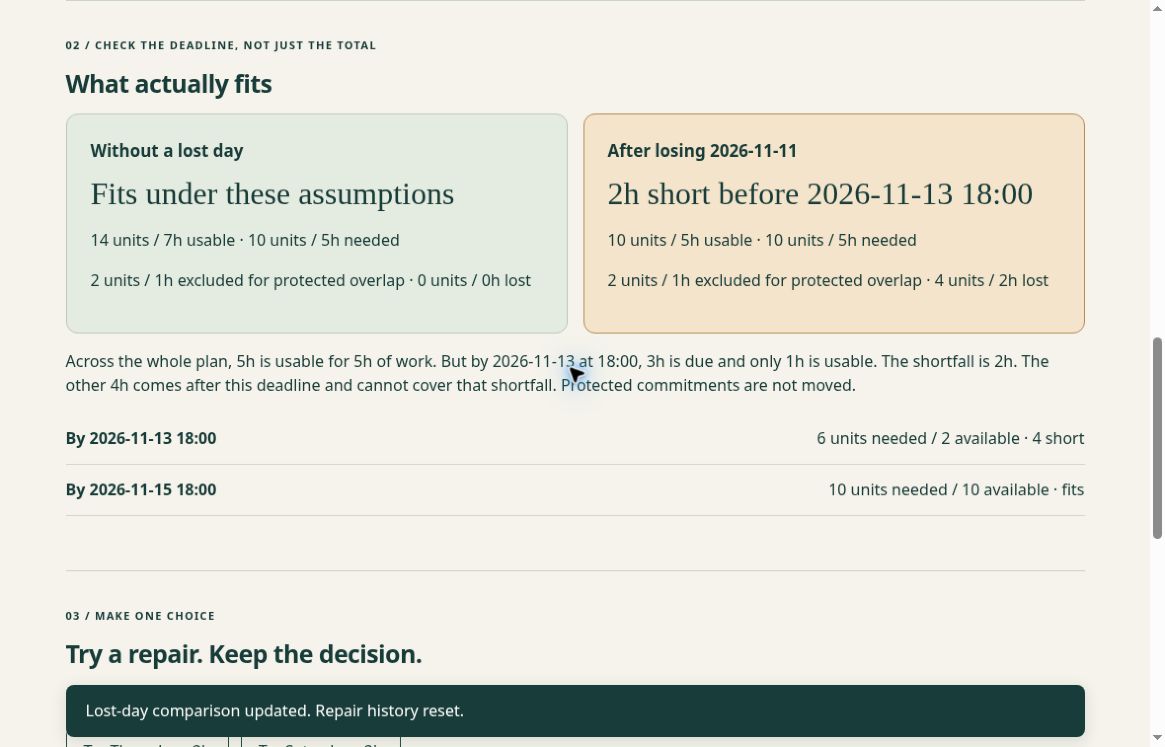
In the synthetic example, losing Wednesday leaves five usable hours for five hours of work. But Friday needs three hours and has only one available before it. Saturday time cannot fix that two-hour gap. Previewing genuinely available Thursday time can. Apply makes that explicit plan change; Undo restores the previous plan. Neither action books time or completes work. Deadlines and protected commitments are not silently moved.
How it was built
Plain JavaScript modules, semantic HTML and CSS, with no third-party runtime dependencies, account, AI API or calendar integration. A deterministic core allocates divisible 30-minute units in deadline order and checks cumulative capacity at each deadline. The interface separates staged edits, previews and applied state.
A reproducible exporter embeds the four modules and stylesheet into one HTML artifact. A public static application, public source and a downloadable prerelease are available. A local HTTP server is also documented for running the download. Entered data stays in page memory and is lost on reload.
Challenges and iteration
The central challenge was avoiding a false green result when weekly hours are sufficient but an early deadline is not. Another was keeping invalid drafts and unapplied previews distinct from the saved plan.
Review and browser testing led to concrete fixes: clearing a stale preview after validation failure, disabling hidden inactive form inputs, restoring keyboard focus after adding or removing editor rows, and wrapping long user-entered text at narrow widths. The explanation now distinguishes later capacity from capacity available before the failing deadline.
Accomplishments / verification
The released version passes 23 local automated tests. A separate brute-force assignment oracle checked 15,360 small synthetic cases against the scheduling core and detected a deliberately introduced weekly-total bug. Independent packaging checks matched the embedded modules to their source. Bounded browser checks exercised missed-day comparison, early and late previews, Apply, Undo, draft recovery and selected keyboard/narrow-width paths.
These are engineering checks, not user research or proof of real-world outcomes. The 96-second demonstration is explicitly a screenshot walkthrough of the actual prototype using synthetic data, with captions and a transcript, not a live recording.
What was learned
The timing of capacity matters more than its weekly sum. A useful planning tool should expose assumptions and let the person choose the change, rather than silently reducing work or moving commitments. Accurate explanations, reversible changes and error recovery are part of correctness, not just polish.
What's next
Test whether students can understand the shortfall and choose a realistic repair without guidance. Validate workload-estimate assumptions before expanding the model. Broader screen-reader, physical-device and reduced-motion runtime checks remain to be done.
Model limits
One person; a 1–31-day horizon; divisible half-hour work, all available from the start; explicit civil dates in one time basis. No fatigue, prerequisites, uncertain effort, timezone conversion or overnight blocks. An infeasible allocation witness is partial. A feasible result is a capacity check under estimates, not a completion guarantee.
Tools, reuse and contribution disclosure
Solo entrant/project owner: Sharon Basovich. Design, implementation, tests, review and demonstration preparation were produced with OpenAI AI-assistant assistance. This does not claim that Sharon personally wrote or manually tested the code. The prototype was created during the event build window. No third-party runtime dependencies or external media assets are included; it uses system fonts and synthetic example data. No human user interviews or measured student outcomes are claimed. Public source is available for inspection; no open-source license grant is asserted.
Try the prototype and watch the walkthrough
Downloadable prerelease, 96-second screenshot walkthrough, captions and transcript
The live prototype runs in your browser without an account; the release also provides a local download/run route. The demonstration is an editorially arranged screenshot walkthrough of synthetic data, not a live recording.
