-
-
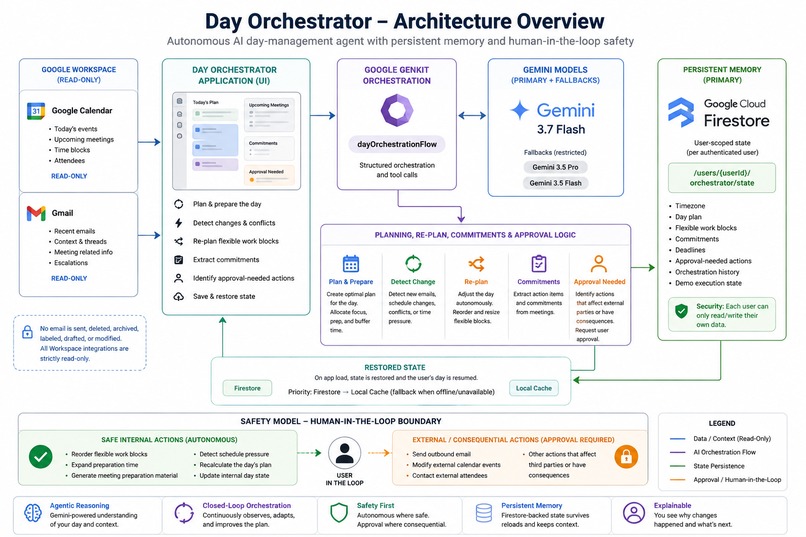
Project Architecture
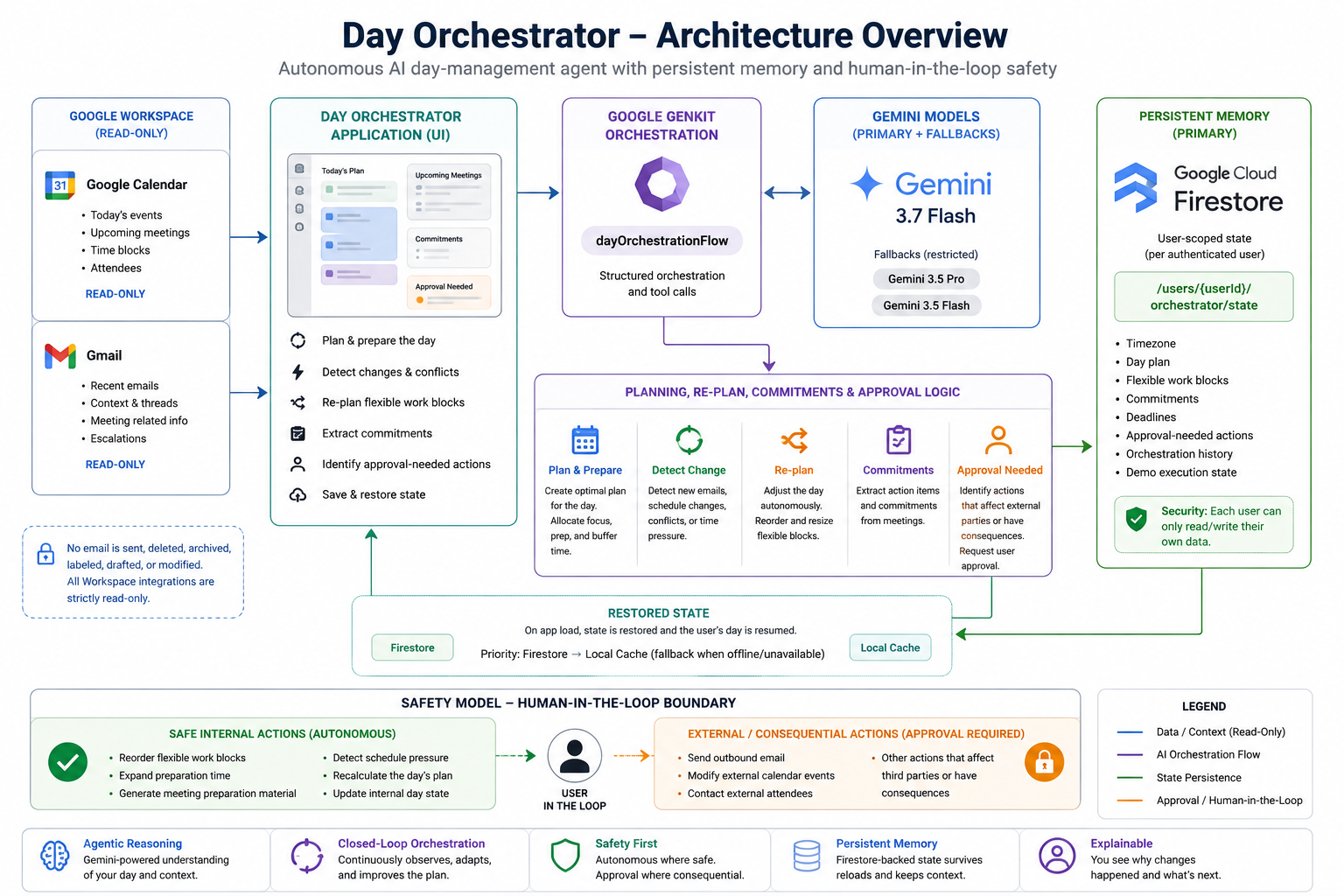
What it does
Day Orchestrator turns scattered information from calendars, emails, meetings, tasks, household needs, and personal priorities into one adaptive plan for the day.
Instead of making the user check multiple apps and decide what matters next, it helps identify priorities, prepare for upcoming events, capture follow-up actions, and adjust when the day changes.
The goal is not just to organize information. It is to reduce the mental work required to manage a busy life.
How we built it
We built Day Orchestrator as an AI-first prototype using Google AI Studio and Gemini.
The project was designed around orchestration rather than a traditional chatbot experience. Gemini provides the reasoning layer that can interpret what is happening across the user's day, determine what deserves attention, and turn that context into useful next actions.
We focused on creating a simple daily dashboard experience where AI works behind the scenes instead of requiring the user to repeatedly prompt it for every task.
Challenges we ran into
One of the biggest challenges was deciding what AI should handle automatically and what should remain under the user's control.
A useful assistant has to recognize urgency without treating everything as urgent. It also has to understand enough context to be helpful without overwhelming the user with information.
Another challenge was keeping the concept simple. Day Orchestrator is meant to coordinate work, family, meetings, errands, meals, and personal tasks without becoming another complicated productivity platform the user has to manage.
Accomplishments that we're proud of
We are proud that Day Orchestrator evolved beyond a basic calendar or task manager into a broader concept for AI-powered life coordination.
The project demonstrates how AI can act as a connective layer between different parts of a person's day instead of existing as another isolated tool.
We are especially proud of the focus on reducing cognitive load. The system is designed around a simple question: what can the technology remember, prepare, organize, or surface so the user does not have to?
What we learned
We learned that some of the most useful AI experiences may involve less direct interaction with AI, not more.
The real opportunity is orchestration.
AI can help connect calendars, communications, tasks, meetings, and decisions, then translate that information into a practical sequence of next actions.
We also learned that designing useful automation requires restraint. The best system is not the one that does everything. It is the one that knows when to help.
What's next for Day Orchestrator
The next step is deeper integration with calendars, email, meeting transcripts, task systems, notifications, and household planning.
Future versions could automatically prepare meeting briefs, identify unanswered messages, capture action items, recommend schedule changes, coordinate errands and meals, and continuously update the user's daily plan as circumstances change.
The long-term vision is for Day Orchestrator to become a quiet coordination layer for daily life.
Instead of asking, "What am I forgetting?"
The user should be able to trust that Day Orchestrator already noticed. Inspiration

Log in or sign up for Devpost to join the conversation.