-
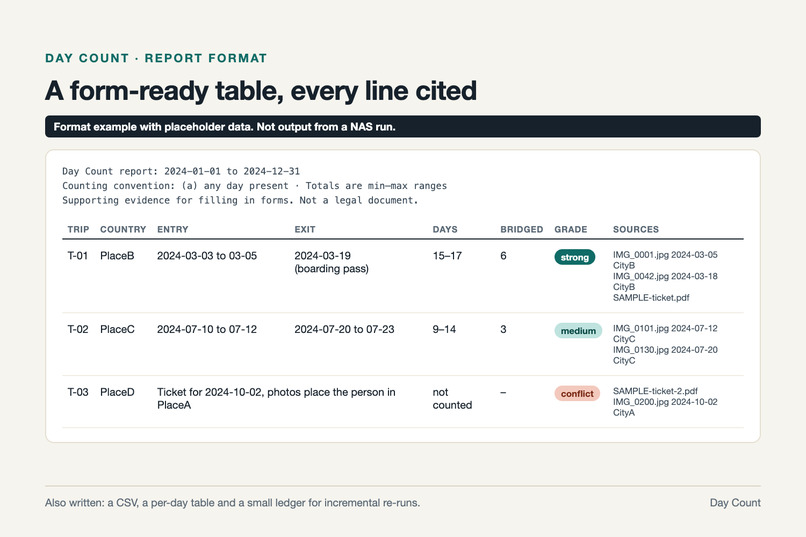
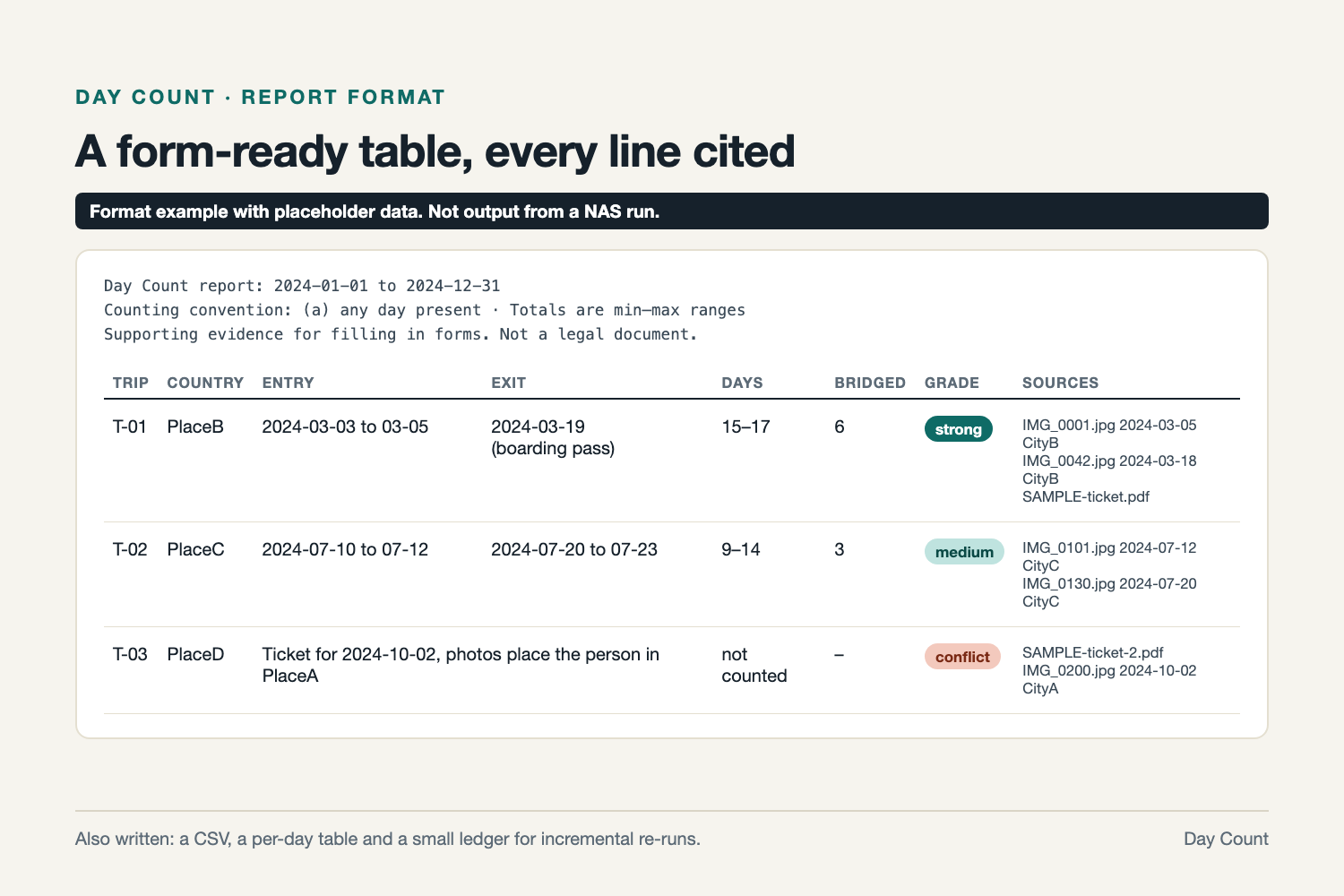
Format example with placeholder data.
-
-
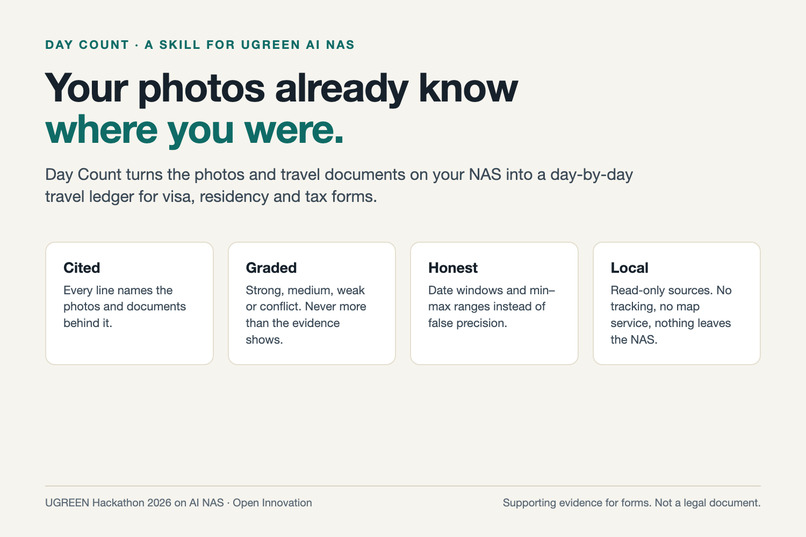
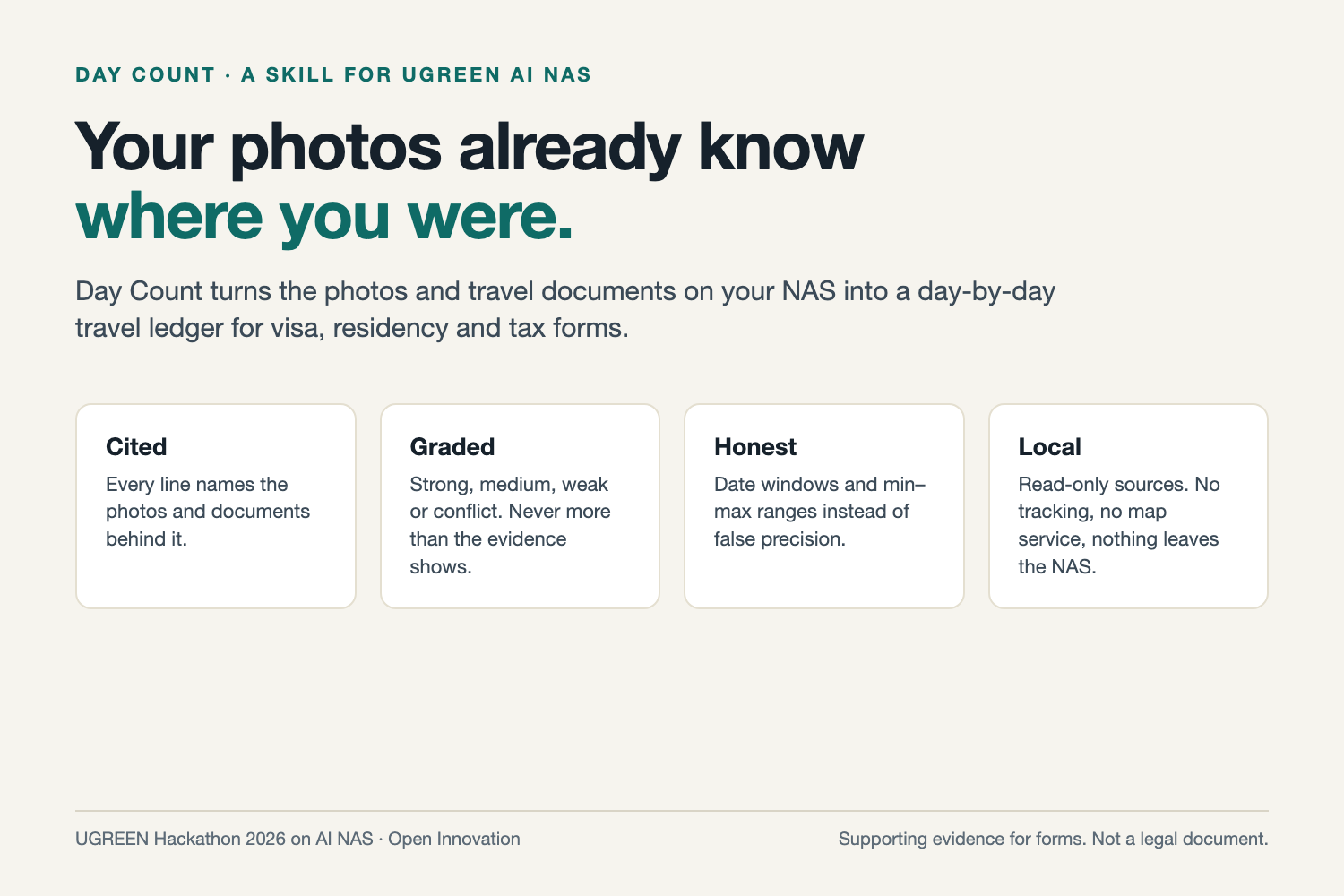
Your photos already know where you were, with the four selling points (cited, graded, honest, local)
-
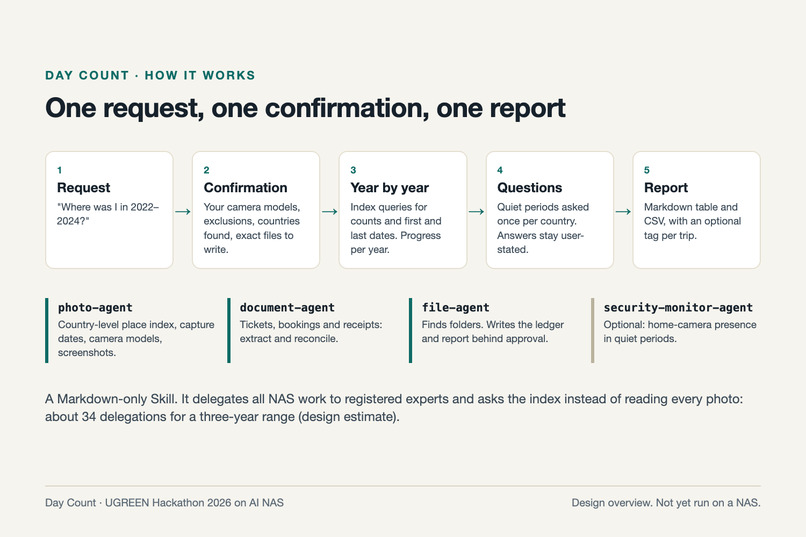
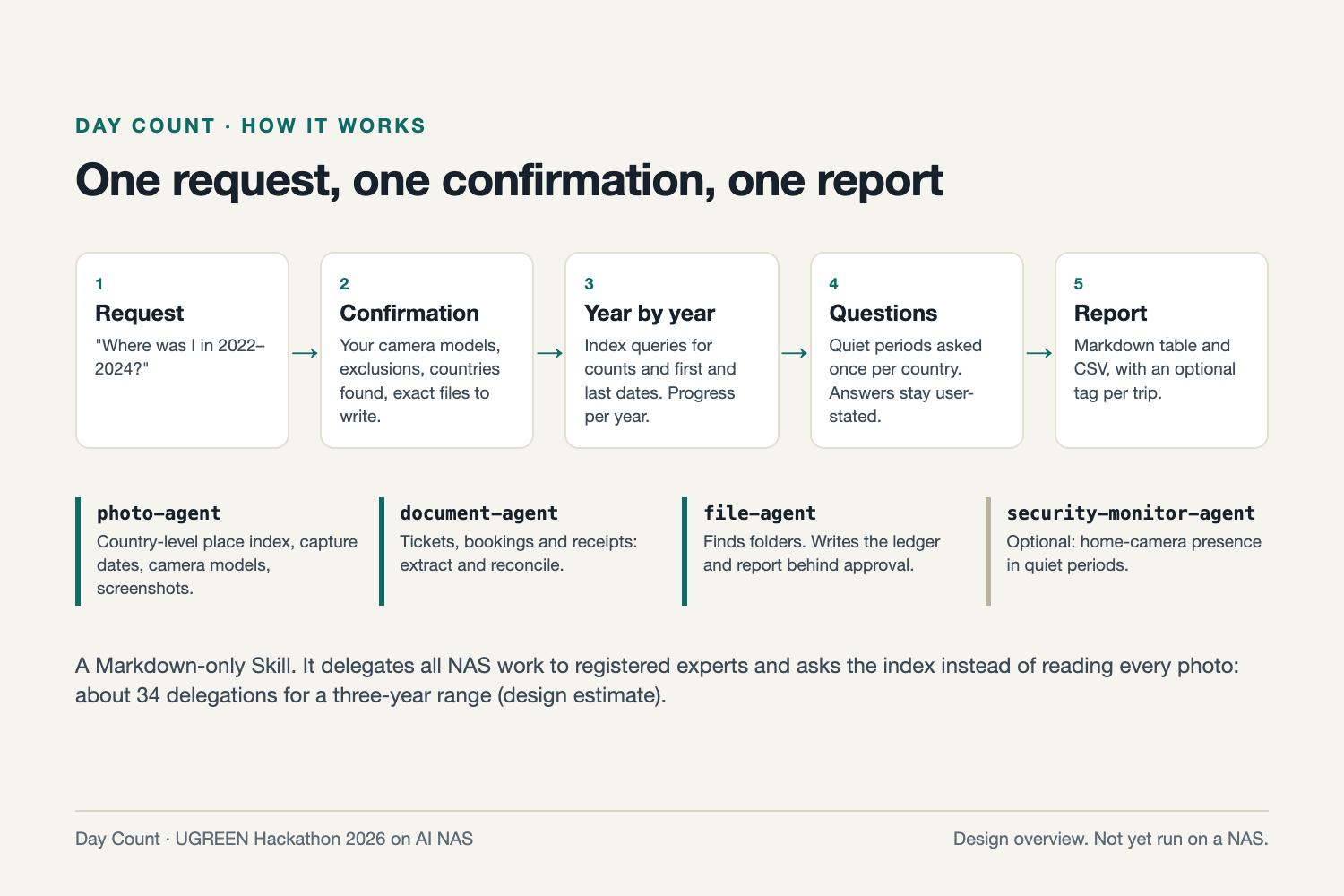
Design overview.
Inspiration
Visa, residency, citizenship and tax forms ask the same hard question: where were you, on which days, for the last several years? People answer it by digging through passport stamps and old emails, and a wrong date can delay an application. Location-history apps only help if tracking was switched on, and day-count calculators need every trip typed in.
The answer is usually already sitting on the NAS. Every phone photo carries a capture date and a place, and tickets and hotel bookings are in a documents folder. Nobody had joined them up.
What it does
Day Count builds an evidence-backed travel ledger for one person and one date range, from the photos and travel documents already on a UGREEN AI NAS.
- Trip list: country, entry and exit dates, days, and the photos and documents behind each line.
- Days per country per year, with a configurable year start. Rolling-window (for example 90 days in any 180) and long-absence checks on request.
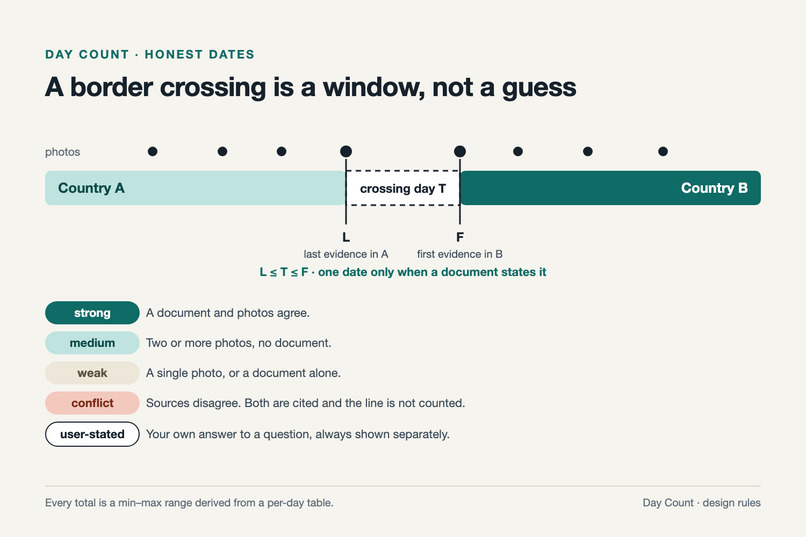
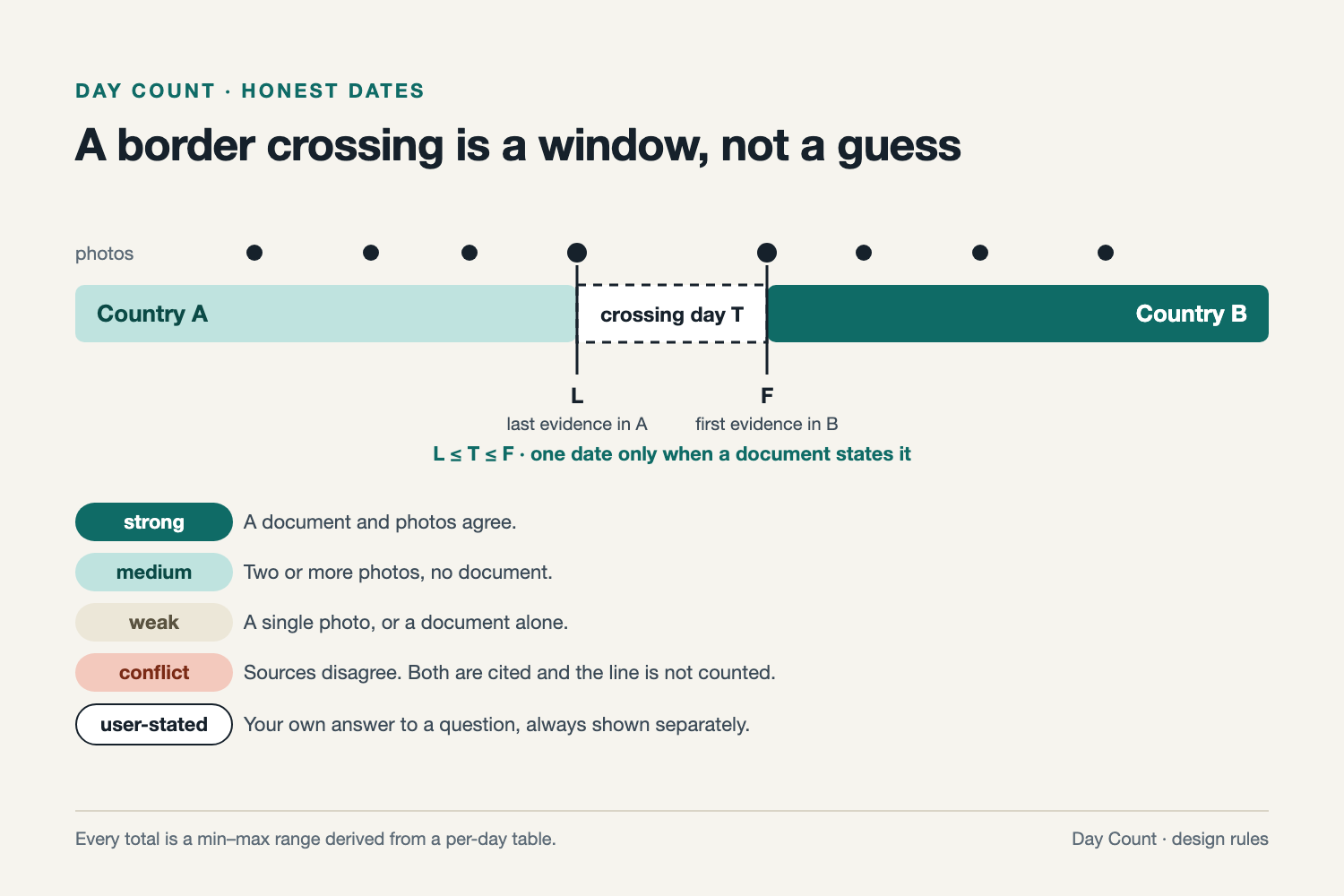
- Honest dates: an entry or exit is a window between the last evidence in one country and the first in the next. It becomes a single date only when a document states it. Every total is a min–max range.
- Graded evidence: strong (document plus photos), medium (photos only), weak (single photo), conflict (sources disagree).
- Questions instead of guesses: a period with no evidence is asked about, and the answer is recorded as user-stated, separate from file evidence.
- Private: photos and documents are read-only, every write needs approval, and place names come from the NAS's own index with no map service.
Output is a form-ready Markdown table, a CSV, and an optional tag per trip.
Optional extras, each off by default and run only with the user's consent:
- Home-camera presence: the NAS's own security cameras confirm the dates the person was home during periods with no photos. No snapshots or clips are requested.
- Receipts and invoices as dated, located evidence, for people who take few photos.
- Photos you appear in, taken by other people's cameras, so children and partners can have a ledger too.
- Rule templates and days remaining: named checks such as 90/180 or a 183-day test, with numbers the user confirms, and the allowance left as a range.
- Region detail, household runs, an evidence pack, a translated report and an expense check.
How we built it
Day Count is a Markdown-only Skill built with the UGREEN Skill Developer Package. It runs no code of its own. It delegates to four registered experts:
photo-agentfor the country-level place index, camera models, screenshots and searches by country, device and capture datedocument-agentfor extracting and reconciling tickets, bookings and receiptsfile-agentfor finding folders and for writing the ledger, report and tags behind approvalsecurity-monitor-agentfor home-camera presence in quiet periods (optional)
The core ledger needs only the first three, and only photos. Documents and every extra add evidence; none of them can block it.
It asks the photo index for counts and first and last dates instead of reading every photo, so the work grows with the number of trips, not the number of photos: about 34 delegations for a three-year range, by our estimate.
At a border crossing from country A to B, with \(L\) the last evidence day in A and \(F\) the first in B, the crossing day \(T\) is only known to satisfy \(L \le T \le F\). Day Count keeps that uncertainty and reports ranges.
Every total comes from a per-day table, with one row per calendar day, and a self-check:
$$N_{\text{assigned}} + N_{\text{unknown}} = N_{\text{calendar days}}$$
A small ledger file stores settings, answers and per-month photo counts, so a re-run processes only what changed and never repeats a question.
Challenges we ran into
- No travel-document schema. The catalog has schemas for invoices and contracts, not boarding passes or hotel bookings. We made photos the core track, so the ledger is complete without documents, and documents only upgrade a line to strong.
- No compute capability. A Skill can only delegate, so the counting rules had to be exact enough to apply by hand, with the self-check as a guard.
- No way to list camera models or detect forwarded images. We filter by the user's own devices, and label the forwarded-image rule as a heuristic in every report.
- Two counting conventions. "Any day present" and the midnight rule give different answers on travel days and overnight flights. The user picks one and it is printed on every report.
- Mixing evidence of different strength. A camera sighting, a receipt and a face match are not equal to the person's own photo. Each carries its own label and a capped grade, so a reader can see what every line rests on.
- An unverified catalog. Every action is marked with unknown stability, so each assumption is listed as pending NAS validation.
Accomplishments that we're proud of
- The official checker reports static-pass with 0 errors and 0 warnings.
- All 13 product requirements map to real catalog capabilities; none is unsupported.
- The Skill never states more than the evidence supports: windows, ranges, grades and a visible user-stated section.
- It uses four capability domains of the NAS together (photos, documents, files and monitoring) for one user need.
- A complete test plan: a synthetic three-year library with a ground-truth ledger, two core tests and an edge case (a silent period, a ticket for a flight never taken, a forwarded photo from another country).
What we learned
- Designing from the capability catalog first saved us from building on features that do not exist.
- For evidence used on official forms, an honest range is worth more than a confident single number.
- Asking the index the right question is cheaper than reading the data: first date, last date and count are enough to place a trip.
- Approval and privacy rules are easier to keep when they are part of the conversation design from the first message.
What's next for Day Count
Nothing has run on a NAS yet, and we say so plainly. Next:
- Build the synthetic test library and run the three test cases on a UGREEN AI NAS.
- Validate the ten core items, starting with the place index and photo search behaviour.
- Validate the six optional-extra items once the core passes.
- Measure real delegation counts and tune the batching.
