-

DartDavis Logo
-
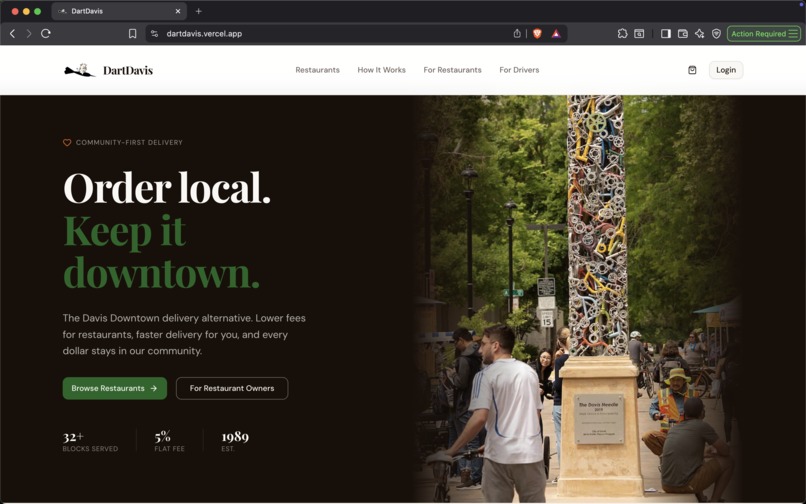
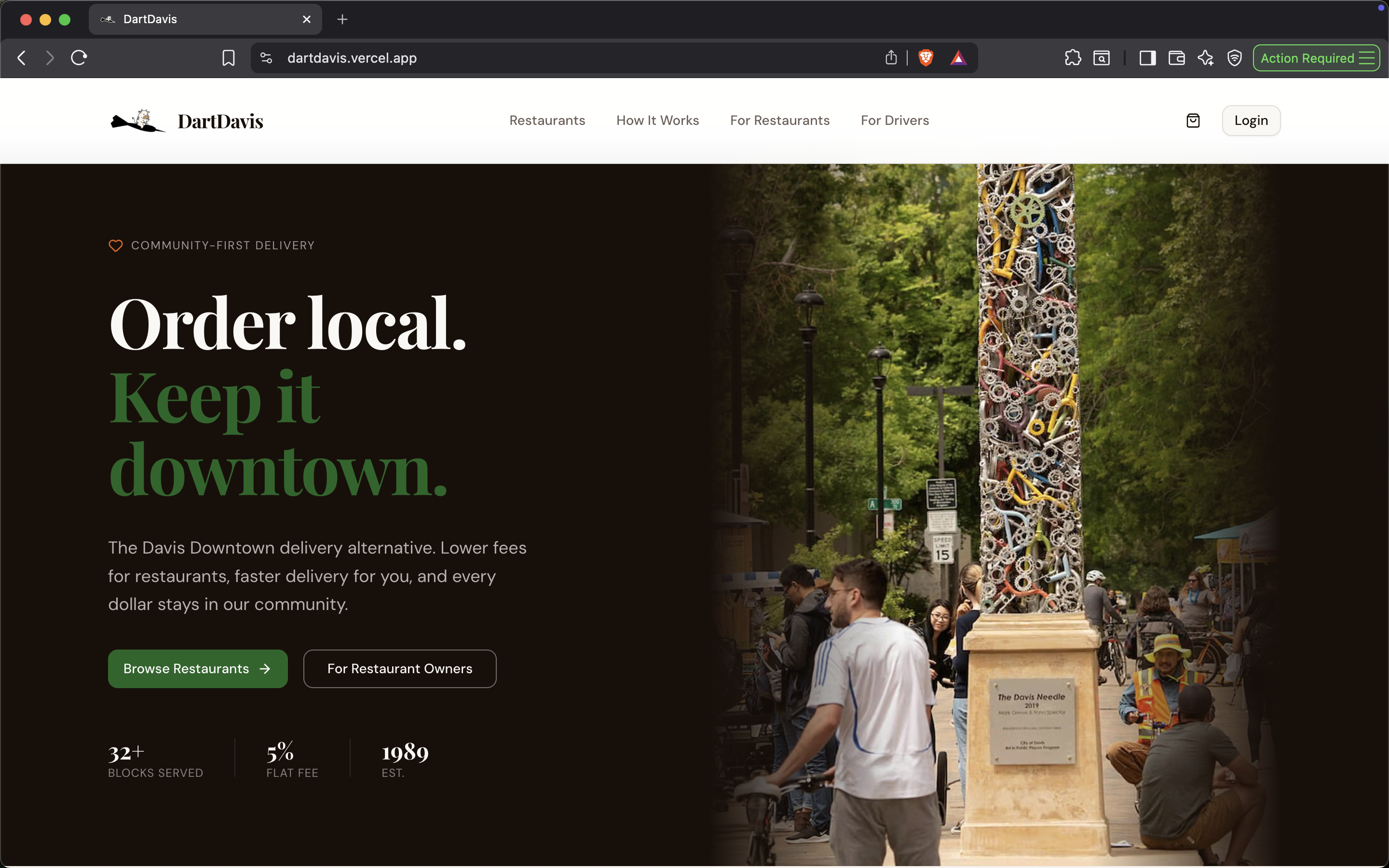
Landing page

Inspiration
DoorDash, but niche.
The problem statement we chose was that many local businesses struggle with DoorDash delivery fees. Our solution was to create a nonprofit local alternative similar to established food delivery apps, except revenue would be focused into paying the local business and the drivers, with a minimal cut going towards the service fees we provide.
What it does
DartDavis partners with nonprofit, Downtown Davis Business Association, to provide an alternative food delivery service that keeps more money in the hands of local businesses and out of large-scale national corporations For Restaurants: 0% commission on all orders. For Customers: Accurate in-store pricing with a transparent fee structure. For Riders: Price-based, flat-fee model: ($2.50 for orders $10 or less, $5.00 for orders more than $10 and less than $30, $7.50 for orders more than $30). No waitlist. 18+ age requirement. Targeted towards students.
How we built it
To build out the website, we used V0 to prototype frontend Next.js for overall framework Resend for notifications Supabase for database & authentication Stripe to handle payments Google Reviews API for star ratings Claude code, VSCode chat for coding Git & github for version control & collaboration
With it being the first time for both of us creating a Next.js app for production, we did a lot learning along the way. We described to Claude our overall idea and what features we wanted specifically and had it create for us a step by step tutorial that we could follow. With that, we were able to lay the foundations – exporting the V0 frontend, setting up Supabase and the database schema, and getting all our needed API keys. Similarly, it was also the first time for both of us in using git to collaborate on a project, but the plan generated by Claude also guided us through that, and we were branching and merging pretty seamlessly for the most part, apart from a couple times we had to hard reset.
Challenges we ran into
The first challenge we ran into was thinking about “how do we incentivize businesses, delivery drivers, and customers to use our local alternative vs the established ones?” To incentivize businesses: Established food delivery services have to take a cut to go towards service fees, paying drivers, and profit. And usually, businesses don’t get 100% of the order cost. With DartDavis, being a nonprofit, we would only have to markup for service fees and paying drivers. To incentivize delivery drivers: Davis is a small college town described as tight knit. So locals and students of this community would naturally want to help support local businesses by allowing them more revenue through a local food delivery alternative.
To incentivize customers: Same reason that motivates delivery drivers.
Challenges beyond that were more technical, including getting used to the git workflow, getting API keys to work in production, debugging build & runtime logs, and interface design questions such as “should we follow doordash’s delivery dispatch algorithm or let driver’s choose?”
Accomplishments that we're proud of
We’re proud of successfully implementing and connecting all the API’s and services together, especially the Stripe integration, email notification system, and Google Review visibility. We’re also proud of making the customer order creation as frictionless as possible, skipping account creation in favor of a contact-based order tracking system.
What we learned
Git workflow Branching, merge conflicts, pull requests Don’t try to oneshot prompts, break down a feature you’re trying to build, implement incrementally, and test often Got more comfortable w/ Next.js routing, APIs, API integration Stripe Google Supabase & postgresql
What's next for DartDavis
Further implementation will include: Age Verification: riders will need to provide a valid california ID or drivers license in order to start delivering Marketing: get customers and riders by putting adverts across school campus Point System: rewards customers who use DartDavis, increasing engagement & retention. In-app Discounts: Since local businesses would be earning more from DartDavis than other established food delivery services, these businesses are incentivized & able to do so. Seamless restaurant onboarding: Use computer vision or webscraping to scan existing menus and import data into Dart Restaurants can customize their menu page on DartDavis
Built With
- google-places
- next.js
- react
- resend
- stripe
- supabase
- vercel


Log in or sign up for Devpost to join the conversation.