-
Prototype
Inspiration
Financial information is everywhere, but understanding what it means for your own goals remains difficult. A promising investment for someone pursuing long-term growth may be unsuitable for someone approaching retirement.
We built AlphaForge AI around a simple question: How can an investor understand whether a decision fits their goals—and verify the reasoning behind it?
The challenge’s three personas—Amira, Mateo, and Robert—inspired us to consider different risk tolerances, investment horizons, and personal preferences. We wanted our system to recognize those differences and question requests that conflict with them.
What it does
AlphaForge AI is an explainable investment-analysis simulator. Users explore fictional portfolios and ask questions about assets, diversification, financial news, and investment decisions.
The application:
- Compares 31 assets against an investor’s profile using a transparent fit score.
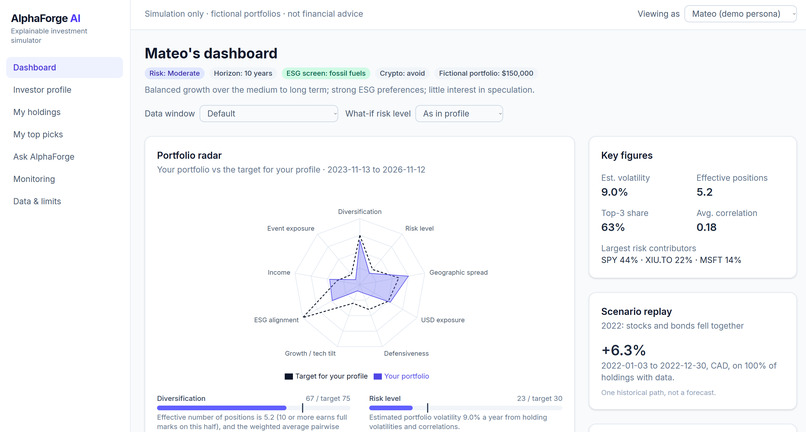
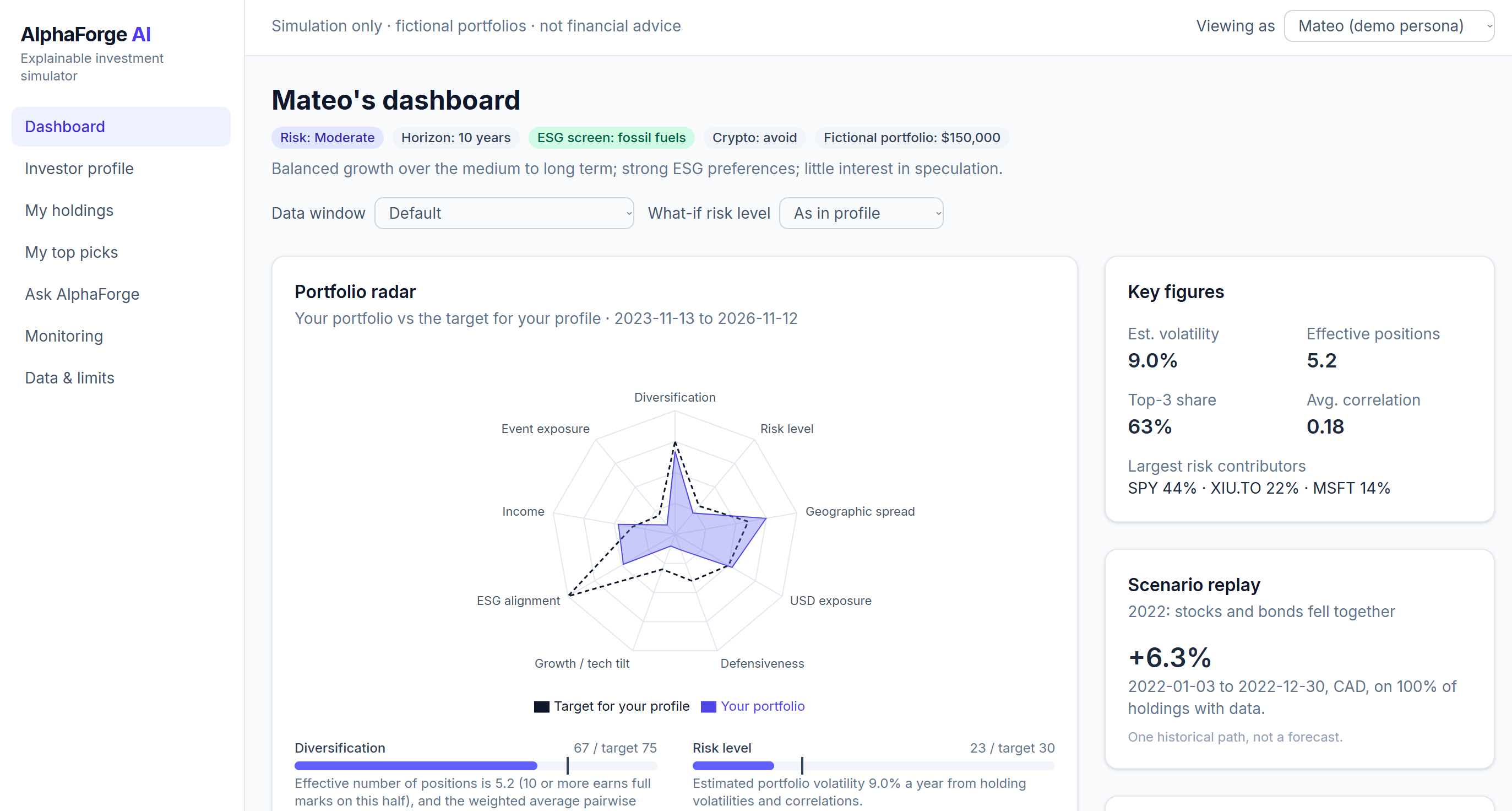
- Visualizes portfolio characteristics against profile targets.
- Checks proposed allocations against risk limits and preferences.
- Replays historical stress scenarios.
- Connects relevant news and filings to asset analysis.
- Presents evidence, sources, assumptions, and limitations alongside its answers.
For example, when Robert asks about putting 30% of his portfolio into Tesla, AlphaForge examines the tension between that request and his goal of preserving capital.
How we built it
We built the interface with React, Vite, Tailwind CSS, and Recharts, supported by a Python backend.
Our data pipeline processes the provided market dataset, aligns trading calendars, converts returns into Canadian dollars, and calculates portfolio and asset indicators. Optional ingestion modules collect market updates, SEC filings, central-bank releases, and headlines from selected publishers.
For conversational analysis, we connected the backend to Amazon Bedrock AgentCore. The agent can request portfolio information, retrieve evidence, and call analytical tools. Python performs the financial calculations, while the model explains their relevance.
The application also includes a local rules-based mode for development and testing. This helped us validate the analytical workflow independently of cloud access.
Challenges we faced
Making data comparable. Canadian equities, U.S. equities, and cryptocurrencies have different trading calendars and currencies. We had to make those processing choices explicit.
Keeping explanations grounded. Fluent text can sound convincing without sufficient evidence. We added source references, tool traces, and checks that flag numerical claims unmatched to tool outputs.
Separating association from causation. A headline appearing near a price movement does not prove it caused that movement. Our explanations distinguish observed events from possible mechanisms.
Configuring AWS access. We encountered model-activation and IAM restrictions even when the agent infrastructure reported itself ready. This taught us to test the entire request path, including the model invocation.
What we learned
We learned that useful financial AI depends on reliable data, reproducible calculations, and clear communication of uncertainty.
We also learned that personalization requires more than changing an answer’s tone. Different goals should influence the constraints checked, the evidence selected, and the trade-offs explained.
What’s next
We want to expand ETF holdings analysis, improve event-to-portfolio explanations, complete production authentication, and evaluate responses across more investor scenarios.
Our goal is to help users understand the evidence and consequences behind a decision. AlphaForge remains a simulation tool: it uses fictional portfolios and executes no real trades.
Built With
- amazon-bedrock
- amazon-bedrock-agentcore
- amazon-web-services
- aws-iam
- javascript
- kiro
- python
- react
- recharts
- tailwind-css
- vite

