-
-
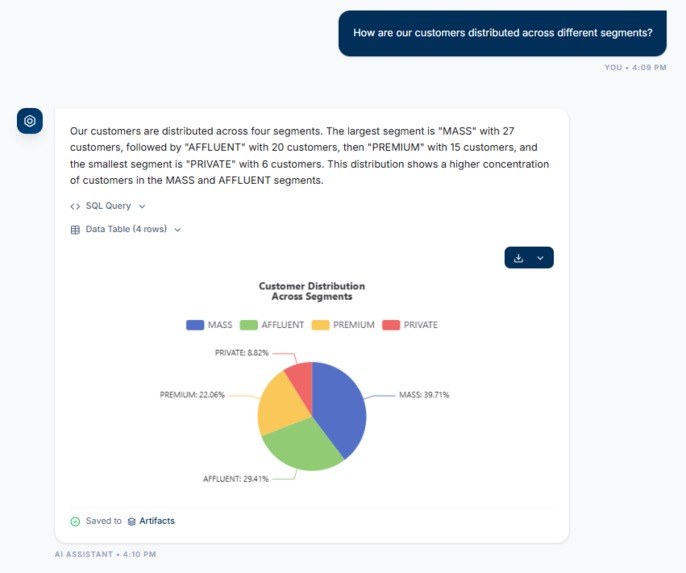
Automatic Chart Selection & Multiple Visualizations
-
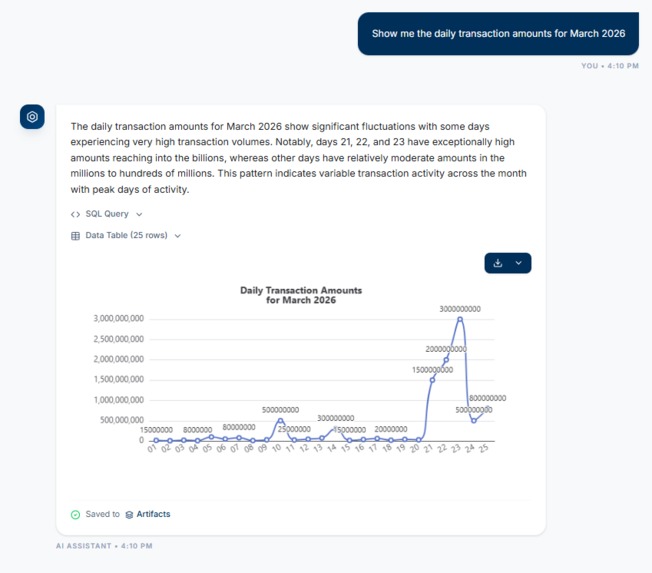
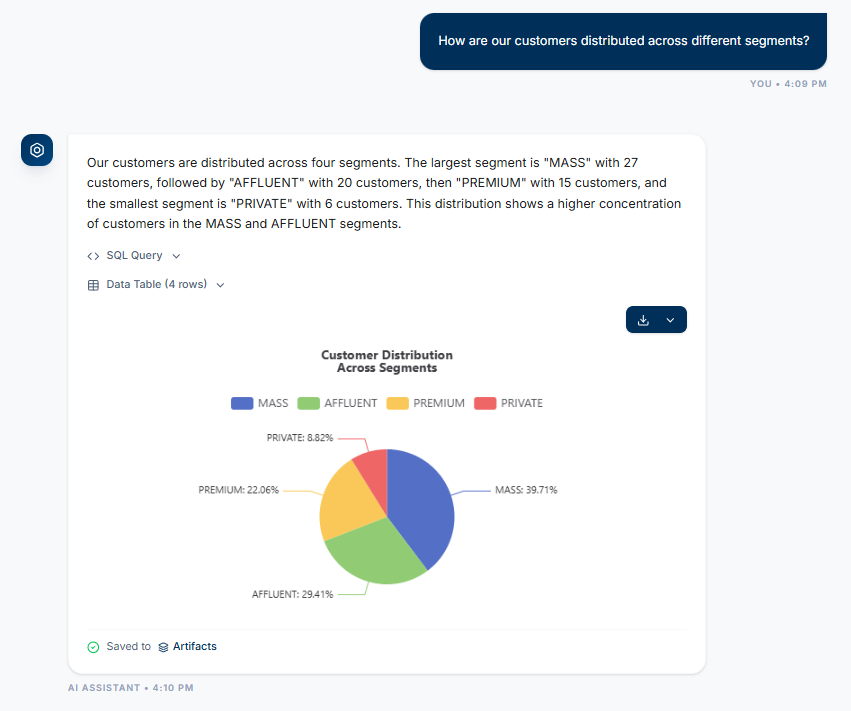
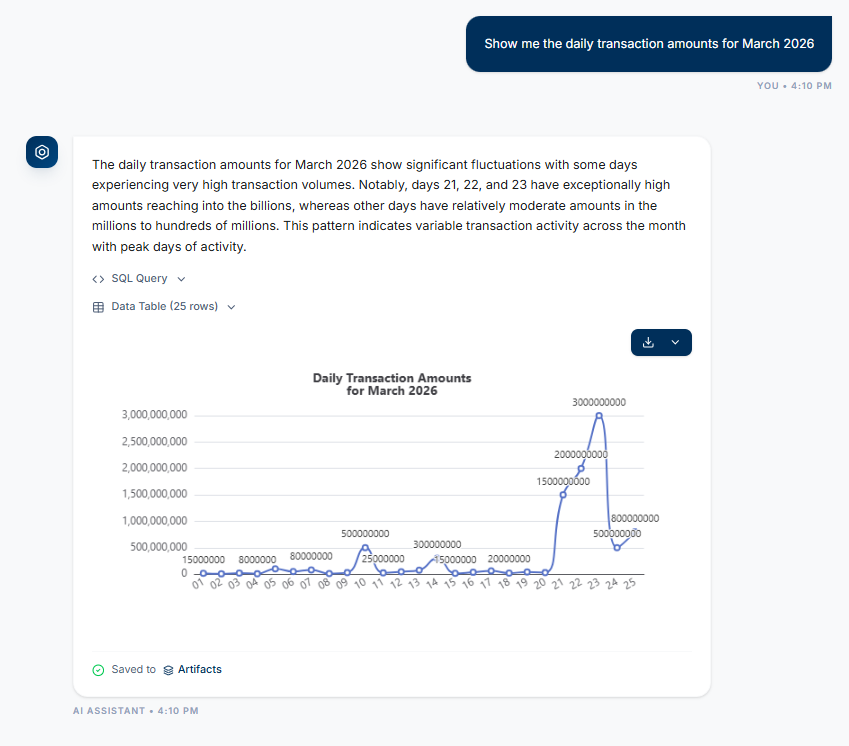
DatAsk automatically selects the most suitable chart and supports multiple chart types.
-
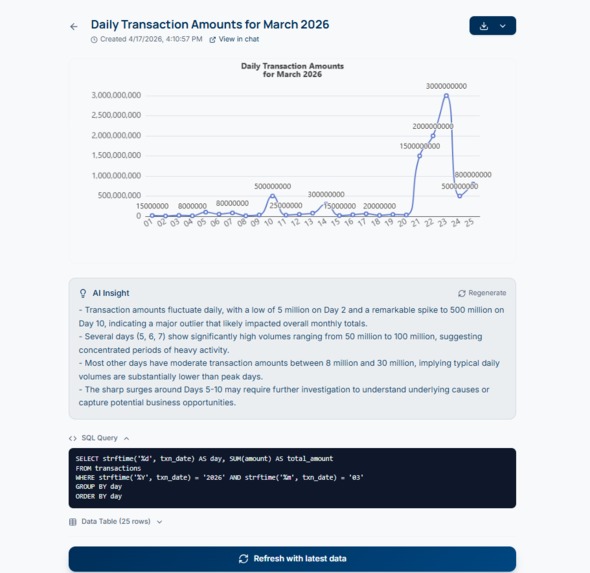
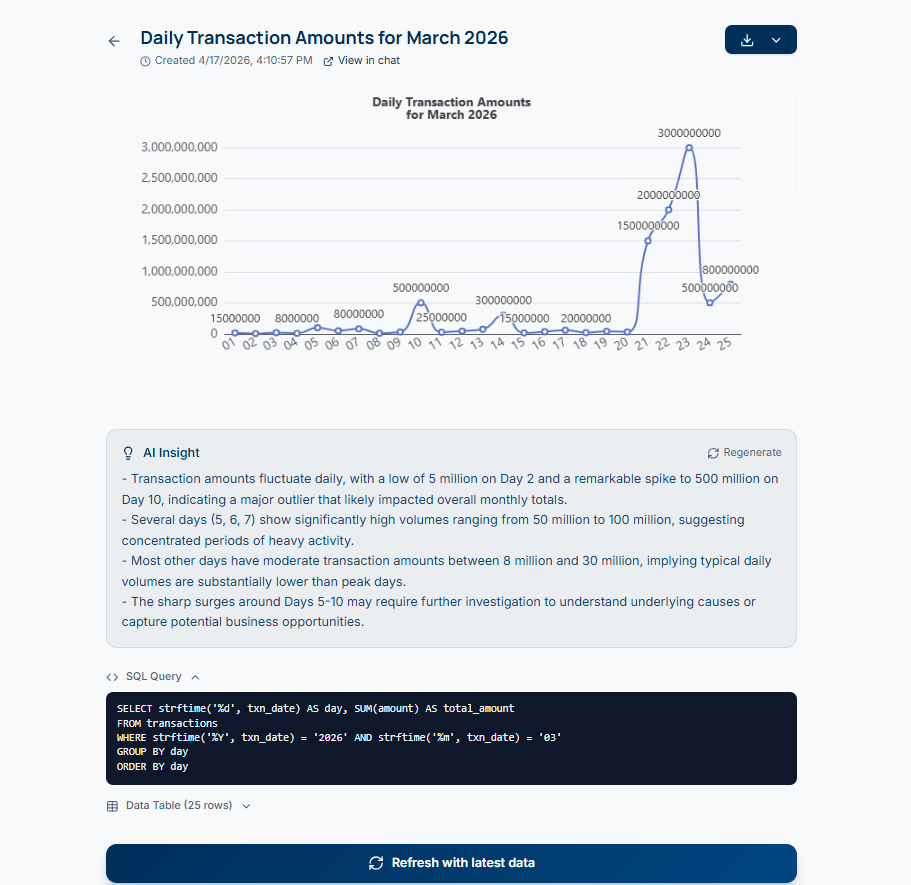
AI Insights for the Chart
-
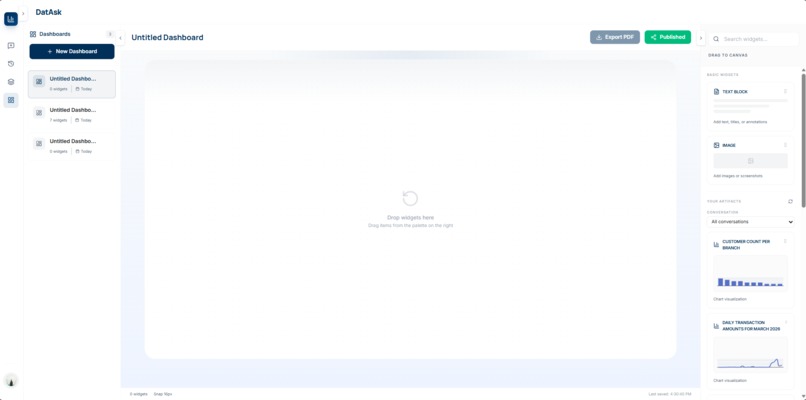
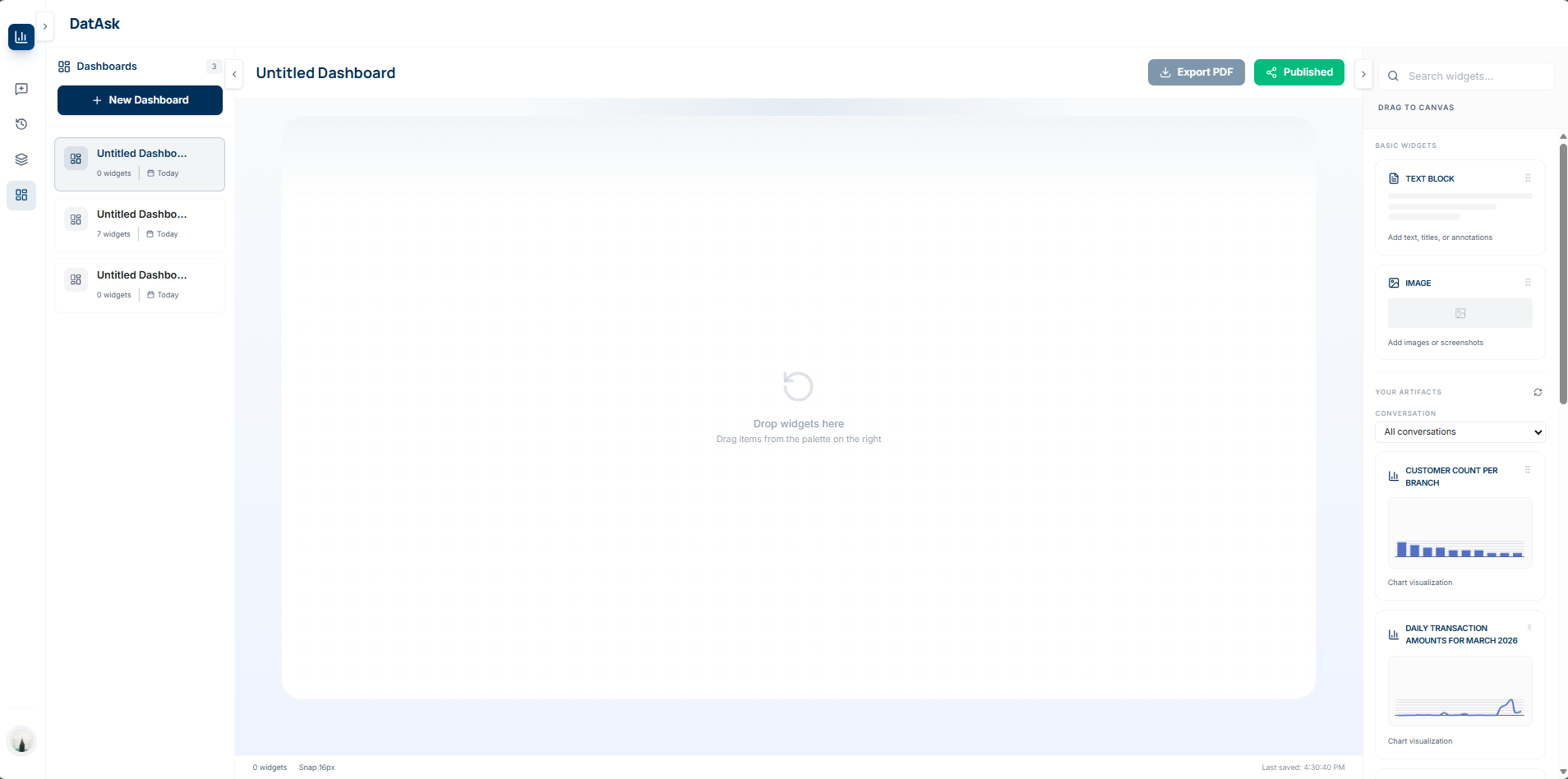
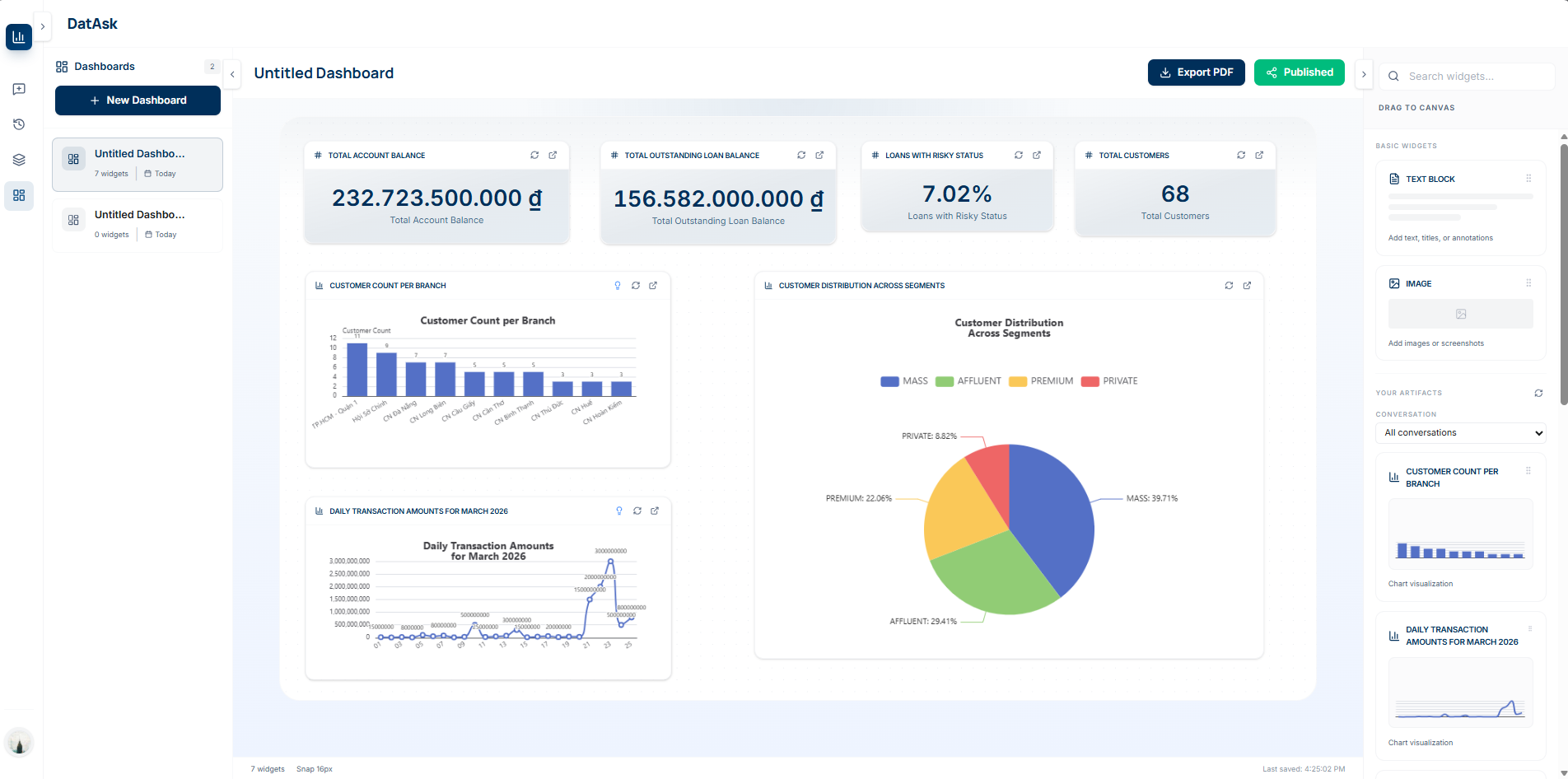
Flexible Dashboard Customization
-
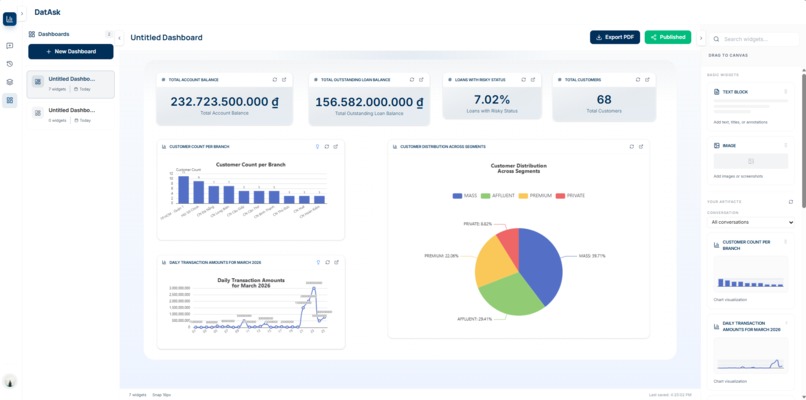
Custom Dashboard Example (DatAsk)
-
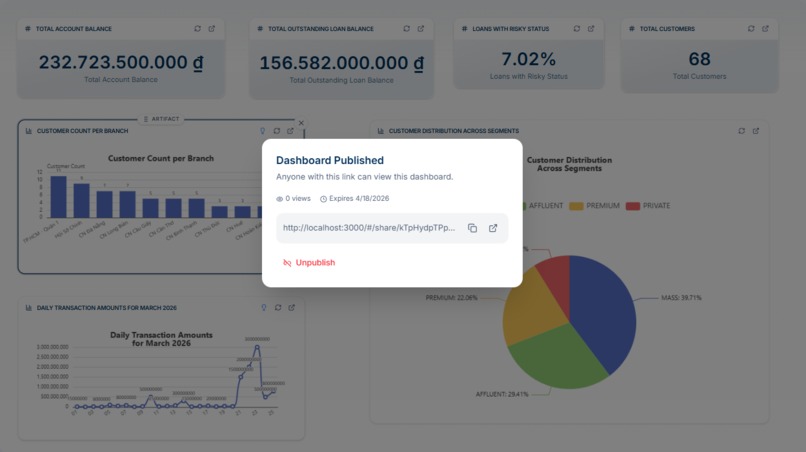
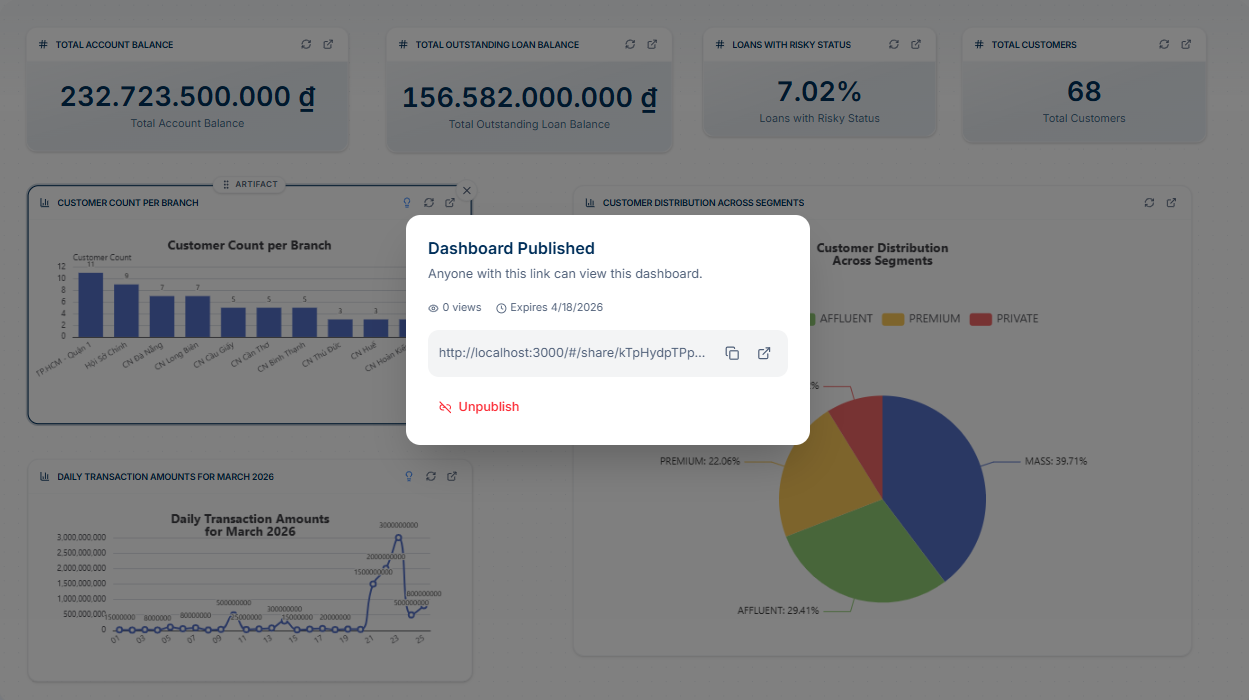
One-Click Dashboard Publishing
-
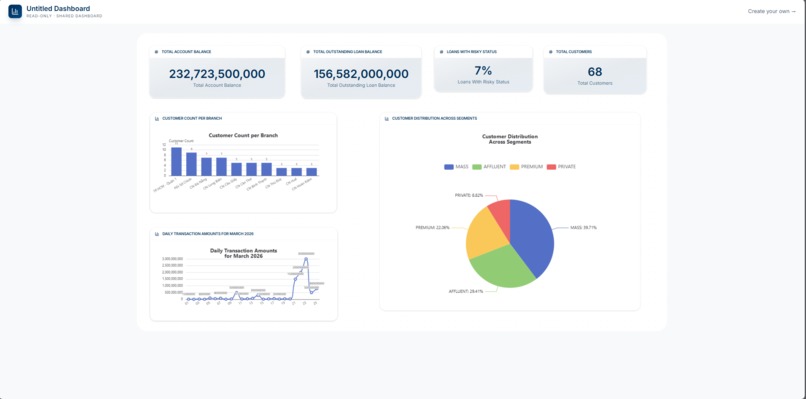
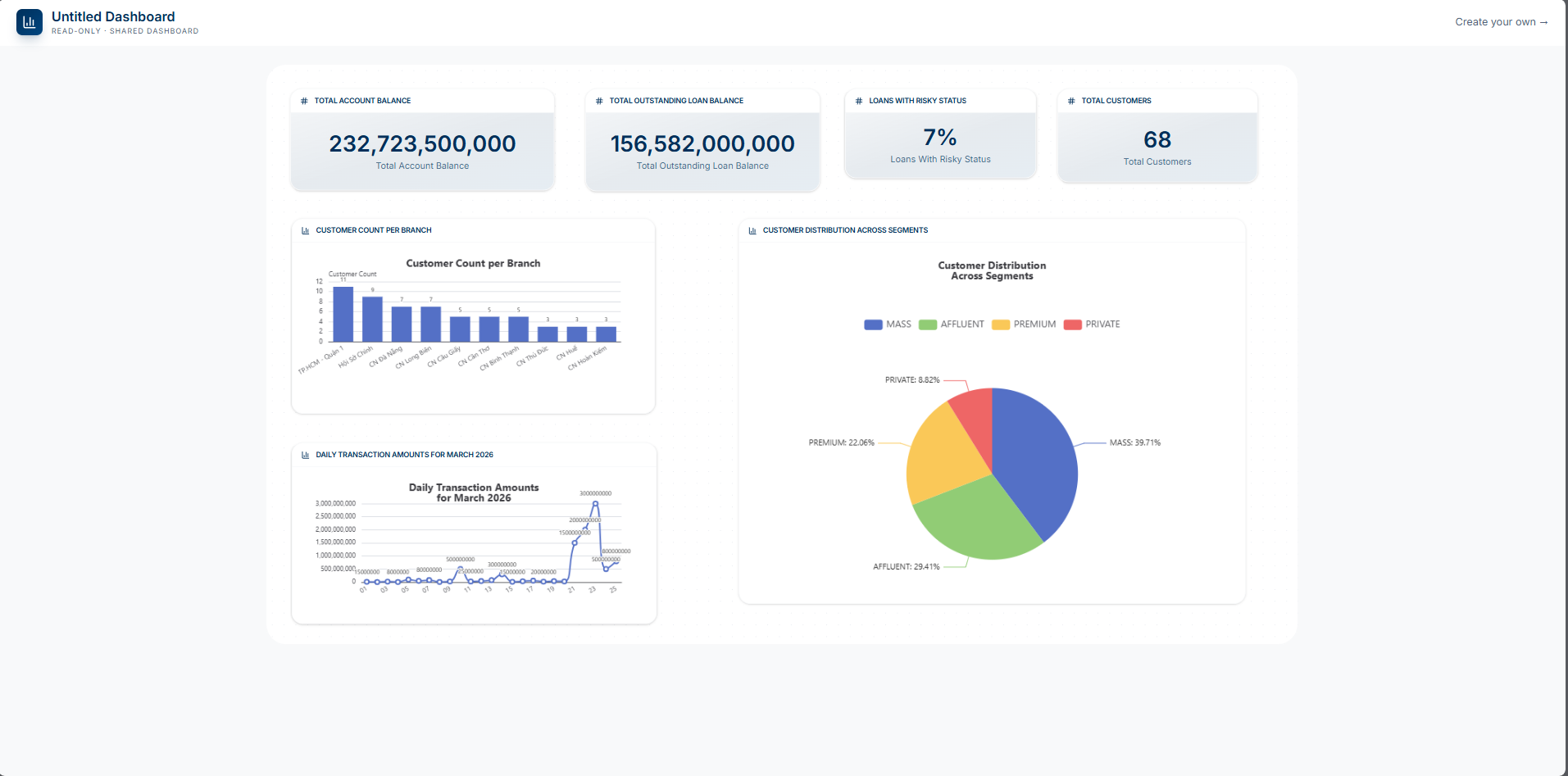
Shareable Public Dashboard
-
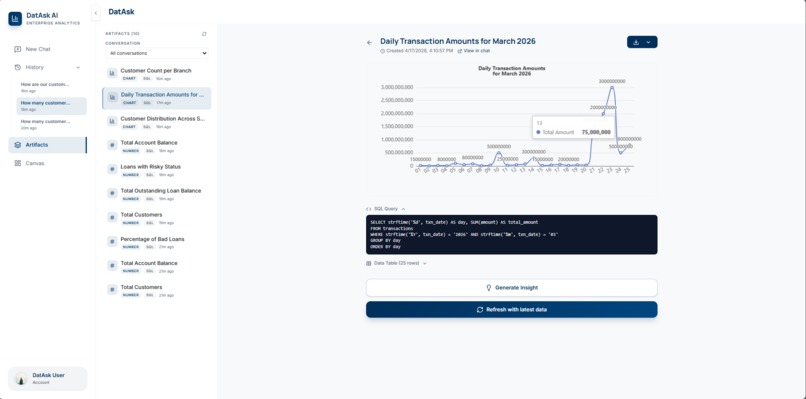
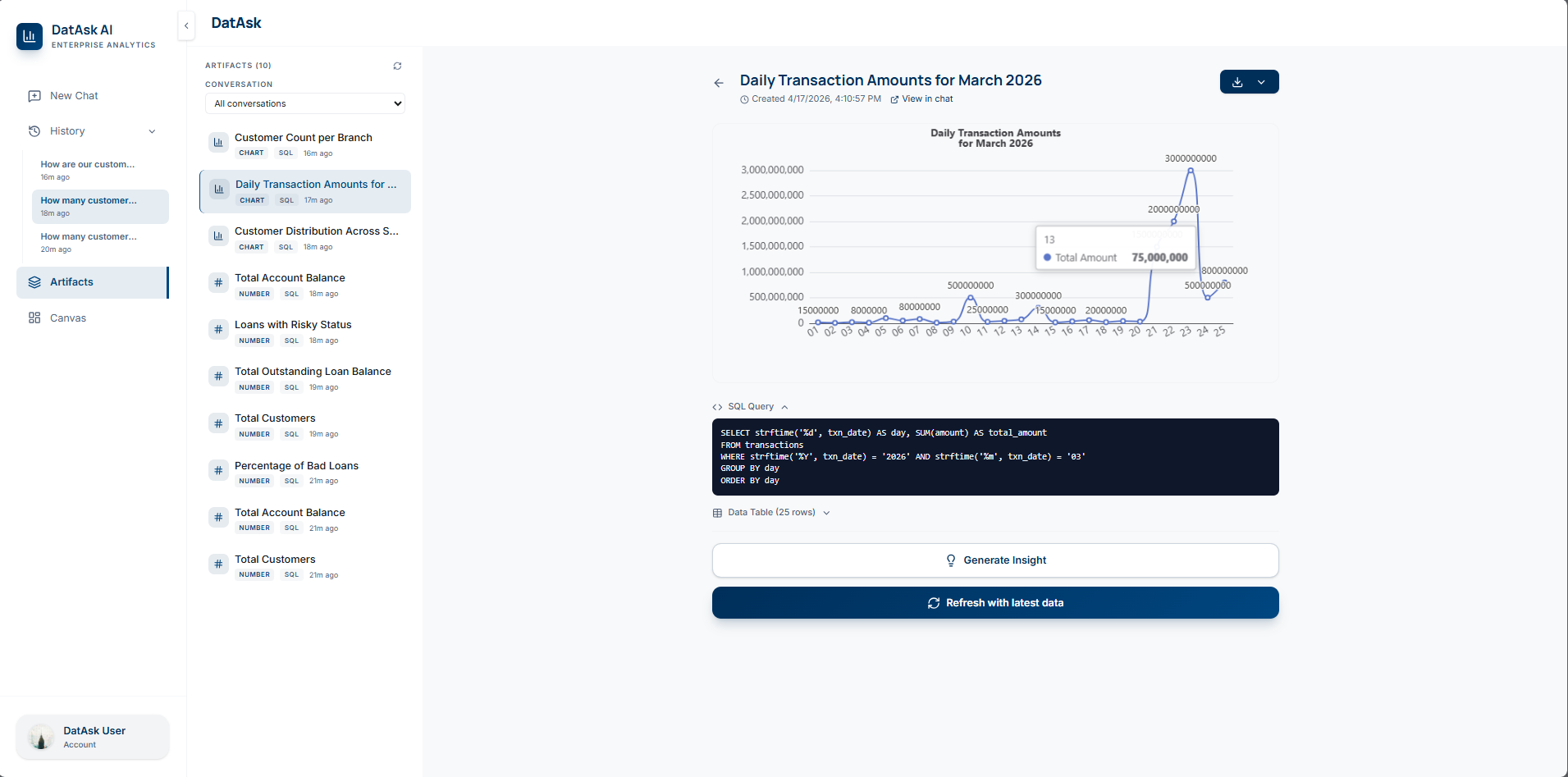
Transparent SQL & Data Access
DatAsk — AI for Internal Reporting & BI
Inspiration
In every enterprise, managers are making decisions without data. Not because the data doesn't exist — it's sitting in the warehouse — but because nobody has time to pull it out.
A branch manager needs yesterday's transaction numbers for the 9am meeting. They email the ICT reporting team. By 2pm the report arrives. But the meeting ended at 10am, and the decision was already made on a gut estimate. Multiply this by hundreds of ad-hoc requests every week and you get two painful realities: an ICT team drowning in MIS tickets, and business leaders running the bank on stale data.
Meanwhile, Power BI and Tableau exist — but they require IT to model the data, business users to learn DAX, and a drag-and-drop ritual just to answer a simple question. For the 99% of employees who aren't analysts, self-service BI has been a promise, never a reality.
We set out to build something different: a BI layer that speaks natural language, in Vietnamese, with the auditability and governance a bank actually needs. No dashboards to configure. No DAX. Just ask.
What We Built
DatAsk is a fully AI-powered self-service BI platform featuring:
- Conversational Query — Ask any question in natural Vietnamese or English; Qwen3-Max generates schema-aware SQL and returns the answer in seconds
- Auto-rendered charts — The right visualization (bar, line, pie, number) is picked automatically based on the shape of the data
- Artifact Dashboard — Every answer is saved as a reusable artifact; drag and drop them onto a canvas to compose a dashboard in minutes
- One-click Publish & Share — Generate a time-bound, read-only link so colleagues can view dashboards without logging in
- Human-in-the-loop governance — Generated SQL is always visible, raw data is always shown, AI narrative insights are explicitly labeled and manually triggered
Prompt-to-Dashboard: Empowering Non-Technical Users
The game-changer of our solution: anyone can build a dashboard without touching a single field mapping, DAX formula, or query builder.
A branch manager simply types:
"Show me total transactions by day for March 2026, and highlight the branches with the biggest month-over-month growth."
Qwen3-Max instantly:
- Inspects the connected schema (customers, transactions, branches, products)
- Generates a complete SQL query — joins, aggregations, window functions, all correct
- Executes the query against the read-only data warehouse
- Picks the optimal chart type (bar chart for time series, horizontal bar for ranking)
- Writes a plain-language AI Insight summarizing what the chart shows
- Saves everything as an Artifact — re-runnable, auditable, shareable
The user can then drag the artifact onto the Dashboard Canvas next to other saved answers, resize widgets, hit Publish, and send a link. From "I have a question" to "my team has a live dashboard" — under 5 minutes.
Why this matters for banks and enterprises
- Zero engineering cost per report — Every department gets self-service analytics without adding BI headcount
- Business teams own their dashboards — No waiting for IT, no developer bottlenecks, no prioritization queues
- Rapid iteration — Test a new metric definition in 10 seconds, not a two-week BI sprint
- Consistency across branches — Same AI, same SQL patterns, same interpretation — every query, every branch, every time
- ICT is promoted, not replaced — The reporting team stops writing repetitive MIS queries and becomes the Data Governance team — owning schema, access controls, and semantic validation
Powered by Qwen3-Max & Alibaba Cloud
Our solution is built entirely on the Alibaba Cloud AI ecosystem, with Qwen3-Max as the single AI engine powering every capability end-to-end.
Qwen3-Max — The Core AI Engine
Qwen3-Max via DashScope drives every step of the DatAsk experience:
- Schema-aware SQL generation — Reads the database schema, foreign keys, and column descriptions before generating each query; understands Vietnamese column names and business terms without translation
- Complex joins and aggregations — Handles multi-table joins, window functions, CTEs, and nested subqueries reliably — the benchmark top-tier performance on the Spider text-to-SQL dataset translates directly to real enterprise workloads
- Self-correction loop — When generated SQL fails validation or returns an error, Qwen3-Max retries with the error message as context, pushing end-to-end accuracy above 90%
- Chart-type selection — Classifies every result and picks the right visualization (bar, line, pie, grouped bar, area, number) automatically based on the shape of the data
- Cross-language query handling — An English-speaking regional manager and a Vietnamese branch manager can ask the same question in their own language and get the same underlying answer, with banking-aware handling of product names, regulatory terms, and Vietnamese financial jargon
- Natural-language insight generation — After the chart renders, Qwen3-Max (manually triggered) writes a short plain-language interpretation, labeled clearly as AI-generated so users never confuse it with a validated metric
- Prompt-to-flow compilation — Transforms the user's intent into a structured plan that can be audited, saved, and replayed with fresh data
DashScope — The Unified AI Endpoint
All Qwen3-Max calls go through DashScope with a single unified contract:
- One endpoint, one model — All reasoning, classification, translation, and insight generation handled by Qwen3-Max with the same auth and the same billing
- Asia-Pacific latency — Regional endpoints keep round-trip time low enough for interactive use
- Predictable unit economics — ~$0.002–0.008 per query vs. ~$15–20 internal cost per manual MIS request — a 2,000× efficiency gain
Alibaba Cloud — The Complete AI Infrastructure
DatAsk runs entirely on Alibaba Cloud, providing enterprise-grade reliability and the compliance posture a bank actually needs.
| Service | Role in Our Solution |
|---|---|
| DashScope | Powers Qwen3-Max for text-to-SQL, chart classification, translation, and insight generation |
| RDS for MySQL | Read-only data warehouse mirror — where every generated SQL query actually runs |
| Function Compute | Stateless SQL execution, chart rendering pre-processing, and artifact save/fetch endpoints |
| Object Storage Service (OSS) | Stores published dashboard snapshots, exported PDFs, and cached chart images |
| API Gateway | Rate-limiting, authentication, and request routing for the DatAsk web app and embedded share links |
| ECS | Web application servers in the Asia-Pacific region (low latency to Vietnam) |
| Cloud Monitor | Tracks SQL error rate, Qwen retry rate, and end-to-end accuracy — feeds the governance dashboard |
Why Alibaba Cloud?
- Unified AI + data ecosystem — Qwen models, RDS, Function Compute, and OSS all live in one VPC with native IAM — no cross-cloud glue, no egress surprises
- Southeast Asia presence — Bangkok and Singapore regions keep latency under 50ms for Vietnamese users
- Enterprise compliance — Data residency, encryption at rest and in transit, audit logs, and role-based access meet banking security requirements out of the box
- Cost efficiency — Pay-per-use AI inference plus auto-scaling Function Compute means we only pay for actual query volume — no idle BI licenses
Challenges We Faced
Schema understanding in Vietnamese
Enterprise data warehouses in Vietnam mix English and Vietnamese freely — table names in English, column names in snake_case English, but business descriptions, enumerated values, and reference data often in Vietnamese. Getting the SQL generator to reason across both was non-trivial. Qwen3-Max handles this natively without a translation step, but we still had to invest in a clean schema-description layer that feeds context to every prompt.
Governance for a black-box model
Banks cannot ship answers to executives when the reasoning is hidden. "Trust me, the AI said so" is not an audit trail. We solved this by making every intermediate artifact — the generated SQL, the raw row-level data, the chart, and the AI insight — visible and labeled. The user can audit any of them before sharing.
Avoiding stale-data risk
BI tools traditionally cache heavily, which is dangerous when the underlying data is moving. DatAsk enforces a re-run, never cache policy for published dashboards — every "Refresh with latest data" click re-executes the SQL against the source. Caching only happens at the artifact metadata level, never at the numbers level.
Interactive latency
For a conversational interface to feel natural, the full loop — parse → generate SQL → execute → pick chart → render — has to complete in under 10 seconds for most queries. We hit that by parallelizing the Qwen3-Max chart classification with the SQL execution, and by keeping Function Compute warm for the hot path.
What We Learned
- Qwen3-Max is production-grade for text-to-SQL. Schema-aware prompts plus the self-correction loop get us above 90% accuracy on real enterprise queries — high enough to be useful, with the governance layer catching the rest.
- Qwen3-Max's speed changes the UX. Fast chart classification lets us render results before the user has finished reading the answer.
- The Alibaba Cloud ecosystem is genuinely cohesive. DashScope, RDS, Function Compute, OSS, and API Gateway fit together without custom glue — we shipped the full stack in weeks, not quarters.
- Governance is the wedge, not the blocker. Banks don't buy AI BI because it's magical; they buy it because every SQL query is visible, every number is auditable, and no insight is ever auto-published.
- Self-service adoption is a human problem, not a tech problem. The moment we showed branch managers that they could ask a question in Vietnamese and get a chart back, we had to stop the demo — they wanted to start using it.
What's Next
Semantic Layer & Metric Governance
Today each SQL query is generated fresh from the schema. Next phase: a curated metric layer where business-critical definitions (e.g., "active customer", "NPL ratio", "month-over-month growth") are pre-defined and always reused — so "revenue" means the same thing in every department.
- Metric catalog — Business owners define a metric once; Qwen3-Max references it instead of regenerating
- Row-level security — Integrate with the bank's existing access model so branch managers only see their branch data
- Anomaly alerts — DatAsk monitors saved metrics and pings owners when numbers move outside expected bounds
Embedded Analytics & Slack / Teams Integration
Bring DatAsk to where the work happens:
- Slack / MS Teams bot — Ask "@datask what's today's transaction volume?" in any channel; get the chart inline
- Embedded widgets — Drop a DatAsk artifact into Notion, Confluence, or internal portals with a one-line embed
- Scheduled deliveries — "Send me yesterday's branch performance every morning at 7am" — delivered to email, Teams, or LINE
Proactive Insights & Forecasting
Move from reactive (user asks a question) to proactive (DatAsk surfaces things to pay attention to):
- Weekly briefings — Auto-generated Monday-morning summary of the week's key movements per business unit, powered by Qwen3-Max over the saved metric layer
- Qwen3-Max forecasting — Short-horizon forecasts for transactions, deposits, and loan volumes, with confidence intervals
- Drill-down chains — When a metric drops, DatAsk pre-computes the likely contributing factors so the investigation starts from an answer, not a blank canvas
This transforms DatAsk from a self-service query tool into an always-on AI analyst embedded in the enterprise.
Tech Stack
| Component | Technology |
|---|---|
| Text-to-SQL, Reasoning, Classification & Translation | Qwen3-Max (DashScope) |
| Data Warehouse | Alibaba Cloud RDS for MySQL (read-only mirror) |
| Compute | Alibaba Cloud Function Compute + ECS |
| Storage | Alibaba Cloud OSS (dashboards, exports, cached charts) |
| API Gateway & Auth | Alibaba Cloud API Gateway |
| Observability | Alibaba Cloud Monitor + custom governance dashboard |
| Frontend | React + TypeScript |
| Visualization | Recharts + custom Canvas layout engine |
| Open-source Libraries | Ant Design, React Flow, Axios, TanStack Query |
The Vision
"Every decision-maker deserves data they can trust, in the language they speak, in the time they have."
Today, a manager emails ICT at 8am and makes a decision without the answer at 10am. That gap — between question and insight — is where opportunities are missed, risks go unseen, and gut feel replaces evidence.
DatAsk closes that gap. With Qwen3-Max and Alibaba Cloud, every employee becomes a data-driven employee — one natural question at a time.
Built With
- nextjs
- python


Log in or sign up for Devpost to join the conversation.