-
-
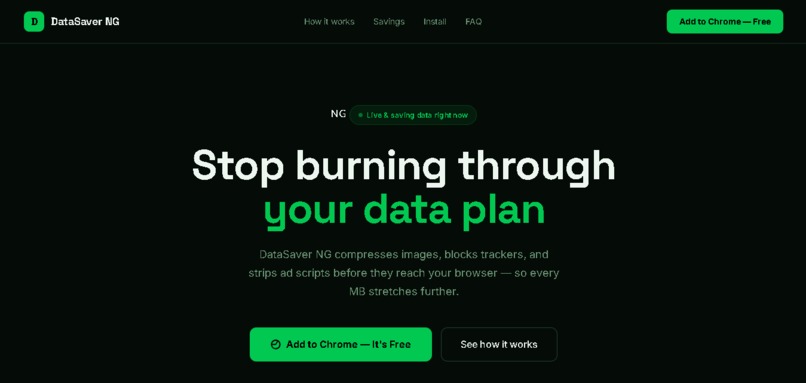
DataSaver NG
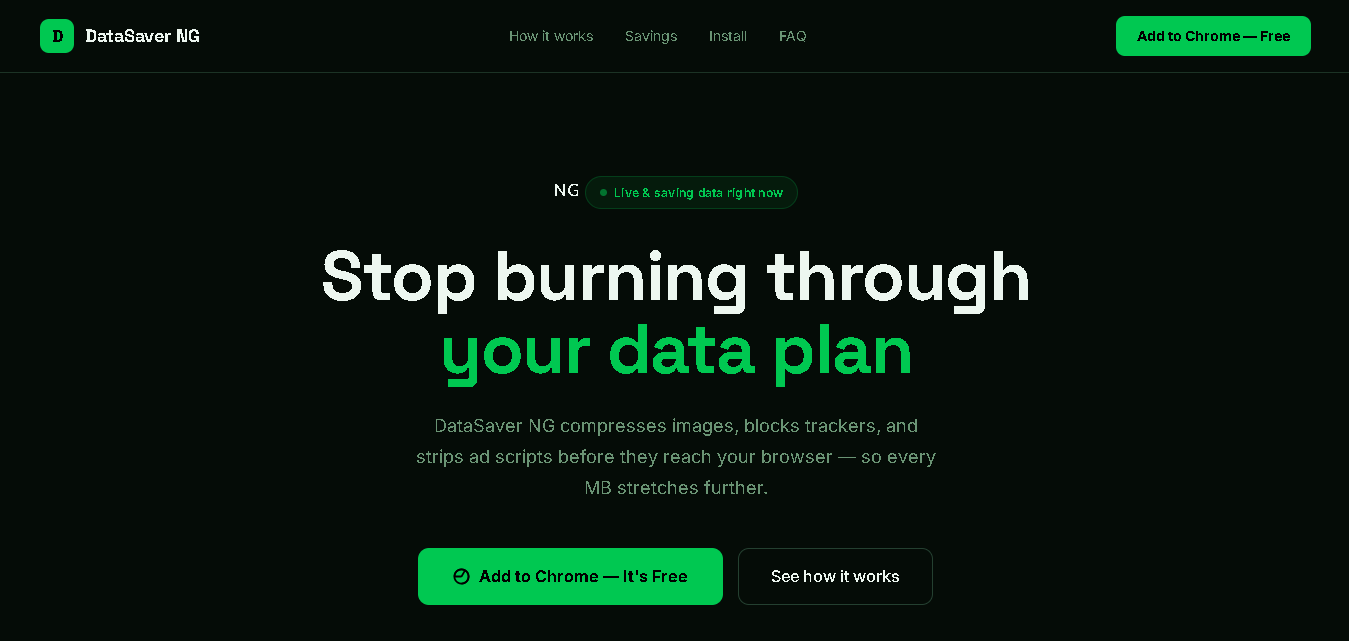
DataSaver NG — Hackathon Submission
🏷️ PROJECT TITLE
DataSaver NG — Your Data, Your Money, Protected
🌍 THE PROBLEM (Inspiration)
In Nigeria, 1GB of mobile data costs between ₦1,000–₦3,000 (~$0.65–$2 USD). The average Nigerian earns around ₦77,000/month. That means a significant portion of income goes toward data — and most of it is wasted.
Here's what most people don't know: up to 60% of the data consumed on a typical webpage is never actually useful to the user. It's tracker scripts, analytics pixels, uncompressed images, and ad networks — all silently burning through data plans.
We searched for existing data savers. Every "data saver" app we found either:
- Only speeds up browsing without reducing actual bytes downloaded
- Requires a paid subscription
- Doesn't work at the network level where savings actually happen
We decided to build the real thing.
💡 WHAT WE BUILT
DataSaver NG is a two-part system:
1. Chrome Browser Extension
- Blocks 30+ ad networks and trackers before they download (Google Analytics, Facebook Pixel, Taboola, PopAds, ExoClick, and more)
- Routes all images through our compression proxy automatically using a content script that runs on every website
- Shows live stats: total data saved, trackers blocked, requests optimized
- Works on every website — Nigerian news sites, streaming sites, social media
2. Node.js Compression Proxy (Live on Vercel)
- Compresses every image to WebP format at 60% quality — saving up to 70% on images alone
- Strips tracking scripts and ad pixels from HTML pages
- Gzip compresses all text responses (HTML, CSS, JS) — saving up to 40%
- Live at: https://datasaver-ng.vercel.app
- Endpoints: /proxy, /stats, /health
Combined savings per browsing session:
| Method | Typical Saving |
|---|---|
| Image compression (WebP) | 50–70% |
| Tracker blocking | 10–30% per page |
| HTML bloat removal | 5–15% |
| Gzip compression | 20–40% |
| Combined | up to 75% |
🤖 HOW AI WAS USED
AI (Claude by Anthropic) was used throughout the development process as a coding partner and technical advisor:
- Architecture design — AI helped design the proxy-extension architecture and explained why a server-side compression approach saves more data than client-side approaches
- Code generation & debugging — AI wrote and debugged the Node.js proxy server, Chrome extension manifest (MV3 compliance), content scripts, and declarativeNetRequest rules
- Problem solving — When Chrome rejected our webRequestBlocking approach, AI identified the MV3 restriction and rewrote the blocking system using declarativeNetRequest
- Deployment — AI guided the Vercel deployment process and fixed a node-fetch compatibility crash in production
- Content — AI helped write this submission and the product landing page
This project demonstrates exactly what Track 05 describes: "You don't need a team of 50 engineers anymore. With AI tools, a high schooler can build something that looks and works like a real startup."
🛠️ HOW WE BUILT IT
Tech Stack:
- Node.js + Express (proxy server)
- Sharp (WebP image compression)
- Cheerio (HTML parsing and cleanup)
- Chrome Extension Manifest V3
- declarativeNetRequest API (tracker blocking)
- Vercel (free hosting)
- GitHub (version control)
Architecture:
[User's Browser]
      ↓
[DataSaver NG Extension]
      ↓  blocks 30+ trackers via declarativeNetRequest
      ↓  rewrites image URLs via content script
[Proxy Server — datasaver-ng.vercel.app]
      ↓  compresses images to WebP (60% quality)
      ↓  strips tracking scripts from HTML
      ↓  gzip compresses all responses
[Website loads — using up to 75% less data]
Build process:
- Identified the problem from personal experience with Nigerian data costs
- Designed the proxy architecture
- Built the Node.js compression proxy
- Built the Chrome extension (MV3 compliant)
- Debugged and fixed multiple Chrome API compatibility issues
- Deployed the proxy to Vercel
- Built the landing page
- Submitted to hackathon
😤 CHALLENGES WE FACED
1. Chrome Manifest V3 restrictions
Chrome's new MV3 standard removed webRequestBlocking — our first approach for blocking trackers. We had to completely rewrite the blocking system using declarativeNetRequest, which required a separate JSON rules file and a different architecture.
2. node-fetch compatibility crash
Our initial proxy used node-fetch v3 which crashed on Railway with ReferenceError: File is not defined. We rewrote the HTTP fetching logic using Node.js built-in http/https modules, removing the dependency entirely.
3. Image CSP restrictions Some websites use Content Security Policy headers that block third-party image loading. We handled this with a fallback in the content script — if the proxy fails, the original image URL is restored automatically.
4. File structure confusion Chrome extensions require exact file naming and folder structure. Several iterations were needed to get the manifest, icons, and rules folder correctly structured.
🏆 ACCOMPLISHMENTS
- Built a fully working, deployed product — not a prototype or mockup
- Proxy server live at datasaver-ng.vercel.app serving real traffic
- Chrome extension installed and working with live stats
- Blocks 30+ tracker domains including networks used by streaming and news sites
- Compresses images by up to 70% using WebP conversion
- Built in under a week using AI as a coding partner
- Real social impact — directly addresses data poverty in Nigeria
📚 WHAT WE LEARNED
- How Chrome Extension Manifest V3 works and its restrictions vs MV2
- How HTTP proxy servers compress and transform content
- How to deploy Node.js applications to Vercel
- How image compression algorithms work (WebP vs JPEG vs PNG)
- How tracker networks operate and how to block them at the browser level
- How AI can dramatically accelerate solo development — from idea to deployed product in days
🚀 WHAT'S NEXT
- Android VPN app — routes ALL app traffic through the proxy, not just Chrome. This means savings on Twitter, Instagram, YouTube, and file downloads
- Chrome Web Store publication — making it available to all Nigerian Chrome users
- Firefox extension — expanding to Firefox users
- Network-aware mode — automatically increase compression on 2G, reduce on WiFi
- User accounts — track cumulative savings over time
🔗 LINKS
- Live proxy API: https://datasaver-ng.vercel.app
- Health check: https://datasaver-ng.vercel.app/health
- Stats endpoint: https://datasaver-ng.vercel.app/stats
- GitHub: https://github.com/Zenskistudios/datasaver-ng
- Landing page: https://datasaver-ng-website.vercel.app/
🎯 PRIZE CATEGORIES WE'RE TARGETING
Best Social Value — DataSaver NG directly addresses digital inequality. In Nigeria and across Africa, expensive mobile data is a barrier to education, opportunity, and connectivity. By making every MB go further, we help students access learning resources, job seekers find opportunities, and families stay connected — without burning through their income on data plans.
Best Original Idea — A server-side compression proxy paired with a browser extension that actively rewrites page content in real time is a genuinely novel approach to data saving. We don't just block — we transform.
Best UI/UX — The extension popup shows live, real-time savings with a clean Nigerian-green design. Simple, honest, and functional.
Built in Nigeria 🇳🇬 for Nigerian internet users and everyone who pays too much for data. Your data, your money, protected.
Built With
- api
- chrome
- extensions
- html5
- javascript
- manifest


Log in or sign up for Devpost to join the conversation.