-
-
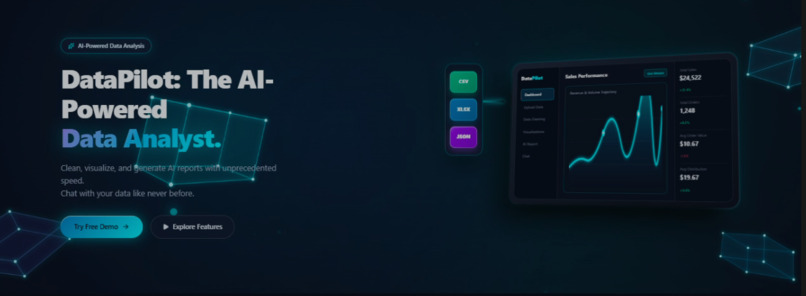
Introducing our latest AI build! Powered by advanced generative visual models,
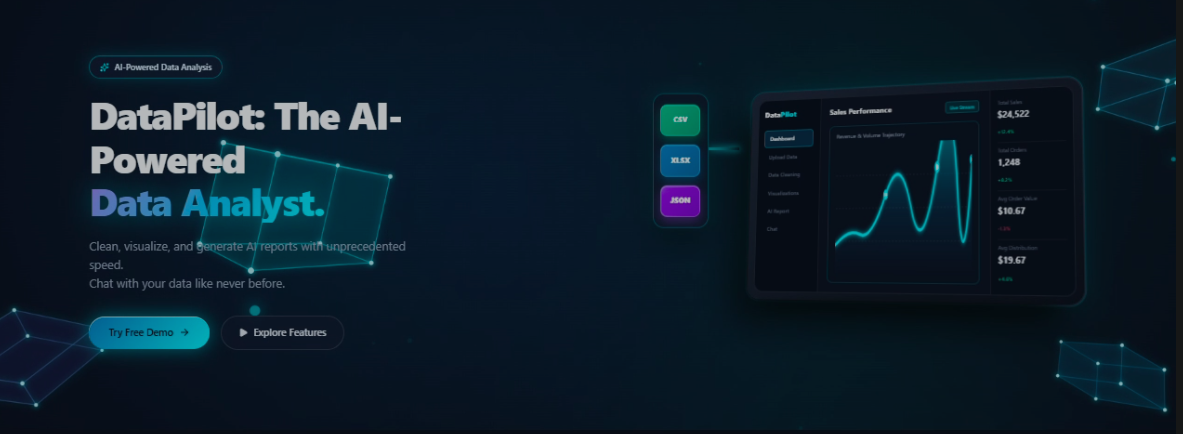
Inspiration Data analysis is often bottlenecked by tedious tasks. Non-technical users, students, and busy professionals waste hours writing scripts just to clean missing values, generate basic charts, or write summaries. Existing business intelligence tools are often too bloated, expensive, or complex for quick insights. We built DataPilot to democratize data analysis, turning raw, messy data into interactive insights and comprehensive reports through simple natural language.
What it does DataPilot is your all-in-one AI data assistant that instantly cleans, visualizes, compares, and answers questions about your data. The platform features automated data cleaning that detects and handles missing values, fixes duplicates, standardizes formats, and logs all changes. It includes smart visualizations that automatically recommend and generate the best charts tailored to the dataset's structure. A conversational AI Q&A feature allows users to ask plain English questions about their data to receive instant analytical answers. Additionally, dual dataset comparison lets users upload two separate files to compare metrics and performance variance side by side, while automated reporting generates clean summary reports detailing key statistical findings.
How we built it We built the frontend using a clean, intuitive dashboard interface for a seamless user experience. For the backend and data engine, we used Python, Pandas, and NumPy for robust and fast data manipulation. We integrated LLM APIs to parse user questions and safely execute analytical queries, and utilized interactive plotting libraries to render responsive charts.
Challenges we ran into We had to handle messy, unstructured, or improperly formatted data types gracefully without crashing the application. Ensuring the AI's natural language responses mapped accurately to the correct columns and rows in user-uploaded datasets also required careful prompt engineering and error handling in our execution pipeline.
Accomplishments that we're proud of We successfully bridged the gap between raw data upload and instant, actionable insights in under a minute. We are also proud of building a reliable dual-dataset comparison engine that accurately highlights clear variances between two separate files.
What we learned We gained a deeper understanding of how to safely sandbox and execute analytical queries from natural language inputs. We also learned how crucial robust data validation is when building applications that deal with unpredictable, messy user-uploaded datasets.
What's next for DataPilot Moving forward, the next steps for DataPilot include adding support for larger enterprise databases like SQL and Snowflake, enabling automated report exports directly to PDF and PowerPoint formats, and enhancing the AI agent to suggest deeper predictive modeling based on historical trends.
Built With
- ai
- codex

