Inspiration
Every February, America asks a groundhog to predict the weather and takes its word for it. Commerce works in much the same way. A buyer pays, a seller delivers, and a payment processor confirms that the money moved. However, nothing in that chain checks whether the buyer received what they paid for.
The cost of this gap is already visible in ordinary transactions. In 2025, eBay facilitated nearly $80 billion in merchandise volume. Its seller standards hold cases closed without seller resolution to 0.3% of transactions, with a two-case allowance, and hold the broader transaction-defect rate to 2%. Even a mature marketplace needs an entire system to handle exceptions, assign responsibility and protect the trust of both buyers and sellers.
Sources: eBay 2025 Annual Report and eBay Seller Standards.
Now the sellers are becoming agents. AI agents already buy data, call APIs, outsource inference and exchange digital services with other agents. These transactions settle in seconds, but a successful payment says nothing about whether the promised work was done. We are automating commerce faster than we are automating accountability. This leads us to ask: when someone pays for a result, what checks that result against the agreement before the money moves?
We built Groundhog to be that check.
What it does
Groundhog is an autonomous order-to-cash employee. It turns a request into an agreement, verifies the delivery against that agreement, investigates disputes and decides whether payment can be collected.
We start with data brokerage, where disagreements over quality, coverage, definitions and provenance come up constantly and can be checked directly. Our demo follows DatumCo, a synthetic data broker, selling a custom dataset to AcmeFitness. Consider the request: "Give me the number of San Francisco adults aged 25–34 interested in fitness, grouped by ZIP code." It sounds simple. However, does fitness include yoga? What happens to a missing ZIP code, or to a suppressed count? Who pays when the buyer wants more data? Today these questions turn into email threads, manual investigations and refunds. Groundhog handles them as part of the work.
Agreement. Groundhog clarifies ambiguous requirements and turns the request into a versioned, machine-checkable specification, covering definitions, geography, data sources, schema, coverage, price and delivery conditions. Both sides accept it before any work begins. Verification. Groundhog coordinates production of the dataset and runs eight independent checks against the delivered CSV and its source artifacts. It verifies what was delivered, not what the provider says was delivered.
Investigation. The buyer can object in plain language. Groundhog ties the objection to the accepted agreement, inspects the evidence and classifies the issue as a provider defect, a misunderstanding, a request for additional scope or an open question. A provider defect triggers a free correction. Additional scope requires a new quote and a new authorization. An unsupported complaint costs the customer nothing, and an open question goes to a person.
Payment. A language model cannot declare that payment is deserved. Groundhog's financial layer enforces the agreement, the verification results, customer consent, the dispute state and the settlement rules before it allows collection.
Learning. When a source owner explains an ambiguous data convention, Groundhog turns that answer into a reusable procedure backed by evidence. Once approved, the procedure persists across orders and restarts, so the next order uses what the company already knows instead of asking the same question again.
Thus, Groundhog connects the contract, the work, the evidence, the company's knowledge and the payment in one persistent system of work.
How we built it
Groundhog follows one principle: AI interprets the work, and verifiable evidence and enforceable rules decide its consequences.
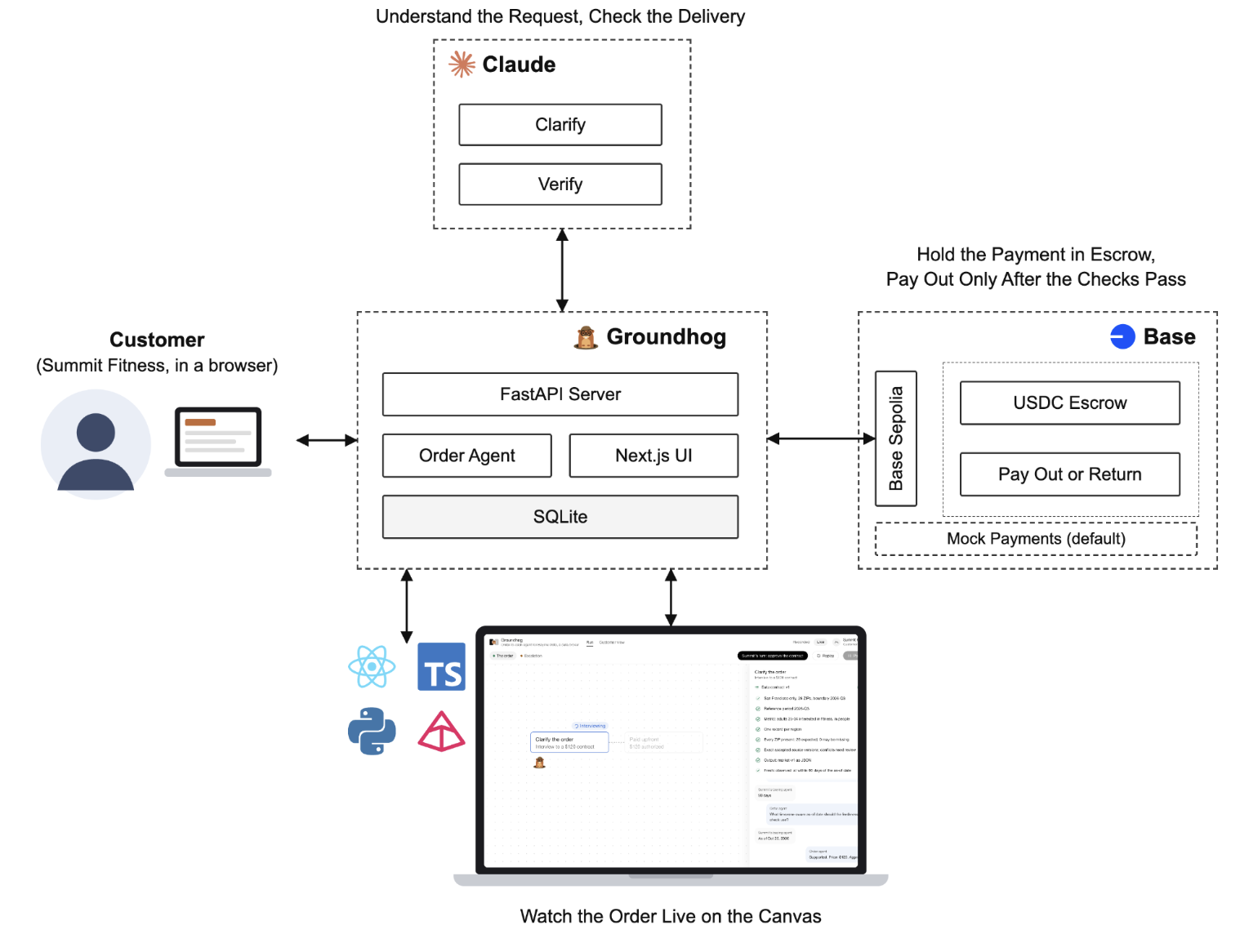
The backend uses Python, FastAPI, Pydantic and SQLite to keep persistent orders, accepted agreements, background jobs, investigation records, learned procedures and financial state.
We use Claude structured outputs for bounded language interpretation and semantic investigation. Each assessment is bound to the contractual requirement and the stored evidence it concerns, so a model response is an input to a decision rather than the decision itself.
The verification layer reopens the source and delivery bytes, checks their hashes and evaluates eight contractual requirements. A model's confidence or explanation cannot override these checks.
A durable state machine coordinates clarification, quoting, acceptance, funding, production, verification, review, disputes, correction and settlement. Idempotent operations and persistent events keep every decision intact across retries and process restarts.
The institutional-learning layer stores each source-specific procedure with its evidence, scope, version and approval history. Reuse depends on the current authority of the source, so changed or revoked evidence cannot become an accepted company rule.
The payment layer integrates Base Commerce Payments on Base Sepolia, with authorization, capture, void and reconciliation. The end-to-end demo runs the full commercial workflow through mock settlement.
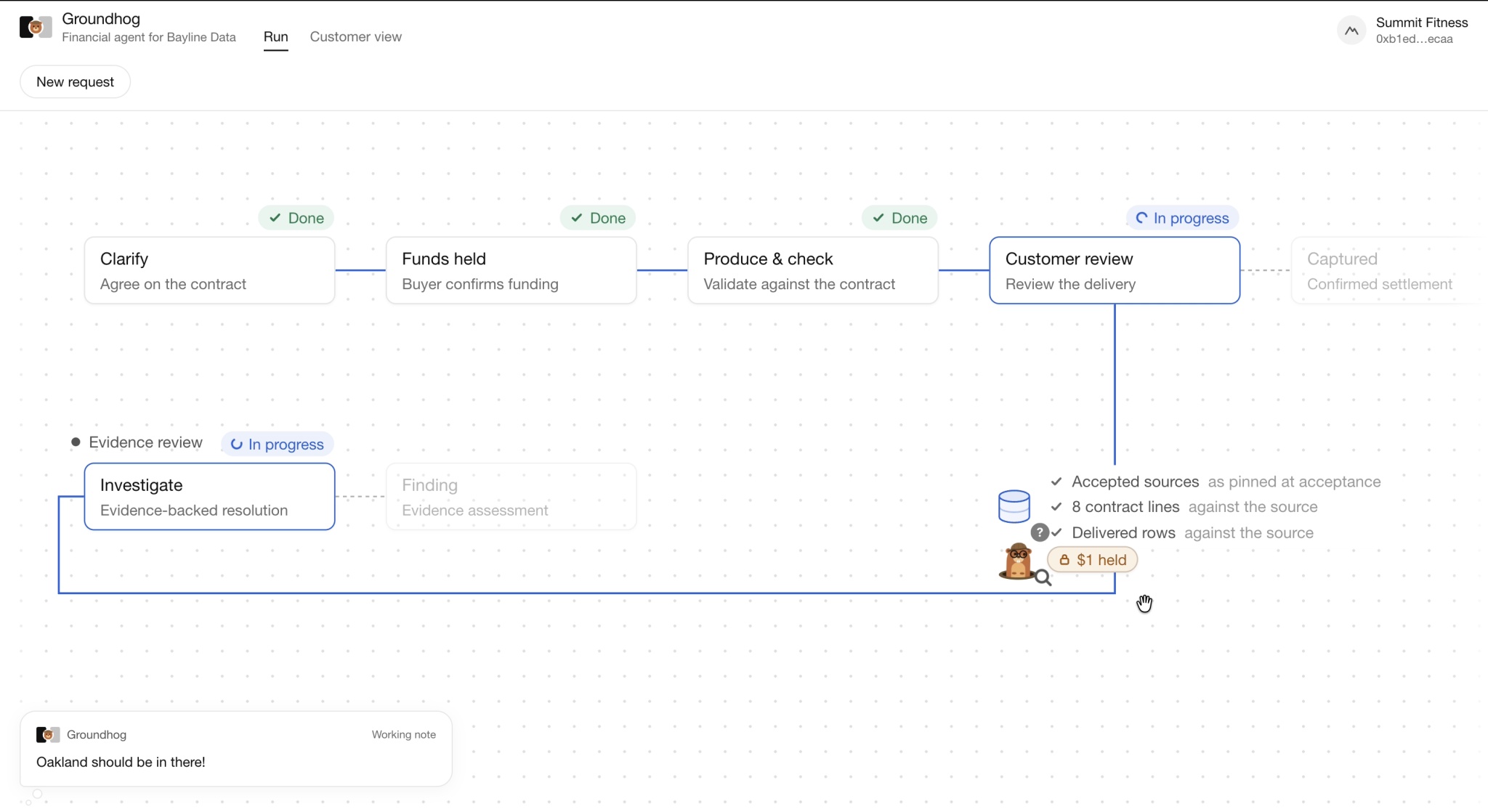
The frontend uses Next.js, React and TypeScript to turn the process into an interactive visual workflow. A groundhog moves through the order lifecycle, investigates problems, returns to earlier stages when needed and shows the evidence behind each decision. The customer conversation and the operational view read the same persisted order.
Challenges we ran into
Turning natural-language promises into enforceable obligations. A contract is only useful to an autonomous system if its requirements can be interpreted and checked. Even a plain request for "fitness data" hides disagreements about definitions, units, geography and coverage. We separated clarification from acceptance and froze the resulting specification before fulfillment. Any later change requires renewed consent instead of silently rewriting what was promised.
Separating convincing explanations from actual evidence. A language model can write a clear explanation with valid citations and still reach the wrong conclusion. We built independent evidence checks and strict financial gates, so a model judgment without evidence cannot authorize a payment. Groundhog investigates and explains, and the accepted contract and verified state hold the financial authority.
Making organizational learning safe to reuse. Remembering a previous answer is dangerous on its own, since a rule that holds for one publisher or schema can be wrong for another. Our learning system binds each procedure to its source evidence and authority, qualifies it on fresh inputs and requires approval before it is activated. Groundhog keeps the lesson without gaining unrestricted authority over company policy.
Surviving the real world. Orders do not happen in one uninterrupted model call. Customers respond late, evidence changes, workers restart, payment operations stall and disputes arrive at inconvenient moments. We built durable jobs, replay protection, versioned records, deadline-aware execution and inspectable event histories, so Groundhog holds the commercial state well beyond a single conversation.
Accomplishments that we're proud of
A working end-to-end order-to-cash workflow. A buyer requests a custom dataset, clarifies its requirements, accepts a quote, authorizes funding, receives an independently verified deliverable, challenges the result and reaches a financial outcome governed by evidence. Every step runs on real persisted state.
Independently checkable fulfillment. Eight contractual requirements are checked against the generated artifacts and their sources. Failed evidence blocks publication or collection instead of hiding behind an AI-generated success message.
Financial guardrails built into the application. Groundhog separates a recommendation from a permission. Missing evidence, unresolved disputes, stale agreements and absent consent cannot be talked past by a persuasive model response.
Persistent institutional learning that does real work. In a controlled nine-case comparison, retained knowledge cut internal reviews from 8 to 6 while keeping 9/9 correct outcomes in both configurations. In later application runs on new source data, approved knowledge cut repeated source-owner reviews from 2 to 0 per order, including after a backend restart. Groundhog reuses approved procedures to interpret fresh source data and produce new deliverables, and it keeps the evidence that links each result to its authority.
A fully inspectable lifecycle. Accepted specifications, generated artifacts, source references, disputes, approvals, learned procedures and payment operations are all persisted, so the reasoning behind any outcome can be reconstructed.
Our favorite result: the groundhog learns not to relive the same day.
What we learned
The hardest part of building an autonomous financial employee is not getting a model to make decisions. It is building a system in which those decisions carry weight.
AI reasoning becomes far more useful once it is grounded in persistent commercial state: what was promised, what was delivered, what evidence exists, what people approved and what the agreement permits. We also found that determinism and autonomy work together. A model does not need to decide whether two amounts match or whether a contract was signed. Deterministic checks settle those questions, which frees the model to interpret ambiguous requests, investigate disagreements that depend on context and bring in a person when one is needed.
Most importantly, an autonomous employee should make its organization better at the job over time. In our experiments, retained knowledge reduced repeated human intervention with no loss in the tested outcomes. Thus, people stop answering the same questions forever and instead teach a system that remembers the answers and applies them under explicit authority.
Verification, dispute resolution and payment authorization turned out to be three stages of one question: did the work satisfy the agreement?
What's next for Groundhog
Data brokerage is our first vertical. The architecture is tool-agnostic and applies to any service with an agreed specification, an observable deliverable and evidence that can be checked against the specification. Anything that can be formally verified can be governed this way, including AI inference marketplaces, document-extraction jobs, contracted software deliverables and agents buying services from other agents. Each industry brings its own contracts, tools and verification adapters, and the workflow stays the same:
Agreement → Execution → Evidence → Investigation → Resolution → Financial Action.
Our next steps are to extend verification to more categories of digital services, integrate with existing marketplaces and enterprise systems, qualify live on-chain settlement on Base and connect authenticated business participants. We also plan to deepen institutional learning, so that successful human interventions become reusable, governed procedures across many more kinds of commercial work.
We are building toward a world where AI agents do more than buy and sell services on their own. They prove what they delivered, defend their decisions, resolve exceptions and justify every dollar that moves. Groundhog starts with data brokerage, and its goal is accountable autonomous commerce.


Log in or sign up for Devpost to join the conversation.