-
-
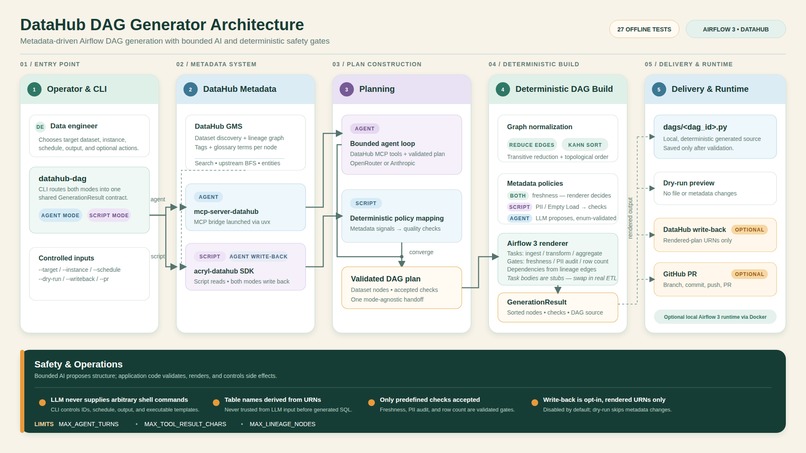
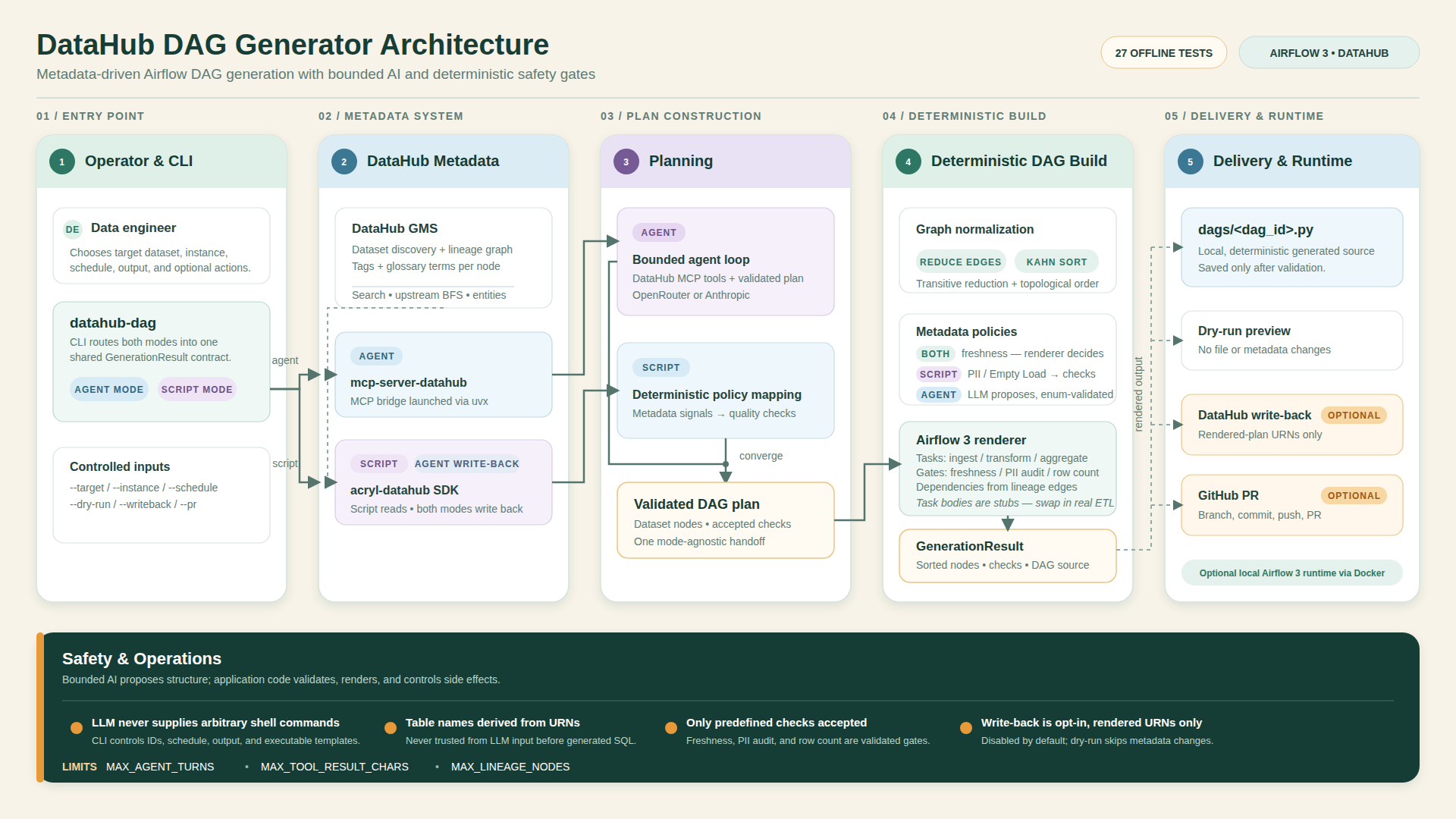
DataHub DAG Generator Architecture
Inspiration
Data engineers already have everything they need to build a correct pipeline — it's all in DataHub: the lineage graph, freshness SLAs, PII tags, and quality glossary terms. But turning that institutional knowledge into an Airflow DAG still means hours of manual work: copy-paste a template, re-derive the execution order, remember which tables need freshness gates, add PII audits by hand.
We wanted to close that loop. If the metadata already says a table is tagged pii or carries a FreshnessSLA glossary term, a tool should be able to read those signals and wire the right tasks into the DAG automatically — without a human translating them.
What it does
datahub-dag is a CLI tool that takes a target table name and generates a production-ready Airflow 3 DAG in seconds:
- Discovers lineage — traverses the upstream graph in DataHub via BFS to find every table the target depends on
- Reads metadata signals — tags (
pii,daily_refresh) and glossary terms (FreshnessSLA,EmptyLoad) on every node - Maps signals to tasks —
pii→data_audit_<table>,FreshnessSLA→freshness_check_<table>,EmptyLoad→validate_row_count_<table> - Renders a clean DAG — topological sort + transitive reduction, deterministic output, Airflow 3 syntax
- Optionally opens a PR — commits the file to a branch and creates a GitHub PR with a lineage summary table
How we built it
The tool runs in two modes:
Agent mode (default): An LLM agent (Claude or any OpenRouter model) connects to a live DataHub instance via the MCP protocol. It calls search, get_lineage, and get_entities tools to explore the graph, then invokes a custom render_airflow_dag tool with a validated plan. The renderer is fully deterministic — the LLM plans, but never writes code directly.
Script mode: Skips the LLM entirely. DataHub SDK calls + policies.py rule engine produce the same output deterministically. Useful for CI or environments without an API key.
Key design decisions:
- No LLM code injection — all
BashOperatorcommands are generated byairflow.pyfrom templates. The LLM cannot inject arbitrary shell commands. - Transitive reduction — removes redundant lineage edges before rendering so the DAG only shows direct dependencies.
- Kahn's algorithm with a min-heap for a deterministic, reproducible task order across runs.
Challenges we ran into
- MCP + async agent loop — bridging the MCP session lifecycle with a bounded async tool-call loop required careful state management to avoid dangling connections and runaway agents.
- LLM safety boundary — deciding exactly where the LLM's authority ends and the deterministic renderer begins. We settled on: the LLM produces a plan (structured JSON), the renderer produces code.
- Transitive edges in lineage — DataHub sometimes returns both direct and transitive edges. Without reduction, the generated DAG had redundant dependencies that would confuse Airflow's scheduler.
Accomplishments that we're proud of
- A genuine end-to-end demo: point the tool at a real DataHub instance with the NYC Taxi dataset and get a working, runnable Airflow DAG in under 30 seconds.
- The metadata → quality check mapping is table-driven and extensible — adding a new signal is a one-line change in
policies.py. - Two modes, one output contract:
GenerationResultis identical whether the LLM or the script engine produced it, so all downstream logic (file emit, PR creation, write-back) is shared.
What we learned
- The MCP protocol is a surprisingly clean interface for giving LLM agents structured access to data catalogs — much better than prompt-stuffing raw API responses.
- Metadata that looks decorative (tags, glossary terms) becomes load-bearing the moment you have a system that acts on it. Data quality improves as a side effect of better tagging.
What's next
- Support for dbt and Spark operators alongside the current shell-based stubs
- Schema change detection: if upstream schema drifts, flag it as a DAG comment
- DataHub write-back of execution results to close the observability loop
Built With
- airflow
- claude
- datahub
- mcp
- openrouter
- python


Log in or sign up for Devpost to join the conversation.