-
-
2
-
7
-
5
-
1
-
4
-
3
-
9
-
6
-
8
-
12
-
11
-
14
-
10
-
13
-
15
💡 The Inspiration
The idea came from a simple question:
What if an AI agent could understand an organization's entire data ecosystem before taking action?
Consider a seemingly harmless change:
customers.email → removed
In a traditional workflow, someone may discover the consequences only after a downstream pipeline fails.
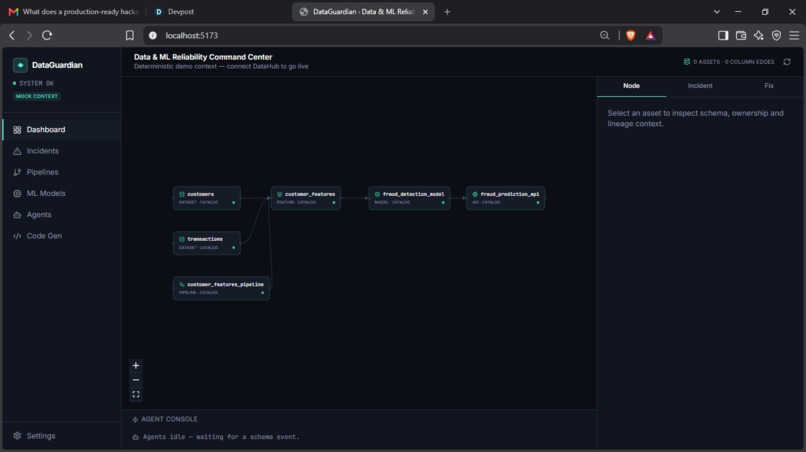
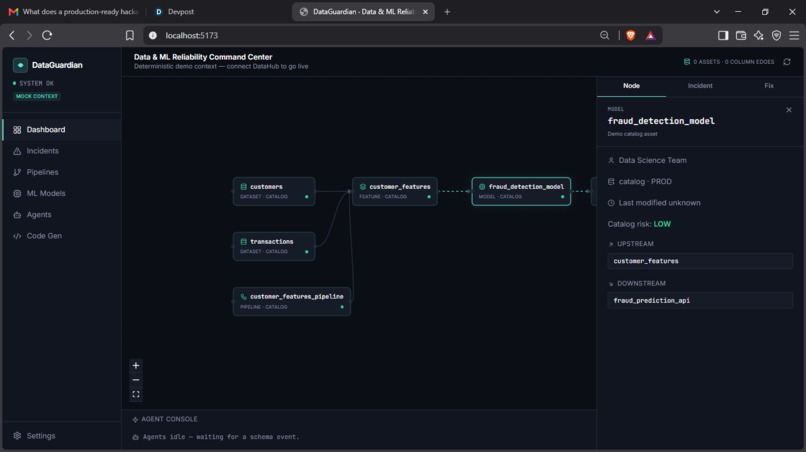
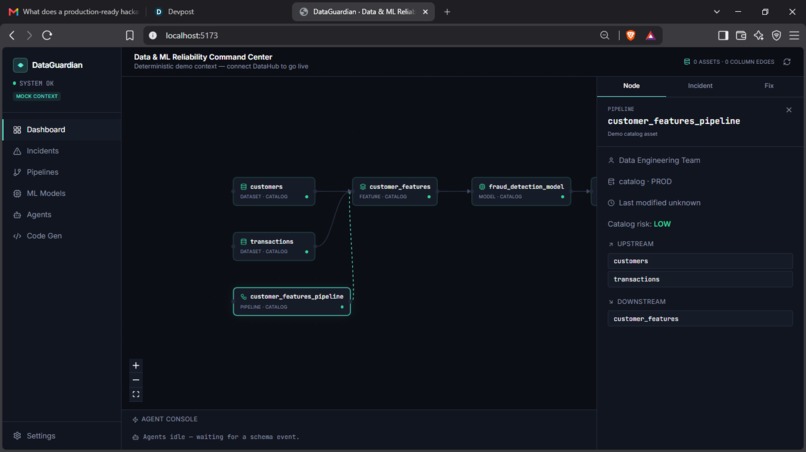
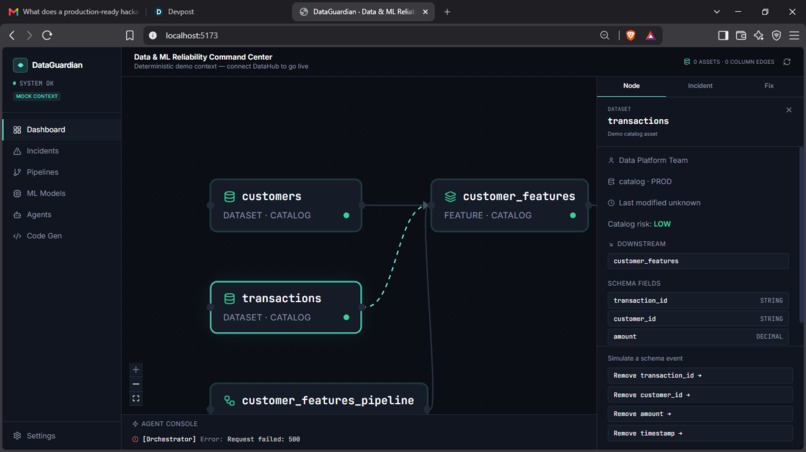
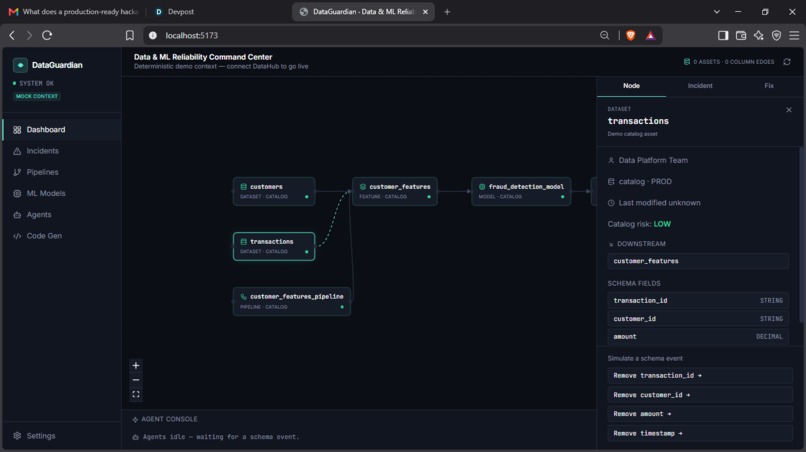
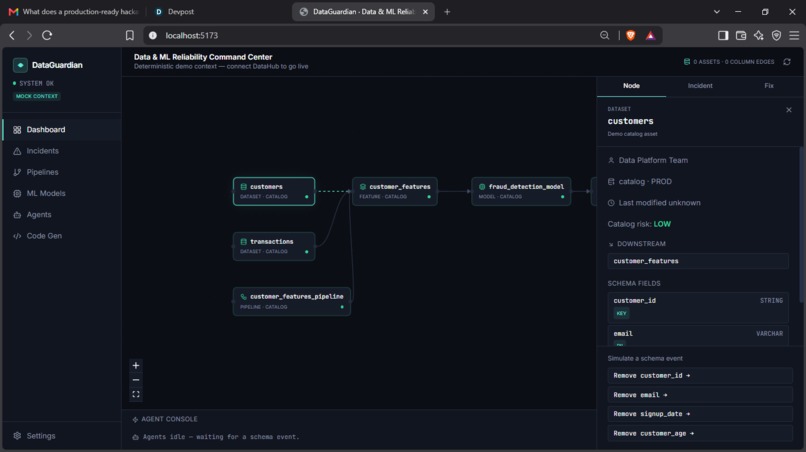
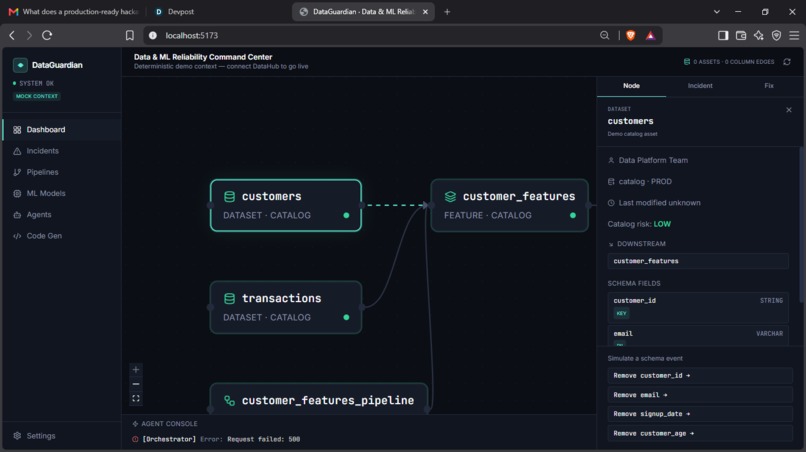
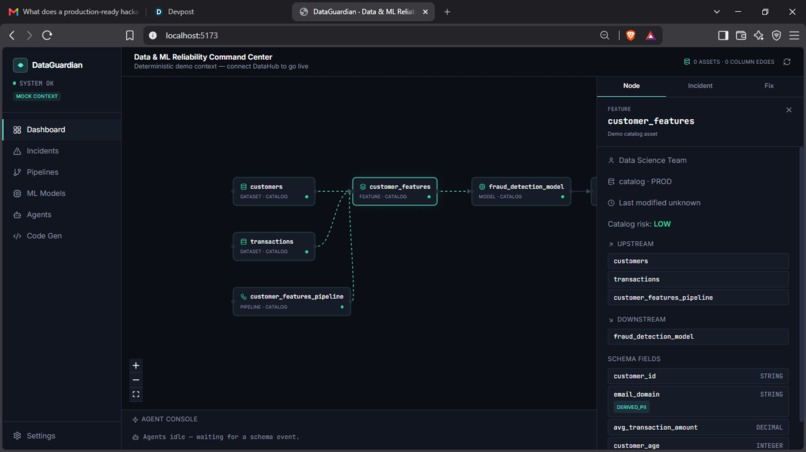
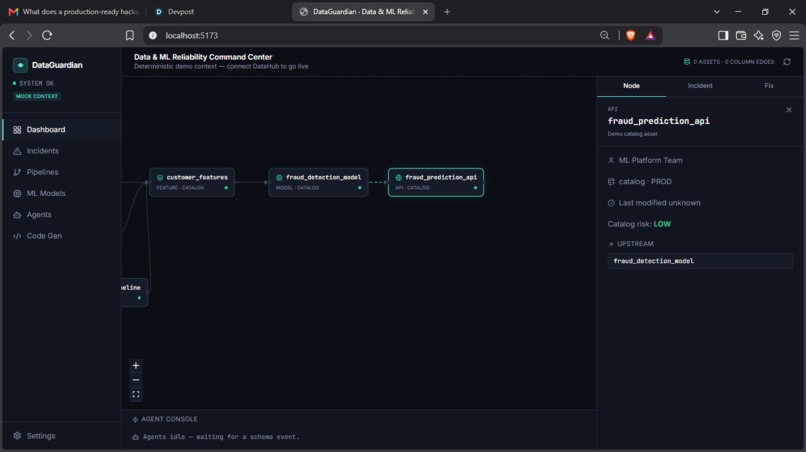
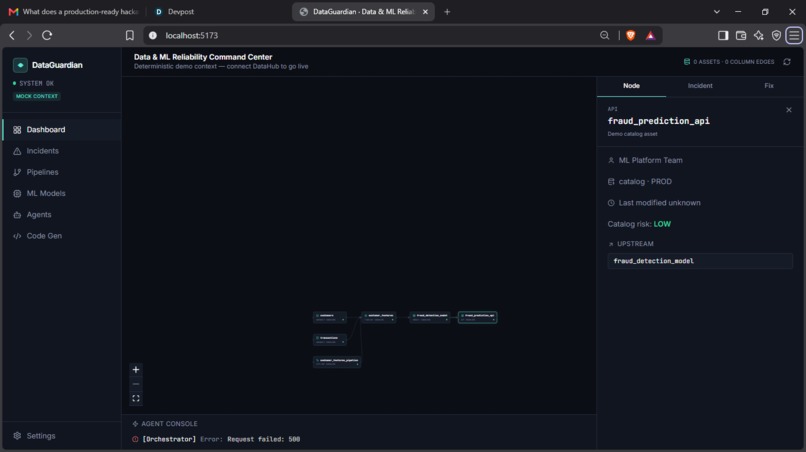
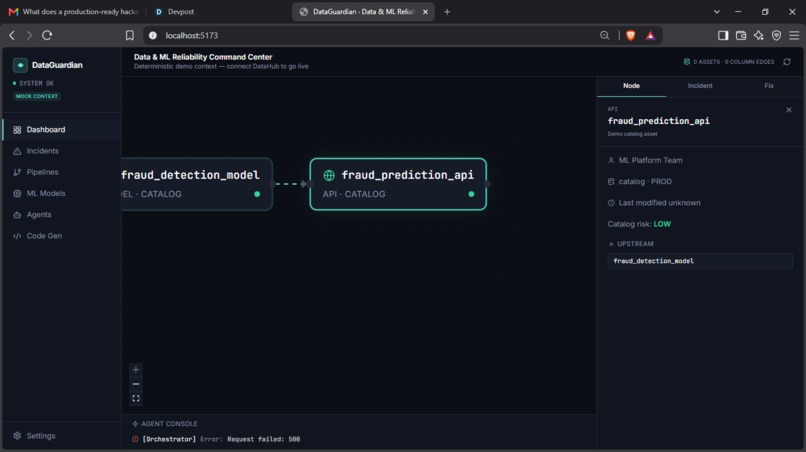
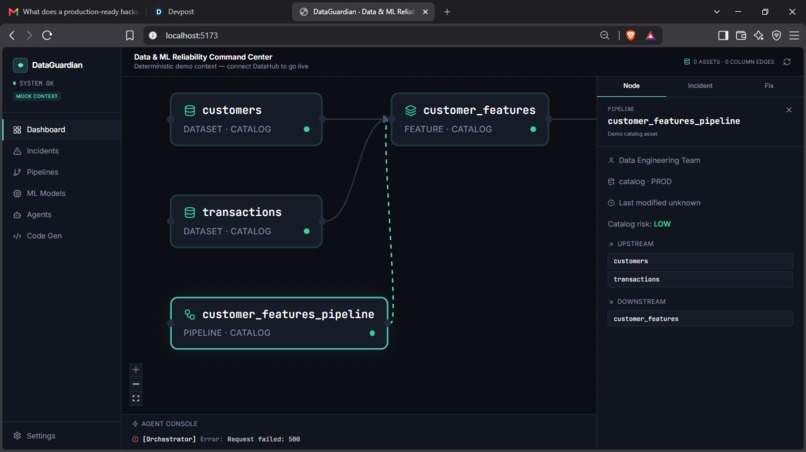
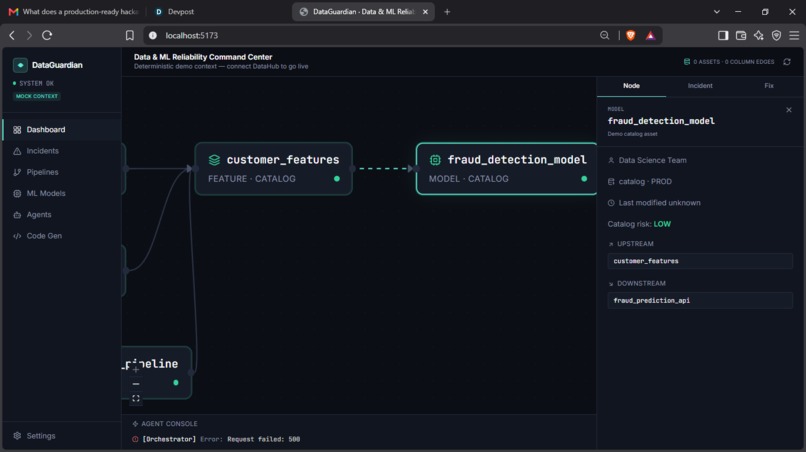
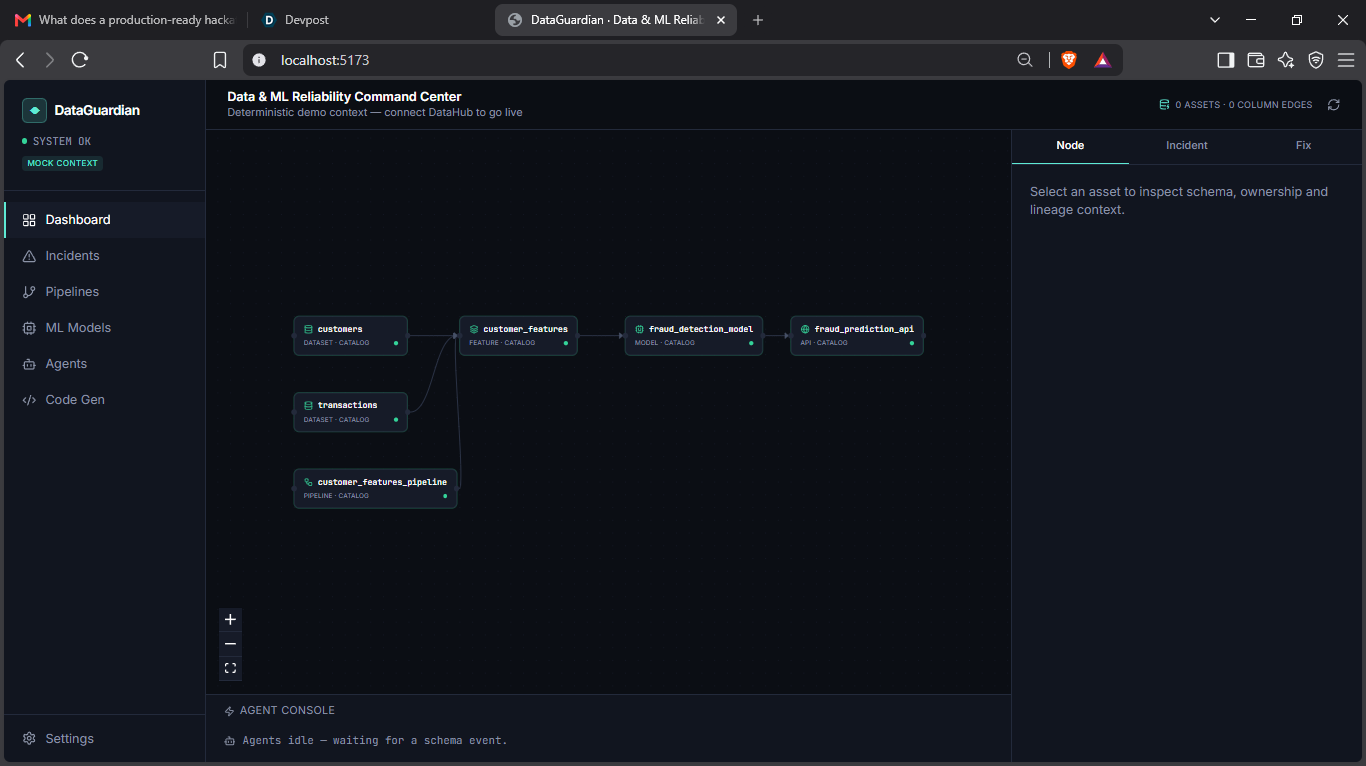
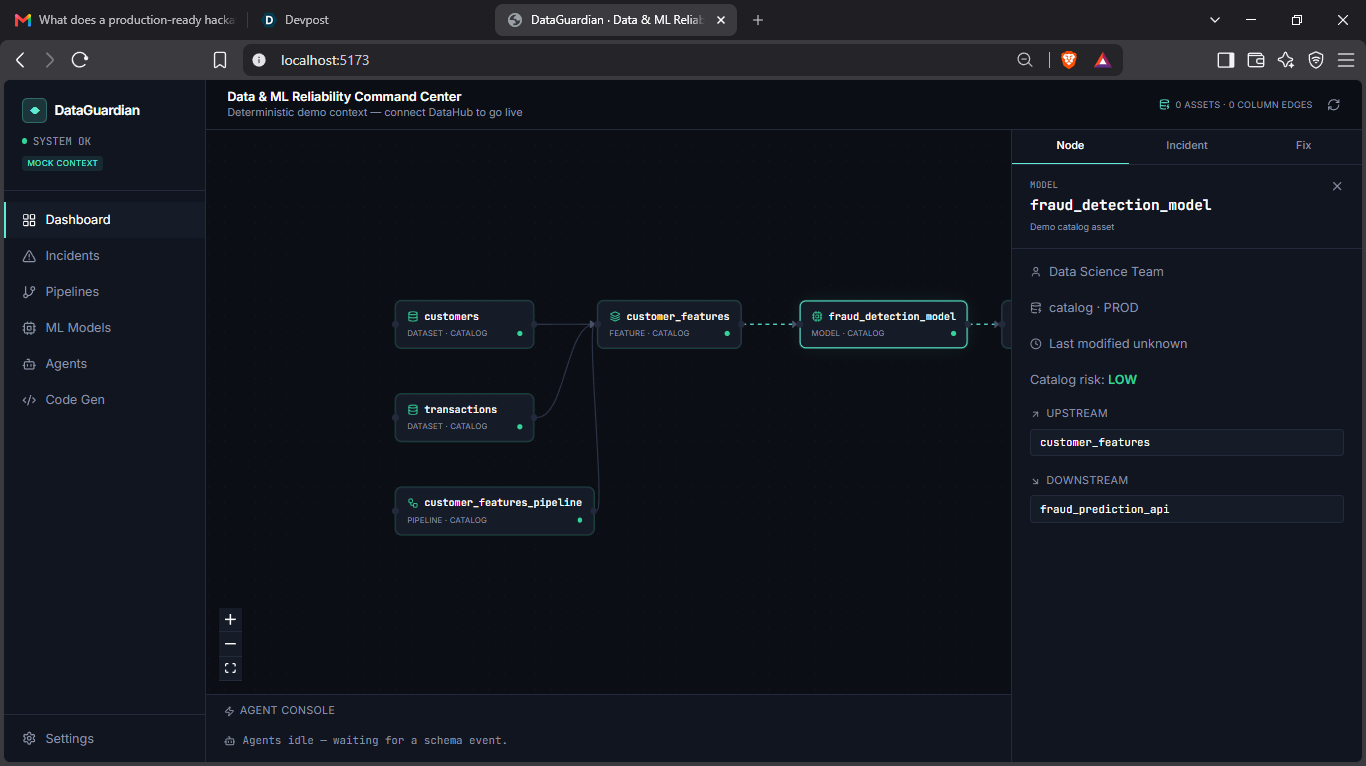
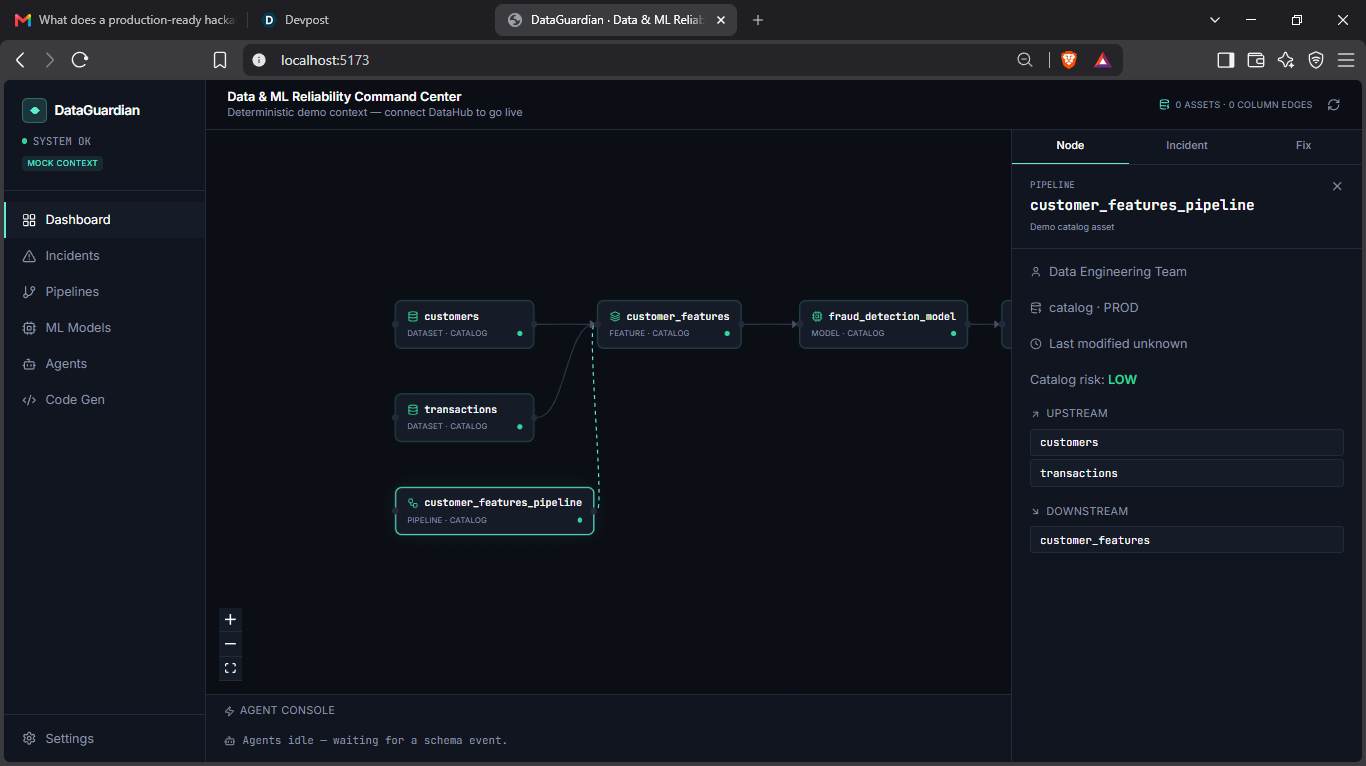
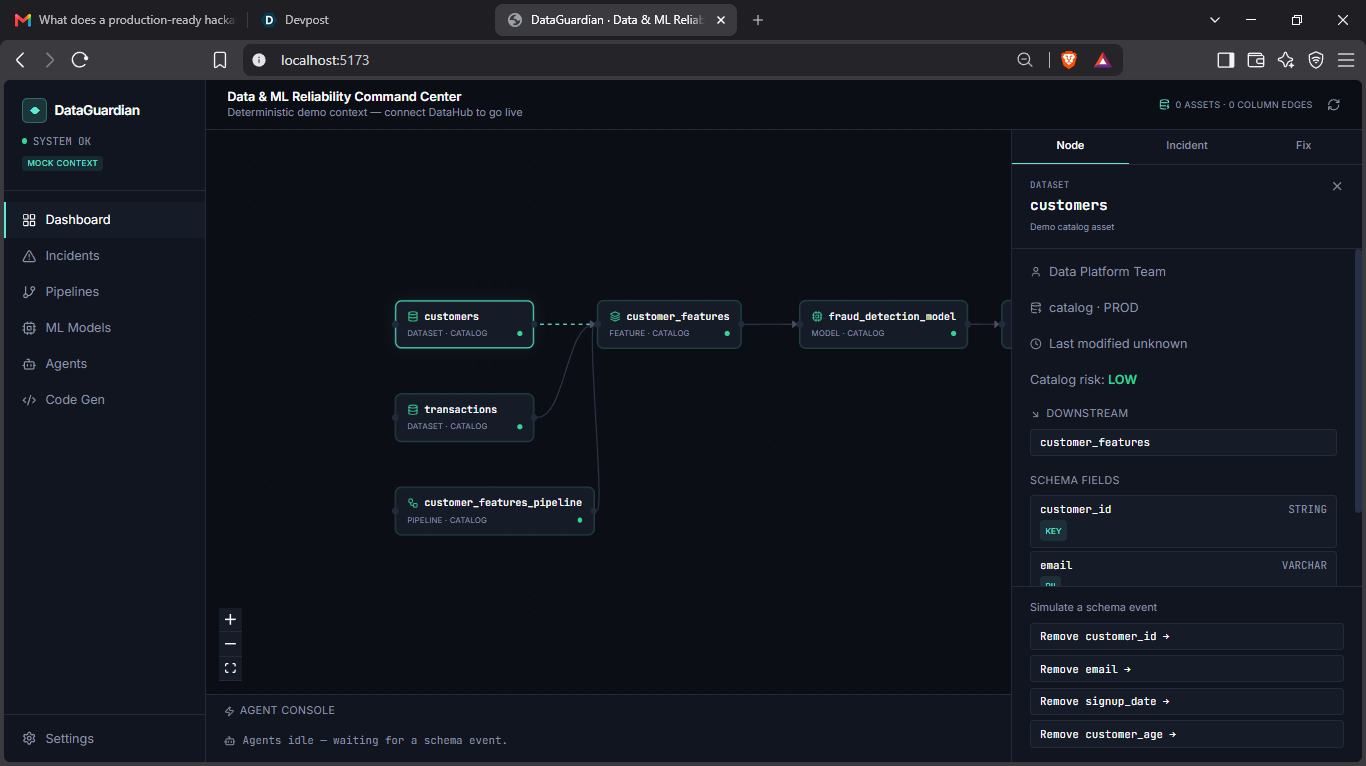
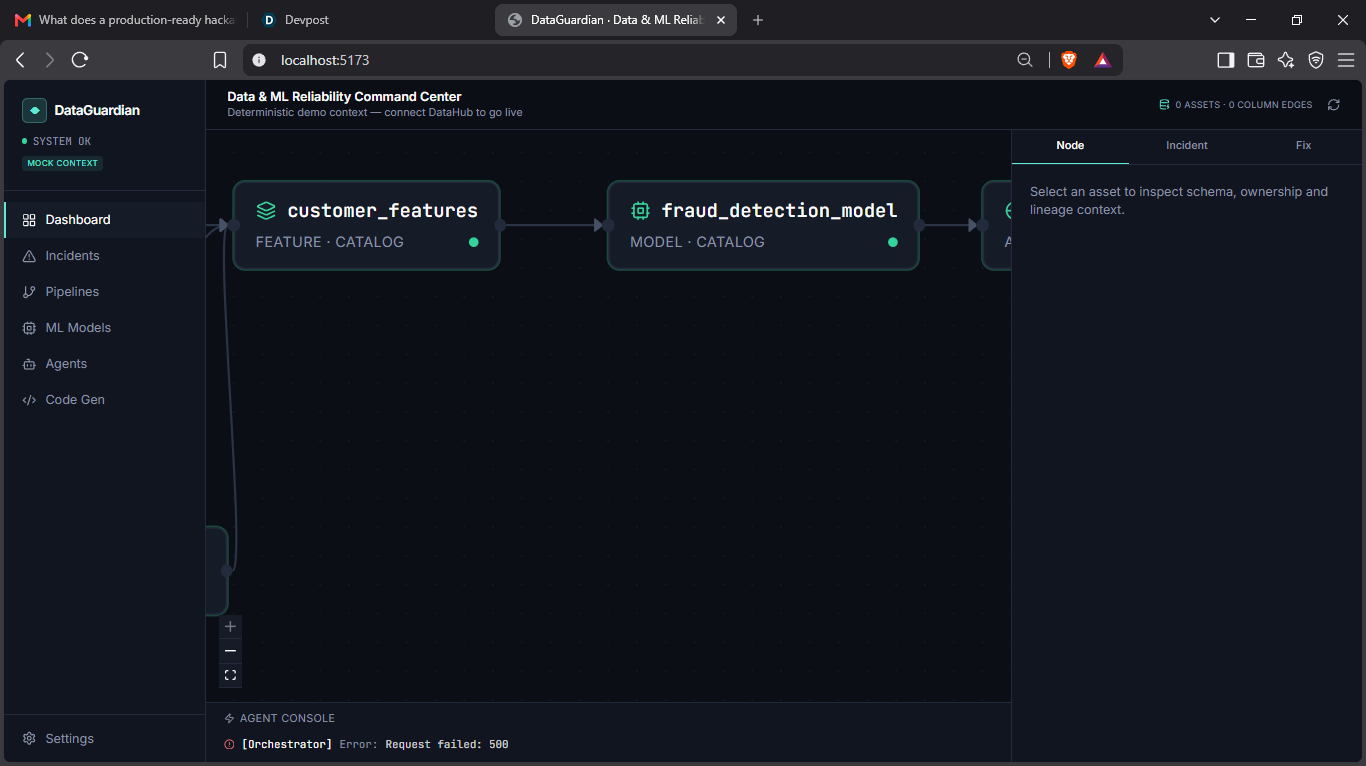
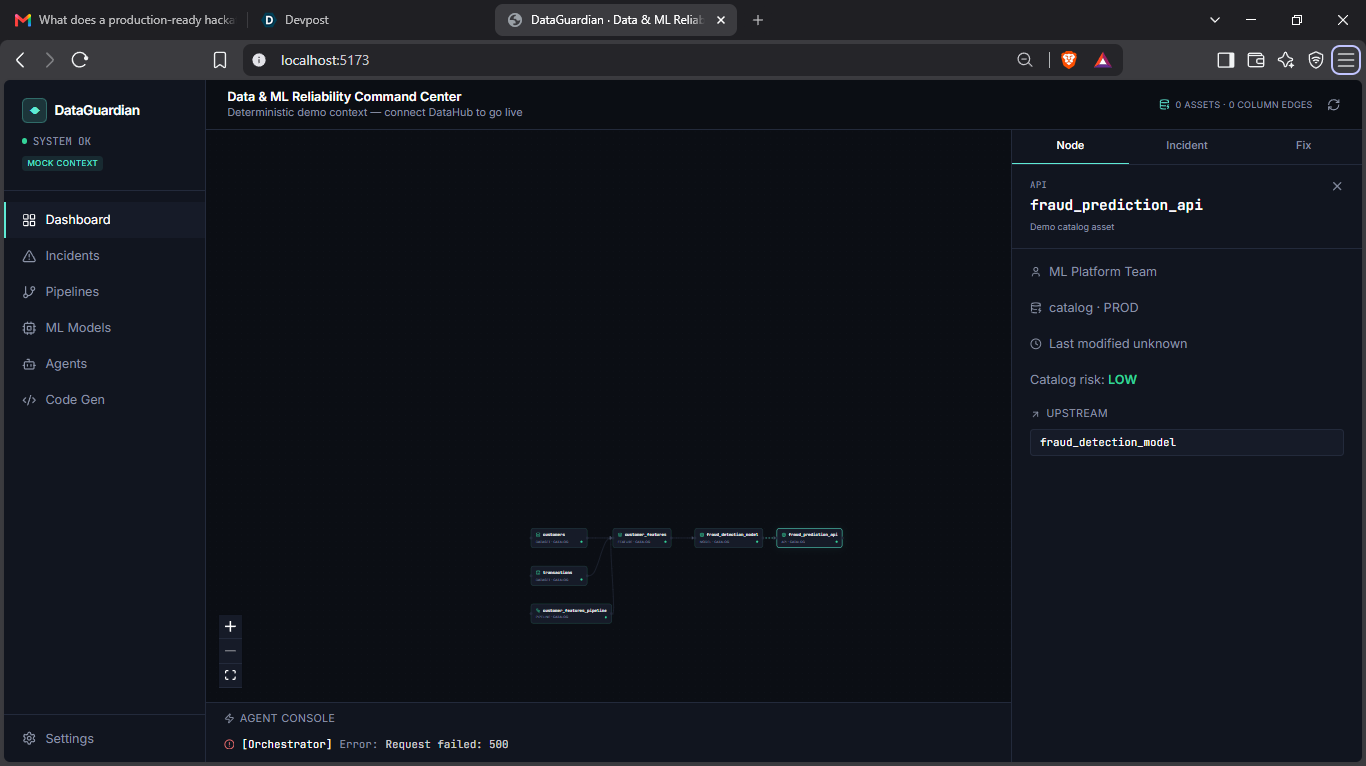
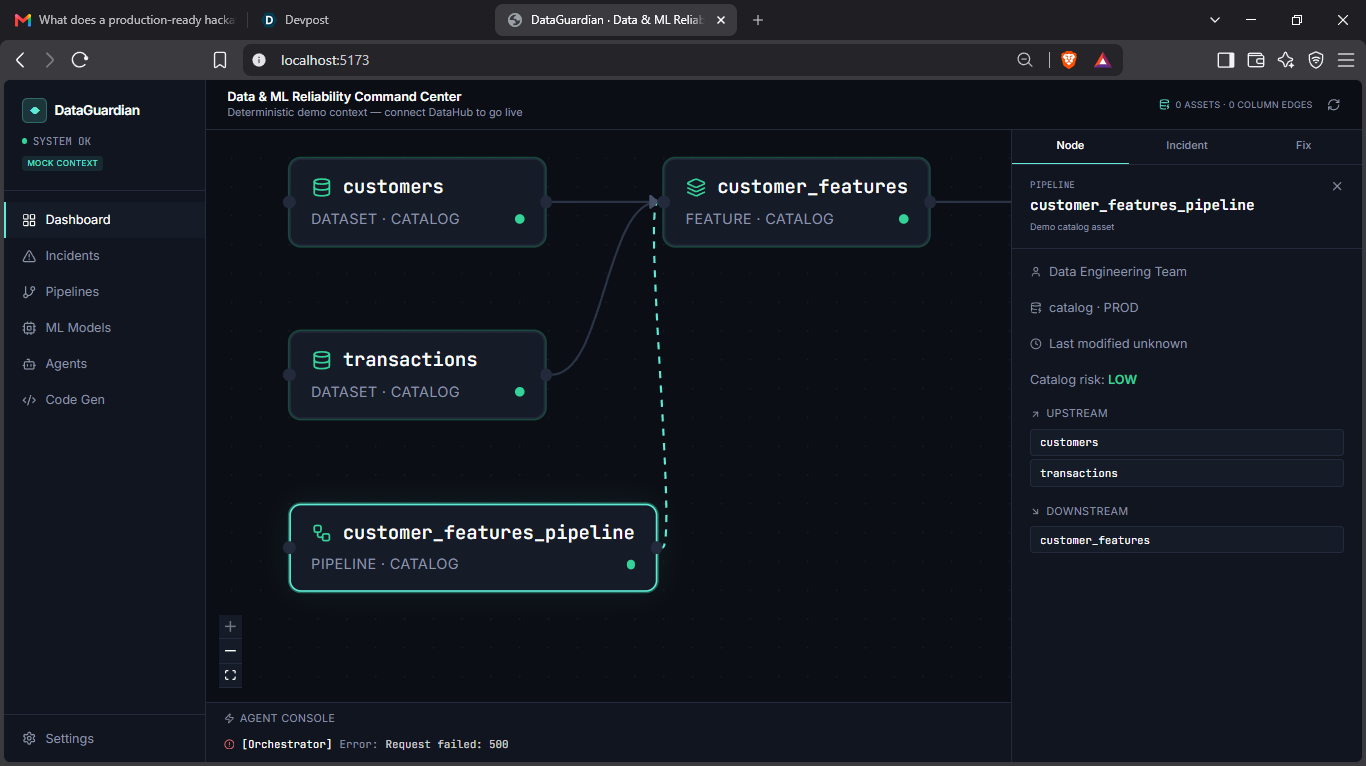
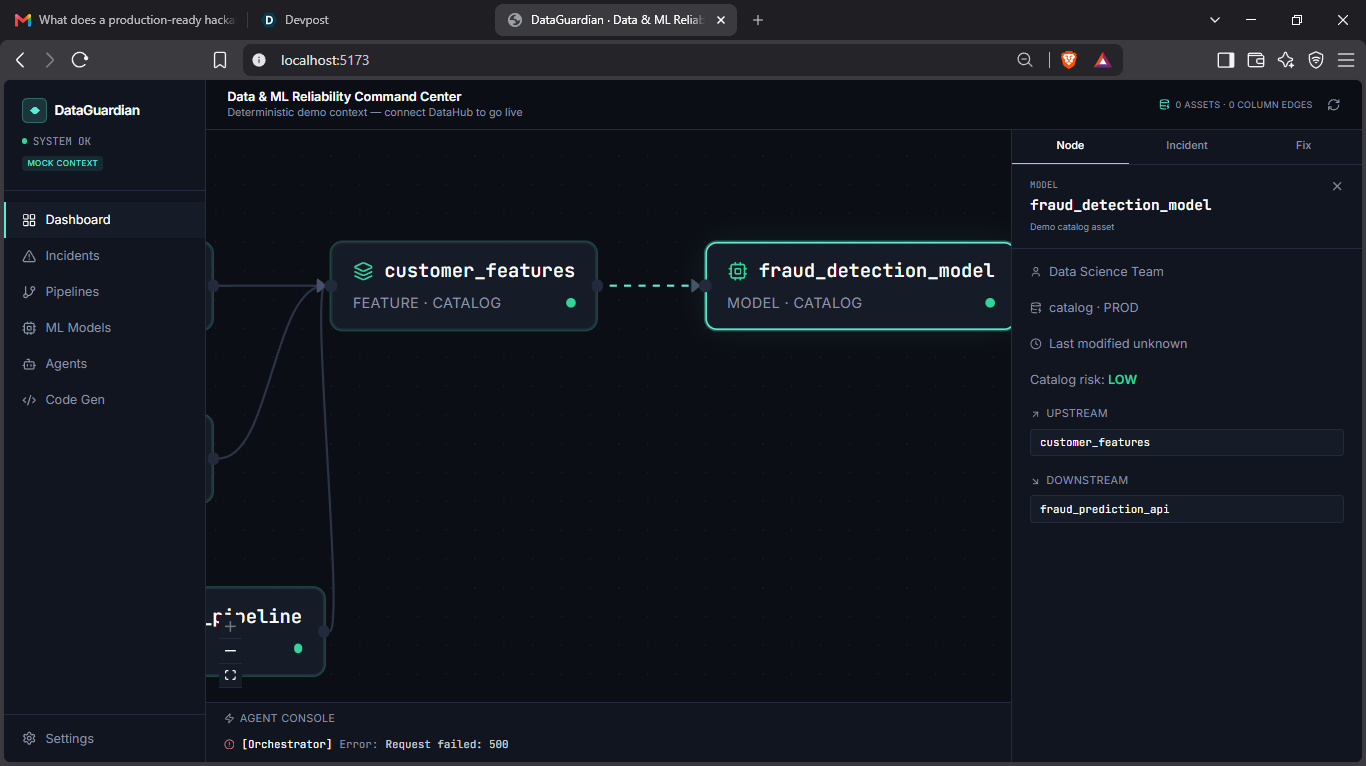
With DataGuardian, the agent can trace the dependency chain:
customers.email
      ↓
customer_features.email_domain
      ↓
fraud_detection_model
      ↓
fraud_prediction_api
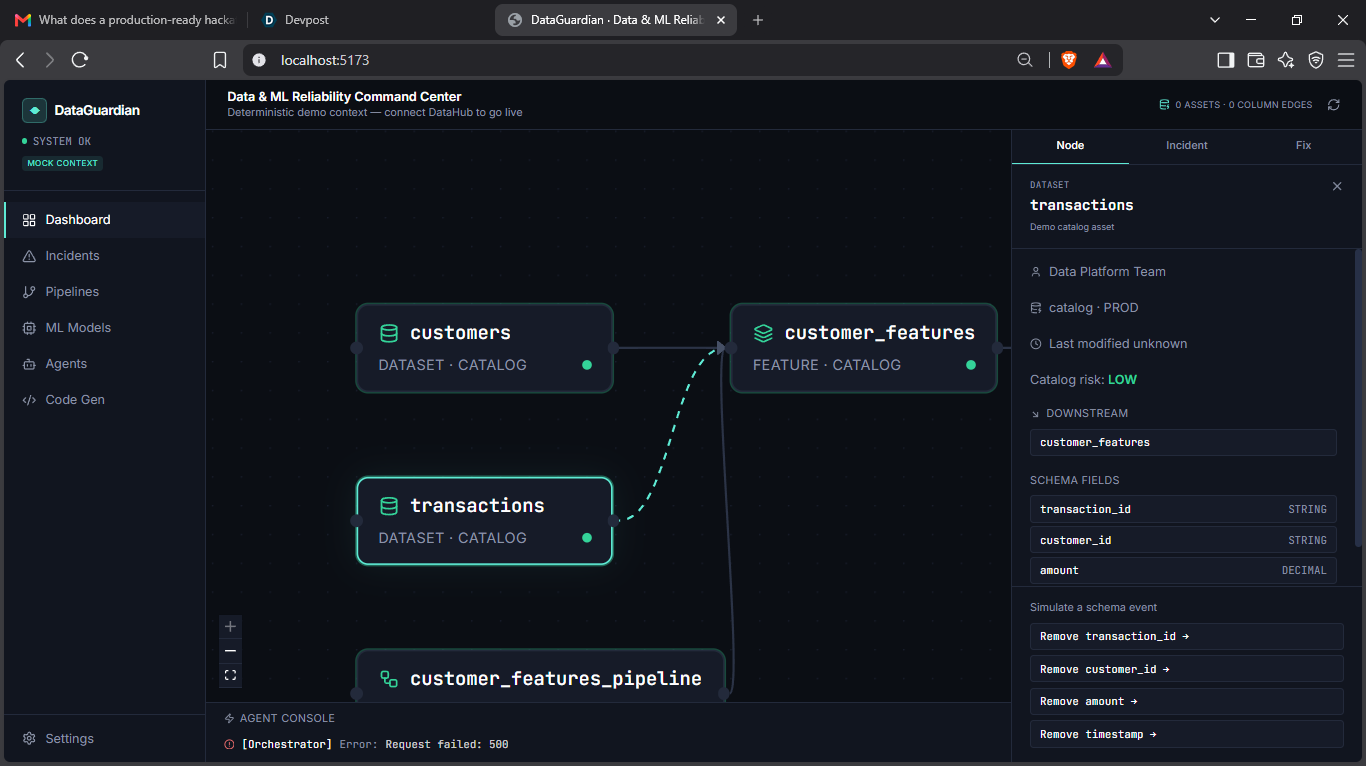
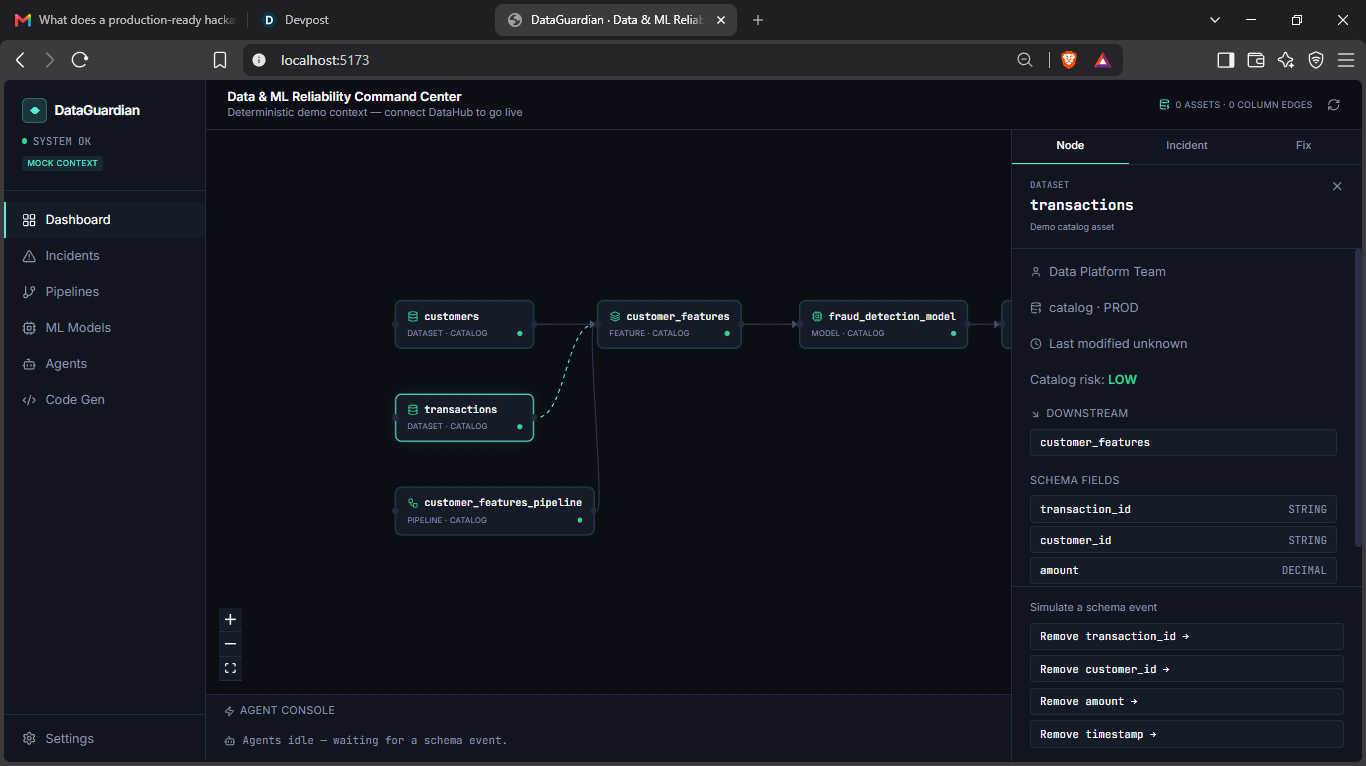
Instead of waiting for something to break, DataGuardian identifies the potential blast radius, calculates the risk, explains why the change matters, and proposes a remediation.
This led us to build around a simple principle:
Give AI agents context before giving them autonomy.
What it does
Data Guardian is designed as a multi-agent system with specialized responsibilities:
🔎 Data Agent
Uses DataHub context to investigate:
- datasets
- schemas
- columns
- lineage
- downstream dependencies
- ownership
🛡️ ML Guardian
Analyzes whether a data change can affect:
- features
- training datasets
- ML models
- production deployments
- prediction services
💻 Code Agent
Generates metadata-aware artifacts such as:
- SQL
- dbt transformations
- Airflow tasks
- validation tests
- migration code
🔧 Remediation Agent
Turns the analysis into an actionable response, including:
- recommended fixes
- incident reports
- validation steps
- code patches
- remediation plans
An orchestrator coordinates these agents so that the system behaves more like a data engineering team than a simple chatbot.
How we built it
DataGuardian is built around a modular architecture.
                 ┌──────────────────┐
                 │   Web Dashboard   │
                 └────────┬─────────┘
                          │
                          ▼
                 ┌──────────────────┐
                 │ Agent Orchestrator│
                 └────────┬─────────┘
                          │
             ┌────────────┼────────────┐
             ▼            ▼            ▼
        Data Agent   ML Guardian   Code Agent
             │            │            │
             └────────────┼────────────┘
                          ▼
                    DataHub Context
                          │
                          ▼
                 Lineage + Metadata
                          │
                          ▼
                 Risk & Impact Engine
                          │
                          ▼
                    Remediation
Technology Stack
Frontend
- React
- Vite
- Tailwind CSS
- GSAP
- React Flow
- Lucide icons
Backend
- Python
- FastAPI
AI
- LLM-powered agents
- Tool-based agent architecture
- Structured outputs
Data Context
- DataHub
- DataHub APIs / MCP integration
- Dataset and column lineage
Infrastructure
- Docker
- Git
- REST APIs
🚨 The Main Demo Scenario
Our primary scenario demonstrates what happens when a critical data field changes.
Suppose:
customers.email
is removed.
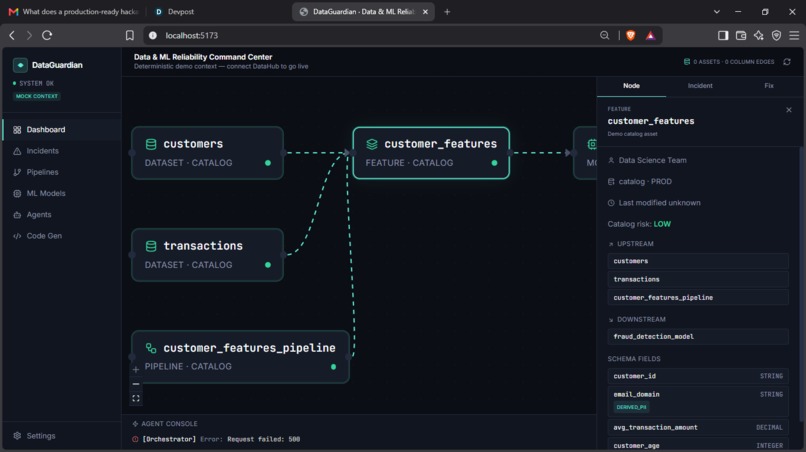
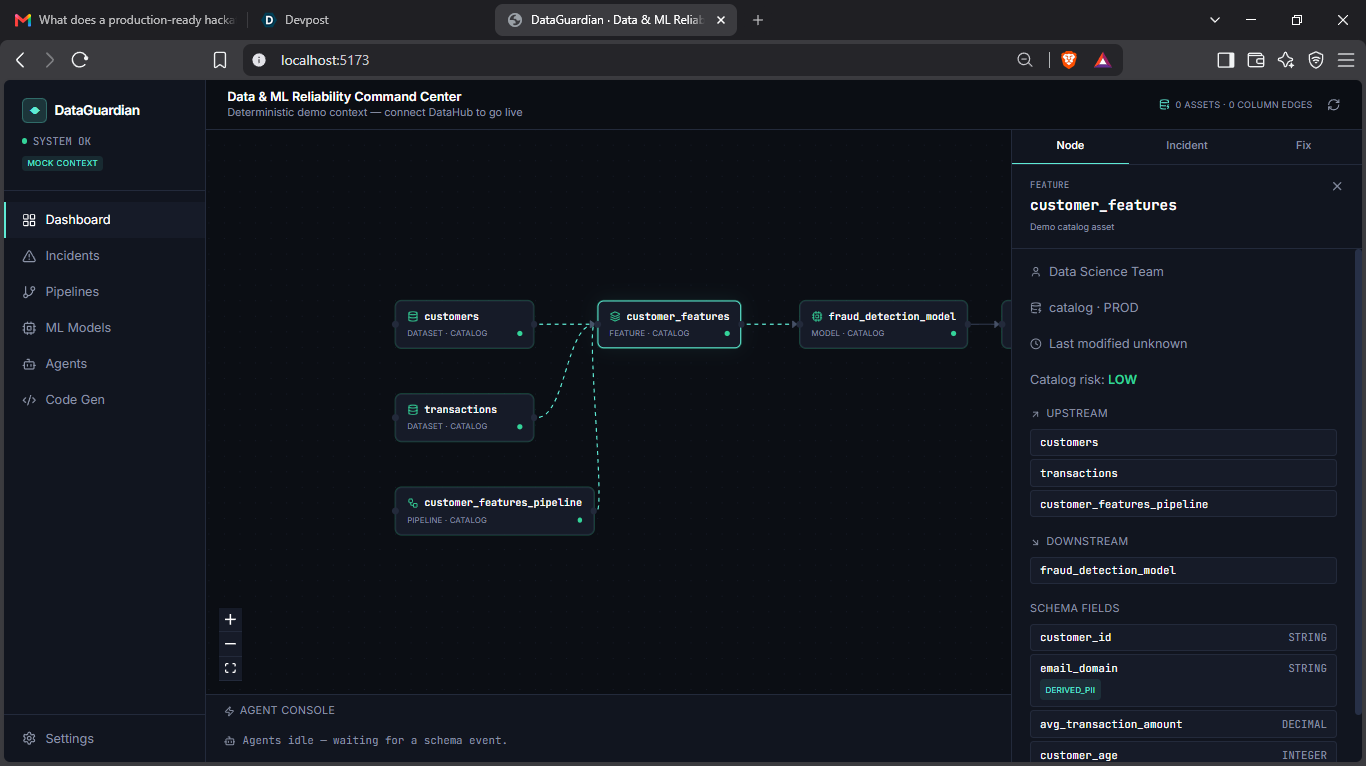
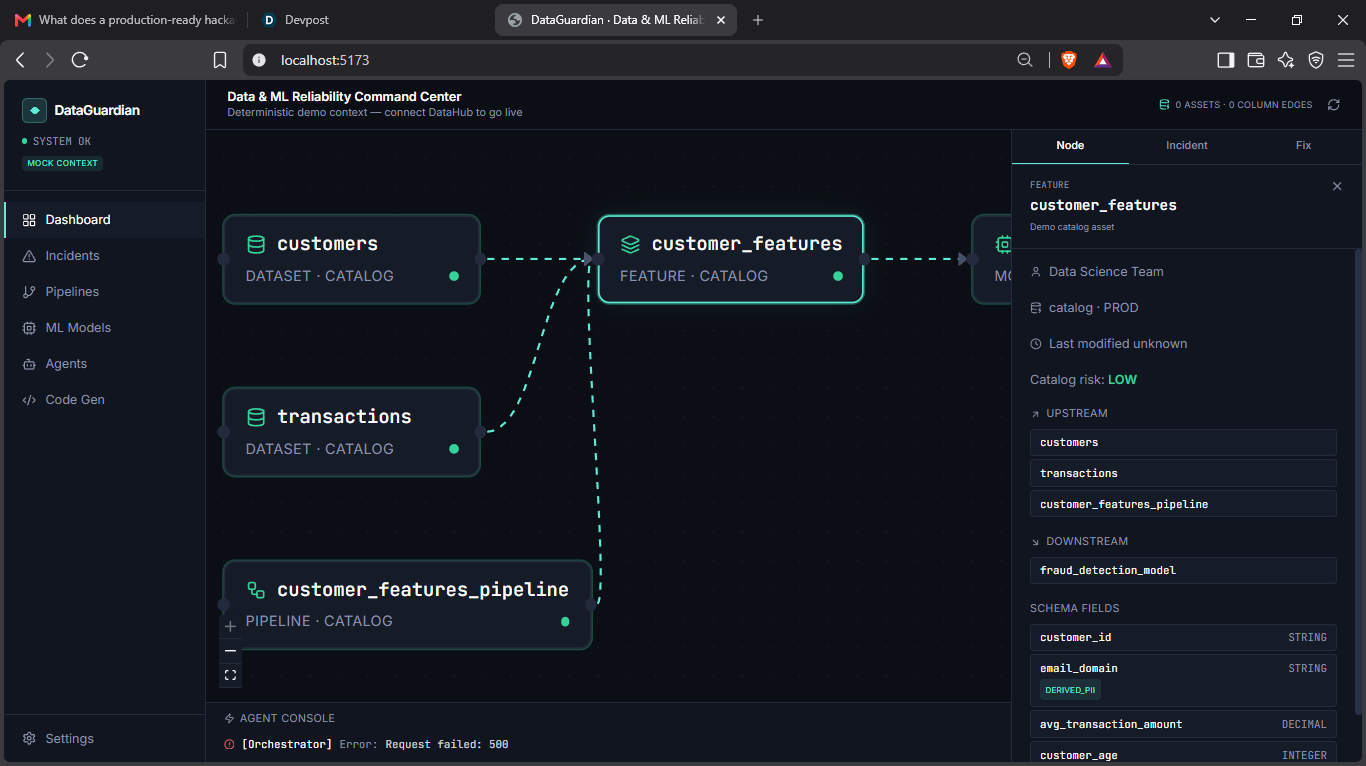
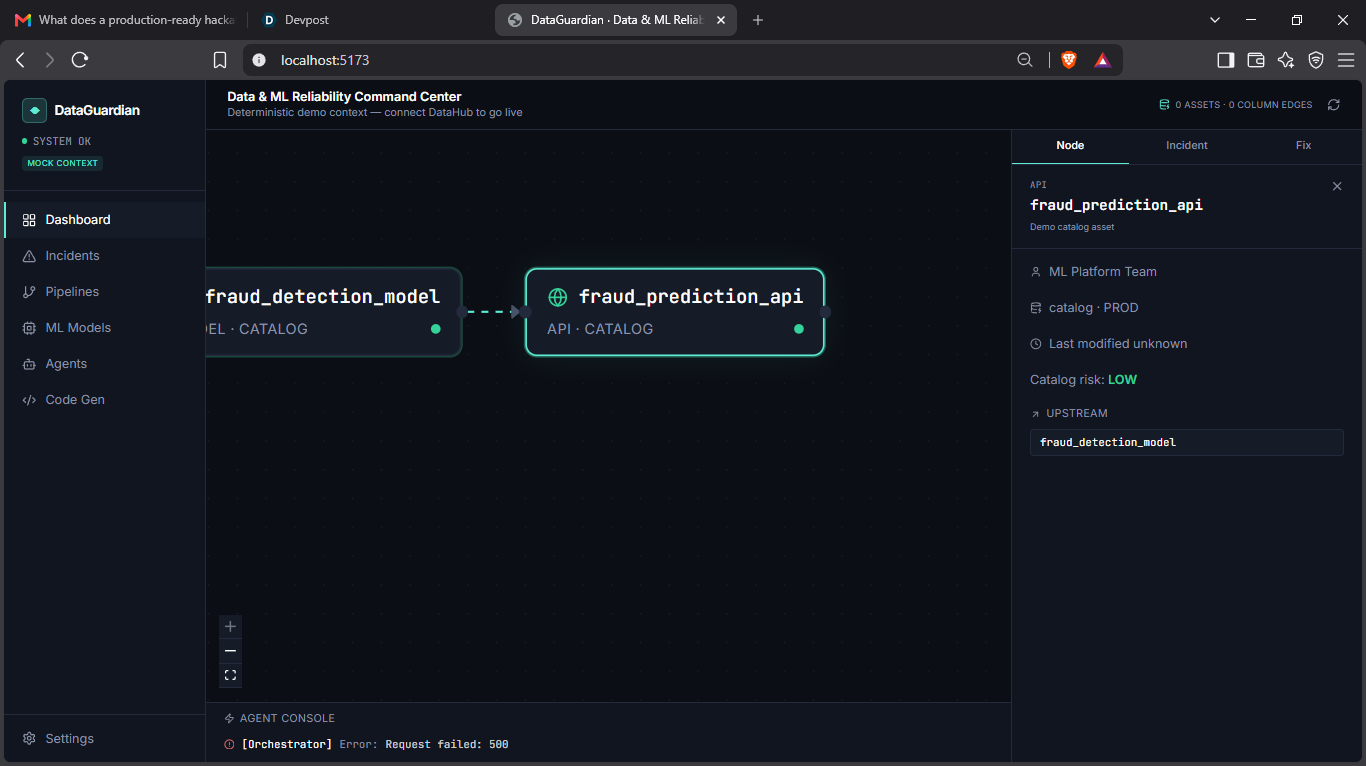
DataGuardian investigates the change and discovers that the column contributes to a downstream feature:
customers.email
       ↓
customer_features.email_domain
       ↓
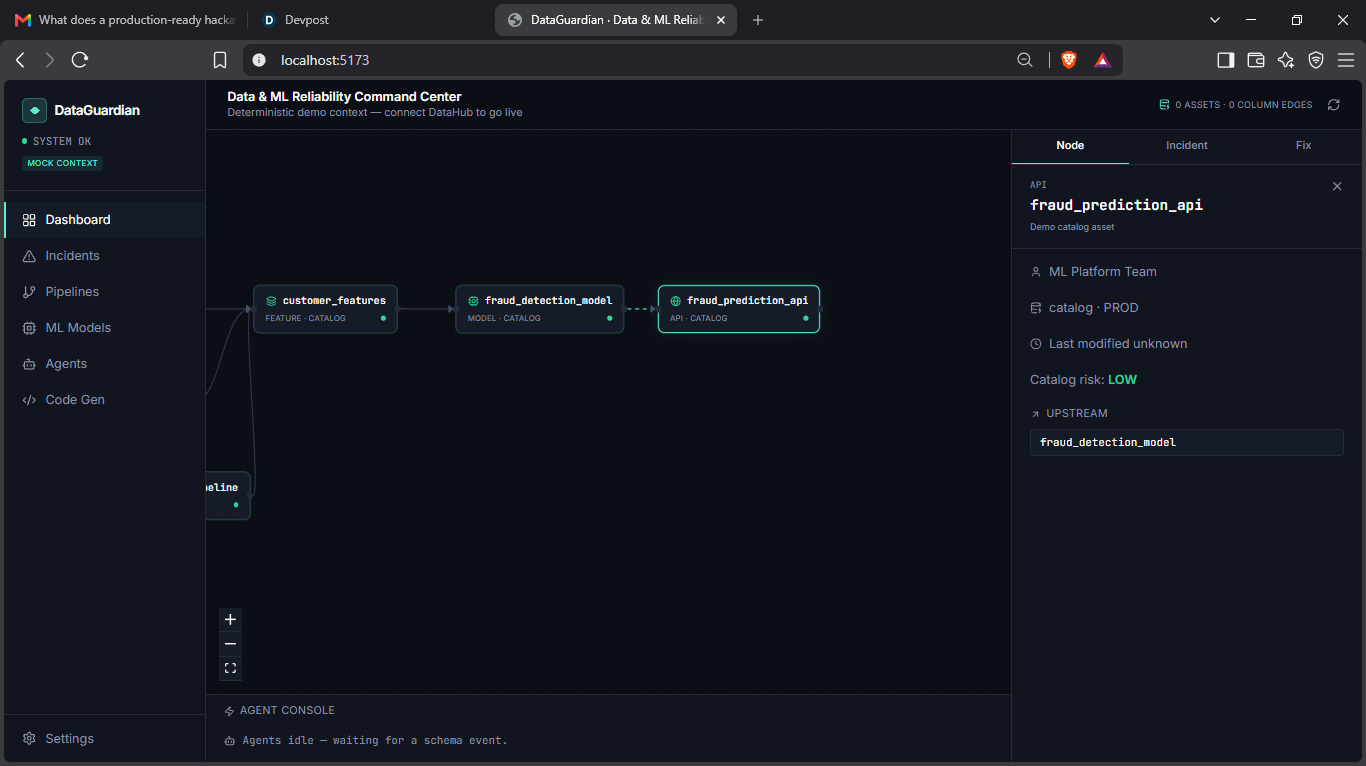
fraud_detection_model
       ↓
fraud_prediction_api
The system then evaluates the blast radius.
For example:
🚨 CRITICAL DATA INCIDENT

Affected datasets:      1
Affected features:      1
Affected pipelines:     1
Affected ML models:     1
Production services:    1

Risk Score: 96/100
Rather than simply reporting the problem, the agents continue working.
The Code Agent can generate a remediation such as:
- Restore schema compatibility
- Update the feature transformation
- Add a schema validation test
- Validate downstream model compatibility
- Prepare a migration/patch
This demonstrates the difference between an AI assistant that answers questions and an AI agent that can perform meaningful data engineering work.
📊 Explainable Risk Scoring
We intentionally designed the risk system to be explainable rather than relying entirely on an opaque AI-generated score.
A simplified model can be represented as:
$$R = B + \sum_i W_i$$
where:
- $R$ = overall risk score
- $B$ = baseline risk
- $W_i$ = weighted impact of each detected condition
For example, a removed column can carry a higher weight than a newly added optional column, while downstream ML models and production services increase the severity.
This lets DataGuardian explain why an incident received a particular risk score.
The individual component weights can be expressed as:
$$W_i = \alpha_i \cdot I_i \cdot D_i$$
where:
- $\alpha_i$ = condition severity coefficient (e.g., column removed = 1.0, column added = 0.3)
- $I_i$ = impact multiplier based on downstream count
- $D_i$ = depth factor penalizing deeper lineage paths
The final normalized risk score is then:
$$R_{normalized} = \min\left(100, \frac{R - R_{min}}{R_{max} - R_{min}} \times 100\right)$$
The lineage depth penalty decays exponentially with hop distance:
$$D_i = e^{-\lambda \cdot h_i}$$
where $h_i$ is the number of lineage hops from the changed asset, and $\lambda$ is a decay constant (typically $\lambda = 0.3$).
Challenges we ran into
One of our biggest challenges was making the system more than a simple AI chatbot.
A chatbot can answer:
"What might be affected if this table changes?"
But DataGuardian needs to prove the answer using metadata and lineage.
We therefore had to think carefully about:
- connecting the agents to DataHub context
- representing lineage accurately
- tracing dependencies across multiple levels
- identifying ML model impact
- calculating explainable risk
- generating useful remediation code
- keeping AI-generated actions grounded in real metadata
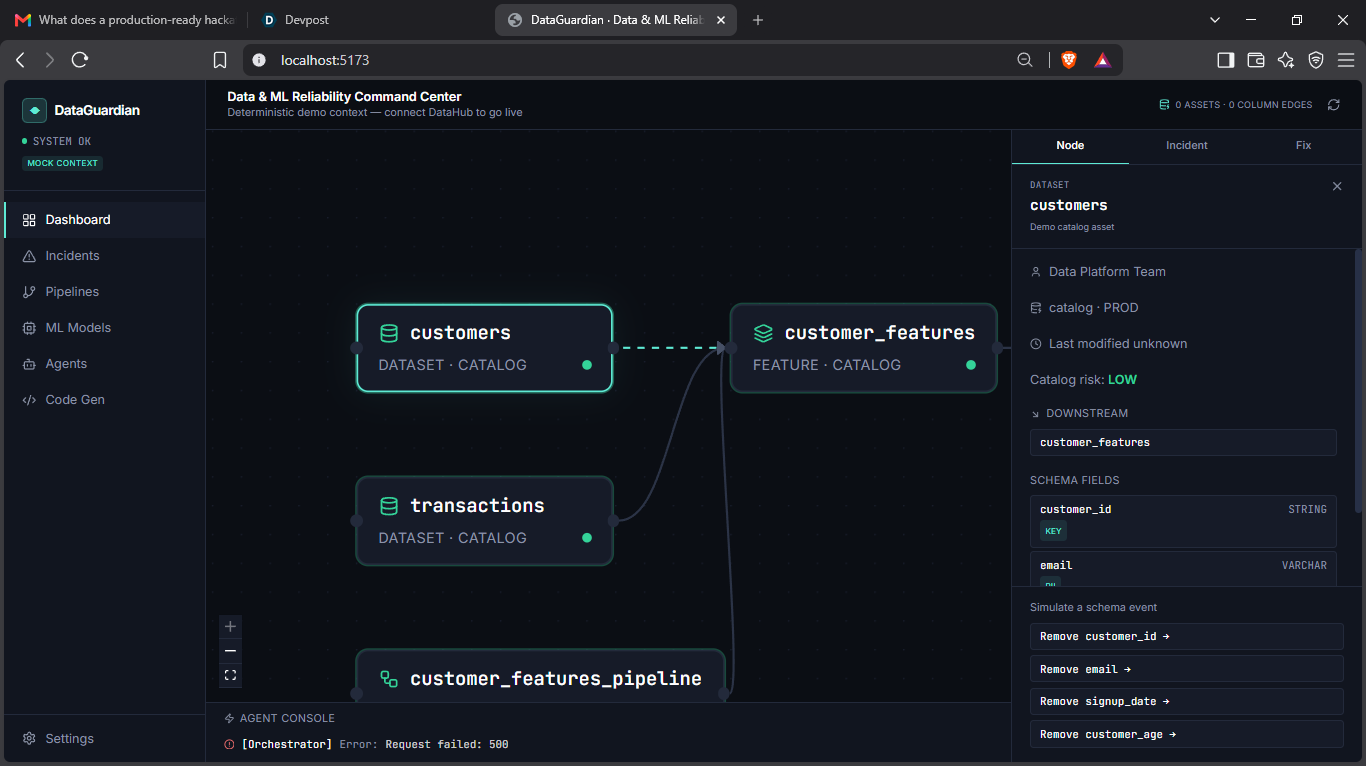
Another challenge was designing the system so that it remains useful even when an external LLM is unavailable. We therefore built deterministic components for core analysis and structured the AI layer so that it can be configured with any LLM provider.
What we learned
One of our biggest challenges was making the system more than a simple AI chatbot.
A chatbot can answer:
"What might be affected if this table changes?"
But DataGuardian needs to prove the answer using metadata and lineage.
We therefore had to think carefully about:
- connecting the agents to DataHub context
- representing lineage accurately
- tracing dependencies across multiple levels
- identifying ML model impact
- calculating explainable risk
- generating useful remediation code
- keeping AI-generated actions grounded in real metadata
Another challenge was designing the system so that it remains useful even when an external LLM is unavailable. We therefore built deterministic components for core analysis and structured the AI layer so that it can be configured with any LLM provider.
What's next for DataGuardian — Autonomous Data & ML Reliability Agent
DataGuardian is designed as a foundation rather than the end of the idea.
Future versions could:
- automatically create GitHub pull requests
- integrate with CI/CD pipelines
- monitor real-time metadata changes
- detect data quality regressions
- monitor ML feature drift
- automatically validate generated code
- connect to Slack or incident-management systems
- support multiple DataHub environments
- create long-term organizational knowledge from resolved incidents
The long-term goal is to move from:
"AI that understands data."
to:
"AI that safely operates within a data ecosystem."
❤️ Why This Matters
Data engineering teams spend significant time understanding dependencies, tracing failures, investigating schema changes, and determining who or what might be affected.
DataGuardian explores how much of that work can be accelerated when AI agents have access to reliable organizational context.
DataHub provides the context. AI provides the reasoning. DataGuardian connects the two to turn context into action.
That's the idea behind DataGuardian.


Log in or sign up for Devpost to join the conversation.