-
-
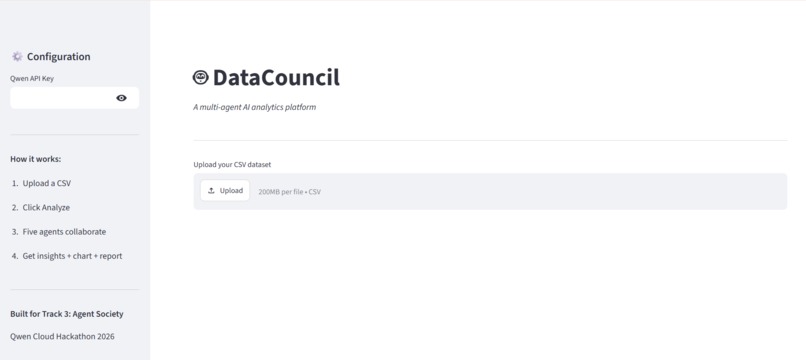
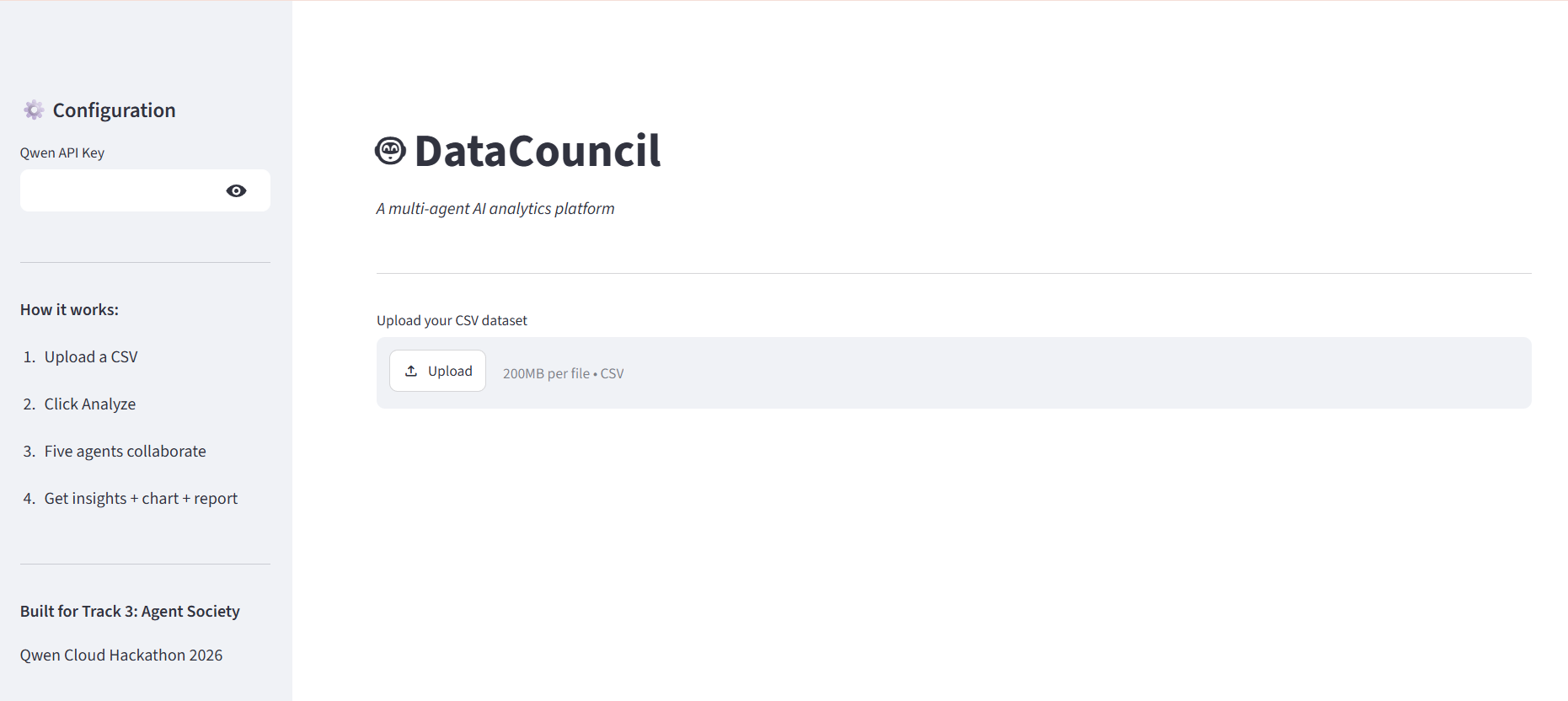
UI of DataCouncil
-
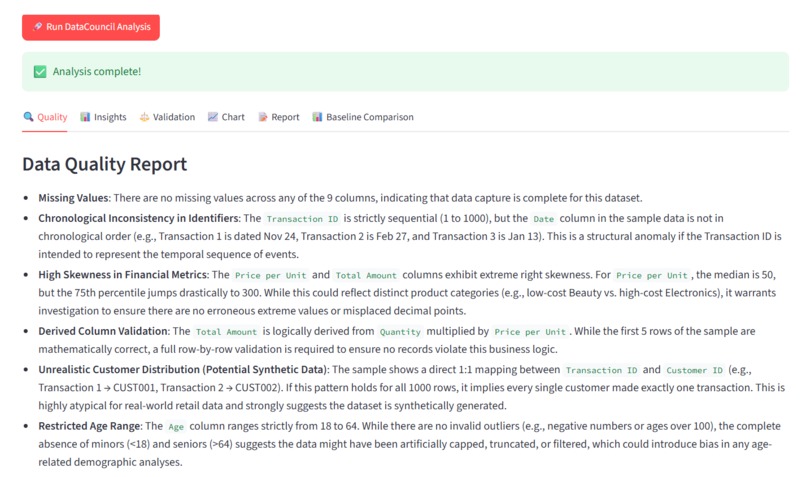
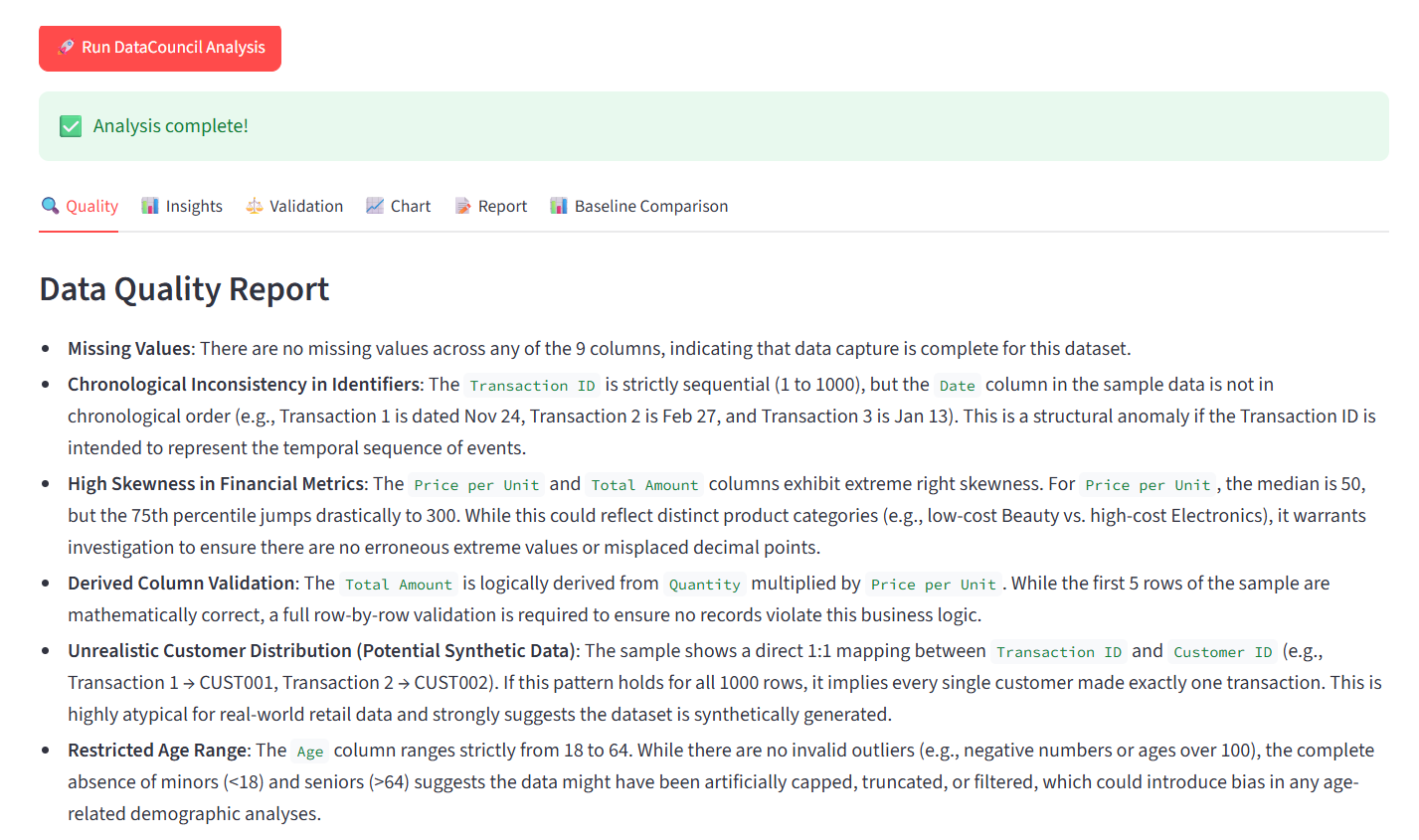
AI Agent's results and findings
Inspiration
Traditional AI analytics tools often rely on a single model to perform every task—from analyzing data to generating reports. While convenient, this approach lacks independent verification, making it easier for unsupported conclusions to go unnoticed. For Track 3: Agent Society, I wanted to explore whether dividing the workflow among multiple specialized AI agents could produce more reliable and trustworthy business insights. This idea led to the creation of DataCouncil, where each agent performs a distinct responsibility and collaborates with the others to complete the analysis.
What it does
DataCouncil is a multi-agent AI analytics platform that transforms CSV datasets into validated business insights. Instead of assigning every task to one AI agent, the workflow is divided among five specialized agents:
- Data Quality Agent reviews the dataset for missing values, outliers, and structural issues.
- Data Analyst Agent generates evidence-backed business insights.
- Insight Validator Agent independently reviews every insight, flags unsupported claims, and provides corrected revisions.
- Visualization Agent recommends the most suitable chart.
- Report Writer Agent generates an executive summary using only validated insights. The application also compares its collaborative workflow against a traditional single-agent baseline to demonstrate the advantages of specialized AI collaboration.
How we built it
I built DataCouncil using Python, CrewAI, Qwen API, Pandas, Plotly, and Streamlit. The application uses CrewAI's sequential task orchestration, where each agent receives the previous agent's output as context. This creates a collaborative pipeline instead of independent AI calls. To improve development speed, I also implemented a debug mode that loads previously generated outputs from a JSON file. This allowed me to continue building and testing the Streamlit interface without repeatedly consuming API tokens.
Challenges we ran into
The biggest challenge was working with CrewAI. During development I encountered several configuration and integration issues while connecting CrewAI with the Qwen API. I resolved these by creating a shared LLM object and attaching it to each individual agent, ensuring every agent used the same model configuration consistently. Another major challenge was execution time. Running all five agents sequentially through the Streamlit application took approximately eight minutes for a single analysis, making development slow and consuming unnecessary API tokens. To solve this, I saved the outputs from a successful pipeline execution into a JSON file and introduced a debug mode. During UI development and demonstrations, the application loads these saved outputs instead of rerunning the entire multi-agent pipeline, significantly reducing development time while preserving the real agent-generated results.
Accomplishments that we're proud of
- Built a complete five-agent collaborative AI system from scratch.
- Designed an independent validation stage instead of allowing the analyst to review its own work.
- Successfully compared a multi-agent workflow against a single-agent baseline.
- Developed a full Streamlit application with interactive visualizations and downloadable executive reports.
- Created a modular workflow where every AI agent has a clearly defined responsibility.
What we learned
This project taught me that building effective AI systems is not only about choosing a powerful language model, but also about designing how multiple specialized agents collaborate. I gained hands-on experience with CrewAI orchestration, prompt engineering, Streamlit development, and designing structured AI workflows where agents communicate through shared context instead of working independently. Perhaps the biggest lesson was that separating analysis from validation produces more transparent and trustworthy results than allowing a single AI agent to evaluate its own conclusions.
What's next for DataCouncil
There are several directions I would like to explore in the future:
- Parallel execution of independent agents to reduce runtime.
- Automatic chart generation based on the Visualization Agent's recommendations.
- Support for multiple datasets and additional file formats.
- Human-in-the-loop validation for high-stakes business decisions.
- Deployment as a cloud-hosted analytics platform with persistent user sessions and analysis history. Ultimately, I envision DataCouncil evolving into a collaborative AI analytics assistant capable of supporting real-world business decision-making through transparent and trustworthy multi-agent reasoning.
Built With
- agents
- ai
- api
- crewai
- csv
- data
- engineering
- llms
- multi-agent
- pandas
- plotly
- processing
- prompt
- python
- qwen
- streamlit
- visualization


Log in or sign up for Devpost to join the conversation.