-
-
Value
repo_HACKATHON_2024
Official repository of the Datacoders team, where analyses were conducted for Capital One’s organization in the 2024 HACKATHON.
Members of DataCoders
- Luis Maximiliano López Ramírez - A00833321
- Dilan González Castañeda - A00831905
- Rogelio Lizárraga Escobar - A01742161
- Adrian Pineda Sánxhez - A00834710
Proyect with Capital One
The issue of fraud in transactions is a growing challenge for businesses and consumers worldwide. As digital transactions expand and diversify, new opportunities arise for fraudsters seeking to exploit payment systems. Frauds can take various forms, from credit card misuse to identity theft and transaction manipulation on online platforms. These incidents not only cause significant financial losses but also erode customer trust and damage the reputation of the affected companies.
Solution
To address the growing issue of fraud in transactions, an effective solution has been the implementation of machine learning tools and the use of TensorFlow for neural networks, which efficiently classify fraudulent transactions. These technologies analyze large volumes of data in real-time, identifying suspicious patterns and anomalies that could indicate fraud. Through supervised and unsupervised learning, machine learning models are trained with historical transaction data, allowing them to detect atypical behaviors with high accuracy. TensorFlow, with its ability to develop complex neural networks, enhances automated fraud detection through classification models that continuously learn and adapt to new fraudulent tactics.
File's distribution
Datasets
Here are the datasets generated from the scripts.
- fraud.csv
Scripts
Contains the .py and .ipynb codes for solving the stated problem.
- Fraud.py: Performs the transformation of the original dataset to create columns of interest, generating fraud.csv.
- Modelos_Convencionales.ipynb: Based on fraud.csv, conventional Machine Learning models are generated for the detection of fraudulent transactions.
- Modelos_Hackathon.ipynb: Based on fraud.csv, several neural networks are generated with TensorFlow for the detection of fraudulent transactions, obtaining the best prediction model here.
- crew_ai_csv_decode.py: Python code that uses LLM to generate reports and insights of interest from fraud.csv.
Demonstrations
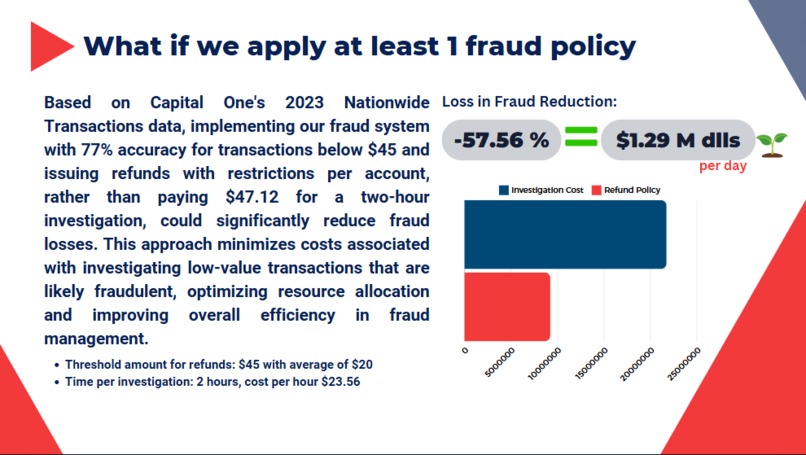
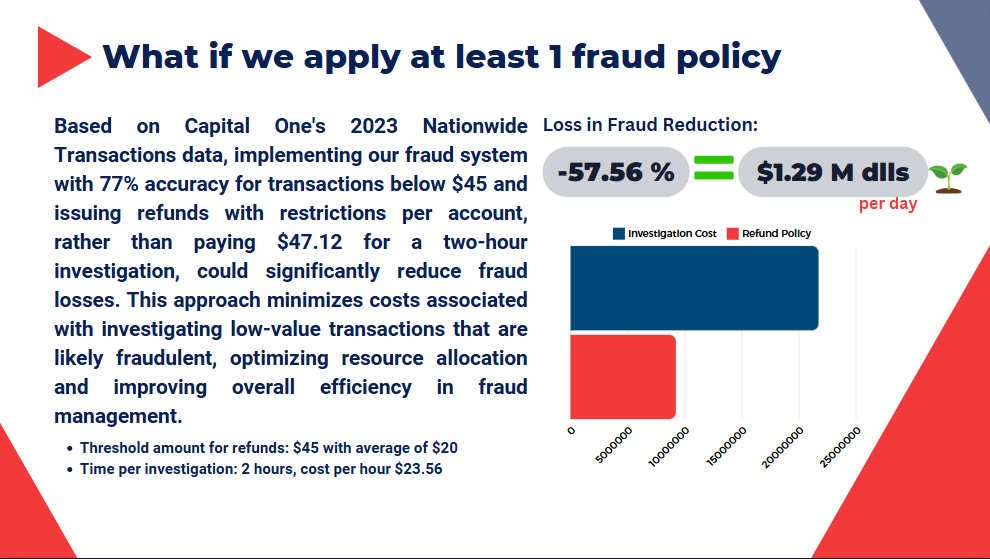
Contains the demo video of some tests of the fraudulent transaction prediction model, as well as the presentation used for the Capital One presentation.
- Final presentation.pdf
- Video_Hackathon_2.mp4

Log in or sign up for Devpost to join the conversation.