-
-
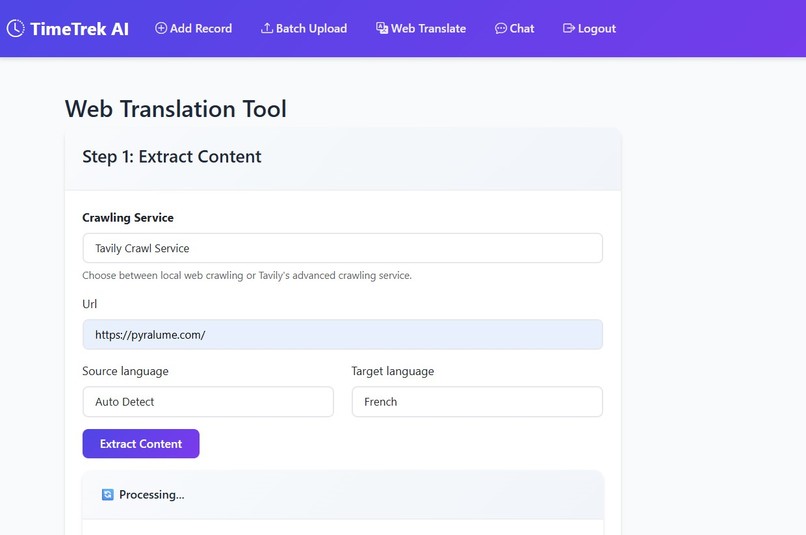
a page to crawling page and translate the content

🚀 Inspiration We observed that most machine learning and analytics tools rely on static, limited datasets, and struggle when context is thin. But the internet has rich, live content—if only it could be easily gathered and expanded. We were inspired to build a platform that not only crawls relevant information from the web, but also generates deep, vertical content using AI—helping users and models alike gain more context and richer material to work with.
💡 What it does DataBridge AI is a smart backend platform that:
Crawls websites and online sources for relevant data using AI-powered scraping tools.
Uses LLMs (like GPT) and Prolog-style logic to expand the collected data, generate deeper insights, and simulate new examples or facts based on the original input.
Provides this enriched, structured, and semantic data to power downstream applications, machine learning models, or decision tools.
Allows users to access all this through a single API or frontend, with options for automation, querying, or voice interaction.
🏗️ How we built it Backend: Django + API endpoints for content processing.
Crawling: Tavily API and Playwright for dynamic data scraping.
Data Expansion: GPT-based generation combined with logic-driven expansion (Prolog-style inference or rule-based systems).
Vector Search: Vectorize.io for storing and querying enriched content.
Frontend: Lightweight interface for uploading prompts or connecting to other apps.
🧗 Challenges we ran into Making AI-generated expansions accurate and context-relevant.
Managing crawl limits, noise, and content parsing from dynamic sites.
Creating reusable and interpretable logic layers for vertical depth generation.
🏅 Accomplishments that we're proud of Built an end-to-end system that transforms raw web data into enriched ML-ready materials.
Enabled downstream apps to receive both original and AI-augmented data from a unified source.
Demonstrated cross-app automation and fast deployment using Django and vector databases.
📚 What we learned Combining symbolic reasoning (Prolog-style logic) with modern LLMs produces surprisingly rich content.
Crawled data can be far more useful when expanded and semantically tagged.
Simulating user-like prompts helps train more robust ML models.
🔮 What's next for DataBridge AI Add UI support for rule-building (custom Prolog-style inference templates).
Scale crawling to handle domain-specific verticals (finance, legal, health).
Package as a service for ML engineers to plug into their pipelines.
Develop Chrome extension for one-click crawl → expand → export workflows.

Log in or sign up for Devpost to join the conversation.