Inspiration
Small businesses often manage their daily operations through WhatsApp, notebooks, and spreadsheets. Sales and expenses get buried in conversations, while financial reporting becomes a manual and time-consuming process.
We wanted to build something that fits into the way businesses already work instead of forcing them to learn complicated business-management software.
That led to DataBot.ai — a WhatsApp-powered business assistant that turns simple messages into structured business data, analytics, and actionable insights.
Our goal was simple: make business management as easy as sending a WhatsApp message.
What it does
DataBot.ai transforms WhatsApp into a lightweight business management platform.
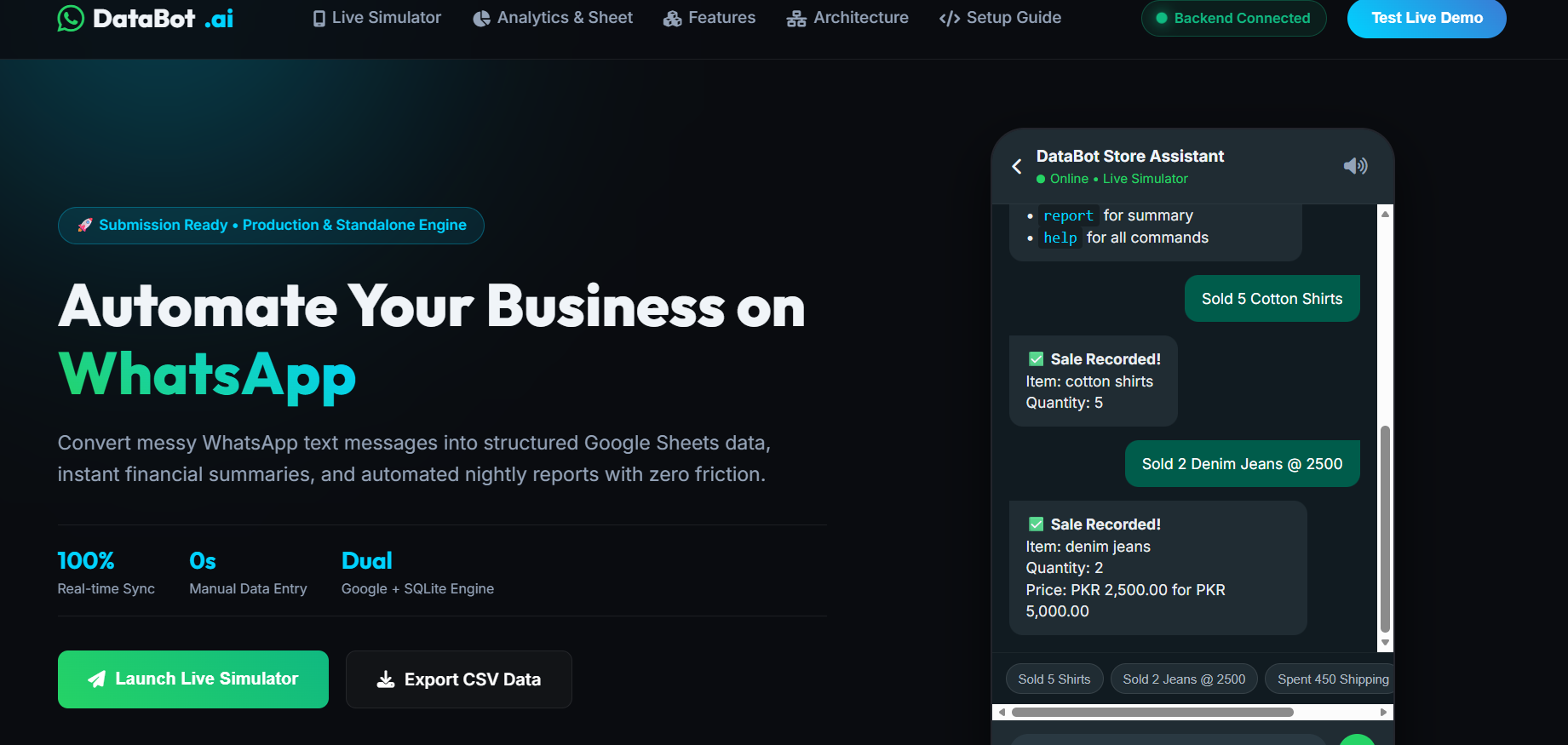
Business owners can send natural messages such as:
Sold 5 cotton shirtsSold 2 denim jeans @ 2500Spent 450 shippingReport
DataBot.ai interprets these messages, extracts the relevant information, and automatically records the transaction.
The system provides:
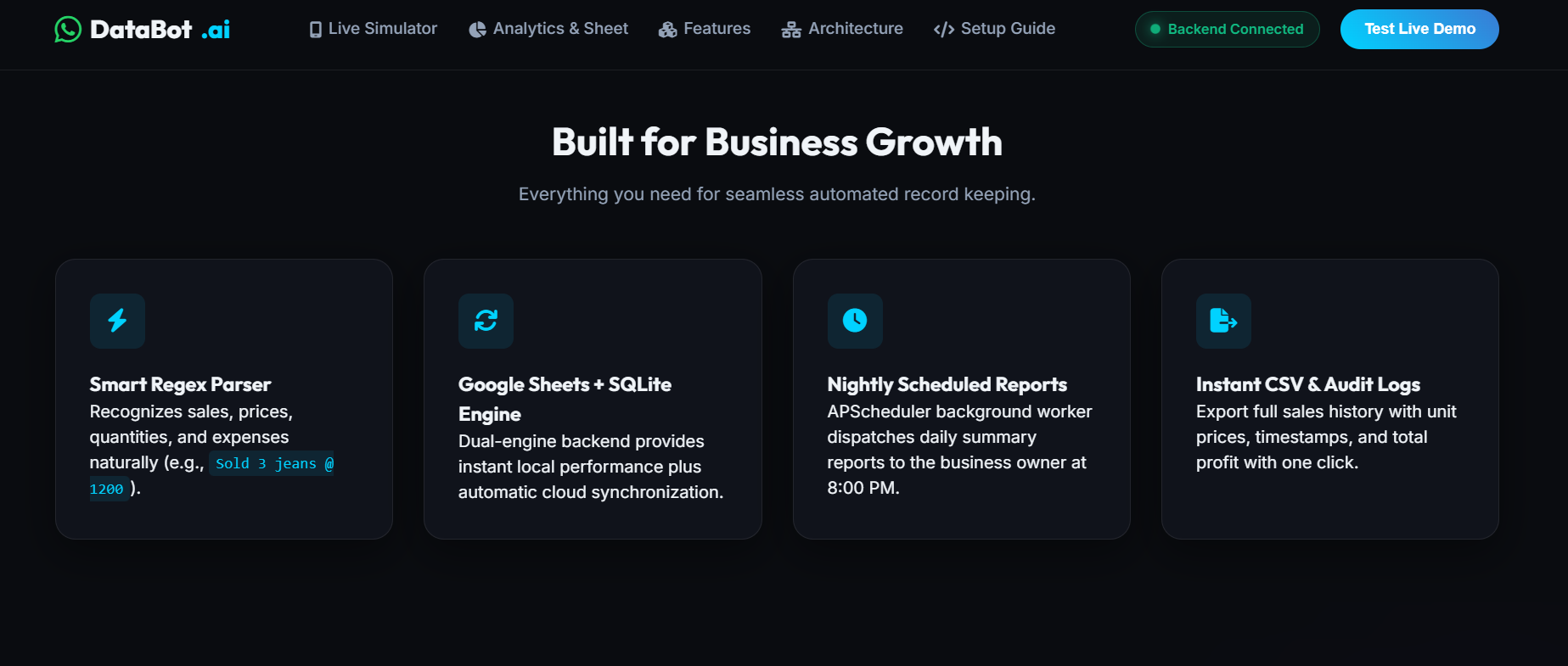
- 💬 WhatsApp-based business interaction
- 🧠 Intelligent message and command parsing
- 💰 Automated sales and expense recording
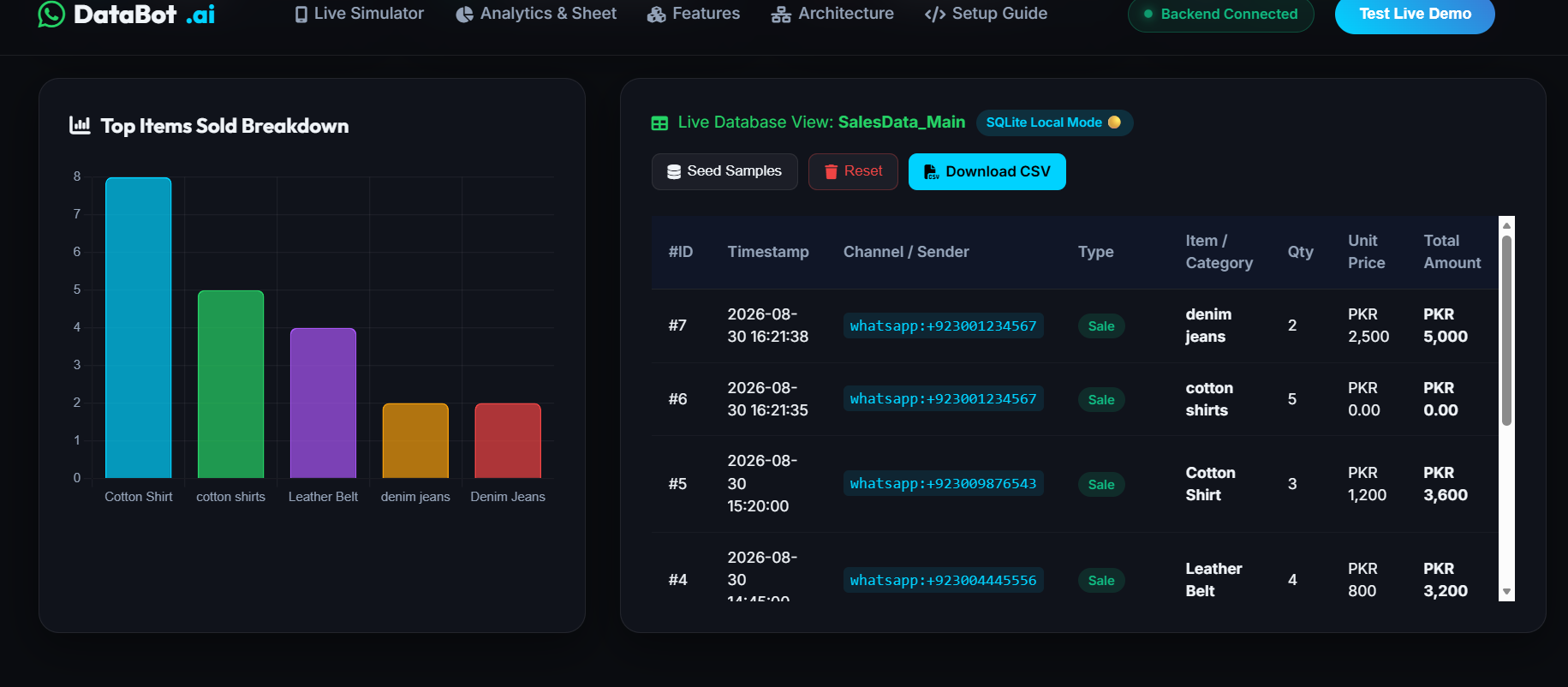
- 📊 Business analytics and dashboards
- 📑 Google Sheets synchronization
- 🗄️ SQLite-based data storage
- 📥 CSV data export
- 📈 Automated business reports
- ⏰ Scheduled reporting capabilities
Instead of manually maintaining spreadsheets, users can simply send a message and let DataBot.ai handle the rest.
How we built it
DataBot.ai was built as a full-stack automation system connecting WhatsApp, a backend processing engine, databases, and business analytics.
Core Architecture
WhatsApp
   ↓
Twilio
   ↓
Flask Webhook
   ↓
Message Parser
   ↓
Business Logic
   ↓
SQLite Database
   ↓
Google Sheets
   ↓
Analytics & Reports
Technology Stack
Backend
- Python
- Flask
- REST APIs
Database
- SQLite
Communication
- Twilio
Data & Reporting
- Google Sheets API
- CSV
- Analytics engine
Frontend
- HTML
- CSS
- JavaScript
We focused on keeping the architecture lightweight, modular, and easy to extend for different types of small businesses.
Challenges we ran into
One of the biggest challenges was converting unstructured human messages into reliable structured business data.
A user might write:
sold 3 shirts for 4500
or:
3 shirts sold @ 1500 each
or:
received 4500 from shirts
The system needs to understand the intent, identify the product, determine the quantity, and calculate the correct transaction value.
Other challenges included:
- Designing a flexible message-parsing system
- Handling incomplete or invalid user inputs
- Keeping local database records synchronized with Google Sheets
- Connecting WhatsApp messages through webhooks
- Generating meaningful business reports from raw transactions
- Making the interface simple enough for non-technical users
- Maintaining security around API credentials and business data
These challenges pushed us to think beyond simply building features and focus on reliability and real-world usability.
Accomplishments that we're proud of
We are proud that DataBot.ai evolved from a simple automation concept into a functional business intelligence system.
Some of the highlights include:
- 🚀 Built a working WhatsApp-to-business-data workflow
- 🧠 Created intelligent parsing for everyday business messages
- 📊 Developed a business analytics dashboard
- 🔄 Integrated Google Sheets for accessible record keeping
- 🗄️ Implemented structured SQLite data storage
- 📑 Added CSV export capabilities
- 📈 Built automated reporting functionality
- 🔗 Connected WhatsApp workflows through Twilio
- 🎯 Designed the system specifically around the needs of small businesses
Most importantly, we built the system around a simple principle:
The user shouldn't have to adapt to the software. The software should adapt to the user.
What we learned
Building DataBot.ai taught us that successful automation isn't only about making a technically powerful system — it's about reducing friction for the person using it.
We learned how to:
- Design systems around real-world user behavior
- Process natural-language business inputs
- Build webhook-based integrations
- Work with APIs and external services
- Synchronize data between different platforms
- Structure transaction data for analytics
- Design dashboards around meaningful business metrics
- Think about security and scalability from the beginning
We also learned that simplicity can be one of the most powerful features of a product.
A business owner shouldn't need accounting knowledge or technical expertise to record a sale. Sending a message should be enough.
What's next for DataBot.ai
DataBot.ai is only the beginning.
Our next goal is to evolve it from a transaction-recording assistant into a complete AI-powered business copilot for SMEs.
Planned improvements
- 🎙️ Voice message transaction processing
- 🌍 Multilingual support
- 📦 Real-time inventory management
- 👥 Customer and supplier management
- 🧾 Automated invoice generation
- 💳 Payment and receivables tracking
- 📊 Advanced financial dashboards
- 📈 AI-powered sales forecasting
- 🤖 Personalized business recommendations
- 📄 Automated PDF reports
- 🔐 Role-based authentication
- ☁️ Cloud deployment and scalable infrastructure
- 📱 Production-grade WhatsApp Business integration
Ultimately, we want DataBot.ai to move beyond recording what happened and start helping business owners understand what is happening, why it is happening, and what they should do next.
The long-term vision
From a WhatsApp business assistant → to an AI-powered operating system for small businesses.

Log in or sign up for Devpost to join the conversation.